

Last Updated on July 29, 2026 by Mason Reed
BLM dispersed camping can give you quiet, low-cost access to wide-open public lands, but it comes with few services and rules that change by location. Before you leave, confirm the land boundary, local stay limit, road access, permit requirements, waste rules, closures, weather, and current fire restrictions for the exact field office or recreation area you plan to visit.
Quick Answer
BLM dispersed camping is usually free and allowed outside developed campgrounds, but the rules are local. A common limit is 14 days within 28 days, followed by a required move—often 25 to 30 miles. Verify maps, closures, permits, vehicle access, waste rules, and fire restrictions before every trip.
Key Takeaways
- The common 14-days-within-28-days limit is not universal; confirm the exact rule with the local BLM field office.
- Use an existing disturbed site, stay on legal roads and routes, and follow posted setbacks rather than assuming one nationwide distance.
- A fire permit does not override a fire restriction, closure, Red Flag Warning, or site-specific ban.
- Most dispersed sites have no water, toilets, trash service, cell signal, or emergency help nearby.
- Pack out trash, follow local human-waste rules, control pets, and leave natural and cultural objects where you find them.
At a Glance
| Time Required | About 30–60 minutes for map, rule, weather, and fire checks before travel |
| Difficulty | Easy to moderate; remote roads, weather, and self-sufficiency can raise the difficulty |
| Tools Needed | Official BLM map, offline navigation, local rules, weather forecast, fire-status check, and emergency plan |
| Cost | Often free, but special-use areas, local permits, developed sites, and LTVAs may charge fees |
Note: This guide covers common practices, not a nationwide rulebook. A posted order, closure, permit condition, travel-management plan, or local field-office rule always takes priority.
Disclosure: As an Amazon Associate I earn from qualifying purchases. Some links on this page are affiliate links, at no extra cost to you.
Understanding BLM Dispersed Camping

BLM dispersed camping means camping outside a developed campground on land managed by the Bureau of Land Management. These sites usually do not have marked pads, reservations, drinking water, toilets, trash pickup, picnic tables, or reliable cell service. You are responsible for confirming that the parcel is public land and that overnight use is allowed.
The BLM says dispersed camping is generally limited to short-term recreational use. A common stay limit is 14 days within a 28-day period, but the exact limit and required relocation distance can vary by state, field office, recreation area, or special order. Start with the BLM camping guidance, then check the page for your destination.
How to Verify a Legal BLM Campsite Before You Go
- Confirm the land manager. Use the official BLM visit map and recreation-site search. Public and private parcels can be mixed together, so do not rely on a roadside sign, social-media pin, or campground app alone.
- Identify the local field office. Open the destination page and note the office that manages the area. That office can confirm stay limits, permits, road rules, closures, and seasonal conditions.
- Read current orders and alerts. Look for temporary closures, fire orders, restoration areas, wildlife protections, permit zones, and travel restrictions.
- Check the access route. Confirm that your vehicle is allowed and capable of using the road. A route shown on a map may be rough, washed out, snowed in, or impassable when wet.
- Download offline information. Save maps, coordinates, rules, and an alternate campsite before losing cell service.
- Share your plan. Tell someone where you are going, which route you will use, and when you expect to return.
Pro Tip: Arrive before dark. Daylight makes it much easier to confirm boundaries, inspect the road, spot hazards, and avoid setting up on private land or in a drainage.
The 14-Day Rule and Local Stay Limits
The well-known 14-day rule is a common BLM limit, not a promise that every site follows the same formula. National BLM guidance says dispersed camping is generally limited to 14 days within 28 days, and campers often must relocate at least 25 to 30 miles after reaching the limit. Some locations use different periods, distances, permit systems, or shorter stays.
California provides a clear example. Unless otherwise posted, BLM California allows no more than 14 days of camping within 28 consecutive days. The 14 days may be continuous or spread across several visits. After day 14, the camper must move outside a 25-mile radius until day 29 from the initial occupation. California also states that personal property may not be left unattended for more than 10 days.
Treat “14 days” as a starting point for research—not as a nationwide rule that automatically applies to every BLM parcel.
Stay limits protect access, reduce long-term site damage, and keep dispersed camping focused on recreation rather than residence. Violations may lead to citations, removal, or other enforcement under the rule or order that applies to the location.
Selecting the Right Campsite
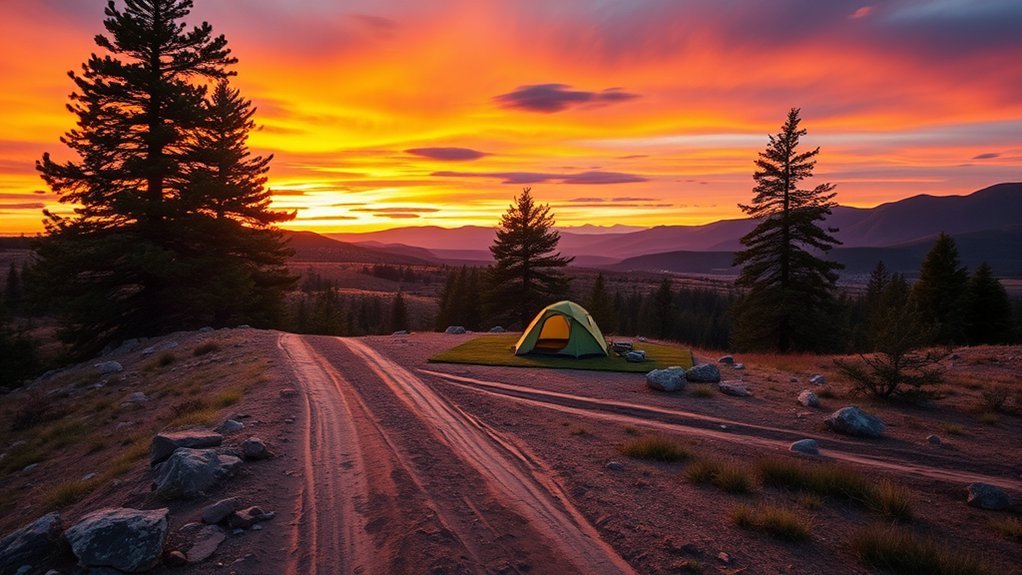
Choose a level, durable area that already shows signs of legal camping, such as a compacted pad or previously disturbed surface. Reusing an established site helps prevent new vegetation loss and soil damage. Do not enlarge the site, cut live plants, trench around the tent, or create a new road.
As a Leave No Trace practice, camp about 200 feet from lakes, streams, springs, trails, and other busy areas when local rules allow. This is a low-impact guideline, not a universal legal setback. Some BLM sites require a different distance from roads, wildlife water sources, cultural sites, or riparian areas, so follow posted rules for the exact location.
- Use legal access: Stay on roads and routes open to your vehicle. Do not drive cross-country to reach a flat spot.
- Protect water: Avoid streambanks, springs, wet meadows, and fragile riparian vegetation.
- Look overhead: Do not camp beneath dead limbs, unstable trees, loose rock, or steep slopes.
- Read the terrain: Avoid dry washes, narrow canyons, low basins, and riverbeds that can flood far from the storm.
- Respect neighbors: Leave space between camps and keep roads, gates, trailheads, and livestock access clear.
- Leave artifacts alone: Do not collect, move, carve, or disturb historic objects, fossils, rock art, structures, or archaeological sites.
Warning: A dry wash can become a fast-moving flood even when the sky above your campsite is clear. Check the wider forecast and never camp in a drainage when storms are possible.
Environmental Stewardship Principles
Dispersed sites receive little daily maintenance, so each camper’s choices matter. Follow Leave No Trace practices and any stricter local rule.
Leave No Trace
- Plan ahead: Know the regulations, weather, fire danger, road conditions, and group-size limits.
- Use durable surfaces: Camp and park on existing disturbed ground rather than vegetation or biological soil crust.
- Pack out trash: Remove food scraps, cans, glass, foil, spent charcoal, pet waste, and micro-trash. Do not burn garbage.
- Leave what you find: Keep rocks, plants, antlers, wood, fossils, and cultural items in place.
- Reduce fire impacts: Use a stove when possible and only have a fire when it is legal and safe.
- Respect wildlife: Observe from a distance, secure food, and never feed animals.
- Consider other visitors: Limit noise, lights, dust, and generator use, especially at night.
Waste Management Practices
Use a toilet, portable toilet, or waste bag when local rules require it. Where catholes are allowed, the Leave No Trace Center recommends digging a hole 6–8 inches deep at least 200 feet from water, camp, and trails, then covering and disguising it. Pack out hygiene products. Packing out toilet paper is the lowest-impact option and is required in some high-use, desert, canyon, river, alpine, or sensitive areas.
For dishwashing, carry water away from lakes and streams, use only a small amount of biodegradable soap, strain food particles, pack those particles out, and scatter the remaining water where local rules allow. “Biodegradable” does not mean soap belongs in a water source.
Food Storage, Trash, and Gray Water
Store food, trash, toiletries, cooking grease, and scented items according to local wildlife rules. In bear country, that may mean an approved bear-resistant container or locked vehicle. Elsewhere, a secure hard-sided container may be enough. Never leave food outside overnight, and do not dump gray water where it can attract animals or affect other campers.
Navigating California Fire Regulations
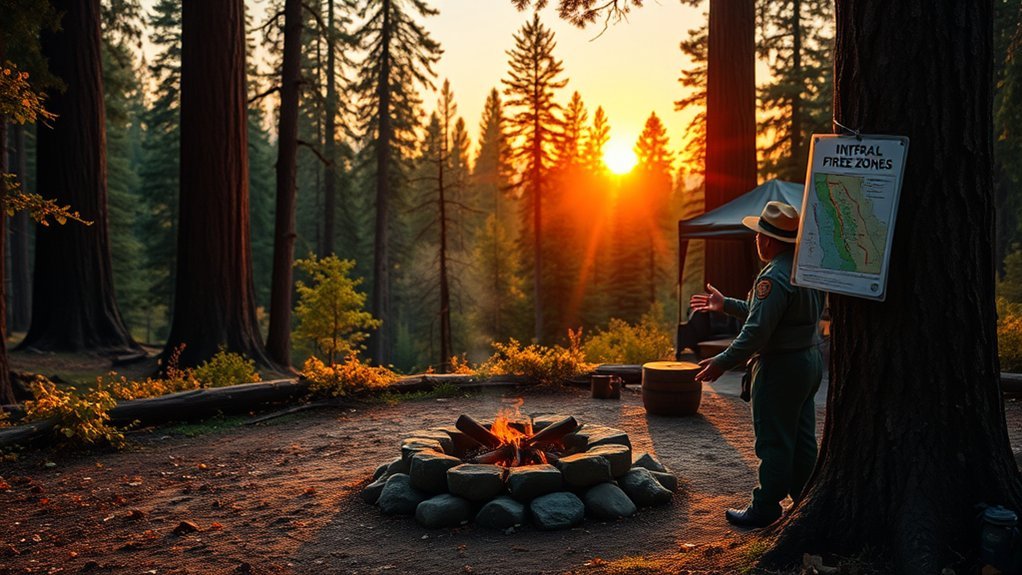
California fire rules can change by district, field office, season, weather, and emergency order. Check the BLM California fire-restrictions page on the day you travel, not only when you begin planning.
- Get the required permit. A free California Campfire Permit may be required for campfires, barbecues, lanterns, or portable stoves on federal- and state-controlled lands outside developed facilities.
- Read the active order. A permit does not allow an activity prohibited by a seasonal restriction, Red Flag Warning, Fire Weather Watch, closure, or local order.
- Use the safest legal option. A shut-off gas stove is often permitted when wood or charcoal fires are not, but only the current order can confirm that.
- Do not trust an old fire ring. An existing ring shows that someone built a fire there; it does not prove that a fire is legal today.
- Keep control tools ready. When fires are allowed, keep water and a shovel within reach, attend the fire at all times, and keep it small.
- Put it dead out. Drown, stir, and feel for heat. Leave only when the ashes and surrounding soil are cool.
Warning: Fire restrictions override permits and existing fire rings. If the rule is unclear, use no open flame and contact the managing BLM office.
Seasonal Considerations for Dispersed Camping
The best season depends on elevation, latitude, road surface, water availability, and current closures. Use this table as planning guidance, then check the local forecast and field-office alerts.
| Season | Possible Destinations | Main Considerations |
|---|---|---|
| Spring | Lower- and mid-elevation desert or foothill areas | Wildflowers, mud, snowmelt, strong wind, cold nights, and flash-flood risk |
| Summer | Higher-elevation areas, including accessible parts of the Eastern Sierra | Extreme heat at lower elevations, wildfire restrictions, smoke, thunderstorms, altitude, and limited water |
| Fall | Many lower- and mid-elevation regions | Shorter daylight, freezing nights, hunting seasons, early snow, and continuing fire restrictions |
| Winter | Desert and other low-elevation regions | Freezing nights, snow at elevation, heavy rain, washed-out roads, wind, and desert temperature swings |
Unpaved roads can become impassable after rain or snow. Turning around before the road becomes dangerous protects you, your vehicle, and the land.
Long-Term Visitor Areas: An Overview
BLM Long-Term Visitor Areas, or LTVAs, are designated winter-use areas in parts of Arizona and California. They are the main exception to the usual short-term nature of dispersed camping.
As of July 2026, the official LTVA information lists a $180 long-term permit for the September 15–April 15 season and a $40 short-visit permit valid for 14 consecutive days. Both permit types may be used at designated LTVAs, subject to each area’s rules.
- Season: The long-term-use season runs from September 15 through April 15.
- Length: A long-term permit can cover up to seven consecutive months; a short permit covers 14 consecutive days.
- Amenities: Services vary. Some areas may offer trash collection, dump stations, toilets, or non-potable water, while others have limited or no services.
- Self-containment: Some LTVA zones require camping units to be fully self-contained or limit where non-self-contained visitors may stay.
- Community: Some LTVAs have hosts, repeat winter visitors, and informal social activities, but the level of activity varies by location and season.
- Off-season use: Rules can change after April 15, and the standard short-term stay limit may apply.
Note: LTVA fees, services, permit sales, and supplemental rules can change. Verify the specific LTVA page before relying on water, toilets, trash service, or dump facilities.
Navigation, Road, and Vehicle Safety
Dispersed camping roads may be unmarked and rarely maintained. A passenger car may reach some sites in dry weather, while other routes require high clearance, four-wheel drive, or specialized recovery equipment.
- Use an official land-status map and keep an offline copy.
- Stay on routes open to your type of vehicle.
- Do not drive around a locked gate, closure sign, washout, or muddy section.
- Carry a full-size spare tire, jack, basic tools, tire gauge, traction aid, and enough fuel to return.
- Avoid parking over dry grass, which can contact hot exhaust components.
- Keep a backup campsite that does not require the same access road.
- Do not block gates, cattle guards, fire routes, or another camper’s exit.
Water, Weather, and Emergency Planning
Assume there will be no safe drinking water. Bring enough for drinking, cooking, hygiene, pets, and emergencies. For desert travel, BLM LTVA safety guidance recommends carrying at least one gallon of water per person per day; hot weather, exertion, pets, and delays may require more.
- Check heat, wind, thunderstorms, flood watches, smoke, and overnight lows.
- Carry a first-aid kit, required medicines, sun protection, warm layers, rain protection, and extra food.
- Know the nearest paved road, fuel source, medical facility, and ranger or field-office contact.
- Use a satellite communicator or personal locator beacon when the trip’s remoteness justifies it.
- Leave your route and return time with a trusted person.
- In an emergency, call 911 when service is available and provide coordinates, road names, and landmarks.
Wildlife Awareness and Safety Tips
Wildlife varies widely across BLM lands. Bears may be the main food-storage concern in some mountain regions, while snakes, scorpions, rodents, coyotes, insects, or livestock may be more common elsewhere.
- Research the animals and food-storage rules for the exact destination.
- Keep food, trash, cooking gear, and scented products secured.
- Watch where you place hands and feet, and check shoes and bedding in desert habitat.
- Give all wildlife room to move and never feed or approach an animal.
- Do not leave food scraps, grease, or pet food at the campsite.
- Keep children and pets close, especially near water, cliffs, livestock, or dense brush.
Camping With Pets
Pets are allowed on many BLM lands, but leash and access rules are site-specific. Keep your pet under control, prevent chasing wildlife or livestock, carry enough water, protect paws from hot or sharp ground, remove pet waste, and check the destination page for leash requirements or seasonal closures.
BLM Dispersed Camping Packing Checklist
- Shelter and sleep: Tent or vehicle shelter, stakes, sleeping bag, sleeping pad, and weather-appropriate layers
- Water: Drinking water, emergency reserve, durable containers, and a treatment method only when a usable source is confirmed
- Food and cooking: Food, secure storage, cookware, and a legal stove or no-cook backup
- Navigation: Official maps, offline map, compass or GPS, coordinates, and alternate routes
- Safety: First-aid kit, medicines, headlamp, spare batteries, sun protection, and emergency communication
- Sanitation: Portable toilet or waste bags when required, trowel where catholes are legal, toilet-paper pack-out bags, soap, and hand sanitizer
- Fire safety: Current permit when required, water, shovel, and extinguisher—but only when the planned flame is legal
- Vehicle support: Spare tire, jack, tools, recovery gear, extra fuel where safe, and roadside emergency supplies
- Cleanup: Strong trash bags, food-scrap container, pet-waste bags, and a final micro-trash check
Frequently Asked Questions
What permits are required for BLM dispersed camping?
Many general dispersed camping areas do not require a camping permit, but special recreation areas, monuments, high-use destinations, backcountry zones, and LTVAs may require permits or fees. Check the official destination page and managing field office before travel.
Can I have a campfire while dispersed camping?
Only when the managing office allows it. Check current fire restrictions, obtain any required permit, and follow the active order. An existing fire ring does not make a fire legal, and a permit does not override a ban.
Are pets allowed in dispersed camping areas?
Pets are allowed on many BLM lands, but leash, trail, and seasonal rules vary. Keep pets under control, prevent wildlife chasing, carry water, protect their paws, and pack out their waste.
How do I find BLM dispersed camping locations?
Start with the official BLM visit map and destination search. Confirm land ownership, identify the local field office, read current alerts and supplementary rules, and download offline maps. Treat crowdsourced pins as leads, not proof that camping is legal.
What should I pack for a BLM dispersed camping trip?
Bring shelter, sleep gear, food, more water than you expect to use, navigation, first aid, lighting, weather protection, sanitation supplies, trash bags, emergency communication, and vehicle-recovery equipment suited to the route.
Can I camp in any roadside pullout on BLM land?
No. The pullout may be a day-use area, trailhead, private parcel, closed restoration site, unsafe shoulder, or location covered by a no-camping order. Verify that overnight use is legal and that your vehicle is parked on an open route without blocking access.
What happens after I reach a 14-day stay limit?
You must follow the relocation rule for that location. BLM guidance says the required move is often 25 to 30 miles, while California generally requires moving outside a 25-mile radius until day 29. Other offices may use different distances or time periods.
How far should I camp from water?
Leave No Trace recommends camping about 200 feet from water, trails, and other busy areas when local rules allow. Treat that as low-impact guidance and follow any posted setback, riparian closure, wildlife-water restriction, or site-specific requirement.
Conclusion
Safe BLM dispersed camping starts with one habit: verify the exact location before you go. Confirm the boundary, stay limit, permit rules, road access, fire status, waste requirements, and closures; then camp on durable ground and leave the site cleaner than you found it. The BLM manages about 245 million acres—roughly one-tenth of the U.S. land base—so responsible choices help keep an enormous shared landscape open and healthy.
Sources
- Bureau of Land Management: Camping on Public Lands — general dispersed-camping rules, stay limits, and local variation
- Bureau of Land Management: Visit Our Public Lands — official map and recreation-site search
- Bureau of Land Management: California Recreation Activities — California stay limits, relocation distance, and unattended-property rule
- Bureau of Land Management: California Fire Information and Restrictions — current field-office fire orders and restrictions
- Bureau of Land Management: Midland Long-Term Visitor Area — LTVA season, permit fees, and supplemental rules
- Leave No Trace Center: Dispose of Waste Properly — cathole depth, water setbacks, trash, and hygiene guidance
