
Last Updated on July 29, 2026 by Mason Reed
Dispersed camping in U.S. National Forests lets you stay outside developed campgrounds, often without reservations or campground amenities. The tradeoff is that you must confirm where camping is legal, follow local stay and fire rules, protect water and wildlife, and carry everything needed for a safe, self-contained trip.
Quick Answer
Dispersed camping is usually allowed outside developed campgrounds on many National Forest System lands, but there is no single nationwide rulebook. Before you go, check the destination forest’s alerts, closure orders, stay limits, fire restrictions, road-use map, waste rules, and permit requirements. Use existing sites, pack out trash, and follow local instructions.
Key Takeaways
- Rules differ by national forest, ranger district, season, and special closure order; verify the exact destination before leaving.
- A 14-day stay limit is common, but it is not universal. Local rules may be shorter or may require you to move a stated distance.
- Use an existing disturbed site on a durable surface and obey local setbacks from water, roads, trails, developed areas, and private property.
- Check fire restrictions on the day of travel. A legal campfire can become prohibited when wildfire danger rises.
- Bring safe water, navigation tools, food-storage supplies, waste bags, and an emergency plan because dispersed sites usually have no services.
At a Glance
| Time Required | Allow 30–60 minutes for rule, map, road, weather, and fire checks before travel, plus extra time to reach and inspect a campsite. |
| Difficulty | Moderate; you must navigate, manage water and waste, assess road conditions, and handle emergencies without campground services. |
| Tools Needed | Current forest alerts, Motor Vehicle Use Map when driving, offline map, water or treatment system, trowel or approved pack-out toilet system, trash bags, first-aid kit, and fire tools when fires are allowed. |
| Cost | Often free, but parking, wilderness, high-use-area, group, or campfire permits may apply. Equipment, fuel, and water costs vary. |
Disclosure: As an Amazon Associate I earn from qualifying purchases. Some links on this page are affiliate links, at no extra cost to you.
What Is Dispersed Camping?
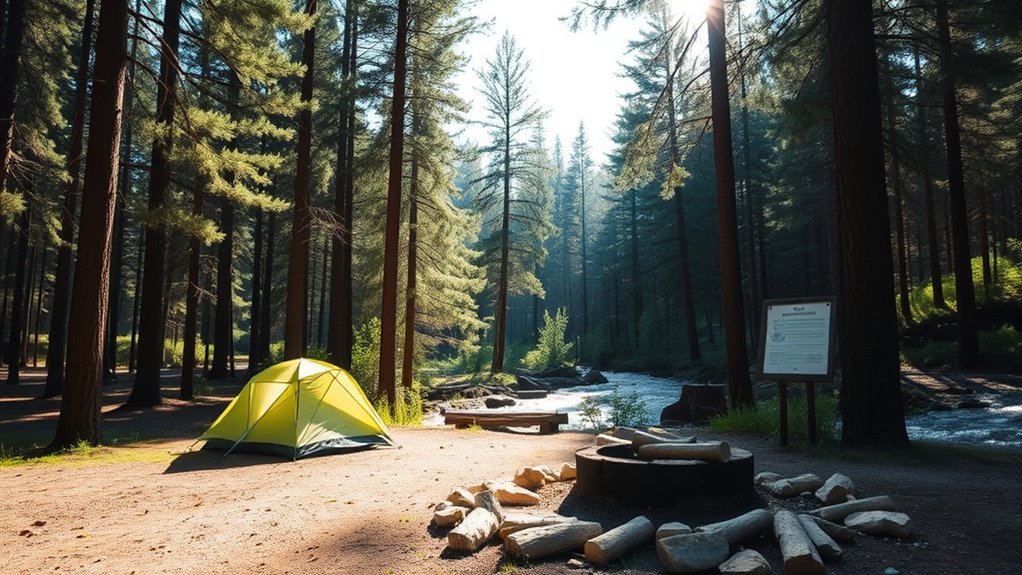
Dispersed camping means camping on public land outside a developed or designated campground. In National Forests, these sites usually have no piped water, toilets, trash collection, picnic tables, or hosts. You must be self-contained and prepared to leave the area as clean as—or cleaner than—you found it.
Dispersed camping is not permission to camp anywhere. Developed recreation areas, trailheads, day-use sites, closed roads, restoration zones, sensitive habitat, private inholdings, and some heavily used corridors may be off-limits. Wilderness areas can also have separate quotas, campsite rules, food-storage orders, or permit systems.
Stay limits are set locally. Many forests use a limit of about 14 days, but the counting period, relocation distance, and annual cap can differ. Treat posted signs, forest orders, and instructions from the responsible ranger district as the controlling rules.
Where Can You Disperse Camp?
Your best starting points are National Forest System lands and Bureau of Land Management lands that are not closed or otherwise restricted. State forests and Wildlife Management Areas follow separate state rules, so do not assume federal dispersed-camping practices apply there.
Public Land Options
National Forests often allow dispersed camping outside developed campgrounds, while BLM lands generally allow it unless an area is posted closed or has a specific land-use restriction. In both systems, local rules override broad guidance. Existing roadside pullouts are not automatically legal campsites, and a campsite shown in a community app may be closed, on private land, or reachable only by a route that is not open to your vehicle.
Use official land-management maps to confirm ownership and access. When driving on National Forest System lands, consult the current Motor Vehicle Use Map. It is the legal reference for routes open to motorized travel and may show where limited motorized access for dispersed camping is allowed. A route being legal does not mean it is safe for a passenger car, trailer, or RV.
Local Ranger Guidance
Contact the ranger district responsible for the area, not only the forest headquarters. Ask about:
- Areas where dispersed camping is currently allowed or prohibited
- Stay limits, relocation requirements, group-size limits, and permit rules
- Required setbacks from water, roads, trails, developed sites, and private property
- Seasonal gates, washed-out roads, snow, flood damage, and vehicle suitability
- Current fire restrictions, campfire-permit rules, and stove restrictions
- Food-storage orders, wildlife activity, and human-waste pack-out requirements
Pro Tip: Save the ranger district phone number, forest alerts page, map, and evacuation route offline. Cell service may disappear before you reach the campsite.
Online Resource Tools
Use official tools first. Satellite imagery and community camping databases can help with trip planning, but they do not prove that a site or access road is legal today.
| Resource | Best Use | Important Limit |
|---|---|---|
| Destination forest website and alerts | Find the forest or recreation area, then check current orders, closures, permits, and contacts. | Rules can change by ranger district and date. |
| Forest Service Interactive Visitor Map | Explore Forest Service roads, trails, and recreation features. | Use the latest MVUM for enforceable motorized-route designations. |
| BLM camping page | Review general BLM dispersed-camping rules and locate the local field office. | BLM rules do not replace National Forest rules. |
| Google Maps and satellite imagery | Preview terrain, road junctions, and possible turnarounds. | Land boundaries, closures, gates, and road conditions may be missing or outdated. |
| Boondocking.org and Freecampsites.net | Gather community leads and recent visitor comments. | Verify every lead with the land manager and official map before traveling. |
How to Choose a Legal, Low-Impact Campsite
- Confirm land ownership. Make sure the location is on the public land you intend to visit and not on a private inholding, tribal land, state land, or a closed administrative site.
- Verify legal motorized access. Stay on routes open to your vehicle class. Do not drive across meadows, around gates, or along user-created tracks.
- Use an existing site. Choose a previously disturbed area with bare, compacted ground instead of creating a new clearing or fire ring.
- Follow local setbacks. Water, road, trail, campground, and trailhead distances vary. Use the local legal rule; where no stricter rule applies, follow Leave No Trace guidance and stay well away from water and high-use areas.
- Check drainage and hazards. Avoid dry washes, flood channels, dead trees, unstable slopes, loose rock, tall grass, and low spots where cold air or water collects.
- Leave room to exit. Park without blocking roads, gates, turnarounds, trail access, or emergency vehicles. Do not trap your vehicle on soft ground.
Note: The familiar “200 feet from water” rule is a strong Leave No Trace benchmark, not a universal National Forest campsite law. Some forests require 100 feet, 150 feet, 200 feet, or another distance. Follow the stricter local rule.
Fees and Permits for Dispersed Camping
Basic dispersed camping is often free, but “free” does not mean unrestricted. A fee or permit may apply when you park at a fee site, enter a quota-controlled wilderness, use a designated high-impact corridor, travel with a large group, hold an event, or use fire outside developed recreation areas.
- Check the destination forest’s permits page and alerts before the trip.
- Ask whether a wilderness, overnight, parking, group-use, or campfire permit is required.
- Read permit conditions; they can include campsite zones, food-storage methods, group limits, and pack-out rules.
- If your route crosses BLM or state land, review that agency’s rules separately.
The Forest Service explains that many recreation opportunities are free, while some sites and activities require fees or permits. Start with the destination’s official page and the national Forest Service passes and permits guide.
Dispersed Camping Rules and Guidelines
Dispersed-camping rules protect water, vegetation, wildlife, public access, and other visitors. The most important rule is to follow the current order for the exact forest and district you are visiting. A practice allowed in one forest may be restricted in another.
Check the Rules Before You Leave
- Read current alerts, closure orders, fire restrictions, and food-storage orders.
- Download the latest official road and visitor maps for offline use.
- Confirm camping and parking are allowed at the planned location.
- Check the maximum stay, how days are counted, and how far you must move afterward.
- Review weather, air quality, stream crossings, and road conditions.
- Tell a trusted person your route, campsite area, vehicle description, and return time.
Minimum Distance Requirements
There is no nationwide National Forest distance that applies to every dispersed campsite. Local orders may set distances from water, roads, trails, developed recreation areas, buildings, or private property. Leave No Trace recommends locating campsites and catholes at least 200 feet from water, but a local forest may require a different campsite setback.
- Use the local legal setback whenever one is posted or stated in a forest order.
- Keep tents, cooking areas, and waste away from shorelines, springs, seeps, and drainage channels.
- Do not block roads, trailheads, gates, or turnarounds.
- Do not assume an old fire ring makes a site legal.
Motorized Access and Road Rules
Motorized travel is limited to roads, trails, and areas designated for your vehicle class. The current MVUM is the official reference. Some maps show a limited distance that vehicles may travel from a designated route for dispersed camping; where no such allowance exists, driving cross-country is prohibited.
Roads can be legal but unsuitable. Check grade, width, surface, water crossings, snow, mud, turnaround space, and trailer clearance. Avoid traveling on wet roads when your tires would leave deep ruts.
Waste Disposal Practices
Local rules control human-waste disposal. Some places allow catholes; fragile deserts, alpine zones, river corridors, winter sites, and crowded areas may require a portable toilet or approved waste pack-out bag.
| Waste Type | Preferred Method | Important Notes |
|---|---|---|
| Human feces | Where allowed, dig a cathole 6–8 inches deep and at least 200 feet from water, trails, and camp; otherwise use an approved pack-out system. | Cover and disguise the cathole. Never use a dry wash or drainage channel. |
| Toilet paper and wipes | Pack them out in a sealed bag for the lowest impact. | Wipes, including products labeled biodegradable, should always be packed out. Never burn toilet paper. |
| Hygiene products | Seal and pack out pads, tampons, diapers, and applicators. | Do not bury them; animals may uncover them. |
| Trash, grease, and leftovers | Pack out every item and food scrap. | Do not bury, scatter, or burn food waste. |
| Dishwater and washing water | Carry water 200 feet from natural water, use minimal soap, strain food particles, and scatter the water broadly where allowed. | Biodegradable soap still does not belong in a lake or stream. |
Leave No Trace Principles
Leave No Trace is a decision-making framework for reducing damage, not a substitute for local law. Apply all seven principles: plan ahead, travel and camp on durable surfaces, dispose of waste properly, leave what you find, minimize campfire impacts, respect wildlife, and be considerate of others.
- Use existing sites rather than enlarging or “improving” them.
- Pack out trash, food scraps, foil, bottle caps, pet waste, and micro-trash.
- Do not cut live vegetation, dig drainage trenches, build furniture, or move large rocks.
- Keep noise and bright lights low, especially near other campers and wildlife habitat.
- Restore movable items you used and scan the site before leaving.
A campsite that has been used before is usually the lowest-impact choice—but only after you confirm that camping there is still legal.
Fire Safety Regulations
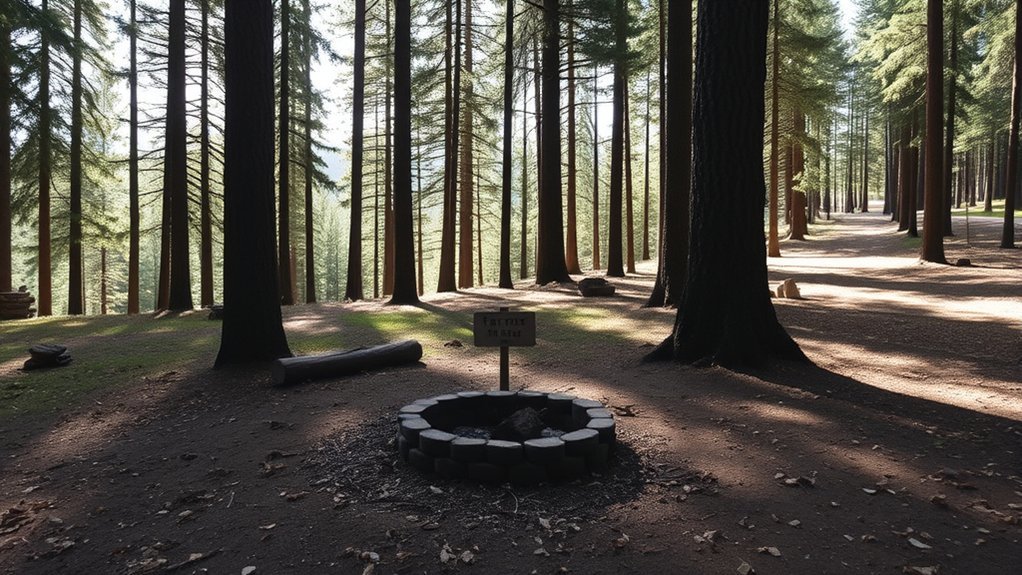
Fire restrictions can change quickly with weather and wildfire danger. Check the destination forest’s alerts immediately before travel and again when you arrive. Some restrictions ban wood and charcoal fires outside developed campgrounds; stricter stages can also limit certain stoves, smoking, vehicles, or other ignition sources.
Warning: An existing fire ring does not make a campfire legal. If a restriction or closure prohibits open flame, do not light one. Violations can start wildfires and may lead to fines, liability, or evacuation.
When a fire is allowed:
- Use an existing fire ring where required or recommended; do not build a new ring simply for convenience.
- Keep the fire small and away from tents, dry grass, roots, vehicles, and overhanging branches.
- Keep water and a shovel within reach and never leave the fire unattended.
- Burn only permitted firewood. Never burn cans, glass, foil, plastics, food, or other trash.
- Follow local rules for collecting or transporting wood; invasive-pest rules may restrict moving firewood.
- Extinguish with the “drown, stir, and feel” method until every ember is cold to the touch.
Water Purification Methods
Do not assume clear mountain water is safe. It can contain parasites, bacteria, or viruses, and treatment methods have different limits. Carry enough water when possible and have a backup treatment method.
Boiling Water Effectively
The CDC recommends bringing clear water to a rolling boil for 1 minute. At elevations above 6,500 feet, boil it for 3 minutes. Let it cool in a clean, covered container.
- If water is cloudy, first let sediment settle or prefilter it through a clean cloth or coffee filter.
- Boiling kills germs but does not remove fuel, pesticides, heavy metals, harmful algal toxins, or other chemicals.
- If chemical contamination is possible, use water from a known safe source instead of relying on boiling.
Portable Water Filters
Read the filter label instead of relying only on the advertised pore size. According to the CDC, many portable filters remove parasites but not viruses or all bacteria. A filter with an absolute pore size of 0.3 micron or smaller can remove bacteria and parasites, but not viruses. Reverse-osmosis systems can remove parasites, bacteria, and viruses, though they are less common for lightweight backcountry use.
For broad germ protection, filter cloudy water and then disinfect it using a method and contact time approved by the product manufacturer. Backflush, clean, protect from freezing, and replace filter elements as directed. A filter that freezes while wet may be damaged even when no crack is visible.
Note: Water treatment reduces biological risk; it does not make every polluted water source safe. Avoid water near mine drainage, chemical spills, heavy livestock use, or visible algal blooms.
Waste Disposal in the Wilderness
Catholes are not appropriate everywhere. Pack out solid human waste when a local order requires it or when soil is too shallow, frozen, rocky, saturated, or absent. Pack-out systems are also commonly required or preferred in narrow river canyons, high alpine zones, fragile deserts, snow-covered sites, and heavily used corridors.
- Carry an approved human-waste bag or portable toilet when destination rules call for one.
- Keep waste bags sealed, protected from puncture, and separate from food and clean gear.
- Dispose of packed waste only as the product instructions and local authority allow; do not place untreated waste in recycling or leave it at a trailhead.
- Pack out all toilet paper, wipes, hygiene products, pet waste, and trash.
The Leave No Trace waste guidance recommends 6–8-inch catholes at least 200 feet from water, trails, and camp where catholes are permitted. Local land-manager instructions always take priority.
Food Storage and Wildlife Safety
Food, garbage, coolers, pet food, toiletries, cooking gear, and other scented items can attract bears and smaller animals. Some forests have enforceable food-storage orders that require an approved bear-resistant container, a locked hard-sided vehicle, a provided locker, or another stated method.
- Read the destination’s current food-storage order before selecting a container or hanging method.
- Keep a clean cooking area and secure attractants whenever they are not in immediate use.
- Never store food or scented items in a tent.
- Do not feed wildlife or leave food scraps “for animals.”
- Observe animals from a distance and give them a clear escape route.
If you encounter wildlife, stay calm, do not approach, and follow species-specific guidance from the local land manager. The safest response to a bear, moose, bison, mountain lion, or snake is not identical, so learn which animals live at your destination before the trip.
Pet Considerations While Camping
Pets are welcome in many National Forest areas, but there is no universal six-foot-leash rule for every dispersed site. Developed recreation areas, trails, wilderness zones, wildlife-protection areas, and local jurisdictions can have different requirements. Some places prohibit dogs entirely.
- Check the destination’s pet rules and carry a leash even where voice control is allowed.
- Keep your pet from chasing wildlife, entering other camps, barking continuously, or approaching livestock.
- Pack out pet waste and secure pet food with other attractants.
- Bring identification, vaccination records, first aid, water, paw protection when needed, and parasite prevention recommended for the area.
- Never leave a pet unattended in camp or in a vehicle exposed to unsafe temperatures.
Essential Gear and Emergency Planning
A dispersed campsite has no guarantee of drinking water, toilets, trash cans, lighting, cell service, road maintenance, or emergency assistance. Build your gear list around the location, season, vehicle, and group.
- Navigation: printed or downloaded official maps, offline GPS, compass, and the skills to use them
- Water: carried supply, treatment system, backup treatment, and extra capacity
- Shelter and warmth: weather-appropriate tent, sleep system, rain protection, and spare layers
- Waste: trowel where catholes are allowed, required pack-out system, toilet paper bags, and trash bags
- Safety: first-aid kit, medications, headlamp, emergency shelter, signaling device, and fire extinguisher for vehicle-based trips
- Vehicle recovery: full-size spare, jack, tire tools, traction aids, shovel, recovery equipment suitable for the vehicle, and enough fuel to return
- Communication: itinerary left with a trusted person and, for remote travel, a satellite messenger or personal locator beacon
Resources for Dispersed Campers
Use this order of operations when planning:
- Find the correct National Forest and ranger district.
- Read its dispersed-camping page, alerts, closure orders, and permit pages.
- Download the latest MVUM if using a motor vehicle and a detailed visitor or topographic map for navigation.
- Call the district office about unclear rules, road conditions, water availability, fires, food storage, and waste.
- Check the forecast, wildfire conditions, and air quality immediately before departure.
- Leave your itinerary and expected return time with a trusted contact.
Useful official starting points include the Forest Service dispersed-camping guidance, Motor Vehicle Use Map information, and the BLM camping guide. Always finish your research on the local office’s current page.
Sources
- U.S. Forest Service: Dispersed Camping — definition, lack of amenities, local stay limits, campsite selection, permits, and fire checks
- U.S. Forest Service: Motor Vehicle Use Map FAQ — official motorized-route designations and map limitations
- U.S. Forest Service: Passes and Permits — recreation fees and permit types
- Leave No Trace: Dispose of Waste Properly — catholes, toilet paper, trash, dishwater, and soap guidance
- Centers for Disease Control and Prevention: Backcountry Water Treatment — boiling, filtering, disinfection, and treatment limits
- U.S. Forest Service: Pacific Southwest Region FAQs — pet-control and motorized-use guidance
Frequently Asked Questions
Can I camp in winter at dispersed sites?
Often yes, unless a seasonal closure, snowmobile rule, wildlife restriction, or road gate prevents access. Winter roads may be unplowed and impassable. Check avalanche and weather conditions, carry winter survival equipment, and use a human-waste method suitable for frozen or snow-covered ground.
What equipment do I need for dispersed camping?
Bring shelter, a sleep system, food, more water than expected or a suitable treatment system, maps, lighting, first aid, weather layers, sanitation supplies, trash bags, food storage, and emergency communication. Vehicle-based campers should also carry a spare tire, tools, recovery gear, and extra fuel appropriate to the route.
Are there seasonal campfire restrictions?
Yes. Restrictions can change during a trip and may ban wood or charcoal fires outside developed campgrounds. Check the destination forest’s alerts on the day you travel. An old fire ring does not override a restriction or closure.
How do I find available dispersed camping sites?
Start with the destination forest website, current alerts, the ranger district, and official visitor and motor-vehicle maps. Community apps can suggest possibilities, but confirm land ownership, road access, closures, and camping legality with official sources before relying on a listing.
What should I do if I encounter wildlife?
Do not approach, feed, surround, or block the animal. Stay calm, give it space and an escape route, control pets, and follow species-specific guidance for the area. Report aggressive, injured, or food-conditioned wildlife to the local ranger district when safe to do so.
Do I need a reservation or permit?
Many dispersed sites have no reservation system, but some forests require permits for wilderness travel, high-use areas, large groups, parking, or campfires. Check the exact forest and ranger district rather than assuming the trip is permit-free.
Can I sleep in my vehicle on a National Forest road?
Only where overnight occupancy and parking are allowed. Your vehicle must remain on a route or area open to that vehicle class, and you cannot block traffic, gates, trailheads, or turnarounds. Local camping corridors, parking restrictions, and stay limits still apply.
Conclusion
Dispersed camping in U.S. National Forests can offer solitude and flexibility, but the rules are local, not one-size-fits-all. Confirm the exact forest and ranger district, use official maps, check alerts and fire restrictions, choose an existing low-impact site, store food securely, treat water correctly, and pack out all waste. Careful planning protects both your group and the places you came to enjoy.
