
Last Updated on July 29, 2026 by Mason Reed
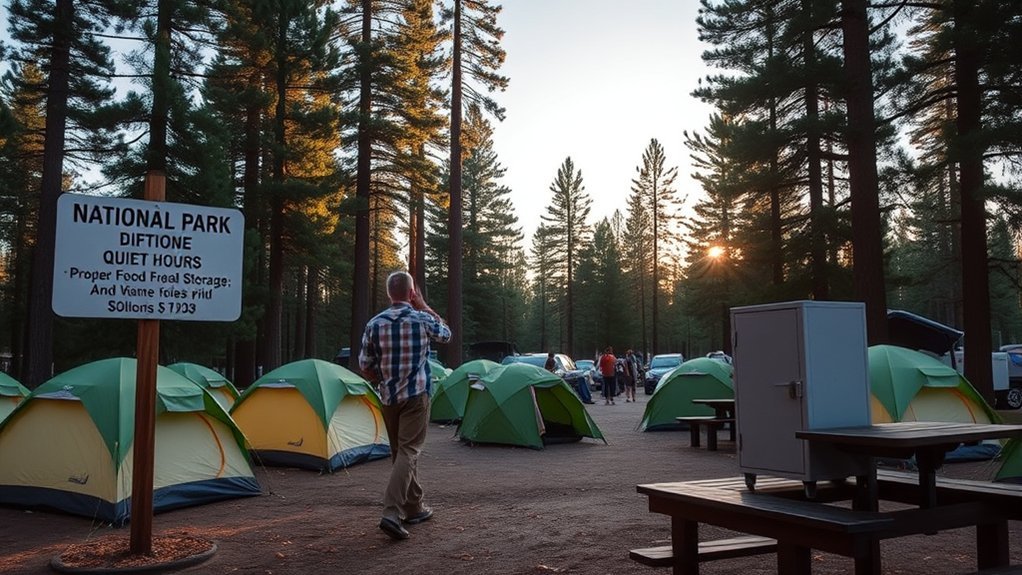
National park campground rules help campers share limited space without disturbing their neighbors or attracting wildlife. Quiet hours are often around 10 p.m. to 6 a.m., but times, generator limits, food-storage methods, and penalties vary by park. Check the exact rules for your campground before leaving home and again when you arrive.
Quick Answer
Most national park campgrounds post quiet hours, often around 10 p.m. to 6 a.m., but the exact schedule and generator rules vary. Food, trash, toiletries, coolers, and cooking gear must be stored exactly as that park directs—often in a locked hard-sided vehicle, food locker, approved canister, or provided cable system—never in a tent.
Key Takeaways
- Treat 10 p.m. to 6 a.m. as a common quiet-hour schedule, not a nationwide guarantee.
- Check generator hours separately because they may begin earlier and end later than quiet hours.
- Store food, trash, coolers, toiletries, pet food, and cooking equipment according to the selected park’s instructions.
- Frontcountry and backcountry storage rules are often different.
- Warnings, fines, impoundment, citations, or removal may result from serious or repeated violations.
At a Glance
| Time Required | About 10–15 minutes to review the campground page, alerts, map, and storage requirements |
| Difficulty | Easy, provided you verify the rules for the specific park and camping area |
| Tools Needed | Park rules, campground map, secure storage method, trash bags, and headphones for quiet listening |
| Cost | Usually $0 with suitable existing gear; an approved canister or other required container may cost extra |
Disclosure: As an Amazon Associate I earn from qualifying purchases. Some links on this page are affiliate links, at no extra cost to you.
Check the Campground’s Current Rules First
The National Park Service manages hundreds of locations, and each park can adopt local restrictions based on wildlife, campground design, visitor use, fire danger, and other conditions. The NPS campground-etiquette guidance says quiet hours are posted in most campgrounds and commonly use a schedule such as 10 p.m. to 6 a.m. That example should not be treated as a universal timetable.
Before your trip, check these sources in order:
- The park’s official NPS camping page: Look for quiet hours, generator limits, food-storage rules, fire restrictions, and late-arrival procedures.
- The campground’s individual page or map: Rules and facilities may differ between campgrounds in the same park.
- Current alerts and closures: Wildlife activity, wildfire danger, storms, or facility problems can cause temporary changes.
- The superintendent’s compendium: This document explains park-specific restrictions adopted under federal authority.
- Posted signs and ranger instructions: Follow current on-site directions even when an older brochure or third-party website says something different.
Note: Great Smoky Mountains National Park appears throughout this guide because several details in the original article came from that park. Its rules are useful examples, but they do not automatically apply to Yellowstone, Yosemite, Acadia, or another NPS campground.
How Quiet Hours Work in National Park Campgrounds
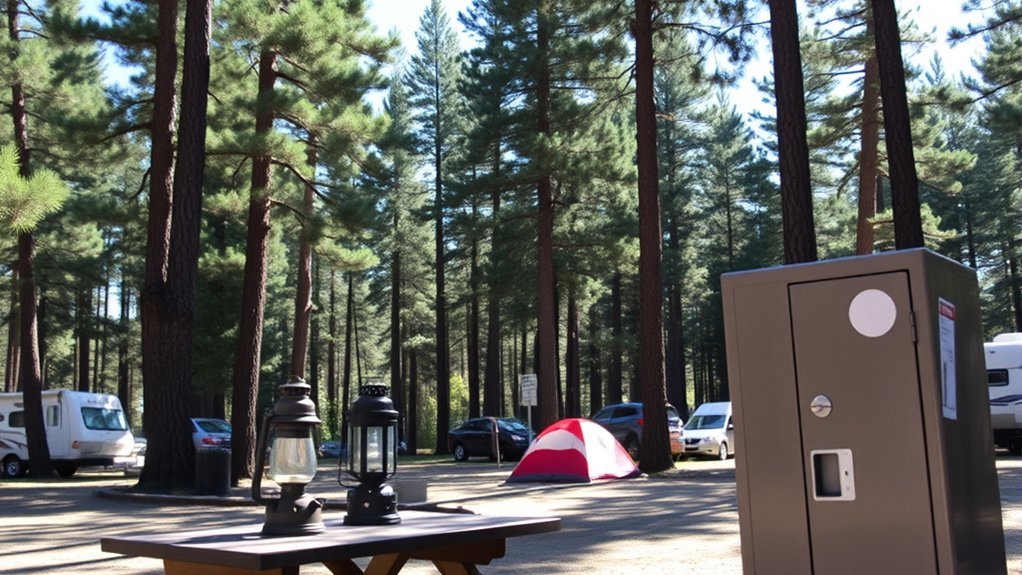
Quiet hours create a predictable time when campers can sleep and enjoy a campground’s natural soundscape. Many campgrounds use 10 p.m. to 6 a.m., but some begin earlier, end later, or impose additional limits on generators and vehicle idling.
Quiet hours do not always mean complete silence. Normal movement and a brief low conversation may be unavoidable. The practical standard is that sound from your campsite should not disturb neighboring sites. Park-specific rules may be stricter and may require radios, speakers, generators, and other noise-producing equipment to be turned off.
Noise Sources to Control
Common problems during quiet hours include:
- Portable speakers, radios, televisions, and musical instruments
- Loud conversations, singing, shouting, or group games
- Generators, power tools, and prolonged engine idling
- Repeatedly opening vehicle doors or using panic-lock horns
- Barking dogs or unattended pets
- Bright lanterns or vehicle headlights aimed into nearby campsites
- Hammering stakes or completing a noisy setup late at night
Federal audio-disturbance rules can also apply outside posted quiet hours. The NPS explains that motorized equipment may be prohibited when it exceeds specified sound levels or creates unreasonable noise even below that level. Courtesy therefore matters throughout the day, not only after the posted start time.
Quiet Hours and Generator Hours Are Different
Never assume that a generator may run until quiet hours begin. A park may set a wider generator-free window or allow generators only during short morning and evening periods.
For example, Great Smoky Mountains campground regulations list quiet hours from 10 p.m. to 6 a.m. but prohibit generator use from 8 p.m. to 8 a.m. The park also prohibits generator use and battery charging through engine idling in generator-free areas.
Pro Tip: Photograph the campground’s rules board when you arrive. You will have the quiet hours, generator schedule, emergency contact information, checkout time, and local storage rules available even when cell service is poor.
Arriving After Quiet Hours
Late-arrival procedures vary. Some campgrounds close a gate or limit vehicle entry. Others allow registered campers to arrive and quietly occupy their assigned site.
If after-hours arrival is permitted:
- Know your site number before entering the campground.
- Dim headlights when it is safe and legal to do so.
- Avoid locking the vehicle with an audible horn.
- Use quiet hand signals instead of calling directions across the site.
- Set up only the shelter and sleep gear you need for the night.
- Finish nonessential organization after quiet hours end.
Do not assume you must wait until morning. Follow the campground’s posted check-in and late-arrival instructions.
What to Do About a Noisy Neighbor
If the situation feels safe, a calm reminder may solve an accidental disturbance. The camper may not realize how far voices or music travel at night. Do not start an argument or enter another occupied campsite without permission.
For ongoing disturbance, contact the campground host, ranger, or number posted at the entrance or registration office. Call 911 when there is an immediate threat, violence, fire, or medical emergency.
Food Storage Regulations
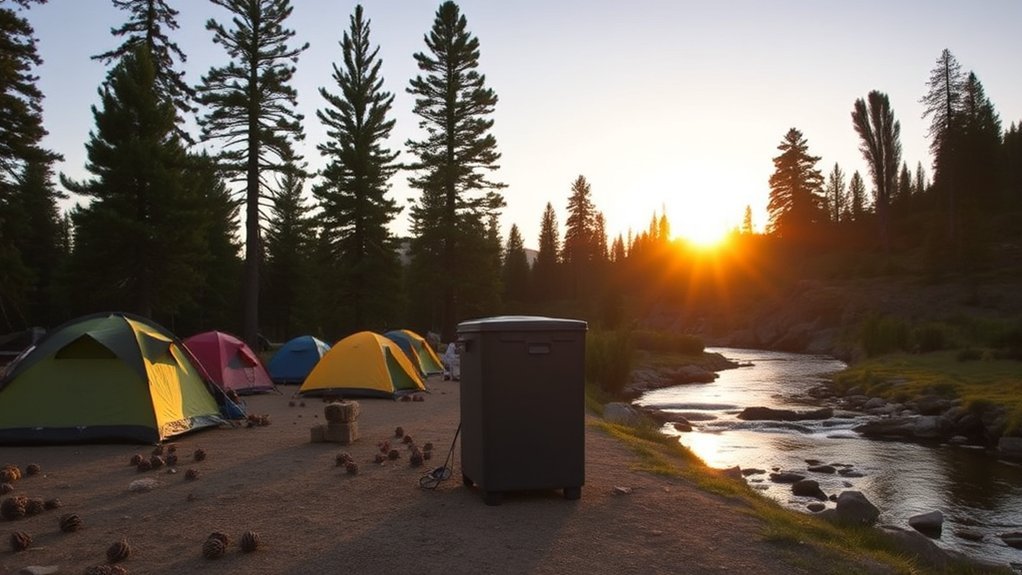
Food-storage rules protect campers and wildlife. Once an animal receives human food, it may return to campsites, damage property, threaten people, or become dependent on an unnatural food source.
The NPS bear-food storage guidance emphasizes that methods vary by park. Depending on the location, campers may be required to use a locked hard-sided vehicle, campground food locker, approved bear-resistant container, food pole, or provided cable system.
Warning: Never use a tent as a food-storage container. A tent provides little protection from wildlife and places sleeping campers close to food odors. Keep food, trash, toiletries, and other attractants out of tents and sleeping areas.
What Counts as Food or a Scented Item?
Storage rules commonly cover more than meals. Unless the park says otherwise, treat the following as attractants:
- Fresh, dried, canned, and packaged food
- Coolers, lunch bags, and empty food containers
- Trash, wrappers, cans, and bottles
- Pet food, treats, bowls, and livestock feed
- Cooking oil, grease, grills, stoves, pots, pans, and utensils
- Toothpaste, soap, shampoo, deodorant, cosmetics, and sunscreen
- Baby wipes, scented tissues, candles, and air fresheners
- Beverages, including water containers when the park includes them
- Fishing bait and harvested fish where applicable
A closed cooler is not automatically compliant. Some parks still require the cooler to be placed inside a locked hard-sided vehicle, camper, or designated food locker.
Frontcountry Food Storage
Frontcountry camping usually means driving to an established campsite. Common storage methods include:
- Locked hard-sided vehicle: Close the windows and doors and place items out of sight when required.
- Hard-sided camper: The camping unit may need solid, non-pliable walls rather than canvas or other soft material.
- Food-storage locker: Close and latch the locker fully after every use. Do not leave it open while walking away from the site.
- Park-approved container: Use only when the park accepts that type of container for the specific campground.
Great Smoky Mountains provides a clear example. In its frontcountry campgrounds, food, coolers, cooking equipment, scented items, and water containers must be sealed in a vehicle or a camping unit made from solid, non-pliable material whenever they are not being used. The park’s current regulations list a limited number of shared food lockers at Abrams Creek, Big Creek, Cades Cove, Cataloochee, Cosby, Deep Creek, Elkmont, and Smokemont.
Locker availability and rules can change, so verify the current campground page rather than relying only on this list.
Backcountry Food Storage
Backcountry rules can differ sharply from frontcountry rules. A park may require:
- An Interagency Grizzly Bear Committee-approved canister
- A park-provided food cable or pole
- A designated storage locker
- A specific hanging method
- Carrying all food and waste out of the area
Do not apply a generic “10 feet high and 4 feet out” formula everywhere. Tree shape, bear species, local wildlife behavior, and park policy affect the approved method.
Great Smoky Mountains requires campers at established backcountry sites and shelters to use the provided cable systems. Its 2026 superintendent’s compendium contains separate requirements for authorized cross-country camping, including certified bear-resistant containers and specific hanging dimensions.
Cleaning, Garbage, and Cooking Equipment
Storage is only part of campsite food safety. Complete these tasks after every meal:
- Return unused ingredients to the required storage location.
- Wash dishes promptly at an approved location.
- Strain or dispose of wastewater as directed by the campground.
- Wipe tables, stoves, grills, and chairs to remove crumbs and grease.
- Pick up dropped food, pet kibble, wrappers, and bottle caps.
- Place trash in a wildlife-resistant receptacle or store it like food until disposal.
- Do not burn food, grease, wrappers, tea bags, or coffee grounds in the campfire.
Pro Tip: Create a “last person awake” routine. Before anyone goes to bed, one adult checks the table, fire ring, cooking area, pet bowls, trash, toiletries, coolers, and vehicle doors.
Why Improper Food Storage Is Dangerous
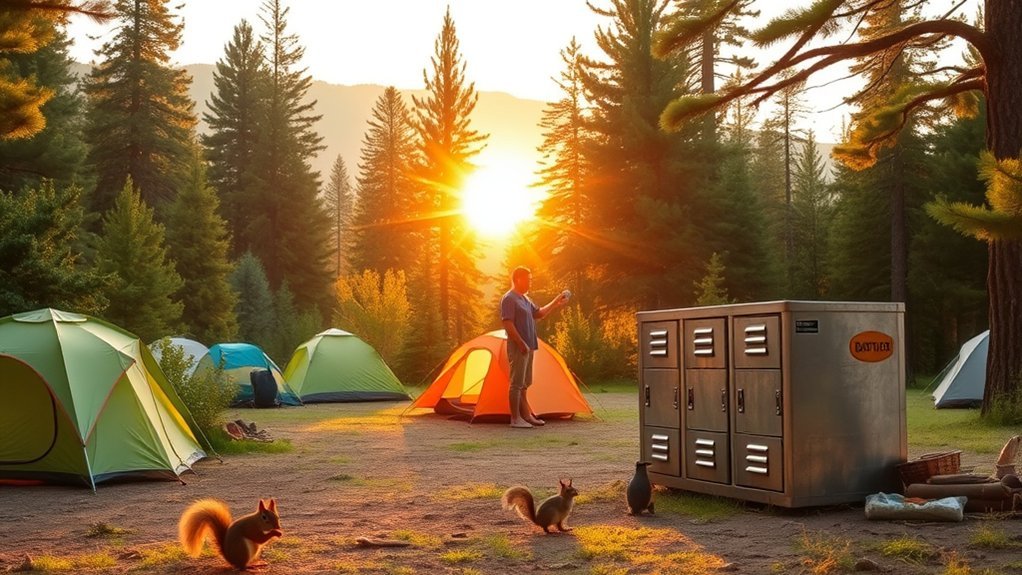
Wild animals learn quickly. A bear, raccoon, fox, rodent, or other animal that finds food at one campsite may inspect tents, vehicles, coolers, and neighboring sites in the future.
Improper storage can lead to:
- Damage to tents, coolers, vehicles, or camping equipment
- Close encounters and injuries
- Food-conditioned wildlife repeatedly entering developed areas
- Temporary campsite or trail closures
- Removal or destruction of an animal that has become dangerous
- Impoundment of unattended food or coolers
- Warnings, citations, fines, or removal from the campground
In Great Smoky Mountains, unattended or improperly stored food, coolers, and scented items may be impounded, and violators are subject to fines. Enforcement practices and penalties differ elsewhere, but food-storage directions should always be treated as mandatory rules rather than optional suggestions.
Wildlife Safety Around Your Campsite
Prevention is safer than trying to manage an animal after it enters camp. Keep a clean site, supervise food while it is outside storage, and never intentionally feed wildlife.
If an animal approaches:
- Do not approach, touch, surround, or feed it.
- Keep children and pets close and move to a safe location.
- Do not attempt to retrieve food from an animal.
- Follow the park’s instructions for the specific species.
- Report aggressive, injured, unusually fearless, or food-conditioned wildlife to a ranger.
- Call 911 when a person is being attacked or faces an immediate threat.
There is no single encounter response that is correct for every animal. Guidance for a black bear may differ from guidance for a grizzly bear, elk, bison, mountain lion, or smaller animal. Review the wildlife-safety page for the park you plan to visit.
Consequences of Violating Campground Rules
Campground staff usually consider the seriousness, risk, and frequency of a violation. Possible actions include:
- A reminder or verbal warning
- A written warning or citation
- A fine
- Impoundment or confiscation of improperly stored food
- Removal from the campground or park
- Additional legal consequences for dangerous conduct or refusal to comply
Do not rely on a fixed assumption such as “three complaints means eviction” or “every removal comes without a refund.” Those details depend on the park, reservation terms, concession contract, and circumstances.
Registered campers should also manage the behavior of children, visitors, and pets in their party. There is no nationwide NPS rule requiring every child under 16 to return to a campsite at 10 p.m., but local supervision or visitor restrictions may be posted.
Campground Compliance Checklist
Before Leaving Home
- Open the official NPS page for the selected park and campground.
- Confirm quiet hours and separate generator hours.
- Check current alerts, fire restrictions, and wildlife notices.
- Read the food-storage rules for your camping type.
- Confirm whether a locker, vehicle, cable, pole, or approved canister is required.
- Download or screenshot the rules for offline use.
When You Arrive
- Read the entrance board and campsite post.
- Locate food lockers, dumpsters, wastewater facilities, and emergency information.
- Ask the campground host or ranger about anything unclear.
- Place food and scented items into compliant storage immediately.
- Review quiet hours with every member of your group.
Before Bed
- Turn off speakers and other noise-producing equipment.
- Shut down generators at the required time.
- Control pets and lower voices.
- Store food, coolers, trash, toiletries, cooking equipment, and pet supplies.
- Clean crumbs, spills, grease, grills, and eating areas.
- Close and lock vehicles, campers, lockers, and canisters as required.
Additional Resources for Campers
Use official information whenever possible. The free NPS app can provide park maps, alerts, tours, and planning information, although features and connectivity vary. Download important material before entering an area with limited service.
Campground hosts and park rangers can clarify local requirements, identify approved storage equipment, explain late-arrival procedures, and tell you how to report noise or wildlife activity. Recreation.gov may provide reservation details, but the park’s official NPS pages and posted regulations remain essential for current operating rules.
Frequently Asked Questions
Do all national park campgrounds use quiet hours from 10 p.m. to 6 a.m.?
No. That is a common schedule, but individual parks and campgrounds may use different times. Check the official campground page, map, registration board, and current superintendent’s compendium.
Can I play music during quiet hours if it is at a low volume?
Do not use a speaker if neighboring campers can hear it. Some campgrounds require noise-producing equipment to be turned off during quiet hours. Headphones at a safe listening level are the better choice.
Are campfires allowed during quiet hours?
Quiet hours do not automatically ban campfires. Fire rules are separate. A fire may be allowed in a designated ring when no closure or restriction is in effect, but voices and activity around it must remain quiet. Never burn food, trash, plastics, cans, or other prohibited material.
What should I do if a neighbor is noisy after quiet hours begin?
A polite reminder may help when it feels safe to speak with the camper. Contact the campground host or a ranger if the disturbance continues. Avoid confrontation, and call 911 for an immediate threat or emergency.
Can I store food in my tent?
No. Store food and scented items in the location and container required by the park, such as a locked hard-sided vehicle, food locker, approved canister, pole, or cable system. A tent is not secure wildlife-resistant storage.
What items must be stored with food?
Rules commonly cover trash, coolers, beverages, pet food, toiletries, cooking oil, grills, dishes, utensils, toothpaste, wipes, cosmetics, and other scented products. Review the selected park’s list because the definition can vary.
Are there penalties for repeated campground-rule violations?
Yes. Depending on the park and violation, enforcement may include a warning, citation, fine, impoundment of improperly stored items, or removal from the campground. Dangerous behavior may lead to additional legal consequences.
Conclusion
Respecting quiet hours and food-storage rules protects your neighbors, your equipment, and the animals that live near the campground. The most important step is to verify the current rules for the exact park, campground, and camping type you plan to use. Keep noise low, follow separate generator limits, clean the site after every meal, and secure every food or scented item before leaving camp or going to sleep.
Sources
- National Park Service: Camp Etiquette — typical quiet hours, lighting, cleanliness, and campground courtesy
- National Park Service: Frontcountry Camping — campground planning, noise, food storage, ranger patrols, and local-rule variation
- National Park Service: Bear Safety—Storing Food — food, garbage, scented-item, tent, vehicle, locker, and canister guidance
- Great Smoky Mountains National Park: Campground Regulations — quiet hours, generator hours, food storage, lockers, fires, fines, and impoundment
- Great Smoky Mountains National Park: 2026 Superintendent’s Compendium — park-specific legal authority and backcountry storage requirements
- National Park Service: Natural Sounds Policies and Authorities — federal audio-disturbance standards
