
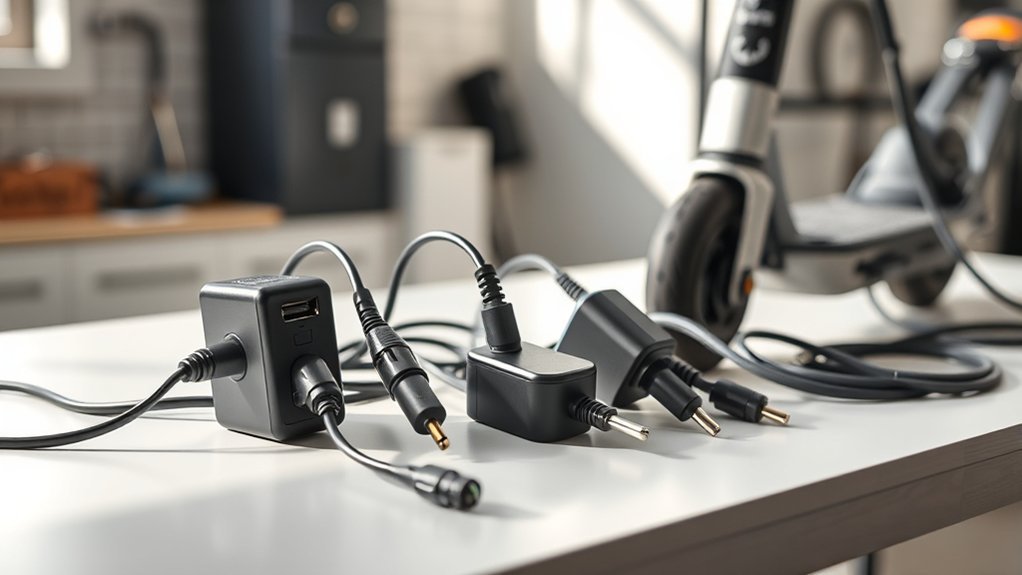
Last Updated on September 10, 2026 by Daniel Globe
No, electric scooter chargers are not all the same or automatically interchangeable. A safe replacement must be approved for your scooter or match the manufacturer-specified charger output, charging current, connector, polarity, and charging system. Do not choose a charger simply because its plug fits or because its voltage number looks similar to the battery label.
Quick Answer
Electric scooter chargers are not universal. The safest choice is the charger supplied with your scooter or a replacement tested and approved for that exact model. Check the specified charger output voltage, current, connector, polarity, and manufacturer compatibility before plugging it in.
Key Takeaways
- Match the replacement to the scooter’s approved charger specification, not just the battery’s nominal voltage.
- A charger that physically fits can still be electrically incompatible.
- Do not assume a higher-current or “fast” charger is safe unless the scooter manufacturer approves it.
- Avoid broadly marketed “universal” micromobility chargers unless they have been tested and approved for your exact device.
- Stay present while charging, never charge while sleeping, and unplug the scooter when charging is complete.
At a Glance
| Time Required | About 5–10 minutes to verify labels and manufacturer specifications |
| Difficulty | Easy if the scooter model and original charger specifications are available |
| Tools Needed | Scooter model number, owner’s manual or manufacturer website, and charger label |
| Cost | Varies by scooter model and manufacturer-approved replacement charger |
Disclosure: As an Amazon Associate I earn from qualifying purchases. Some links on this page are affiliate links, at no extra cost to you.
How to Tell If a Scooter Charger Fits
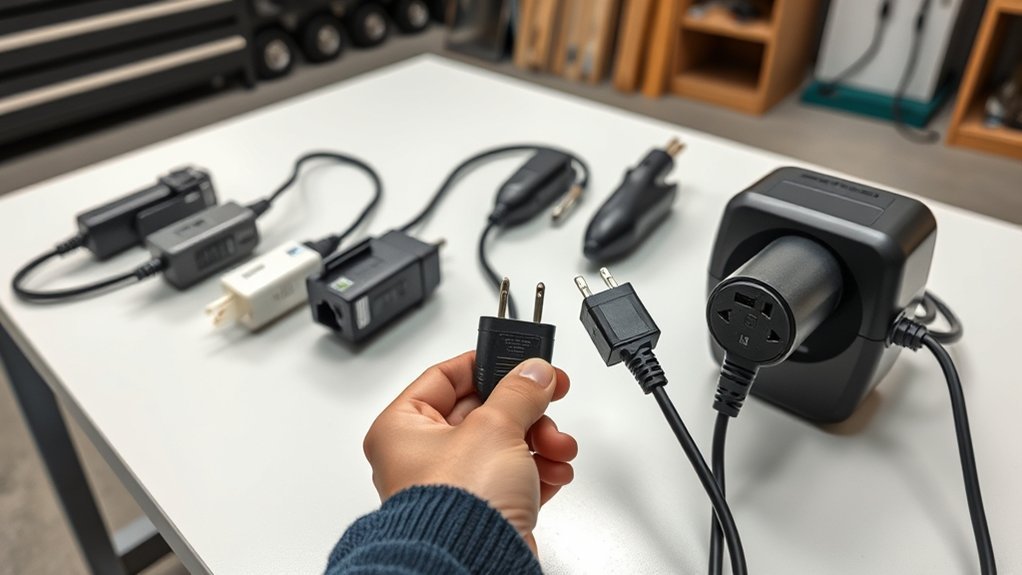
To tell whether a scooter charger is compatible, start with the scooter’s model number and the manufacturer’s approved charger specification. Do not begin by guessing from the connector or battery label alone. A physically compatible plug does not prove that the charger has the correct electrical characteristics.
- Identify the exact scooter model. Look for the model label on the frame, deck, stem, manual, or purchase documentation.
- Find the specified charger output. Check the owner’s manual, original charger label, or manufacturer’s replacement-parts page.
- Compare output voltage. The replacement charger’s output should match the charger specification approved for that scooter.
- Compare charging current. Use the manufacturer-approved amperage or another current rating the manufacturer explicitly lists as compatible.
- Check the connector and polarity. Plug shape, barrel dimensions, pin layout, keying, and positive/negative polarity must all be correct.
- Confirm model compatibility. If any specification is uncertain, ask the scooter manufacturer or an authorized service provider before charging.
Warning: The U.S. Consumer Product Safety Commission warns that chargers marketed as “universal” for e-scooters and other micromobility products can physically fit yet still be incompatible. Use the supplied charger or a replacement tested and approved for your specific device.
You usually do not need a voltmeter to choose a replacement charger. A voltage reading by itself cannot confirm the correct charging profile, current limit, connector polarity, or compatibility with the battery management system. If the manufacturer’s documentation is unavailable and electrical testing is necessary, have a qualified technician perform it.
How to Match Voltage, Amps, and Connectors
The three most visible charger specifications are output voltage, output current, and connector type, but they must be interpreted correctly. The safest reference is the original or manufacturer-approved charger specification.
Voltage and Amp Match
Do not confuse the scooter battery’s nominal voltage with the charger’s output voltage. Lithium-ion battery packs are commonly marketed by nominal battery voltage, while the charger uses a higher charging voltage appropriate for that pack configuration.
For example, GOTRAX lists a 36V battery for the GXL V2 while its official replacement charger is rated 42V 1.5A. That means “buy a charger with the same voltage printed on the battery” would give the wrong rule for this scooter.
Current also varies between models. GOTRAX currently specifies a 42V 1.5A charger for the GXL V2/Rival/Apex family, while its GMAX/GMAX Ultra replacement charger is rated 42V 3A. Even scooters that share a 42V charger-output voltage therefore do not necessarily share the same approved charging current.
A higher-current charger may shorten charging time on a system designed to accept it, but you should not upgrade amperage simply because the connector and voltage match. The battery pack, BMS, wiring, charging port, and thermal design all have limits. Use a faster charger only when the scooter manufacturer explicitly approves it for your model.
Connector Type Compatibility
Connector compatibility is just as important as the electrical rating. Electric scooters can use barrel connectors, multi-pin connectors, XLR-style connectors, magnetic connectors, or proprietary plugs. Similar-looking plugs may use different dimensions or pin assignments.
Check all of the following:
- Connector family: The plug must be the correct physical type.
- Dimensions: Barrel connectors can look identical while using different inner or outer diameters.
- Pin layout: Multi-pin connectors may assign power, ground, or communication pins differently.
- Polarity: Positive and negative contacts must match the scooter specification.
- Keying or locking: Do not grind, modify, force, or bypass a keyed connector to make it fit.
The CPSC specifically warns that a charger can fit into a micromobility device and still be incompatible. That is why connector fit should be treated as one check, not the final proof of compatibility.
Check Charger Input Voltage When Traveling
The charger label normally shows two different electrical specifications: AC input from the wall outlet and DC output to the scooter. Both matter when traveling internationally.
For example, a charger labeled for a wide AC input range such as 100–240V, 50/60Hz may be designed for different mains systems when used with the correct physical plug or approved plug adapter. A plug adapter changes the plug shape; it does not convert electrical voltage. If your charger is rated only for one mains voltage, use equipment specifically approved by the scooter manufacturer for your destination rather than improvising with an unsuitable charger.
Which Scooter Charger Types Are Safe?
The safest charger is normally the one supplied with the scooter or a replacement that the manufacturer has tested, recommended, or approved for that exact device. The U.S. Consumer Product Safety Commission advises consumers to use the charger provided with or recommended by the micromobility-device manufacturer.
Standard, smart, and fast chargers can all be safe when they are part of a compatible charging system. The category name alone does not establish safety.
- Standard charger: Usually follows the scooter’s normal factory charging rate.
- Fast charger: Use only when explicitly approved for your scooter and battery system.
- Smart charger: May include additional status or protection features, but those features vary by model.
- Aftermarket charger: Use only when it has been tested and approved to work safely with the specific scooter.
- “Universal” charger: Do not assume it is compatible simply because the listing names e-scooters or a broad brand family.
Between January 1, 2023 and May 16, 2024, CPSC received 156 reports of fire or thermal incidents involving chargers marketed as “universal” for micromobility products.
For an additional safety signal, look at certification of the complete electrical system rather than assuming a certification logo on an unrelated accessory makes two devices compatible. ANSI/CAN/UL 2272 covers electrical systems for personal e-mobility devices such as e-scooters and evaluates electrical drivetrain, battery, and charger-system combinations.
Do All Electric Scooter Chargers Fit Every Model?
No. Electric scooter chargers do not fit or safely charge every model, even within the same brand. Manufacturers can use different pack voltages, charging currents, connectors, charging profiles, and battery-management requirements across their product ranges.
GOTRAX provides a useful example. Its GXL V2/Rival/Apex family has an official 42V 1.5A charger, while the GMAX/GMAX Ultra family uses an official 42V 3A charger. Other GOTRAX models use still other charger voltages and currents. Sharing a brand name therefore does not make chargers interchangeable.
Even two chargers labeled with the same output voltage can be incompatible because their current rating, connector dimensions, polarity, pinout, or intended battery system differs. Never force a connector or assume that “same voltage” means “same charger.”
How to Choose the Right Scooter Charger
Choosing the right charger starts with your exact scooter model, not with a generic charger listing. Use this order of preference:
- Use the original charger if it is undamaged and operating normally.
- Check the scooter manual for the required charger or charging specification.
- Search the manufacturer’s parts page using the exact scooter model.
- Compare the original charger label with the proposed replacement’s output voltage, amperage, connector, polarity, and model compatibility.
- Confirm fast-charging support before choosing a charger with a higher current rating.
- Buy from the manufacturer or a reputable seller that clearly identifies the exact compatible model and can document approval or testing.
Pro Tip: Take a clear photo of your original charger’s label and connector before replacing it. The output specification and model information are much more useful than trying to remember whether the scooter has a “36V” or “48V” battery.
If the original charger has been lost and you cannot find reliable specifications, contact the manufacturer with the scooter’s exact model and serial information. That is safer than experimenting with chargers until one appears to work.
What Happens If You Use the Wrong Charger?
Using an incompatible charger can result in anything from no charging at all to damage, overheating, or a battery fire. The exact outcome depends on the type of mismatch and the protections built into the scooter.
| Mismatch | Possible Result |
| Wrong output voltage or charging profile | Failure to charge, charging faults, component damage, overheating, or a serious battery-safety hazard |
| Unsupported charging current | Charging faults, excess heat, or stress on components not designed for the charging rate |
| Wrong polarity or pinout | Short circuit, sparks, port damage, charger damage, or electronic failure |
| Wrong connector dimensions | Poor contact, damaged charging port, intermittent charging, or no connection |
The CPSC has documented fires involving incompatible micromobility chargers. Do not keep using a charger merely because the scooter’s display turns on or the battery percentage increases; apparent charging does not prove that the combination is safe.
How to Charge an Electric Scooter Safely
Correct charger selection is only part of battery safety. The CPSC recommends using the supplied or manufacturer-recommended charger, remaining present while charging, never charging while sleeping, following the manufacturer’s charging instructions, and disconnecting the device when charging is complete.
- Inspect the charger, cable, connector, and charging port before use.
- Do not use a charger with cracked insulation, exposed conductors, bent pins, melted plastic, or a loose connector.
- Use only a charger supplied with or recommended for the scooter.
- Stay home and awake while the scooter is charging.
- Follow the manufacturer’s charging-time and temperature instructions.
- Unplug the scooter when the normal charging cycle is complete.
- Keep the charger and scooter dry unless the manufacturer specifically rates the equipment for the conditions involved.
- Stop using the scooter or charger if you notice unusual swelling, smoke, strong odor, leaking, sparking, or abnormal heat, and follow the manufacturer’s safety guidance.
Note: A battery management system adds important protection, but it should not be treated as permission to connect an unapproved charger. Safe charging depends on the complete battery, charger, connector, wiring, and control system working together as designed.
Troubleshooting Scooter Charger Problems
If a charger that should be compatible is not working, avoid immediately trying a different random charger. Work through the simple checks first.
- The plug will not fit: Stop. Do not force, file, bend, or modify the connector. Recheck the scooter model and replacement part number.
- The charger has no indicator light: Check the wall outlet and inspect the power cable according to the manufacturer’s instructions.
- The charger connects but the scooter will not charge: Confirm that the charger is approved for the exact model and check the manual for the manufacturer’s troubleshooting procedure.
- The connector feels loose: Stop using it until the charging port and plug can be inspected. Poor contact can create heat and intermittent charging.
- The port or plug shows scorching or melted plastic: Stop charging and have the scooter inspected.
- The battery or charger becomes abnormally hot, swollen, smoky, or produces an unusual odor: Stop using the equipment and follow the manufacturer’s emergency and service guidance.
Frequently Asked Questions
How Do I Know What Charger My Electric Scooter Needs?
Find your exact scooter model and check the owner’s manual, original charger label, or manufacturer’s replacement-parts page. Match the approved charger’s output voltage, current, connector, polarity, and model compatibility. Do not simply match the voltage printed on the battery.
Do Most Electric Scooters Use the Same Charger?
No. Charger voltage, current, connector dimensions, polarity, pin layout, and charging-system requirements vary between scooters. Models from the same manufacturer can also use different chargers.
Is 20 Mph Fast for an Electric Scooter?
Twenty mph is a substantial speed for a standing electric scooter and requires careful braking, awareness, and protective equipment. Top speed, however, does not tell you which charger the scooter needs. Charger compatibility depends on the scooter’s electrical and battery system.
How Can I Charge My Electric Scooter Without the Original Charger?
If the original charger is lost or damaged, contact the manufacturer or check its official replacement-parts information for a charger tested or approved for your exact scooter. The CPSC advises against relying on broadly marketed universal chargers unless they have been tested and approved for the specific device.
Can I Use a Charger With the Same Voltage From Another Scooter?
Not automatically. Two chargers can have the same output voltage but different current ratings, connectors, polarity, pin assignments, or charging profiles. Use it only if the scooter manufacturer confirms that the charger is compatible with your model.
Can I Use a 2A Charger Instead of a 1.5A Charger?
Only if the scooter manufacturer approves that charging current for your exact model. A higher current rating can change charging speed and thermal load, so matching voltage and connector alone is not enough to establish compatibility.
Sources
- U.S. Consumer Product Safety Commission — Universal Charger Warning — compatibility risks, fire incidents, and replacement-charger guidance.
- U.S. Consumer Product Safety Commission — Micromobility Safety Center — safe charging, supervision, and manufacturer-recommended charger guidance.
- UL Solutions — Personal E-Mobility Testing and Certification — ANSI/CAN/UL 2272 electrical, battery, and charger-system safety context.
- GOTRAX — GXL V2/Rival/Apex 42V 1.5A Charger — official model-specific charger specification.
- GOTRAX — GMAX/GMAX Ultra 42V 3A Charger — example of different charging-current requirements within one brand.
Conclusion
No, not all electric scooter chargers are the same. The safest replacement is the original charger or one specifically tested, recommended, or approved for your exact scooter model. Match the manufacturer’s charger output voltage, current, connector, polarity, and charging-system requirements rather than copying the nominal voltage printed on the battery. Never force a connector or assume a charger is safe because it physically fits. Once you have the correct charger, remain present while charging, follow the manufacturer’s instructions, and unplug the scooter when the charging cycle is complete.
