
Last Updated on September 11, 2026 by Daniel Globe
Iguazú Falls stretches across the border between Argentina and Brazil, combining roughly 275 individual falls with subtropical forest, basalt cliffs, islands, and clouds of spray. You can experience close-up catwalks on the Argentine side and broad panoramic views from Brazil. This guide explains when to visit, how long to stay, which side to choose, how to cross the border, and what to expect on the main trails.
Quick Answer
Iguazú Falls is worth visiting from both Argentina and Brazil. Argentina offers longer, closer trails, while Brazil gives the best wide panorama. Plan one full day for Argentina and about half a day for Brazil, allow extra time for border formalities, and check official tickets, hours, weather, and circuit status before you go.
Key Takeaways
- Set aside two days if you want to explore both national parks without rushing.
- Choose Argentina for several close-up circuits and Brazil for a shorter panoramic visit.
- Arrive when the park opens rather than relying on regular sunrise or late-evening access.
- Carry the documents required to enter both countries and check visa rules for your nationality.
- Expect spray, slippery surfaces, changing river conditions, and occasional circuit closures.
Disclosure: As an Amazon Associate I earn from qualifying purchases. Some links on this page are affiliate links, at no extra cost to you.
What Makes Iguazú Falls a Natural Wonder
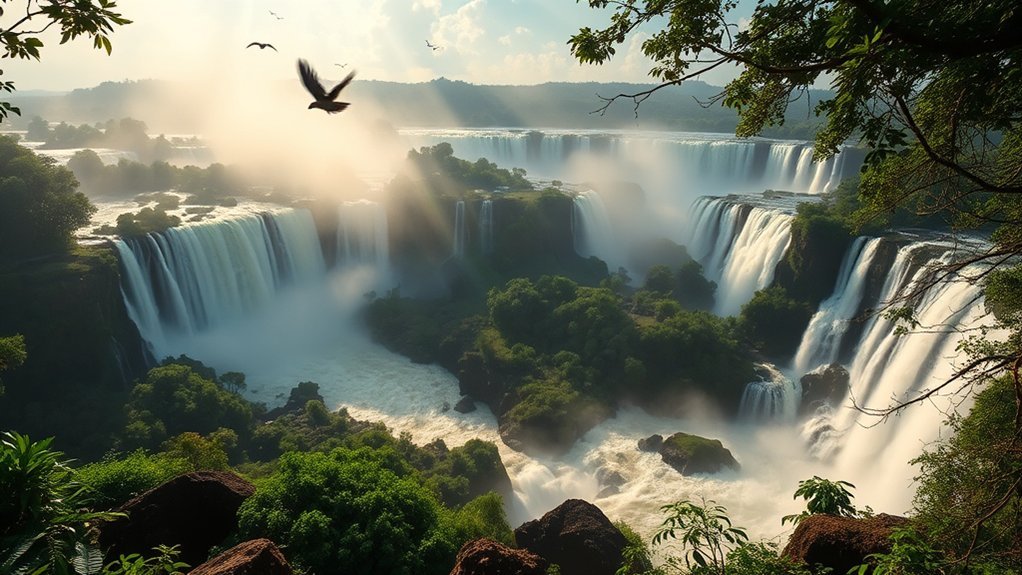
Iguazú Falls is one of the world’s largest and most visually impressive waterfall systems. According to UNESCO, the falls extend across a basaltic front roughly 2.7 kilometers wide, with vertical drops reaching about 80 meters. The river divides around forested islands before falling through a series of cataracts, rapids, and narrow channels.
The best-known section is Devil’s Throat, or Garganta del Diablo. It forms a powerful horseshoe-shaped concentration of water and spray rather than a single narrow waterfall. Walkways on both sides of the border provide different views of this section.
The adjoining national parks also protect an important section of the Atlantic Forest. Argentina’s Iguazú National Park entered the UNESCO World Heritage List in 1984, while Brazil’s Iguaçu National Park received a separate inscription in 1986. Together, the parks protect a large connected habitat for birds, mammals, reptiles, insects, and thousands of plant species.
Iguazú is not one continuous wall of water. It is a changing system of falls, islands, channels, forest, and mist spread across nearly three kilometers.
How Many Days Do You Need at Iguazú Falls?
Plan two full sightseeing days if your schedule allows. Spend one full day on the Argentine side and at least half a day on the Brazilian side. A third night can make the trip more comfortable if you are arriving on a late flight, traveling with children, adding a boat excursion, or crossing the border during a busy period.
Suggested Two-Day Itinerary
- Day one, Argentina: Arrive when the park opens. Visit Devil’s Throat, the Upper Circuit, and the Lower Circuit. Add Macuco Trail or a boat excursion only if your energy, weather, and available time allow.
- Day two, Brazil: Follow the panoramic waterfall trail, use the main viewpoints and elevator area, and allow time for the internal park bus. You can add a separately booked boat, bicycle, sunrise, or sunset experience where available.
Visiting both parks in one day is possible, but it can feel rushed. Immigration queues, traffic, internal transport, ticket times, and circuit walking time can all delay your schedule.
Where to Stay
Puerto Iguazú is the most convenient base for the Argentine park. Foz do Iguaçu offers a larger city, more accommodation choices, and convenient access to the Brazilian park and airport. You can stay in either city and cross the border for the other side, or split your stay if you prefer shorter park-transfer times.
Note: Park hours, ticket categories, trail access, river conditions, and special experiences can change. Check the official park pages again shortly before your visit, even if you already bought flights or accommodation.
Tickets, Hours, and Current Park Status
Buy admission only through official park channels or an authorized operator. Avoid relying on old blog prices because admission fees and resident categories can change during the year.
As of July 24, 2026, the Argentine park’s official information lists daily opening from 8:00 a.m. to 6:00 p.m., entry until 4:00 p.m., and the last train toward Devil’s Throat at 3:30 p.m. The Brazilian visitor information lists standard entry hours that differ between weekdays and weekends. Both parks may announce temporary holiday or seasonal schedules.
Heavy rain and unusual river levels can affect catwalks, boat trips, internal trains, and viewpoints. The Devil’s Throat walkway has required major repairs after previous floods, so never assume that every circuit will be open simply because the park itself is operating.
Pro Tip: Reserve the earliest practical entry time. You will have more time for internal transport, photography, meal breaks, and any delays caused by weather or crowds.
When to Visit Iguazú Falls
You can visit Iguazú Falls throughout the year. The region has a warm, humid subtropical climate without a sharply defined dry season. Argentina’s National Parks Administration reports average temperatures of approximately 24°C in summer and 14°C in winter, with rainfall possible in every season.
Seasonal Conditions
| Season | Typical conditions | Planning considerations |
|---|---|---|
| Summer, December to February | Hot, humid, rainy, and lush | Holiday crowds, strong sun, heavy spray, and possible storms |
| Autumn, March to May | Often milder, though still humid | Comfortable walking conditions outside major holidays |
| Winter, June to August | Cooler mornings and generally easier walking | Popular during July school holidays; bring a light layer |
| Spring, September to November | Warmer weather, active birdlife, and changing rainfall | Good general conditions, but heat and storms increase toward summer |
March through May and August through October are often comfortable choices for travelers who want to avoid the hottest conditions. However, no month guarantees low crowds or a particular water level. Weekends, national holidays, school breaks, and special events may matter more than the season itself.
Water Levels and Rainfall
Higher water can create a dramatic display, but extreme flow may close walkways or boat services. Lower water can expose more rock formations and separate the individual cascades more clearly. Neither condition is automatically better, and the river can change after rainfall far upstream.
Best Time of Day
For standard admission, the best strategy is to arrive when the park opens. Morning air is usually cooler, and you have more time to complete the circuits before final train, bus, or entry cutoffs.
Regular admission does not normally provide sunrise access. The Brazilian side sometimes sells separate sunrise and sunset experiences, while Argentina offers reservable full-moon walks on selected dates. Argentina’s official activity information says the moonlight walk lasts about two and a half hours and may be canceled because of rain.
A full moon can create an unusual night atmosphere, but a visible lunar rainbow is never guaranteed. Cloud cover, spray, moon position, and viewing angle all affect what you see.
How to Get to Iguazú Falls
You can reach the falls through either Argentina or Brazil. Your best arrival airport depends on your flight route, accommodation, visa requirements, and which park you plan to visit first.
By Air
The Argentine gateway is Cataratas del Iguazú International Airport, code IGR. It is close to the Argentine national park and receives domestic flights, including services from Buenos Aires. The Brazilian gateway is Foz do Iguaçu International Airport, code IGU, which is convenient for the Brazilian park and the city of Foz do Iguaçu.
- Compare both airports before booking an international itinerary.
- Check whether a connection requires changing airports in Buenos Aires or another city.
- Arrange a taxi, authorized transfer, shuttle, rental car, or public transport after landing.
- Keep your travel documents accessible if your transfer crosses the international border.
A nonstop Buenos Aires-to-Iguazú flight generally takes around two hours, but schedules, airports, and total journey time vary.
By Bus
Long-distance buses connect Buenos Aires with Puerto Iguazú. Current journey listings commonly range from about 17 to 21 hours, depending on the operator, route, terminal, traffic, and number of stops.
| Bus detail | What to check before booking |
|---|---|
| Departure terminal | Services may leave from Retiro, Liniers, or another listed terminal |
| Seat class | Recline, spacing, bedding, and onboard service differ |
| Meals and entertainment | Do not assume they are included; read the exact service description |
| Luggage allowance | Confirm checked and cabin-bag limits |
| Arrival time | Allow time to reach your hotel before planning a park visit |
When you arrive in Puerto Iguazú, local buses, taxis, private transfers, and organized tours can take you to the Argentine park.
Border Crossing
Argentina and Brazil are separate countries, so visiting both sides normally requires immigration formalities. A passport is the safest document for international visitors, although citizens of certain South American countries may be permitted to use approved national identity documents.
Visa requirements depend on your nationality. Review the official Argentine tourist-entry requirements and the Brazilian visa guidance before booking a cross-border visit.
- Carry the original travel document required for both countries.
- Confirm whether you need a visa for Argentina, Brazil, or both.
- Ask whether your taxi, shuttle, or tour waits during immigration processing.
- Allow extra time during weekends, holidays, and busy arrival periods.
- Check entry rules for minors, including parental authorization where applicable.
- Keep proof of accommodation, onward travel, and travel insurance available if required.
Warning: Do not rely on a driver or tour seller to determine whether you need a visa. Entry permission is based on your nationality, documents, and current government rules.
Brazil or Argentina: Which Side Should You Visit?
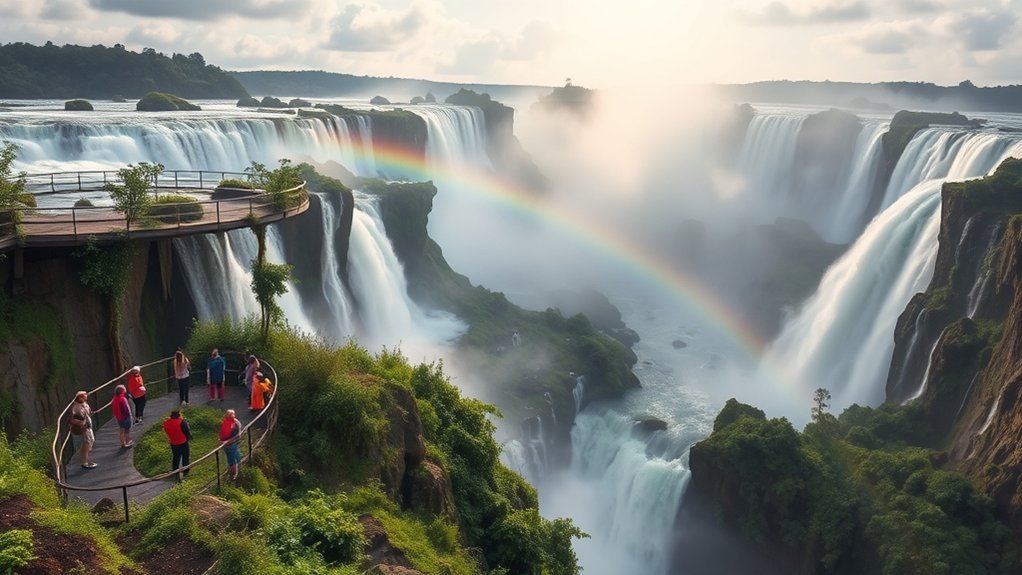
The Argentine and Brazilian sides are complementary rather than interchangeable. Argentina gives you more walking circuits and closer contact with individual falls. Brazil provides a shorter route with a broad view across much of the waterfall system.
| Feature | Argentina | Brazil |
|---|---|---|
| Main experience | Close-up catwalks above and below several cascades | Wide panoramic views across the waterfall system |
| Typical time | Most of a full day | About two to four hours for the main route |
| Walking | Several circuits with different lengths and stair levels | A shorter main waterfall trail plus internal bus transport |
| Accessibility | Upper Circuit and Devil’s Throat walkway are step-free; Lower Circuit has stairs | Accessible transport, principal viewpoints, wheelchairs, and elevator access are available, but the full trail includes stairs |
| Best for | Travelers who want a longer, more immersive visit | Panoramic photography, shorter visits, and easier viewpoint access |
Choose Argentina if you can visit only one side and want the most extensive walking experience. Choose Brazil if you have limited time or prioritize the classic broad view. For the complete experience, visit both.
Most Famous Iguazú Falls Cascades
The waterfall system contains many named and unnamed drops. Their appearance changes with the river level, and some sections can merge visually during high flow.
- Devil’s Throat: The most powerful and famous section, where a large share of the river funnels into a horseshoe-shaped drop.
- San Martín: One of the largest and most recognizable cascades, visible from several Argentine and Brazilian viewpoints.
- Floriano: A prominent Brazilian-side cascade near the main panoramic viewing area.
- Dos Hermanas: A pair of attractive neighboring falls seen from the Argentine circuits.
- Salto Unión: A major section associated with the international boundary near Devil’s Throat.
Devil’s Throat is the most concentrated display, but the scale of Iguazú becomes clear only when you see how many separate cascades spread across the forested river.
Top Trails in Iguazú National Park, Argentina
The Argentine park contains several separate walking routes. The official activity guide provides current distances and accessibility information.
Upper Circuit
The Upper Circuit is approximately 1,850 meters long and follows one-way walkways above several falls. It has no stairs, making it one of the better choices for wheelchairs, strollers, older visitors, and anyone who wants a more level route.
Lower Circuit
The Lower Circuit is approximately 1,750 meters long. It brings you closer to the lower sections of the cascades and provides powerful views through the spray. It includes stairs, so accessibility is limited and the route can feel demanding in hot or wet weather.
Devil’s Throat Circuit
The Devil’s Throat walkway is a separate route of approximately 1,100 meters over the upper Iguazú River. It does not have stairs. Visitors normally reach its station using the park’s ecological train and then walk to the main balcony.
Macuco Trail
Macuco Trail is approximately 7 kilometers round trip. It is a rustic forest trail intended for walking, birdwatching, and observing the ecosystem away from the main waterfall circuits. Ask at the visitor center about weather, closing time, wildlife precautions, and current trail conditions before starting.
The ecological train connects major visitor areas, but queues and final departure times can affect your route order. Do not leave Devil’s Throat until the end of the day without checking the last-train schedule.
Brazilian Waterfall Trail and Accessibility
The Brazilian visit begins with internal park transportation from the visitor center. The main waterfall trail is roughly 1 to 1.5 kilometers, depending on how the route is measured, and includes several panoramic viewpoints before reaching the main walkway and elevator area near Porto Canoas.
The Brazilian park provides accessible internal transportation and free conventional wheelchairs on request. Visitors with limited mobility can use principal viewpoints and the panoramic elevator area without completing every stair section of the full trail.
Families and older visitors often find the Brazilian side easier to manage because the traditional visit is shorter. However, the full walking route is not completely step-free, so ask staff which stops and viewpoints best match your needs.
Best Activities at Iguazú Falls
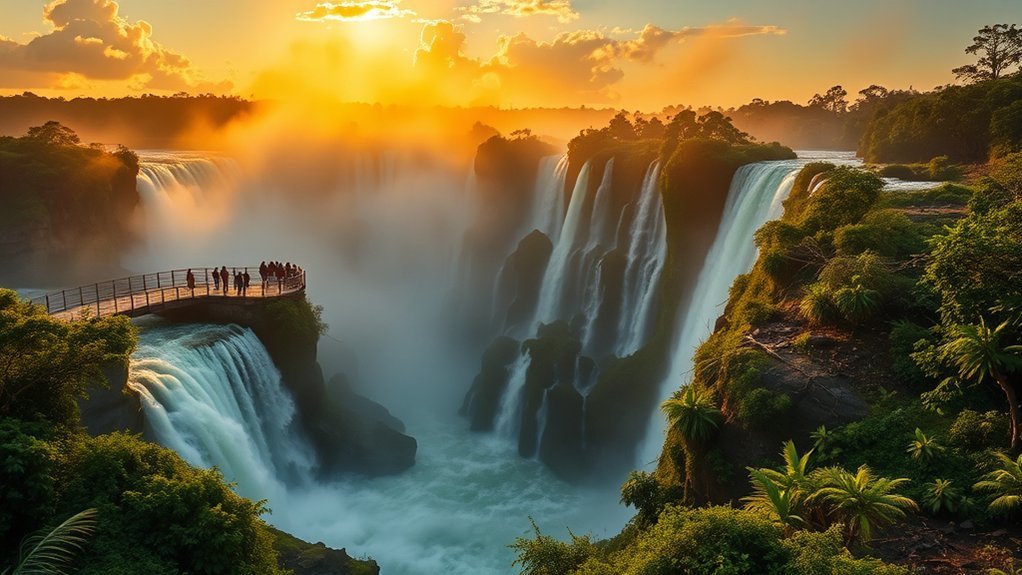
The catwalks are the main attraction, but authorized excursions can add a different view of the river and rainforest.
- Gran Aventura on the Argentine side: This excursion combines a vehicle journey through the forest with a fast boat ride toward the waterfall area. The official park information limits it to visitors over 12 and directs travelers to review additional safety restrictions.
- Ecological navigation: A quieter, rowed excursion on the upper river may be available from the Devil’s Throat area. It focuses on forest, islands, and wildlife rather than rapids.
- Macuco Safari on the Brazilian side: This separately ticketed commercial experience combines a forest approach with a boat ride near the falls.
- Guided forest walks and birdwatching: A qualified local guide can help identify toucans, swifts, butterflies, plants, tracks, and other wildlife.
- Bicycle experiences: Both parks advertise designated cycling options, but reservations, age limits, distance, and permitted routes vary.
- Helicopter flights: Commercial sightseeing flights operate from the Brazilian destination and provide an aerial view. They are not included with national-park admission.
- Full-moon, sunrise, or sunset visits: These require separate tickets and operate only on selected dates or seasons.
Kayaking and horseback riding may be sold by private operators elsewhere in the Iguazú region, but they are not standard activities on the principal waterfall catwalks. Confirm the exact location, permits, insurance, transport, and environmental practices before booking.
Warning: High-speed boat excursions involve rapids, abrupt movement, stairs or docks, loud conditions, and heavy spray. They may be unsuitable for some pregnant travelers and people with back, neck, heart, mobility, or other medical concerns. Follow the operator’s current restrictions.
Wildlife and Park Safety
Iguazú’s forest supports coatis, monkeys, toucans, butterflies, reptiles, and many other species. Seeing wildlife is part of the experience, but the animals are not tame.
- Never feed or touch coatis, monkeys, or other wildlife.
- Keep food inside a closed bag rather than carrying it openly.
- Do not place bags, snacks, or cameras on the ground near animals.
- Stay on marked trails and behind barriers.
- Follow ranger instructions and closure notices.
- Carry insect repellent and check yourself for bites after forest walks.
- Do not enter closed water, cliff, or forest areas for a photograph.
Travel-health recommendations depend on your age, medical history, itinerary, and country of residence. The CDC’s Brazil traveler guidance recommends yellow-fever vaccination for eligible travelers going to Iguaçu Falls, although Brazil does not list it as an entry requirement. Consult a qualified travel-health professional well before departure.
Essential Tips for Visiting Iguazú Falls
| What to bring | Why it helps |
|---|---|
| Quick-drying clothes | Spray, humidity, rain, and boat trips can soak cotton clothing |
| Comfortable shoes with grip | Catwalks and steps may be wet or slippery |
| Refillable water bottle | Helps you stay hydrated in humid weather |
| Sun protection | Some trails and queues have exposed sections |
| Insect repellent | Useful around forest trails and after rain |
| Light rain jacket or poncho | Protects you from rain and heavy spray |
| Waterproof phone pouch | Protects electronics on catwalks and boat excursions |
| Lens cloth | Removes mist from a camera or phone lens |
| Passport and entry documents | Required when crossing between Argentina and Brazil |
- Download tickets and important documents in case mobile service is weak.
- Check the weather forecast, but prepare for brief rain even on a sunny day.
- Use a small day bag that closes securely around wildlife.
- Eat before the longest circuits or plan your meal around final train and entry times.
- Book popular boat and special-access experiences in advance.
- Allow more time if traveling with children, older relatives, or limited mobility.
- Expect to get wet near Devil’s Throat, on lower viewpoints, and during boat trips.
Frequently Asked Questions
Which is better, the Brazil or Argentina side of Iguazú Falls?
Argentina is better for a longer, close-up trail experience. Brazil is better for broad panoramic views and a shorter traditional visit. Seeing both gives you the most complete understanding of the falls.
How many days should you spend at Iguazú Falls?
Two sightseeing days are ideal: one full day for Argentina and at least half a day for Brazil. Add more time if you want boat trips, forest activities, a relaxed pace, or protection against weather and border delays.
Can you visit both sides of Iguazú Falls in one day?
It is possible, but it is usually rushed. You must account for park transport, walking time, immigration, traffic, final admission times, and possible queues. Two days provide a much better experience.
Do you need a passport to visit both sides?
Most international visitors should carry a valid passport. Some citizens of participating South American countries may use approved national identity documents. Visa rules are nationality-specific, so check both governments before traveling.
Is Iguazú Falls in North America?
No. Iguazú Falls is in South America on the border between Argentina and Brazil. Well-known natural attractions in North America include the Grand Canyon, Yellowstone, Niagara Falls, and Glacier National Park.
What is the legend of Iguazú Falls?
A widely told Guaraní legend describes the lovers Naipí and Tarobá fleeing from M’Boí, a powerful serpent deity. In the story, M’Boí splits the river and transforms Naipí into a rock and Tarobá into a tree. It is a cultural legend, not a geological explanation.
How were Iguazú Falls formed?
The falls developed where the Iguazú River crosses layers of resistant basaltic rock. Long-term erosion, differences within the rock layers, river movement, and the regional landscape gradually shaped the cliffs, channels, islands, and separate cascades visible today.
Will you get wet at Iguazú Falls?
Probably. Spray reaches several catwalks and viewpoints, especially near Devil’s Throat and lower viewing areas. Boat excursions can soak you completely, so protect electronics and wear quick-drying clothes.
Conclusion
Iguazú Falls rewards careful planning. Give Argentina enough time for its separate circuits, use Brazil for the broad panoramic view, and avoid building a tight schedule around uncertain border, weather, or river conditions. Check official hours and trail status, pack for heat and spray, protect your food around wildlife, and carry the documents required for both countries. With two well-planned days, you can experience the scale, sound, forest, and close-up power that make Iguazú unforgettable.
Sources
- UNESCO: Iguazú National Park and UNESCO: Iguaçu National Park — waterfall dimensions, basaltic setting, biodiversity, and World Heritage status.
- Argentina National Parks: Activities — circuit distances, accessibility, ecological train, Macuco Trail, boat restrictions, and full-moon visits.
- Argentina National Parks: Hours and Directions — current operating hours, last entry, transport, and airport access.
- Brazilian Park Visitor Guide and General Visitor Information — Brazilian trail, internal transport, visit duration, hours, and facilities.
- Argentina Immigration and Brazilian Ministry of Foreign Affairs — tourist documents and nationality-based visa guidance.
- CDC Brazil Traveler View — current vaccination and travel-health recommendations for the Iguaçu Falls region.
