
Last Updated on July 29, 2026 by Daniel Globe
Abraham Lincoln visited Niagara Falls at least twice: once in late September 1848 and again during an eastern family trip in July 1857. The best evidence comes from Lincoln’s own unfinished Niagara notes, a dated chronology of his travels, and the Cataract House register. Those records also show why some popular retellings need careful wording.
Quick Answer
Yes. Lincoln visited Niagara Falls in late September 1848 and returned with Mary Lincoln during a family trip in July 1857. A chronology places the second visit at the Cataract House on July 24, 1857. His surviving Niagara fragment focuses on the Falls’ roar, mist, water, geology, and immense age.
Key Takeaways
- Lincoln’s first Niagara visit is usually placed in late September 1848, after a Whig speaking tour in Massachusetts.
- Mr. and Mrs. Lincoln were registered at the Cataract House on July 24, 1857, during an eastern family trip.
- Lincoln’s own notes discuss the Falls’ physical action, mist, rainbows, erosion, water cycle, and deep past.
- William Herndon later recalled that Lincoln’s first question was where so much water came from.
- Claims that the visit directly shaped Lincoln’s politics or views on freedom are interpretations, not facts established by the surviving records.
Disclosure: As an Amazon Associate I earn from qualifying purchases. Some links on this page are affiliate links, at no extra cost to you.
Did Abraham Lincoln Visit Niagara Falls?
Yes. The historical record supports two Niagara visits. The Lincoln Log places Lincoln at Niagara Falls on September 28, 1848. Editors of the Papers of Abraham Lincoln date his surviving Niagara notes more cautiously to September 25–30, 1848 because the exact day is inferred rather than proved by a dated manuscript.
Lincoln returned in July 1857. The Lincoln Log records Mr. and Mrs. Lincoln at the Cataract House on July 24. Mary Lincoln later described the summer journey as a pleasant eastern trip that included Niagara, Canada, New York, and other places of interest.
Note: Some retellings use July 25, 1857, but the surviving chronology places the Cataract House registration on July 24. It is safest to describe the visit as July 24–25 only when discussing the broader stay, not the register date itself.
When Did Lincoln Go to Niagara Falls?
The evidence points to these two visits:
| Date | What the record shows | Evidence level |
|---|---|---|
| Late September 1848 | Lincoln stopped at Niagara while traveling from Boston toward Chicago after campaigning for Whig presidential candidate Zachary Taylor. | Strong, but the exact day is inferred; the Lincoln Log uses September 28. |
| July 24, 1857 | Mr. and Mrs. Lincoln were registered at the Cataract House during an eastern family trip. | Directly supported by the dated hotel-register entry cited in the Lincoln chronology. |
The 1848 trip produced the clearest written evidence of Lincoln’s response to Niagara. The 1857 trip adds a separate hotel record and family-travel context, but no surviving document proves that he wrote his Niagara fragment during the second visit.
Why Did Lincoln Visit Niagara Falls?
The two trips had different settings. In 1848, Lincoln had completed a Massachusetts speaking tour for Zachary Taylor, the Whig presidential candidate. He visited Niagara while traveling west from Boston to Chicago. It is more accurate to call Niagara a stop on his return route than to say he campaigned at the Falls.
The 1857 visit appears to have been part of an eastern family journey. The Lincoln Log says Lincoln and Mary left Springfield for New York on July 22, registered at Niagara on July 24, and were in New York City by July 29. Mary later described the trip as travel to Niagara, Canada, New York, and other points of interest. The available record does not identify a political event at Niagara as the purpose of that visit.
What Happened at the Cataract House?
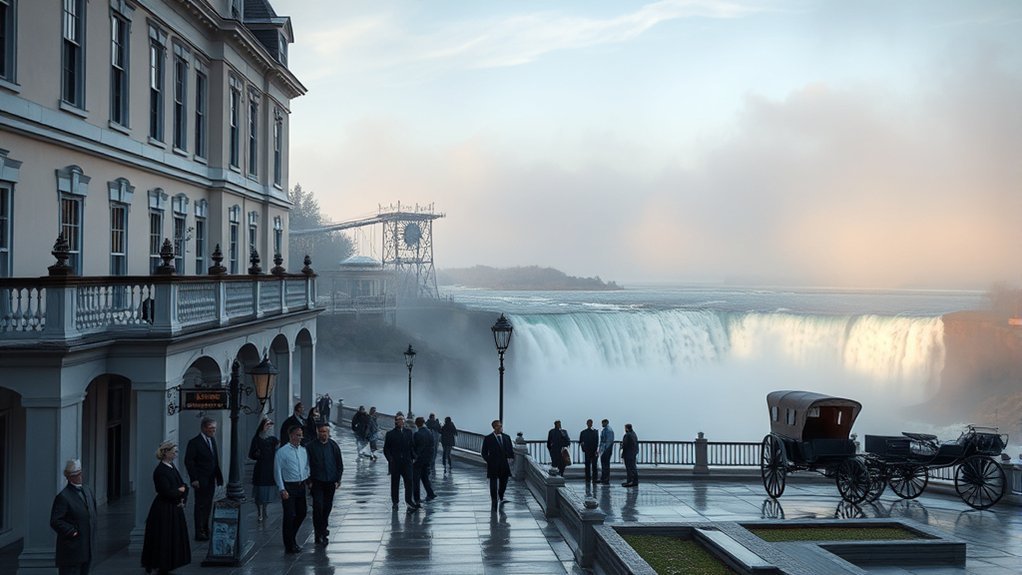
On July 24, 1857, Abraham and Mary Lincoln were entered in the register of the Cataract House, one of Niagara Falls’ best-known hotels. That dated entry is the strongest direct evidence for the second visit.
The hotel has a larger history that should not be reduced to famous guests. According to the Niagara Falls Underground Railroad Heritage Center, Black waiters at the Cataract House helped freedom seekers cross toward Canada. The hotel drew wealthy travelers, including slaveholders, while some members of its staff quietly supported escapes from slavery.
That history gives the site national importance, but the surviving evidence does not show that Lincoln’s stay caused or directly influenced his later antislavery policies. The careful conclusion is that Lincoln lodged at a hotel that was also an important Underground Railroad site.
What Did Lincoln Notice at Niagara Falls?
Lincoln’s own fragment shows that he noticed both the physical scene and the ideas it raised. He described the falling water as foaming and roaring, sending up mist and producing rainbows in sunshine. He then moved from observation to questions about erosion, the source of the water, the sun’s role in lifting water into the atmosphere, and Niagara’s long past.
Water Source Curiosity
William Herndon later recalled asking Lincoln what impressed him most about Niagara. In Herndon’s Lincoln, Lincoln’s answer is remembered as a question about where all the water came from.
Lincoln’s written fragment supports the broader point. He treated Niagara as part of a vast drainage system and reflected on how rain and solar heat continually supplied the water. He did not use the modern scientific term “water cycle,” but he was reasoning about evaporation, rainfall, drainage, and flow.
Power and Timelessness
Lincoln also thought about Niagara across a much longer span of time. His fragment imagines the Falls roaring before major events in human history and even before recorded history. He refers to mammoths and mastodons to stress Niagara’s age and continuity.
“Its power to excite reflection, and emotion, is its great charm.” — Abraham Lincoln, Niagara fragment
Lincoln’s historical estimates reflected the science available to him in the 1840s. They should be read as evidence of his thought, not as current geological measurements.
How Did Herndon Interpret Lincoln’s Reaction?
Herndon presented Lincoln’s response as different from his own. Herndon expected an emotional reaction to Niagara’s grandeur. Instead, he remembered Lincoln asking a practical question about the water’s source.
Herndon’s Awe Contrast
Herndon emphasized beauty, sound, movement, and the emotional effect of the Falls. He treated Lincoln’s question as evidence that his law partner instinctively looked for causes and explanations.
That contrast is useful, but it should not be pushed too far. Lincoln’s surviving fragment explicitly says Niagara’s greatest charm is its power to stir reflection and emotion. His response was analytical, yet it was not emotionless.
Lincoln’s Analytical Curiosity
Lincoln’s notes move through a clear chain of thought:
- He describes the physical plunge, foam, roar, mist, and rainbows.
- He considers erosion and the Falls’ former position nearer Lake Ontario.
- He estimates the force of the falling water.
- He asks how rainfall and the sun continually replenish the system.
- He reflects on Niagara’s age compared with human history.
This pattern supports the view that Lincoln met natural wonder with both observation and analysis.
What Did Lincoln Write About Niagara Falls?
Lincoln left an unfinished, two-page fragment now cataloged by the Papers of Abraham Lincoln as “Fragment of Notes Regarding Niagara Falls.” Editors date it to September 25–30, 1848. The manuscript ends abruptly, so it was probably a draft or private set of notes rather than a completed speech.
The fragment covers four main ideas:
- Physical action: water plunges, foams, roars, creates mist, and forms rainbows.
- Erosion: the Falls had worn backward from a position nearer Lake Ontario.
- Water supply: rainfall over a large drainage area feeds the river, while the sun helps lift water that later returns as rain.
- Deep time: Niagara’s continuing flow makes individual human lives and events seem brief.
The writing does not mention presidential ambition, emancipation, or a political lesson about freedom. Those themes may inspire modern readers, but they should not be presented as Lincoln’s documented meaning.
What Do Lincoln’s Niagara Notes Reveal?
The notes reveal a writer who combined plain description, scientific curiosity, rough calculation, and historical imagination.
| Feature | What Lincoln observed | What it suggests |
|---|---|---|
| Roar, foam, and mist | The visible and audible effects of falling water | Close attention to cause and effect |
| Rainbows | Sunlight acting through persistent spray | Interest in recurring natural processes |
| Erosion | The Falls had moved back from an earlier position | Awareness of geological change over time |
| Water supply | Rainfall, drainage, and solar heat sustain the flow | Systems thinking rather than passive sightseeing |
| Niagara’s age | The Falls seemed ancient beside human history | A strong interest in deep time and historical perspective |
Where Are Lincoln’s Niagara Relics Displayed?
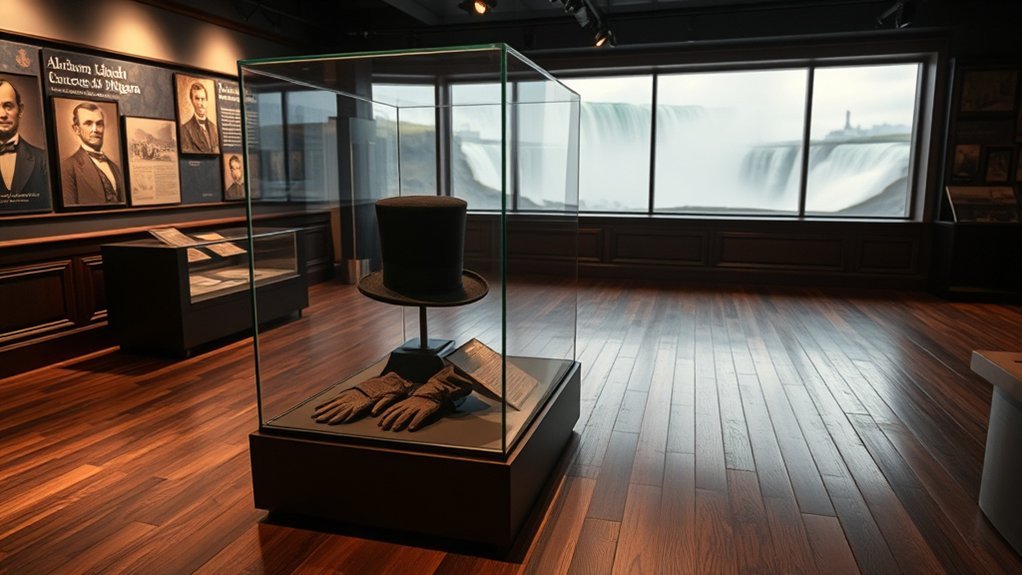
The most important evidence is documentary: the 1848 Niagara fragment and the 1857 Cataract House registration cited by the Lincoln chronology. The manuscript can be viewed through the Papers of Abraham Lincoln and the Library of Congress digital collection.
A separate object is associated with Lincoln through local tradition. A current Visit Buffalo listing says Niagara’s Wax Museum of History displays a chair in which Lincoln reportedly received a haircut. That claim should be described as an attribution, not as proven ownership or use backed by the same level of evidence as the manuscript and hotel register.
Visitors interested in the hotel’s broader history should also consider the Niagara Falls Underground Railroad Heritage Center and the Cataract House site. Museum hours, exhibits, and object displays can change, so check the venue’s current information before traveling.
Pro Tip: Separate primary evidence from local tradition. Lincoln’s handwritten fragment and the dated register entry are documentary records; the haircut chair is a museum attribution that deserves more cautious wording.
How Does Lincoln’s Niagara Visit Still Matter?
Lincoln’s visits matter because they show a well-known political figure away from speeches, courtrooms, and elections. At Niagara, the surviving evidence captures him observing a landscape, asking how it worked, and thinking across long stretches of time.
Historical Memory
The 1848 fragment makes the visit more than an anecdote. It preserves Lincoln’s own words and shows how he moved from plain physical description to scientific and historical reflection. The 1857 register adds a dated record of a later family trip.
The Cataract House also reminds readers that famous-person history can hide the work of less celebrated people. Its Black staff and their Underground Railroad activity are central to the site’s importance and deserve attention beside Lincoln’s brief stay.
Nature and Legacy
Niagara did not need to become a direct political metaphor to matter in Lincoln’s life. The notes are valuable because they reveal his habit of asking questions, tracing causes, and comparing immediate experience with a much larger historical frame.
That is the strongest evidence-based legacy of the visit: not a proven turning point in his politics, but a rare look at how Lincoln observed and reasoned.
Frequently Asked Questions
Did Abe Lincoln ever travel to Niagara Falls?
Yes. Historical chronologies place Lincoln at Niagara Falls in late September 1848 and at the Cataract House with Mary Lincoln on July 24, 1857.
Did Lincoln write his Niagara notes in 1848 or 1857?
Editors of the Papers of Abraham Lincoln date the fragment to September 25–30, 1848. The date is inferred from his travel route, handwriting, and paper. There is no equally strong evidence that the fragment was written during the 1857 visit.
How many bodies have been found at the base of Niagara Falls?
No transparent, current official source provides a dependable all-time total. A figure of about 5,000 recovered bodies is widely repeated in secondary accounts, but it should not be presented as a confirmed official count. This question is also separate from Lincoln’s visits.
Is George Clooney a descendant of Abraham Lincoln?
No. George Clooney is not Lincoln’s descendant. Ancestry’s family-tree research describes Clooney as Lincoln’s half-first cousin five times removed through a shared Hanks-family connection.
Who was Lincoln’s male lover?
No surviving evidence proves that Lincoln had a male lover. Joshua Speed is the man most often discussed because he and Lincoln were close friends, corresponded warmly, and shared a bed when living together in Springfield. Historians disagree about how to interpret that evidence, so a sexual relationship should not be stated as fact. A 2025 Journal of the Abraham Lincoln Association article argues that key evidence has been misconstrued.
Can visitors still see the Cataract House?
The original hotel no longer stands, but its site and history are interpreted in Niagara Falls. The Niagara Falls Underground Railroad Heritage Center explains the role of the hotel’s Black waiters in helping freedom seekers reach Canada.
Conclusion
Abraham Lincoln’s connection to Niagara Falls rests on solid but limited evidence. He visited in late September 1848, left an unfinished fragment about the Falls, and returned with Mary Lincoln during an eastern trip in July 1857. The dated Cataract House entry belongs to July 24, not July 25.
His notes show both analysis and emotion. He studied the water, mist, erosion, and natural forces, then used Niagara’s age to think beyond the scale of one lifetime. That evidence is compelling on its own. It does not need unsupported claims that the Falls directly shaped his politics or his ideas about freedom.
Sources
- Papers of Abraham Lincoln: Fragment of Notes Regarding Niagara Falls — Lincoln’s manuscript, editorial date range, and travel context.
- The Lincoln Log: September 28, 1848 — chronology of the first Niagara visit.
- The Lincoln Log: July 1857 — Cataract House registration and eastern-trip chronology.
- Niagara Falls Underground Railroad Heritage Center: Site of the Cataract House — the hotel’s Black staff and Underground Railroad history.
- Herndon’s Lincoln — Herndon’s recollection of Lincoln’s question about Niagara’s water.
- Visit Buffalo: Niagara’s Wax Museum of History — current visitor listing for the attributed Lincoln haircut chair.
