
Last Updated on September 27, 2026 by Caleb Warren
If walking long distances has become difficult, you may wonder whether the VA will pay for an electric scooter. The answer depends on your medical needs, VA health care eligibility, and an assessment of which mobility device you can use safely. Here is how the prescription, approval, delivery, and repair process works.
Quick Answer
Yes. The VA can provide a medically necessary electric mobility scooter after a clinical assessment and authorization. A service-connected disability is not an absolute requirement; eligible veterans with non-service-connected conditions may also qualify. The VA selects a device that meets your documented needs, rather than automatically approving a model you choose.
Last checked: September 28, 2026. Dates and figures were verified against official sources.
Key Takeaways
- Start with your VA care team. Prosthetics coordinates approved equipment, but the clinical team determines which device is appropriate.
- VA Form 10-10EZ is for health care enrollment, not a separate scooter claim.
- Safe transfers, sitting balance, controls, home access, and transport needs all matter during a scooter assessment.
- VA-authorized repairs may be covered. Do not assume you must pay for every repair or that VA will reimburse an unapproved purchase.
Disclosure: As an Amazon Associate I earn from qualifying purchases. Some links on this page are affiliate links, at no extra cost to you.
Will the VA Pay for an Electric Scooter?

The VA may furnish an electric mobility scooter when it is part of your medical treatment or rehabilitation. Its wheeled-mobility policy covers scooters as well as manual and powered wheelchairs.
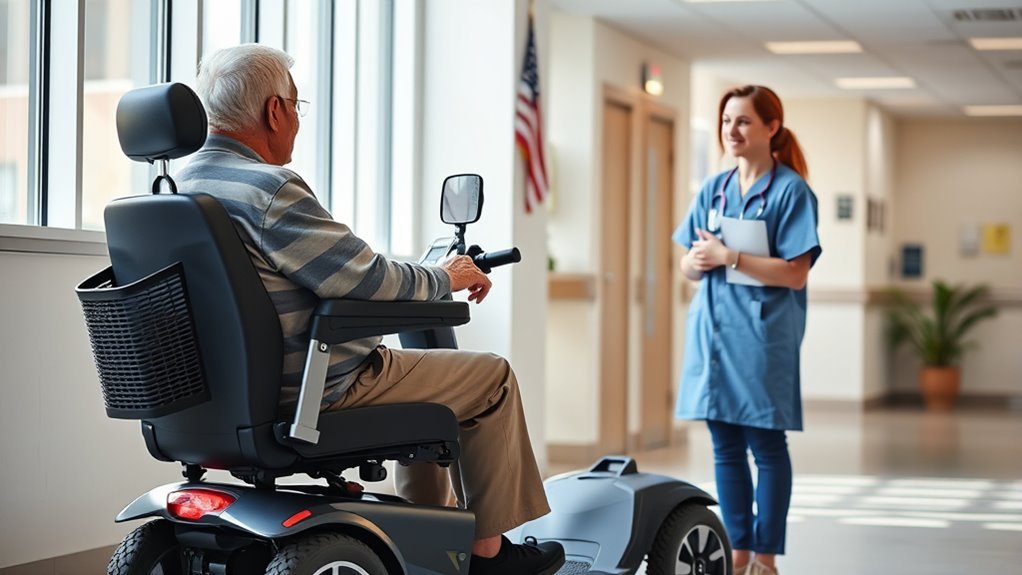
Here, an electric scooter means a seated medical device with three or four wheels and a tiller for steering. It is different from a recreational standing scooter. The right device should help you move safely in the places where you need it, not simply offer a more convenient way to travel.
VA clinicians consider whether you can sit steadily, transfer on and off the scooter, operate its controls, and use it in your home or other regular settings. If a scooter cannot meet your seating or mobility needs, a powered wheelchair or another aid may be more appropriate.
Who Qualifies for a VA Scooter?
Veterans generally need VA health care eligibility and a documented medical need for mobility equipment. A disability rating by itself does not guarantee a scooter, and a service-connected condition is not required in every case.
Service-Connected Eligibility
If you have a service-connected condition that limits your movement, explain how it affects your daily activities. Your medical records, mobility assessment, and treatment goals help the VA decide what equipment you need.
Describe specific problems, such as how far you can walk, whether you can stand long enough to prepare meals, or whether you can reach appointments without becoming exhausted. Your clinician will consider those limits alongside safety and the suitability of other mobility aids.
VA Healthcare Enrollment
Veterans with non-service-connected conditions may also receive medically necessary equipment through VA health care. The VA Prosthetic and Sensory Aids Service explains that its general eligibility includes enrolled veterans with a medical need, although specific programs can have additional rules.
If you are not enrolled, apply for VA health care first. Enrollment eligibility and scooter medical necessity are separate decisions. If you are already enrolled, you do not need to submit another enrollment application merely to ask your provider about a scooter.
Provider Prescription Review
Your primary care provider can start the referral. A clinician with mobility-equipment expertise may then evaluate you and document the device and accessories needed for your treatment.
The assessment can cover sitting balance, strength, transfers, steering, braking, home access, storage, charging, and transport. The care team may ask you to try different devices. A vendor can provide product information, but the vendor does not make the final clinical prescription.
How Do You Get a VA Scooter Prescription?
Start by telling your VA primary care team what you can no longer do safely or reliably. They can arrange the appropriate assessment and referral to prosthetics or a wheeled-mobility clinic.
- Book a VA appointment. Describe your mobility limits and ask whether a scooter assessment is appropriate.
- Bring useful records. Include relevant diagnoses, current mobility aids, falls or near-falls, and examples of daily activities you struggle with.
- Attend the assessment. Be ready to discuss transfers, sitting balance, scooter controls, home entry, doorways, and safe storage.
- Review the prescription. Your clinician documents the recommended device, necessary accessories, and reasons for the choice.
- Wait for VA authorization. Prosthetics coordinates the approved equipment, fitting, delivery, and any needed instruction.
A family member or caregiver can help describe your routine, attend appointments, and organize records. Ask your team whom to contact if your mobility changes while the request is being reviewed.
Warning: Do not buy a scooter or arrange private repairs expecting automatic reimbursement. Federal VA prior-authorization rules generally require approval for covered items and services obtained from outside providers.
What Does VA Scooter Coverage Include?
When the VA authorizes a scooter, coverage can extend beyond the device itself. The approved prescription determines which related items and services are medically needed.
- Prescribed scooter: The device selected to meet your documented mobility needs.
- Clinically needed accessories: Equipment your prescribing clinician identifies and justifies.
- Fitting and training: Instruction on safe operation and use of the prescribed device.
- Authorized repairs or replacement: Support when covered equipment needs repair or when replacement is clinically indicated.
The federal rule on authorized prosthetic items and services includes repairs, replacement under specified circumstances, and fitting and training. It does not promise a newer scooter merely because a newer model exists.
Before delivery, ask prosthetics what is included in your specific order, who will set up the device, and how to request service later. This gives you a clearer answer than assuming every accessory or upgrade is covered.
Which Scooters Does VA Approve?
The VA chooses scooters based on clinical suitability and available procurement options. There is no universal promise that every veteran can request a particular brand or folding model.
The VA National Acquisition Center catalog lists Luggie Scooter, Inc., doing business as FreeRider USA, as a contracted supplier of motorized scooters and related equipment. Models associated with the brand include the Luggie Classic II and Luggie Elite. Their availability for your prescription must be confirmed by your local VA team.
A VA vendor contract does not guarantee that a particular brand or model will be prescribed for you.
When discussing options, focus on how you will use the scooter:
- Explain where you need to travel and what surfaces you encounter.
- Tell the clinician whether you can transfer safely and operate a tiller.
- Discuss storage, charging, vehicle transport, and any needed lift or other accessory.
A portable scooter may be useful for some veterans, but portability alone does not establish medical necessity. If you plan to fly, confirm battery and transport requirements with the airline rather than assuming every mobility scooter meets every travel rule.
How Do VA Scooter Repairs Work?
VA-issued mobility devices may qualify for coordinated repair service. The VA has announced a Scootaround repair contact for enrolled veterans whose qualifying devices appear in their VA patient records.
For the service described in the VA mobility-device repair notice, call 1-888-583-8387, seven days a week, from 7 a.m. to 5 p.m. Central Time. The notice also offers online repair requests at any time. Scootaround contacts the veteran to schedule service.
Have your scooter model, VA issuance details, and a clear description of the problem ready. Tell the repair contact if the problem makes the device unsafe to use. For a device purchased privately or a service question not covered by this repair route, ask your local prosthetics department what authorization or assessment is needed.
Follow your manufacturer’s instructions for charging, storage, tire checks, and routine care. Do not attempt electrical or mechanical work that the instructions reserve for trained repair personnel.
What Costs Stay With You After Approval?
A VA-authorized scooter is not the same as a promise to pay for anything related to it. Your likely costs depend on the approved prescription, the services requested, and whether the VA authorized a purchase or repair in advance.
Ask prosthetics to authorize repairs, accessories, or changes before arranging the work yourself.
- Routine owner care: You are responsible for safe use, charging, storage, and following the instructions provided with the scooter.
- Elective accessories: A convenience upgrade or custom feature that is not medically prescribed may not be covered.
- Unauthorized purchases and repairs: VA reimbursement is not guaranteed when you arrange them without required approval.
- Other health care costs: Any applicable VA visit copay is a separate question from the cost of an authorized scooter.
Do not assume that all wear-related repairs must come out of your pocket. VA policy calls for maintaining wheeled-mobility devices, and repair eligibility depends on the device and circumstances. Ask your care team for a specific coverage decision before paying a repair bill.
What Are Non-Service-Connected Veteran Options?
You may still qualify for a medically necessary scooter if your mobility condition is not service-connected. Begin with VA health care eligibility, then request an assessment through your primary care team.
Eligibility for Non-Service-Connected Veterans
Service connection is not the sole path to VA prosthetic equipment. Your health care eligibility and the medical reasons for the scooter matter.
Income can affect some health care enrollment decisions, but it is not a universal scooter-specific income test. VA considers other eligibility factors as well. If you are unsure about enrollment, seek an eligibility determination rather than assuming your income or disability status rules you out.
PCP Referral Path
Your VA primary care provider can document your mobility difficulties and request further evaluation. The mobility team then considers which aid, if any, meets your needs and can be used safely.
Explain the difference between what you can do on a good day and what you can manage consistently. If walking to appointments, shopping, or moving around your home is difficult, give concrete examples. Ask whether a scooter, powered wheelchair, or another aid fits those needs.
VA Forms and Evaluation
VA Form 10-10EZ is the application for VA health care. It is not an electric scooter prescription form. If you are not enrolled, the VA health care application instructions explain the information you may need.
VA may ask for previous-calendar-year household income and deductible expenses when those details are needed to decide enrollment eligibility. You do not have to report income and expenses in every application when eligibility is established on other grounds.
- Apply for health care if you are not already enrolled.
- Arrange a primary care appointment and explain your mobility needs.
- Complete any referred mobility assessment and follow-up visits.
Family members can help you gather records and track appointments. Once enrolled, work with the clinical team on the scooter request rather than filing another 10-10EZ for the device.
Where Can You Get Help With VA Scooter Benefits?
Your VA care team and local prosthetics department are the first contacts for a scooter request. They can explain the clinical recommendation, equipment order, delivery arrangements, and repair contact for your facility.
Veterans Service Organizations such as Disabled American Veterans (DAV) and the National Association of American Veterans may offer guidance on benefits and paperwork. MobilityWorks provides information about accessible vehicles and adaptive driving equipment. These organizations do not replace a VA clinician’s medical assessment or VA authorization.
If you disagree with a decision about the treatment or equipment your care team recommends, contact your facility’s patient advocate. VA’s Clinical Appeals process explains how to request review of a medical treatment decision. A dispute about health care eligibility follows a different decision-review route.
Note: Your VA clinician and prosthetics team can assess the safest device for your condition and explain what your individual benefits authorize. An online list of scooter models cannot replace that assessment.
What Other Mobility Resources Can Veterans Use?
A scooter is one of several mobility options available through VA care. Depending on your needs, your team may consider manual wheelchairs, powered wheelchairs, other walking aids, accessories, or a referral for vehicle-access needs.
VA Repair Services
For a VA-issued scooter, powerchair, or qualifying wheelchair, keep your equipment details and repair contact accessible. Tell your VA team when the device is no longer safe or your condition changes so they can reassess your mobility needs.
Do not assume a replacement or loaner scooter will be available immediately. Ask prosthetics what temporary mobility arrangements are appropriate for your situation while repairs are pending.
Veteran Mobility Programs
Vehicle lifts and adaptive driving equipment involve needs and benefits beyond the scooter itself. Your mobility assessment can identify transport problems and lead to another evaluation when appropriate.
Organizations such as the Wounded Warrior Project, DAV, and the National Association of American Veterans may help you locate additional veteran resources. MobilityWorks can discuss accessible vehicle options. Confirm any proposed purchase, modification, or funding route with the responsible VA program before committing to a cost.
Frequently Asked Questions
How to Get VA to Pay for Electric Scooter?
Start with your VA primary care provider and request a mobility assessment. Explain your limitations, complete any specialist evaluation, and let your clinical team document the medically appropriate device. Prosthetics then coordinates authorization and procurement. Do not purchase a scooter first and assume VA will reimburse you.
What Kind of Scooter Does the VA Give You?
The VA provides a scooter suited to your documented medical and functional needs. Contracted suppliers include FreeRider USA, associated with Luggie models, but a vendor listing is not a guarantee of a particular model. Your assessment determines whether a scooter or another mobility aid is appropriate.
How Do I Get a Free Electric Scooter?
If you qualify for VA health care and a scooter is medically necessary, the VA may authorize and furnish one through its equipment process. Start with a provider appointment and complete the assessment. Ask prosthetics what the approved order covers, including fitting, training, accessories, and future repairs.
What Changes Are Coming to VA Disability in 2026?
VA published 2026 disability compensation rates effective December 1, 2025. Compensation rates and ratings are separate from the clinical decision to prescribe a mobility scooter. Do not assume a proposed disability-rating reform changes scooter eligibility; use the current VA health care and mobility-device rules for your request.
Conclusion
The VA can provide an electric scooter when your health care eligibility and clinical assessment support the need. Start with your VA primary care team, describe how your mobility limits affect everyday tasks, and ask for an equipment evaluation. Before buying accessories or arranging repairs, confirm what prosthetics has authorized.
Sources
- VA Wheeled Mobility Devices Directive 1173.06: scooter criteria, clinical assessment, prescription, fitting, and maintenance policy.
- VA Prosthetic and Sensory Aids Service: general prosthetic-equipment eligibility and services.
- VA Health Care Application Instructions: Form 10-10EZ and financial information.
- 38 CFR § 17.3230: authorized equipment, repairs, replacement, fitting, and training.
- 38 CFR § 17.3250: veteran responsibilities and prior authorization.
- VA National Acquisition Center Vendor Catalog: FreeRider USA supplier listing.
- VA Mobility Device Repair Notice: Scootaround contact details and repair process.
- VA Clinical Appeals: review of medical treatment decisions.
- VA 2026 Disability Compensation Rates: effective date and distinction from mobility-equipment decisions.
