
Last Updated on July 27, 2026 by Daniel Globe
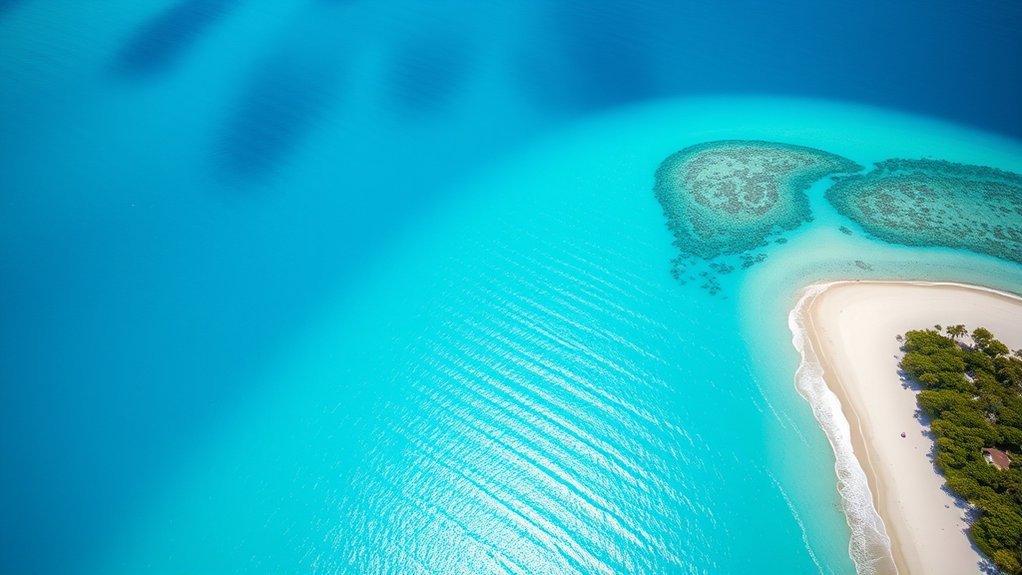
The Bahamas’ water can look almost unreal: pale aquamarine over a sandbar, brilliant turquoise across a shallow bank, and deep navy only a short distance away. The color is real, but it is not caused by one simple trick. Water depth, the way seawater absorbs and scatters sunlight, the pale carbonate seafloor, and the amount of material suspended in the water all affect what reaches your eyes.
Quick Answer
Bahamian water looks intensely blue and turquoise because clear seawater absorbs red wavelengths more strongly than blue, while the shallow Bahama Banks let sunlight reach pale carbonate sand and return through a relatively short water column. Low suspended sediment and limited water-column phytoplankton in many areas help keep that returning light bright and clear.
Key Takeaways
- Clear seawater absorbs longer red wavelengths more strongly, while blue light penetrates farther.
- Large areas over the Bahama Banks are often less than about 10 meters (33 feet) deep, allowing sunlight to reach the bottom and return to the surface.
- Pale carbonate sediment reflects far more light than a dark muddy, rocky, or heavily vegetated bottom.
- Relatively low amounts of suspended particles and water-column phytoplankton in many bank areas help preserve exceptional clarity, although neither is completely absent.
- Depth, seagrass, reefs, clouds, wind, sediment, and viewing angle explain why the same water can shift from aquamarine to teal or deep navy.
Disclosure: As an Amazon Associate I earn from qualifying purchases. Some links on this page are affiliate links, at no extra cost to you.
What Causes the Iconic Blue Color of Bahamian Waters?
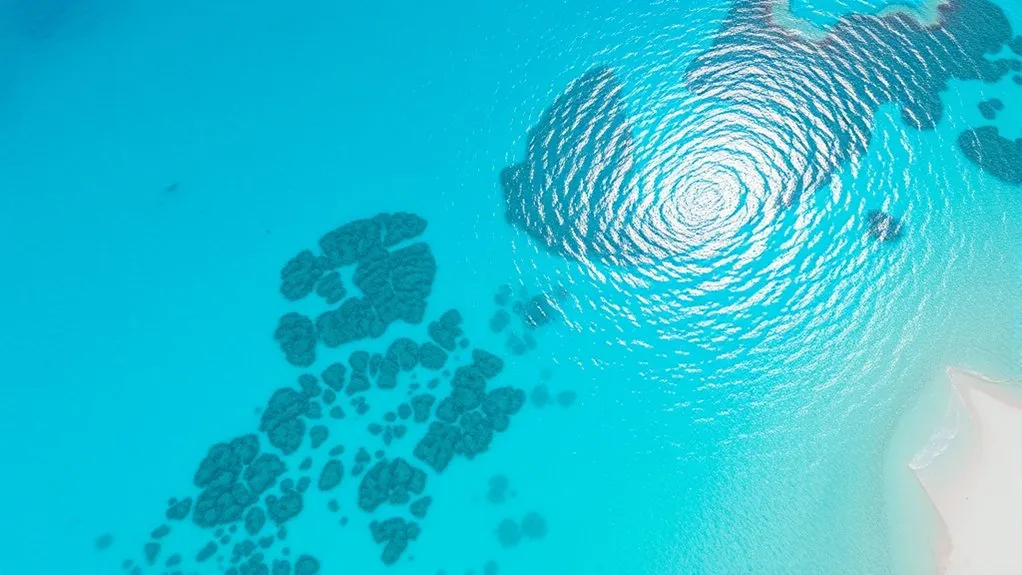
The Bahamas’ famous color starts with the optical properties of water. According to NOAA, water absorbs light from the red part of the visible spectrum more strongly, leaving more blue light available to travel through and scatter back out of clear water.
The geography then intensifies that effect. NASA Earth Observatory reports that water over the Bahama Banks is often less than 10 meters, or about 33 feet, deep. Sunlight can therefore reach the seafloor across enormous areas instead of disappearing into deep water. A pale bottom sends substantial light back upward, giving many shallows their luminous turquoise appearance.
That does not mean the Bahamas has no sediment, algae, or marine vegetation. Seagrass, reefs, suspended carbonate particles, and other materials are present and can change the color locally. The striking clarity comes from the particular combination of shallow water, bright bottom material, and often low concentrations of light-blocking material in the water column.
Light Absorption and Shallow-Water Reflection
How Light Absorption Works
Sunlight contains many visible wavelengths. As it enters water, those wavelengths do not travel equally far. Red light is attenuated relatively quickly, while blue light penetrates farther in clear seawater. Green wavelengths can also travel substantial distances, which is one reason shallow tropical water often appears blue-green rather than pure blue.
It is more accurate to think of seawater as a selective light filter than as a blue mirror. Some sunlight is reflected at the surface, some is scattered within the water, some is absorbed, and—in shallow areas—some reaches the bottom and returns upward. The balance of those processes creates the color you see.
Why Shallow Depth Matters
The Bahama Banks make bottom reflection especially important. NASA notes that bank-top water is often under about 33 feet deep, while nearby basins can plunge thousands of meters. Over a shallow bank, sunlight can reach the seabed, bounce or scatter from pale sediment, and travel back through the water before as much light has been lost.
That is why the Bahamas can look almost illuminated from a boat or a plane. Move across the edge of a bank into a deep channel and the bottom no longer contributes as strongly, so the water quickly changes from bright turquoise to dark blue.
Is the Bahamas’ Blue Water Just a Reflection of the Sky?
No. The sky can influence what you see at the surface, especially when glare is strong, but it is not the main reason Bahamian water is turquoise. Clear water would still have a blue component because of the way water absorbs and scatters sunlight.
Surface reflection can actually hide some of the color. Bright mirror-like reflection from the sun is called sunglint. Viewing angle, waves, and the sun’s position can make sunglint stronger or weaker, which is why two photographs of the same beach can look surprisingly different even on the same day.
How Do Sandy Bottoms Affect Water Color?
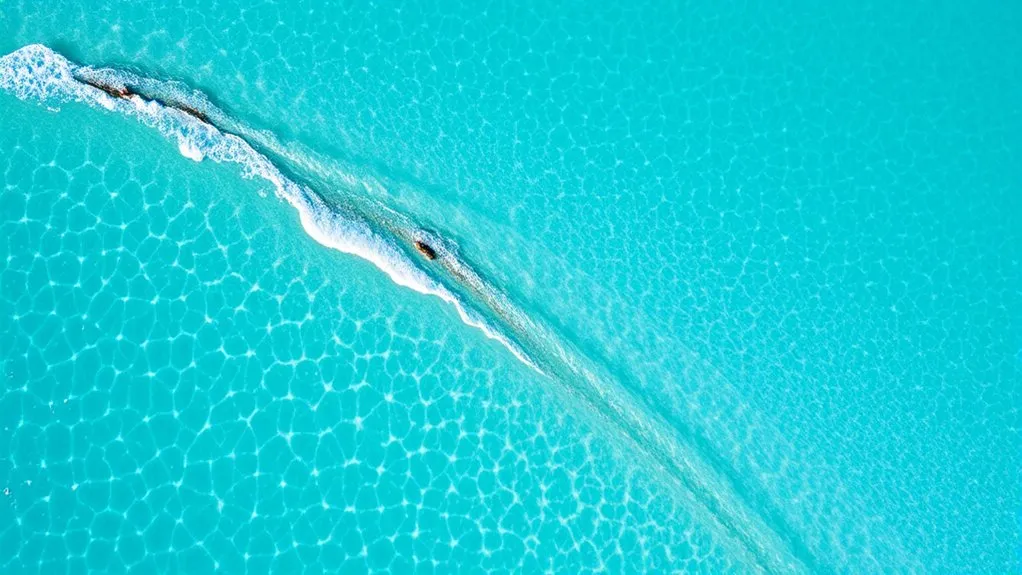
The seafloor does a large share of the visual work. The Great and Little Bahama Banks are carbonate platforms. NASA describes their sediments as being composed mainly of carbonate material, much of it derived from the skeletal remains of marine organisms.
The exact sediment mix varies from place to place. It can include shell and skeletal fragments, fine carbonate mud, coral-derived material, and rounded calcium-carbonate grains such as ooids. What matters visually is that many exposed sandy areas are extremely pale.
- Sunlight reflection: A bright carbonate bottom returns much more light than dark mud, rock, or dense vegetation, making shallow water look lighter and more saturated.
- Light penetration: Because much of the bank is shallow, enough sunlight reaches the bottom for the seabed’s color to influence what you see from above.
- Water clarity: When relatively little sediment or plankton is suspended in the water column, less of the returning light is obscured before it reaches the surface.
- Bottom contrast: Reefs, seagrass, sandy flats, and deep channels have different brightness levels, producing sharply contrasting patches of blue, green, and teal.
This is why one aerial view can contain several colors at once: pale aquamarine over a bright sandbar, richer turquoise over slightly deeper sand, greenish teal where vegetation darkens the bottom, and deep navy where the bank falls into a channel or basin.
Pro Tip: For vivid water photos, late morning through early afternoon often provides strong illumination of the shallow bottom. To reduce surface glare, avoid shooting directly toward the sun, change your viewing angle, and use a polarizing filter when practical.
How Does Biological Activity Influence Water Color?
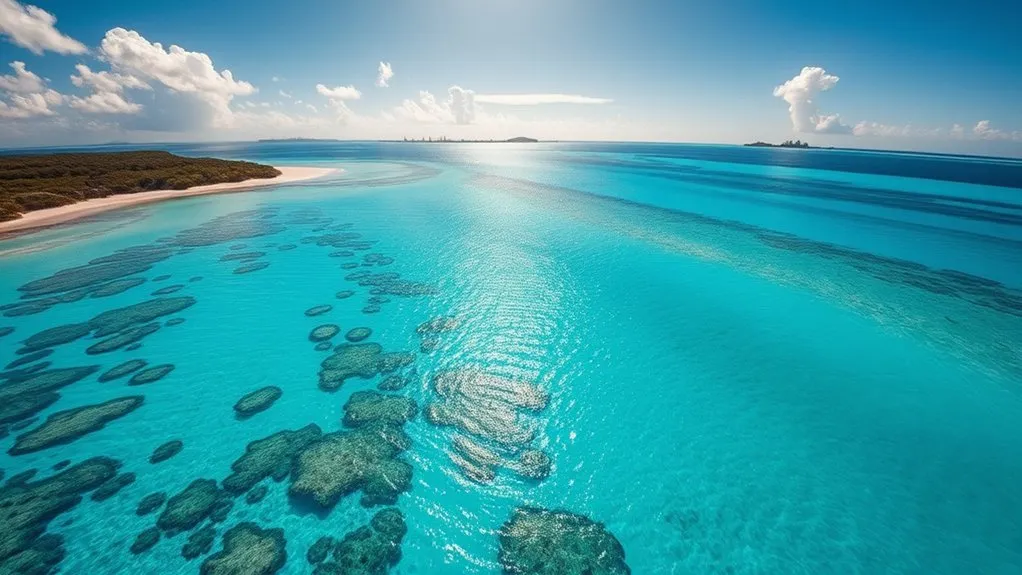
Biology also affects ocean color. Phytoplankton contain pigments such as chlorophyll that absorb and scatter particular wavelengths. As NASA Ocean Color explains, highly productive water with abundant phytoplankton can look green, while water containing fewer optical constituents commonly looks bluer.
Much of the Great Bahama Bank lies in an oligotrophic, or relatively nutrient-poor, subtropical setting. That can mean low water-column phytoplankton biomass in many areas. It does not mean the ecosystem is lifeless: seagrasses, algae, reefs, fish, and other organisms can be abundant on or near the bottom even when relatively little phytoplankton is suspended overhead.
When relatively little phytoplankton or suspended sediment is present in the water column, fewer particles interfere with the combination of clear seawater and a bright shallow bottom.
Why Does the Water Change From Turquoise to Teal and Navy?
The Bahamas is not one uniform shade of blue. The color can change dramatically over just a few hundred yards because apparent water color is partly a map of what lies below the surface.
- Very shallow pale sand: often appears light aquamarine or brilliant turquoise because the bright bottom strongly influences the returning light.
- Deeper sandy water: usually looks richer blue or turquoise as the light travels through more water.
- Seagrass or darker reef habitat: can shift the view toward teal, green, or darker blue because the bottom reflects less light and has its own color.
- Deep channels and drop-offs: appear dark blue or navy because little bottom-reflected light returns to the surface.
NASA imagery of Long Island shows this relationship clearly: light blue-green areas correspond to shallow tidal flats, while deeper channels appear vivid darker blue.
How the Bahamas Differs From Other Tropical Waters
Plenty of tropical destinations have beautiful blue water, but the Bahamas has an unusually large area where shallow depth and pale carbonate sediments occur together. The islands sit on the Great and Little Bahama Banks rather than being surrounded everywhere by a seafloor that immediately drops into deep ocean.
- The Bahama Banks: Large underwater carbonate platforms surround many islands and cays. Water over the banks is often less than about 10 meters (33 feet) deep even though neighboring basins are dramatically deeper.
- Pale carbonate seafloor: Bright sand and other carbonate sediment return sunlight efficiently, enhancing the light appearance of the shallows.
- Limited land-derived sediment in many areas: The offshore bank setting lacks the huge river systems that can deliver large loads of dark continental sediment to some other coastlines, although local sediment can still be resuspended.
- Relatively oligotrophic water: Low water-column nutrient and phytoplankton levels over much of the bank can help preserve clarity without implying that reefs, seagrasses, or bottom-dwelling ecosystems are unproductive.
Note: The familiar claim that “Bahamas” comes from the Spanish bajamar, meaning “shallow sea,” is widely repeated in tourist literature, but academic research on Bahamian place names describes that explanation as a folk etymology. Onomastics research instead points to a Lucayan name, “Bahama,” associated with present-day Grand Bahama.
Key Environmental Factors Improving Water Clarity
Several separate factors determine how clear and colorful Bahamian water appears. The most useful way to understand them is to look at what each one does to the light reaching your eyes.
| Factor | Optical Effect | Typical Appearance |
|---|---|---|
| Shallow water | Lets sunlight reach the bottom and return through a short water column | Bright turquoise or aquamarine |
| Pale carbonate sand | Returns more sunlight than a dark bottom | Lighter, more luminous water |
| Low suspended material | Allows more light to travel through the water without being blocked or redirected | Clearer, more saturated color |
| Water-column phytoplankton | More chlorophyll can shift apparent color toward green | Bluer when concentrations are low; greener when higher |
| Seagrass, reefs, and depth | Darkens the bottom or increases the distance light travels | Teal, darker blue, or navy |
Reefs can also reduce wave energy in protected coastal settings. NOAA explains that coral-reef structures buffer shorelines from waves and storms. That can reduce wave energy locally, although strong winds, tides, and storms can still stir up bottom material and temporarily reduce clarity.
Warning: Clear water can make depth and drop-offs difficult to judge, especially near channels and cuts. The U.S. Department of State advises travelers in The Bahamas never to swim alone, to be realistic about their swimming and snorkeling ability, to watch for nearby watercraft, and to follow local weather and water-condition warnings.
When Does Bahamian Water Look Less Blue?
The Bahamas is famous for clear water, but the color is not fixed. Conditions can make the same shoreline look brighter, grayer, greener, or cloudier from one day to the next.
- Clouds or a low sun: Less direct sunlight reaches the bottom, reducing the glowing appearance of shallow sand.
- Wind and surface chop: Waves change viewing angles and increase glare, making the bottom harder to see.
- Storms and strong currents: Bottom sediment can be stirred into the water column, reducing clarity.
- Phytoplankton or other suspended material: Additional particles and pigments can shift the apparent color.
- Whiting events: The Bahama Banks occasionally develop milky patches caused by large amounts of fine calcium-carbonate particles suspended in the water. NASA has tracked these events by satellite.
So while extraordinarily clear turquoise water is characteristic of many Bahamian shallows, it is not a permanent or identical condition across every island, tide, season, or weather pattern.
Where to Find the Best Views of the Bahamas’ Blue Waters
Color changes with sunlight, wind, tide, water depth, and bottom type, so no location looks identical every day. Still, several places make the Bahamas’ depth-and-sand contrast especially easy to see.
- Exuma Cays: Extensive shallow sandy flats and sandbars create some of the islands’ most recognizable turquoise water.
- Pink Sands Beach, Harbour Island: The clear shallows contrast with pale pink beach sediment. According to the official Bahamas tourism site, the pink component comes largely from microscopic Foraminifera remains mixed with the sand and bits of coral.
- Bimini: Its shallow coastal areas and lagoons can provide strong visibility and dramatic blue-green color close to shore when weather and water conditions cooperate.
- Dean’s Blue Hole, Long Island: The official Bahamas tourism site currently describes it as roughly 663 feet deep and the world’s third-deepest blue hole. Its dark center creates a dramatic contrast with the shallow turquoise lagoon around its rim.
- Cat Island: Long, lightly developed beaches pair pale sand with clear Atlantic and bank-side water, producing broad views of changing blue tones.
Frequently Asked Questions
Why is the water so much bluer in the Bahamas?
Large areas of the Bahama Banks are exceptionally shallow and have pale carbonate bottoms. Clear seawater absorbs red wavelengths more strongly than blue, while sunlight can reach the shallow seabed and return upward. Where suspended sediment and water-column phytoplankton are also low, the result can be unusually bright turquoise or blue water.
What is the leading cause of death in the Bahamas?
The answer depends on the year and dataset. The WHO’s current Bahamas country profile displays cause-specific estimates for 2021, when COVID-19 was the leading single cause in the WHO-derived ranking and ischemic heart disease was the leading non-COVID cause. WHO cautions that Bahamian mortality estimates are affected by low registration completeness and/or cause-assignment quality, so the year and source should always be stated.
Which is safer, Jamaica or the Bahamas?
There is no reliable country-wide answer because risk varies by location and situation. As of July 2026, the U.S. Department of State rates both The Bahamas and Jamaica Level 2, or “Exercise Increased Caution,” while Jamaica also has specified areas where travelers are advised to reconsider travel. Check the current advisory for the exact area you plan to visit and follow normal travel precautions.
Where do billionaires live in the Bahamas?
There is no authoritative public registry showing where individual billionaires live in The Bahamas, and residency changes over time. Lyford Cay and Paradise Island are well known for luxury residential property and affluent residents, but claims that specific billionaires live there should be verified individually rather than treated as a fixed list.
Is the Bahamas’ blue water just a reflection of the sky?
No. Sky reflection and surface glare can change how the water looks, but the underlying blue and turquoise color mainly comes from sunlight interacting with the water itself, combined with the shallow depth and bright seafloor. The water would still have a strong blue component even without a perfectly blue sky.
Why are some patches turquoise, teal, or dark blue?
Depth and bottom type are major reasons. Very shallow pale sand can look aquamarine or turquoise, while seagrass and reefs often make the bottom darker or greener. Deep channels appear navy because the seabed contributes much less reflected light. Clouds, waves, suspended particles, and viewing angle can shift the color further.
Conclusion
The vibrant blue of Bahamian water is not one optical trick. Clear seawater selectively absorbs light, the Bahama Banks keep huge areas shallow, and pale carbonate sediments send sunlight back through the water. Add relatively low suspended material in many locations, and the result is the brilliant turquoise the islands are famous for.
The same science also explains the variations: pale sandbars glow aquamarine, seagrass and reefs can look teal, and deep channels turn navy. Weather, waves, plankton, and suspended sediment can change the view from day to day, making the Bahamas’ color both scientifically understandable and remarkably dynamic.
Sources
- NOAA — Why Is the Ocean Blue? — selective absorption of visible light and the influence of suspended material on ocean color
- NASA Earth Observatory — The Bahamas — Bahama Bank depth, deep surrounding basins, and visible shallow-water color
- NASA Earth Observatory — Tidal Flats and Channels, Long Island — carbonate-platform geology and the relationship between depth and visible color
- NASA Ocean Color — effects of phytoplankton, mineral particles, dissolved material, absorption, and scattering on apparent water color
- World Health Organization — Bahamas Country Data — cause-of-death estimates and data-quality limitations used in the FAQ
- U.S. Department of State — The Bahamas Travel Advisory — current swimming, snorkeling, boating, and travel-safety guidance

