
Last Updated on September 11, 2026 by Daniel Globe
Büyükada has more than one monastery story, which is why its dates are often confused. The island’s documented Byzantine monastic history reaches back to 569 CE, but that date should not be treated as the confirmed founding year of today’s Aya Yorgi Monastery. Aya Yorgi has its own traditional, documented, and modern construction dates.
Quick Answer
Büyükada’s monastic history can be traced to 569 CE, when Emperor Justin II founded a palace and monastery on the island. That foundation should not be confused with Aya Yorgi Monastery: tradition links Aya Yorgi to 963, while Patriarchate records date its older complex to 1751 and its present stone church to 1905-1909.
Key Takeaways
- 569 CE marks an early palace and monastery founded by Emperor Justin II somewhere on Büyükada, not a securely documented founding of the present Aya Yorgi complex.
- Aya Yorgi Monastery has a traditional origin dated to 963, an older complex recorded in 1751, and a stone church built in 1905 and opened in 1909.
- The Prinkipo Greek Orphanage is a separate building on İsa Tepesi. It was designed as a hotel in 1898-1899 and began serving as an orphanage in 1903.
- Visitors should view the orphanage carefully from outside because the long-abandoned wooden structure remains fragile and subject to preservation work.
Disclosure: As an Amazon Associate I earn from qualifying purchases. Some links on this page are affiliate links, at no extra cost to you.
Büyükada’s Byzantine Beginnings
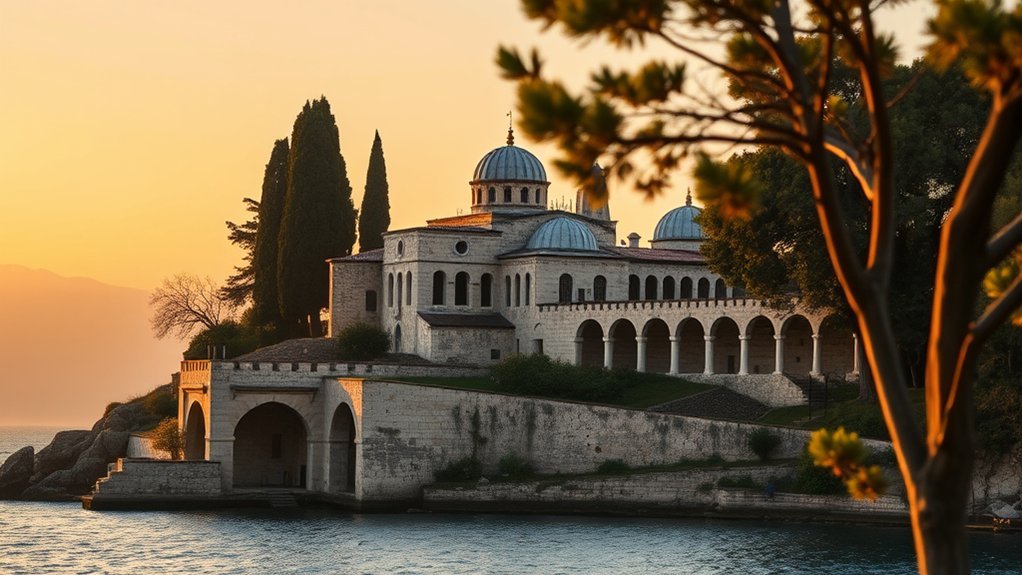
Büyükada’s documented monastic history reaches back to the reign of Byzantine Emperor Justin II. Historical accounts state that he established a palace and a monastery on the island in 569 CE. These buildings helped make Büyükada an important religious retreat and later contributed to the Princes’ Islands’ reputation as places of seclusion and exile.
However, the 569 foundation should not automatically be identified as the present Aya Yorgi Monastery on Yücetepe. The exact relationship between Büyükada’s earliest Byzantine foundations and its surviving religious complexes remains difficult to prove because buildings were destroyed, rebuilt, renamed, or moved over many centuries.
The Adalar Municipality’s account of Aya Yorgi records a local tradition that places a monastery on the hill in 963, during the reign of Emperor Nikephoros II Phokas. It also connects the name Kodono, mentioned in a document from 1158, with Aya Yorgi Kudunas. These links are important historical traditions, but they should not be presented as uncontested archaeological proof.
When Was Aya Yorgi Monastery Built?
The safest answer depends on what you mean by “built.” Aya Yorgi has several important dates:
| Date | What It Represents |
| 569 CE | Emperor Justin II’s palace and monastery on Büyükada. This marks the island’s early documented monastic history, not a confirmed founding date for the surviving Aya Yorgi complex. |
| 963 | The traditional founding date associated with Aya Yorgi during the reign of Nikephoros II Phokas. |
| 1751 | The construction date recorded for the older small church, chapel, and prayer rooms in Patriarchate records. |
| 1905-1909 | The present cut-stone church was built in 1905 and opened for worship in 1909. |
For most visitors, the clearest wording is that Aya Yorgi is an old pilgrimage site with Byzantine traditions, a documented eighteenth-century complex, and an early twentieth-century main church. The Adalar Culture Association records the 1751, 1905, and 1909 dates.
The date 569 belongs to Büyükada’s early Byzantine monastic history. It is not a reliable stand-alone construction date for the Aya Yorgi buildings visitors see today.
How the Island Became an Exile Site
The Princes’ Islands became associated with exile because they were close enough to Constantinople for imperial authorities to control, yet separated from the capital by the Sea of Marmara. During the Byzantine period, emperors, empresses, church leaders, and political rivals were sent to island palaces or religious houses after losing power.
This history applies to Büyükada and the wider island group rather than to Aya Yorgi alone. The presence of monasteries made confinement easier because a person could be removed from court while being housed under religious supervision.
The island’s identity changed during the Ottoman period. Büyükada gradually developed into a fishing community and then a popular summer retreat, especially after regular steamship services made travel from Istanbul easier. Greek, Armenian, Jewish, and Muslim residents contributed to the island’s religious buildings, wooden houses, businesses, and social life.
The compulsory Greek-Turkish population exchange of 1923 did not automatically remove Büyükada’s long-established Greek residents. Greeks already established within the recognized area of Constantinople before October 30, 1918, were exempt under the exchange convention. Later political events, economic pressures, and emigration still caused major demographic change.
Leon Trotsky added another chapter to Büyükada’s exile history when he lived on the island from 1929 to 1933 after being expelled from the Soviet Union. His former residence is separate from both Aya Yorgi and the Greek Orphanage.
From Monastery to Greek Orphanage
Aya Yorgi Monastery and the Prinkipo Greek Orphanage both reflect Büyükada’s Greek Orthodox heritage, but one did not become the other. They are separate complexes on different hills, with different purposes and construction histories.
Byzantine Monastic Beginnings
Büyükada’s early monasteries supported prayer, communal religious life, refuge, and, at times, supervised exile. Aya Yorgi later became one of the island’s most important pilgrimage destinations. It stands on Yücetepe, the island’s highest point, and is dedicated to Saint George.
The final climb to Aya Yorgi is steep and normally completed on foot. Visitors come for the church, the pilgrimage tradition, and broad views across the Sea of Marmara. The busiest pilgrimage periods may be crowded, so an early arrival usually provides a calmer visit.
Greek Orphanage Legacy
The Prinkipo Greek Orphanage stands on İsa Tepesi, also known as Hristos Hill. Published sources give its construction date as either 1898 or 1899, so the most accurate summary is that it was built in 1898-1899.
French-Ottoman architect Alexandre Vallaury designed the vast timber structure for a company connected with the Compagnie Internationale des Wagons-Lits. It was intended to operate as a luxury hotel and casino for travelers, but the planned business did not receive the required permission. The building was later transferred to the Ecumenical Patriarchate and began operating as an orphanage in 1903.
| Feature | Verified Detail |
| Construction | Built in 1898-1899 as a proposed hotel and casino. |
| Architect | Alexandre Vallaury. |
| Orphanage operation | 1903 to 1964. |
| Heritage importance | Widely considered Europe’s largest wooden building and the world’s second largest. |
| Current condition | Long abandoned, seriously deteriorated, and the subject of stabilization and rehabilitation planning. |
The orphanage closed in 1964. Weather, fire, earthquake damage, and decades without full maintenance left the complex at serious risk. A Europa Nostra and European Investment Bank Institute report outlined urgent stabilization needs and a possible long-term rehabilitation plan.
What Makes the Greek Orphanage Famous?
The Prinkipo Greek Orphanage is famous for its exceptional size, timber construction, social history, and endangered condition. Its long façades and repeated rows of windows make it visible from several parts of Büyükada.
Architectural Grandeur
The building demonstrates how late nineteenth-century designers used a timber frame for a project on an unusually large scale. Its interior originally included accommodation, service areas, communal rooms, and a theater. Decorative columns, paneled ceilings, and carefully planned circulation reflected its original hotel design.
Heritage organizations commonly describe it as the largest wooden building in Europe and the second largest in the world. Because rankings can depend on how a “wooden building” is defined, “widely considered” is more accurate than presenting the ranking as an independently certified record.
Historic Island Legacy
From 1903 to 1964, the building served children under the care of the Greek Orthodox community. Its importance therefore goes beyond architecture. It represents social care, education, religious life, and the changing position of Istanbul’s Greek community during the twentieth century.
- Designed by Alexandre Vallaury
- Originally planned as a hotel and casino
- Converted for orphanage use in 1903
- Closed in 1964
- Listed among Europe’s seven most endangered heritage sites in 2018
- Still the subject of preservation and reuse planning
Warning: The orphanage is a fragile, deteriorated heritage structure. Do not enter through damaged fencing, approach unstable walls, or treat the site as an abandoned-building attraction. View it from a lawful public area unless an officially supervised visit has been announced.
What to See on Büyükada Today
Büyükada’s surviving landmarks make it possible to explore several periods of the island’s history in one day.
- Aya Yorgi Church and Monastery: Visit the pilgrimage complex on Yücetepe and enjoy views from the island’s highest hill.
- Prinkipo Greek Orphanage: See the exterior of the monumental wooden complex from a safe and lawful viewpoint.
- Ayios Dimitrios Church: Visit a major Greek Orthodox church that opened on May 7, 1856. Its existing structure is nineteenth-century, not Byzantine.
- Museum of the Princes’ Islands: Learn about the islands’ communities, architecture, migration, transport, literature, and everyday life. The museum opened in 2010, and its main exhibition building is a renovated former helicopter hangar in the Aya Nikola area.
- Historic wooden houses: Walk through the Nizam and Maden neighborhoods to see Büyükada’s late Ottoman and early twentieth-century residential architecture.
- Trotsky’s former residence area: View the location associated with Leon Trotsky’s stay from 1929 to 1933 while respecting current property boundaries.
The Adalar District Governorship records that the Museum of the Princes’ Islands began operating on September 10, 2010.
Best Historic Sites Near the Orphanage
- Prinkipo Greek Orphanage: The island’s monumental former orphanage, built in 1898-1899 and located on İsa Tepesi.
- Hristos Monastery: A religious site on the same hill. It is often connected with an earlier Byzantine monastery, although the municipality notes that firm scientific proof for that identification is lacking.
- Ayios Dimitrios Church: The Greek Orthodox metropolitan church of the Princes’ Islands, opened in 1856.
- Ayios Nikolaos Monastery: Located near the former Byzantine settlement of Karya on Büyükada’s eastern side.
- Museum of the Princes’ Islands: A useful stop for understanding the history behind the island’s churches, monasteries, houses, transport, and communities.
- Aya Yorgi Monastery: Located on Yücetepe rather than İsa Tepesi, it remains Büyükada’s best-known pilgrimage destination.
Pro Tip: Do not plan Aya Yorgi and the orphanage as though they are one combined complex. They stand on different hills. Allow time for walking, steep slopes, photographs, and stops between the two areas.
How to Get to Büyükada From Istanbul
Büyükada is reached by ferry. Şehir Hatları operates Princes’ Islands services from several mainland piers, including Kabataş, Beşiktaş, Bostancı, Maltepe, Kadıköy connections, and selected Tuzla-Pendik services. Routes and departure times change between weekday, weekend, summer, and winter schedules.
From Sultanahmet, you can take the T1 tram toward Kabataş and connect with a ferry when a suitable sailing is available. Travelers staying on Istanbul’s Asian side may find Bostancı or Maltepe faster because those piers are closer to the islands.
Journey time depends on the departure point and the number of stops. A trip from Bostancı or Maltepe can be much shorter than a multi-stop sailing from Kabataş. Check the official Şehir Hatları timetable on the day of travel.
As checked on July 24, 2026, the official full fare for the Princes’ Islands line was listed as 151.23 TL without Adakart and 90.70 TL with Adakart. Fares can change, so confirm the amount on the official fare page before departure.
Normal private vehicle traffic is heavily restricted on Büyükada. Most visitors walk or cycle, while licensed electric public vehicles and electric taxis serve established island routes. Current public-transport routes are listed on the IETT island transportation page.
Note: The climb from the main road to Aya Yorgi is steep and exposed in warm weather. Wear shoes with good grip, carry water, and allow extra time if you have limited mobility.
Frequently Asked Questions
Was Aya Yorgi Monastery built in 569?
Not with certainty. The year 569 refers to a palace and monastery founded by Emperor Justin II on Büyükada. Aya Yorgi has a traditional origin dated to 963, while Patriarchate records date its older surviving complex to 1751. Its present stone church was built in 1905 and opened in 1909.
Did Aya Yorgi Monastery become the Greek Orphanage?
No. They are separate sites. Aya Yorgi stands on Yücetepe, while the Prinkipo Greek Orphanage stands on İsa Tepesi. The orphanage building was originally designed as a hotel and began serving as an orphanage in 1903.
Can visitors enter the Prinkipo Greek Orphanage?
Do not assume that normal interior access is available. The structure is badly deteriorated and requires controlled preservation work. View it from a lawful public area unless the owner or an official organization announces a supervised visit.
Is Büyükada Island worth visiting?
Yes, especially if you enjoy historic architecture, religious heritage, walking, sea views, and a slower pace than central Istanbul. A well-planned day can include Aya Yorgi, the island museum, nineteenth-century churches, wooden houses, and the orphanage exterior.
What does Büyükada mean in English?
Büyükada means “Big Island.” The Turkish word büyük means “big,” and ada means “island.” It is the largest of Istanbul’s Princes’ Islands and was historically known in Greek as Prinkipos.
Is Büyükada expensive?
A day trip can be moderate in cost, but spending depends on the ferry, meals, beach admission, bicycle rental, and electric transport. Ferry and local service prices change regularly, so check official fares and posted business prices instead of relying on older travel estimates.
Conclusion
Büyükada’s monastery history does not fit into one simple construction date. The island’s documented Byzantine monastic story begins with Justin II’s foundation in 569 CE, while Aya Yorgi has a traditional connection to 963, a documented older complex from 1751, and a present church completed between 1905 and 1909.
The Prinkipo Greek Orphanage belongs to a separate story. Built in 1898-1899 as a proposed hotel and used as an orphanage from 1903 to 1964, it became one of Büyükada’s most important architectural and social landmarks. Understanding these sites separately gives you a clearer and more accurate picture of the island’s Byzantine, Ottoman, Greek Orthodox, and modern heritage.
Sources
- Adalar Municipality: Aya Yorgi Greek Monastery – Aya Yorgi’s traditional Byzantine history and location.
- Adalar Culture Association: Büyükada Guide – Patriarchate record of 1751 and the 1905-1909 church construction.
- Europa Nostra: Prinkipo Greek Orphanage Rehabilitation Report – Original purpose, orphanage history, architectural importance, and structural condition.
- Adalar District Governorship: Museums of the Islands – Museum of the Princes’ Islands opening date and institutional background.
- Şehir Hatları Timetables – Current ferry routes and departure information.
- IETT: Transportation on the Princes’ Islands – Licensed electric public-transport routes on Büyükada.

