

Last Updated on September 11, 2026 by Daniel Globe
A cat fountain filter catches hair, food crumbs, dust, and other debris before it reaches the pump or returns to the drinking tray. Activated carbon may also reduce some unpleasant tastes and odors. The filter is only one part of fountain care, however. Clean water still depends on regular washing, pump maintenance, correct installation, and timely filter replacement.
Quick Answer
Replace a cat fountain filter according to the fountain manufacturer’s instructions—often every 2 to 4 weeks, but sometimes monthly or sooner. Change it early if it is clogged, damaged, slimy, or causing slow flow. A filter traps debris and may improve taste, but it does not sterilize the water or replace routine cleaning.
Key Takeaways
- Follow the replacement schedule for your exact fountain and cartridge instead of treating 2 to 4 weeks as a universal rule.
- Standard foam and carbon filters catch debris and improve taste or odor; they do not disinfect the water.
- Wash the basin, drinking surface, filter housing, and pump regularly because circulation alone does not stop slime or biofilm.
- Keep a separate bowl of fresh water available, especially while your cat is learning to use a fountain.
- A fountain can support hydration, but it does not prevent or treat urinary tract or kidney disease.
At a Glance
| Time Required | 5 minutes for a filter change; about 15–25 minutes for a full fountain and pump cleaning |
| Difficulty | Easy |
| Tools Needed | Replacement filter, mild unscented dish soap, soft brush, clean cloth, and the fountain manual |
| Cost | One model-compatible replacement cartridge; price varies by brand and pack size |
Disclosure: As an Amazon Associate I earn from qualifying purchases. Some links on this page are affiliate links, at no extra cost to you.
Why Cat Fountain Filters Matter
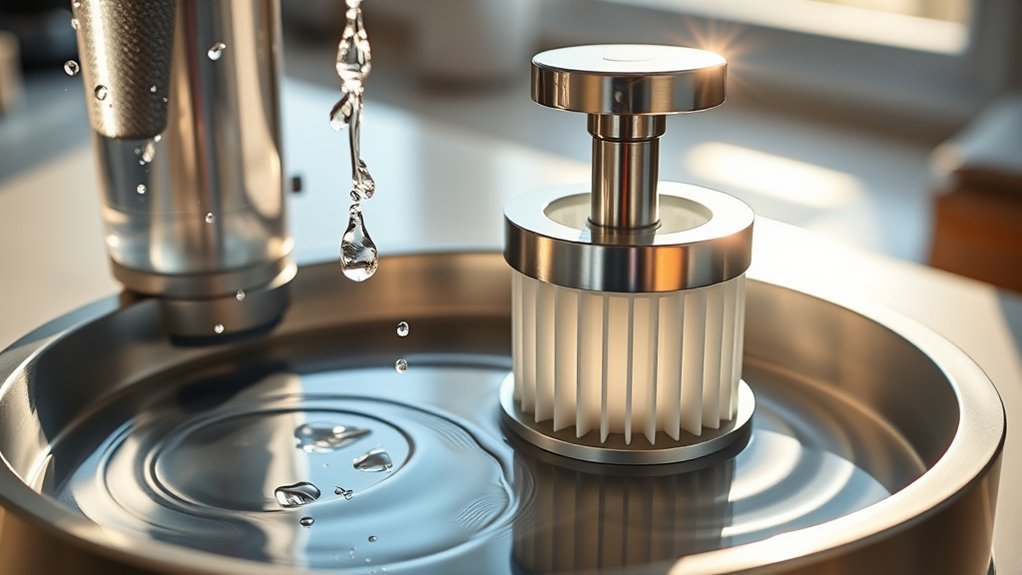
A fountain continually recirculates the same water. Hair, saliva, dust, litter particles, and small pieces of food can therefore move through the system many times unless they are removed. A correctly fitted filter helps catch this debris and can protect the pump intake from larger particles.
Activated carbon has a different job. It can adsorb some compounds that affect taste or odor, making the water more appealing. It does not reliably remove every chemical, mineral, microorganism, or dissolved contaminant, and an ordinary carbon cartridge should not be treated as a water purifier or disinfectant.
Clean, accessible water is important for normal feline health. According to the Cornell Feline Health Center, water supports temperature control, digestion, circulation, electrolyte balance, and other essential functions. A fountain may help some cats drink, but preferences differ and a filter itself does not prevent urinary tract infections, kidney disease, or other medical conditions.
Note: Standard carbon and foam cartridges improve fountain cleanliness, but they do not sterilize the water. Washing the basin, pump, impeller, and hidden channels is essential for controlling slime and biofilm.
How Cat Fountain Filters Work
Most cat fountain filters use two or more forms of media. Water first passes through a physical layer that catches visible debris. It may then pass through activated carbon or another treatment medium before returning to the drinking area.
| Filter component | Main purpose | Important limitation |
|---|---|---|
| Mesh or polyester pad | Catches hair, food crumbs, and larger particles | Does not remove dissolved compounds or disinfect water |
| Foam pump prefilter | Stops larger debris from entering the pump | Can become slimy or clogged and must be cleaned or replaced |
| Activated carbon | Reduces some taste- and odor-causing compounds | Does not remove every contaminant and does not kill bacteria |
| Ion-exchange resin | May reduce selected dissolved ions, depending on the formulation | Performance varies and it does not replace safe source water |
| UV-C component | Specialized models may expose circulating water to UV-C light | Effectiveness depends on the product design, maintenance, exposure time, and lamp condition |
The cartridge must sit in the correct direction and seal against its housing. Water that flows around a loose or undersized filter will bypass the media. Never cut, stack, reverse, or substitute cartridges unless the fountain manufacturer specifically allows it.
How Often to Replace a Cat Fountain Filter
Many disposable carbon filters are replaced every 2 to 4 weeks, but this is a common range rather than a universal standard. Some models call for monthly replacement, while others require changes every two weeks. The instructions for your exact fountain and filter take priority.
PetSafe, for example, gives a 2-to-4-week interval for certain charcoal filters. Catit’s May 2026 guidance for one PIXI filter recommends replacement after about one month of continuous use or when the pad becomes visibly saturated. These differences show why the model manual matters.
Replace the filter sooner when:
- The fountain serves several pets.
- Your cat sheds heavily or drops food into the water.
- The prefilter fills with hair quickly.
- Your water leaves heavy mineral deposits.
- The cartridge becomes slimy, torn, deformed, or heavily discolored.
- Odor or poor taste returns soon after cleaning.
- Flow remains weak after the pump and housing have been cleaned.
Pro Tip: Write the installation date on the filter package or set a phone reminder. Check the cartridge at every cleaning instead of waiting for the reminder when the fountain has heavy use.
Signs Your Cat Fountain Filter Needs Replacing
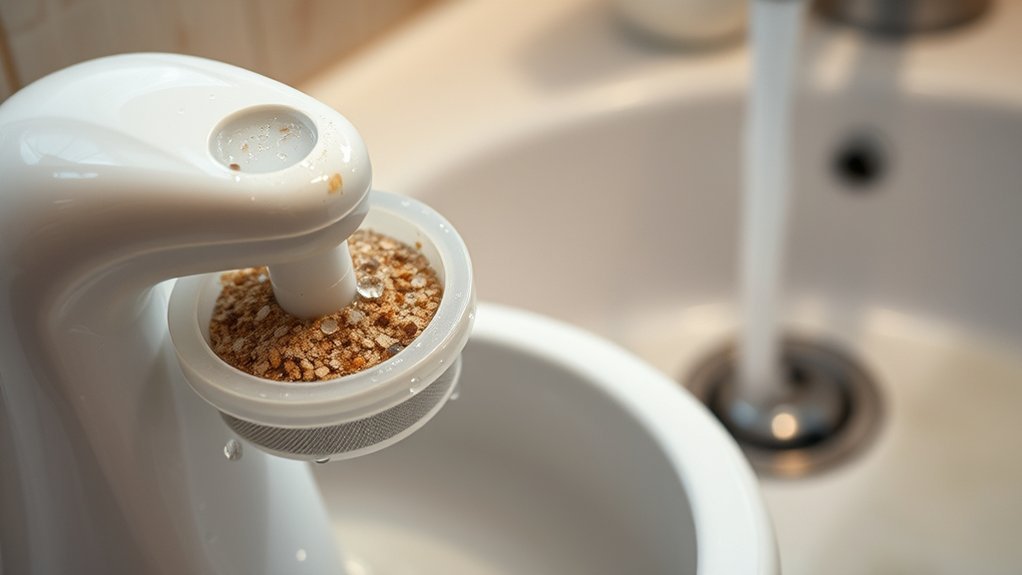
Inspect the filter whenever you clean or refill the fountain. A clogged cartridge can reduce circulation, while damaged media may allow debris or carbon granules into the drinking tray.
Common replacement signs include:
- Persistent slow flow: The pump, intake, water level, and filter housing have been checked, but output remains weak.
- Visible saturation: The pad is packed with hair, residue, or dark organic buildup.
- Slime or odor: The cartridge smells unpleasant or feels slick after the rest of the fountain has been cleaned.
- Physical damage: The pad is torn, compressed, misshapen, or no longer seals inside the housing.
- Particles in the tray: Debris continues to bypass the filter, or loose media escapes from a damaged cartridge.
- Your cat avoids the fountain: A change in smell, sound, flow, or cleanliness may be making it less appealing.
A small amount of black dust from a new carbon filter does not always mean the cartridge is defective. It usually means the filter was not prepared fully. Remove it, follow the model’s soaking or rinsing instructions, rinse the basin, and reinstall it only after loose dust is gone.
How to Clean a Cat Fountain Properly
Cleaning frequency depends on the fountain, water quality, number of pets, and how quickly residue develops. Inspect the unit daily, refresh the water as needed, and perform a complete wash at least as often as the manufacturer recommends. Clean it immediately if you notice slime, food, hair buildup, odor, or reduced flow.
Warning: Unplug the fountain before taking it apart. Do not submerge the power adapter, connector, battery compartment, or non-waterproof electrical base. Never operate a pump below the minimum water line.
- Unplug and empty the fountain. Disconnect the pump from the power source before touching the water.
- Remove the filter. Discard it if it is due for replacement. Do not wash a disposable carbon cartridge with soap.
- Take apart all water-contact parts. Remove the drinking tray, reservoir, spout, filter housing, pump cover, tubing, seals, and foam prefilter where applicable.
- Wash non-electrical parts. Use warm water, mild unscented dish soap, and a soft brush. Check the manual before placing any component in a dishwasher.
- Open and clean the pump. Remove the faceplate and impeller if the design allows. Brush away hair and residue from the impeller well, intake slots, and narrow channels.
- Address mineral scale. Use only the descaling method approved for the model. A manufacturer-approved diluted vinegar soak may help on compatible parts, but all residue must be rinsed away.
- Rinse thoroughly. Soap or vinegar left behind can affect taste and may irritate your cat.
- Prepare the new filter. Follow the cartridge directions. Some need rinsing until the water runs clear; others require several minutes of soaking followed by rinsing.
- Reassemble in the correct order. Make sure seals, tubing, pump covers, and filter housings sit securely.
- Fill before powering on. Add fresh potable water to the recommended level, plug in the fountain, and watch for normal flow, leaks, or unusual noise.
Manufacturer instructions vary. PetSafe’s model-specific cleaning guidance, for example, tells owners to disassemble and clean the pump and to rinse new carbon filters before installation. Always use the directions supplied for your fountain rather than assuming that every pump and cartridge comes apart in the same way.
How to Control Slime and Biofilm
A slippery coating is usually a sign that microorganisms and organic residue have formed a biofilm on the fountain’s surfaces. Replacing the filter alone will not remove it. Disassemble the fountain, open the pump, scrub all reachable water-contact areas, rinse thoroughly, and install a fresh filter when required.
Recurring slime may mean that hidden pump channels, tubing, seals, or the underside of the drinking tray are being missed. Moving the fountain away from direct sunlight and washing food residue from your cat’s face or nearby feeding area may also help.
How to Handle Hard-Water Scale
White or chalky deposits are usually mineral scale rather than mold. Heavy scale can narrow water channels, interfere with the impeller, and make surfaces harder to clean. Follow the manufacturer’s descaling instructions and consider using a safe household water source that produces less scale. Do not assume a small carbon cartridge will soften hard water unless the manufacturer specifically says it contains suitable media.
How to Choose the Best Cat Fountain Filter
The best filter is one that fits the fountain correctly, uses appropriate media, remains available for future purchase, and allows the pump to maintain its intended flow. A highly advertised cartridge is not useful if water bypasses it or replacement packs are difficult to find.
Match the Exact Fountain Model
Check the fountain model number, cartridge dimensions, orientation, and filter-housing shape. Similar-looking filters may differ in thickness or sealing edges. Poor fit can allow water to travel around the media or place extra resistance on the pump.
- Find the model number on the fountain, manual, adapter label, or product account.
- Confirm the manufacturer’s compatible filter part number.
- Check whether the fountain also uses a separate foam pump filter.
- Review the preparation and replacement instructions.
- Confirm that replacement packs are readily available.
Choose Useful Filter Media
A coarse pad or foam layer is valuable when hair and food debris are the main problem. Activated carbon may improve taste and odor. Ion-exchange resin may have a more specialized role, but its presence does not automatically make a cartridge superior.
Choose clearly labeled, model-compatible media from a manufacturer that provides care instructions. Avoid loose, damaged, strongly scented, or unidentified filter material. Do not add aquarium chemicals, essential oils, flavor additives, or cleaning agents to the reservoir unless your veterinarian and the fountain manufacturer both approve them.
Consider Maintenance and Waste
Before buying a fountain, compare the price and availability of replacement filters, whether the pump can be opened for cleaning, and whether major water-contact parts can be washed easily. Some cartridges combine several materials and cannot be recycled through normal curbside programs. Treat a filter as recyclable only when the manufacturer or a local recycling program explicitly accepts it.
Are Multistage Cat Fountain Filters Worth It?
A multistage filter can be worthwhile when each stage has a clear function. A coarse pad may catch hair, activated carbon may improve taste, and a foam prefilter may protect the pump. That does not mean that the cartridge with the most layers is automatically the best.
| Design | Possible advantage | What to check |
|---|---|---|
| Debris pad plus carbon | Useful baseline filtration for hair, particles, taste, and odor | Correct fit, carbon containment, and replacement interval |
| Filter plus separate pump foam | Better protection against hair entering the pump | Whether the foam can be cleaned and when it must be replaced |
| Carbon plus ion-exchange media | May address selected dissolved compounds or ions | Specific manufacturer claims and source-water conditions |
| Very dense cartridge | May capture finer particles | Whether it reduces flow or clogs rapidly in actual use |
Base the decision on the whole system: filter fit, pump capacity, cleaning access, replacement cost, and your cat’s use. A simple cartridge can work well, while a properly engineered multistage cartridge may offer useful debris and pump protection.
Why Flow Matters in Cat Water Fountains
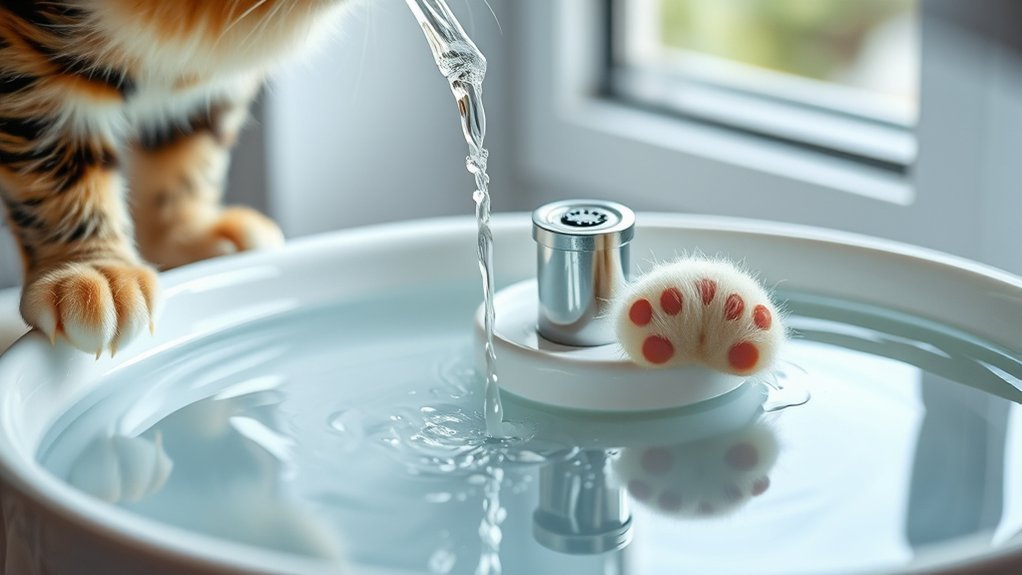
A steady flow shows that the pump, water level, intake, and filter are working together. It may also make the fountain attractive to cats that prefer moving water. However, a fountain is not guaranteed to increase intake for every cat.
A controlled study of different water-bowl types found no appreciable overall difference in water intake, showing that cats do not respond uniformly to fountains. Cornell likewise notes that some cats drink more from fountains while individual preferences vary. Keep a clean still-water bowl available and let your cat choose.
A healthy fountain has a steady, quiet flow—but moving water is not self-cleaning water.
| Flow condition | Likely explanation | Action |
|---|---|---|
| Weak or intermittent | Low water, clogged filter, dirty intake, trapped air, or worn pump | Refill, reseat the filter, clean the pump, and restart as directed |
| Steady and quiet | Normal circulation | Maintain water level and cleaning schedule |
| Loud or vibrating | Low water, debris near the impeller, poor seating, or pump wear | Unplug, refill, clean, and reseat the pump |
| Splashing or overflowing | Excess flow, incorrect assembly, unsoaked filter, blocked return, or uneven surface | Check assembly, filter preparation, flow setting, and surface level |
Cat Fountain Filter and Pump Troubleshooting
The Fountain Flow Is Slow
Check the water level first. Then remove and inspect the filter, foam prefilter, pump intake, spout, and tubing. Clean the impeller area if the pump is designed to open. A new filter that was not soaked or rinsed as instructed may also restrict flow until fully saturated.
The Pump Is Noisy
A pump may become noisy when the water level is low, air is trapped inside, debris reaches the impeller, or the pump is not seated correctly. Unplug it, fill the reservoir, clean the pump, and reassemble the unit on a level surface. Replace a damaged pump or cable rather than attempting an unsafe repair.
The Water Still Smells After a Filter Change
A new filter cannot clean residue already coating the basin, pump, tubing, or seals. Disassemble and wash every water-contact part. Replace any foam or cartridge that remains slimy or damaged. Also check whether food crumbs, saliva, direct sunlight, or long intervals between water changes are contributing to the odor.
Black Particles Appear in the Water
Fine black particles are often loose activated-carbon dust. Follow the filter instructions, which may require rinsing until clear or soaking before rinsing. If particles continue after correct preparation, inspect the cartridge for a tear and replace it if damaged.
The Fountain Leaks
Place the fountain on a level, water-resistant surface. Check the reservoir, gasket, cord channel, tubing, pump cover, filter housing, and maximum-fill line. A misaligned cartridge or blocked return path can redirect water over the edge. Stop using a unit with a cracked reservoir, damaged cable, or wet electrical connection.
How to Keep Your Cat Hydrated at Home
A fountain is one hydration option, not the entire plan. Cornell estimates that cats need about 4 ounces of total water per 5 pounds of lean body weight each day. This includes water in food, so a cat eating moisture-rich wet food may drink less from a fountain or bowl than a cat eating dry food.
Practical ways to make water easier to access include:
- Provide more than one water station in different quiet locations.
- Keep water away from dirty litter areas and heavy foot traffic.
- Offer both a fountain and a wide, clean bowl while learning your cat’s preference.
- Prevent one pet from blocking another cat’s access to water.
- Refresh still-water bowls daily and clean them regularly.
- Discuss wet food or adding water to food with your veterinarian when increased fluid intake is medically important.
- Watch for sudden changes in drinking or urination rather than relying only on a fountain app or reservoir level.
Some cats dislike pump noise, reflections, narrow drinking spaces, or water touching their whiskers. Introduce the fountain gradually, place it beside an existing bowl, and do not remove the familiar bowl until you know the cat is drinking normally.
Warning: Repeated straining to urinate, frequent trips to the litter box with little or no urine, crying during urination, blood in the urine, vomiting, or severe distress can indicate a urinary emergency. Cornell states that complete urethral obstruction requires immediate veterinary treatment. A fountain or filter cannot treat this condition.
Frequently Asked Questions
Do cat fountains really need a filter?
Use a filter when the fountain was designed for one. It catches debris, may improve taste and odor, and can protect the pump. Some models can operate without a disposable carbon cartridge, but you should follow the manufacturer’s instructions and clean the fountain more often when no physical filtration is present.
How often should a cat fountain filter be changed?
Many disposable filters last about 2 to 4 weeks, while some manufacturers specify two weeks or approximately one month. Follow the schedule for your exact model and replace the filter early when it is clogged, slimy, damaged, saturated, or restricting flow.
Which filter goes first, sediment or carbon?
In a system with separate media, the coarse debris or sediment layer normally comes before activated carbon so hair and particles do not clog the carbon section as quickly. Do not rearrange a sealed cartridge or reverse its direction unless the fountain instructions allow it.
How do you prepare a new cat fountain filter?
Read the cartridge directions. Some filters should be rinsed under cold water until the water runs clear. Others require soaking for several minutes and then rinsing. Proper preparation removes loose carbon dust, saturates the media, and can prevent weak flow or overflowing.
Can a disposable carbon filter be washed and reused?
Rinsing may remove loose surface debris, but it does not restore exhausted carbon or fully clean material trapped inside a disposable cartridge. Reuse a filter only when the manufacturer specifically permits it, and never wash carbon media with soap.
Why does a new filter leave black dust in the water?
The dust is usually fine activated-carbon material released during shipping. Remove the filter and prepare it according to the instructions. Rinse the fountain before restarting it. Replace the cartridge if its outer pad or seam is damaged.
Does a cat fountain filter prevent urinary problems?
No. A clean fountain may make water easier or more appealing for some cats, but the filter does not prevent or treat urinary infections, stones, cystitis, kidney disease, or urethral obstruction. Discuss drinking or urinary changes with a veterinarian.
Conclusion
A cat fountain filter is useful for catching debris, reducing selected tastes and odors, and helping protect the pump. Its effectiveness depends on correct fit, proper preparation, regular replacement, and complete fountain cleaning.
Follow the instructions for your exact model, inspect the cartridge during every cleaning, and replace it when it becomes clogged, slimy, damaged, or overdue. Keep another source of fresh water available and remember that circulation and carbon filtration do not sterilize water or replace veterinary care.
Sources
- Cornell Feline Health Center: Hydration — feline water needs, dietary moisture, dehydration, and individual fountain preferences.
- Cornell Feline Health Center: Feline Lower Urinary Tract Disease — urinary warning signs, fresh-water guidance, and urethral-obstruction emergencies.
- Robbins et al.: Quantified Water Intake in Laboratory Cats — research comparing still, circulating, and free-falling water presentations.
- PetSafe Drinkwell Replacement Charcoal Filters — filter construction and the model-specific 2-to-4-week replacement range.
- PetSafe Fountain Cleaning Guidance — disassembly, pump cleaning, filter rinsing, and model-specific maintenance.
- Catit PIXI Stainless Steel UV-C Fountain Q&A — filter preparation, approximately monthly replacement, pump care, and carbon dust.
