

Last Updated on August 25, 2026 by Caleb Warren
Electric scooter batteries serve as the central powerplant of your ride, dictating top speed, acceleration, climbing torque, and total travel distance on a single charge. Understanding how battery chemistry, cell format, pack voltage, and the Battery Management System (BMS) interact allows you to maximize performance, calculate accurate real-world range, and prevent premature degradation.
Quick Answer
Most modern electric scooters use lithium-ion (Li-ion) battery packs composed of cylindrical 18650 or 21700 cells with Nickel Manganese Cobalt (NMC) chemistry. Typical systems operate at 36V, 48V, 52V, or 60V. Li-ion provides the highest energy density, lowest weight, and longest lifespan (300–500 full cycles) compared to heavy, legacy lead-acid alternatives.
Key Takeaways
- Dominant Chemistry: Lithium Nickel Manganese Cobalt Oxide (NMC / LiNiMnCoO2) provides the optimal balance of high energy density, thermal safety, and power delivery for micromobility.
- Cell Formats: Compact commuter scooters rely on standard 18650 cells, while performance models increasingly utilize higher-capacity 21700 cells for reduced voltage sag and cooler operation.
- Range Calculation: Battery capacity is measured in Watt-hours (Wh = Volts × Amp-hours). Real-world riding typically consumes between 15 to 25 Wh per mile.
- Lifespan Preservation: Maintaining battery charge between 20% and 80% and storing packs at 40%–50% charge in climate-controlled spaces prevents premature capacity loss.
Disclosure: As an Amazon Associate I earn from qualifying purchases. Some links on this page are affiliate links, at no extra cost to you.
What Kind of Battery Does an Electric Scooter Use?
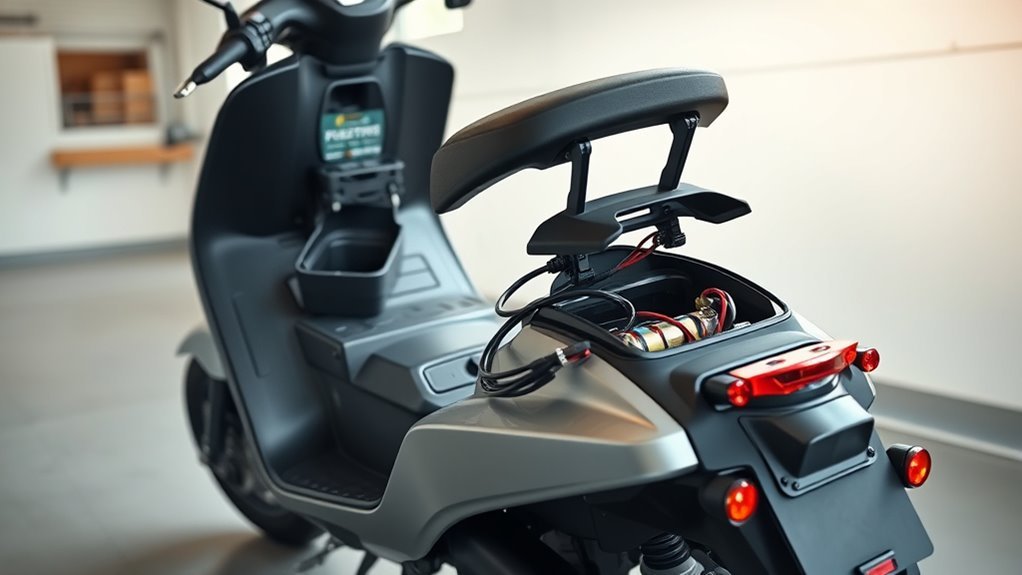
The vast majority of electric scooters rely on lithium-ion (Li-ion) battery packs due to their exceptional energy density, lightweight construction, and low self-discharge rates. Within the lithium family, manufacturers assemble hundreds of individual cylindrical cells—most commonly NMC (Nickel Manganese Cobalt) or INR configurations—into a unified, protective aluminum casing housed within the deck.
Pack configurations vary based on the scooter’s performance tier:
- Entry-Level / Commuter: 36V packs with 250Wh to 360Wh capacity, offering 12 to 18 miles of real-world range at moderate speeds (15 mph).
- Mid-Range Cruisers: 48V to 52V packs with 500Wh to 1,000Wh capacity, delivering 25 to 40 miles of range with stronger hill-climbing torque.
- High-Performance Dual-Motor Models: 60V to 72V packs exceeding 1,500Wh, engineered for sustained high-speed riding, rapid acceleration, and ranges surpassing 50 miles.
While budget or youth models occasionally employ Sealed Lead-Acid (SLA) batteries to minimize upfront retail costs, SLA packs are significantly heavier, offer less than half the usable range per pound, and degrade within 150 to 300 cycles.
Lithium-Ion Battery Types and Cell Formats
Not all lithium-ion packs perform identically. A battery pack’s efficiency, discharge capability, and thermal stability depend heavily on individual cell chemistry and mechanical cell dimensions.
| Battery Chemistry / Type | Energy Density | Cycle Life (to 80% Capacity) | Thermal Runaway Temp | Primary Use Case |
|---|---|---|---|---|
| Li-ion NMC (LiNiMnCoO2) | High (150–220 Wh/kg) | 300–500 cycles | ~210°C (410°F) | Standard for 90%+ of modern commuter and performance scooters. |
| LiFePO4 (LFP / Lithium Iron Phosphate) | Moderate (90–140 Wh/kg) | 2,000–3,000+ cycles | ~270°C (518°F) | Commercial rental fleets and ultra-long-lifespan utility builds. |
| Sealed Lead-Acid (SLA / AGM) | Very Low (30–40 Wh/kg) | 150–300 cycles | Non-combustible | Ultra-budget kids’ toys and legacy entry-level utility scooters. |
Li-Ion Cell Chemistries: NMC vs. LFP
Modern electric scooter packs almost universally standardize on Nickel Manganese Cobalt Oxide (NMC). NMC delivers the necessary sustained discharge current (often 15A to 30A per parallel group) required to accelerate an adult rider uphill without precipitous voltage collapse. Manganese adds structural and thermal stability to the crystal framework, while nickel provides high specific energy.
Lithium Iron Phosphate ($\text{LiFePO}_4$ or LFP) is gaining traction in commercial sharing fleets due to its unmatched cycle life (surpassing 2,000 full recharge cycles) and virtually nonexistent risk of thermal runaway. However, because LFP is roughly 30% heavier and bulkier for an equivalent capacity, consumer portable scooters continue to prioritize NMC.
18650 vs. 21700 Cylindrical Cells
Individual lithium cells are manufactured in standardized cylindrical form factors, named after their physical dimensions:
- 18650 Cells: Measure 18mm in diameter by 65mm in length. Standard capacity ranges from 2,200mAh to 3,500mAh per cell. They have powered consumer electronics and electric mobility for decades.
- 21700 Cells: Measure 21mm in diameter by 70mm in length. With a ~46% increase in internal volume, a single 21700 cell delivers between 4,000mAh and 5,000mAh. Packs built from 21700 cells require fewer total cell welds, exhibit lower internal resistance ($R_{int}$), and dissipate heat more efficiently under heavy throttle loads.
Why Budget Scooters Use Lead-Acid Batteries
Sealed Lead-Acid (SLA) batteries are occasionally found in entry-level, children’s, or budget utility scooters. The primary incentive for manufacturers is upfront affordability: raw lead-acid battery packs cost up to 60% less to produce than lithium-ion equivalents.
However, lead-acid batteries present severe operational limitations for riders:
- Excess Weight: An SLA pack offering just 250Wh can weigh over 18 lbs (8 kg), whereas an equivalent 250Wh Li-ion pack weighs roughly 3.5 lbs (1.6 kg).
- Severe Voltage Sag: Lead-acid chemistry experiences dramatic voltage drops under acceleration, causing the scooter to feel sluggish even when half-charged.
- Peukert’s Law Penalty: Discharging an SLA battery rapidly (as required by an electric motor) dramatically cuts its usable capacity compared to its nominal rating.
- Limited Longevity: Frequent deep discharging rapidly sulfites lead plates, degrading capacity within 150 to 250 cycles.
How Electric Scooter Battery Packs Are Built
A scooter battery is constructed by linking dozens of individual 3.6V (nominal) cylindrical cells into structured matrix configurations known as Series (S) and Parallel (P) groups.
Pack Configuration Math:
• Series (S) adds Voltage: Ten 3.6V cells in series ($10\text{S}$) = $36\text{V}$ nominal ($42\text{V}$ peak).
• Parallel (P) adds Capacity & Current: Three 3,000mAh cells in parallel ($3\text{P}$) = $9,000\text{mAh}$ ($9\text{Ah}$) total capacity.
• A $10\text{S}3\text{P}$ pack utilizes 30 individual cells to produce a $36\text{V}$, $9\text{Ah}$ ($324\text{Wh}$) battery system.
Cells are secured within flame-retardant cell holders, spot-welded together using pure nickel strips to minimize electrical resistance, wrapped in high-temperature fiberglass insulation, sealed in PVC heat-shrink tubing, and wired directly to the BMS board.
Voltage, Capacity, and Range Calculations
Evaluating an electric scooter’s true performance potential requires assessing both Nominal Voltage (V) and Capacity (Amp-hours / Watt-hours) in tandem.
Voltage Ratings Explained
Voltage represents electrical pressure. Higher system voltage allows the motor to spin faster (higher RPM) and draw the same mechanical power with fewer amps of current, reducing heat generation in the motor controller wiring:
- 36V Systems (10S): Maximum charge $42.0\text{V}$, nominal $36.0\text{V}$, cutoff $\sim 30.0\text{V}$. Found on entry commuter scooters with top speeds of 15–18 mph.
- 48V Systems (13S): Maximum charge $54.6\text{V}$, nominal $48.0\text{V}$, cutoff $\sim 39.0\text{V}$. Delivers reliable 20–25 mph speeds and moderate hill climbing.
- 52V Systems (14S): Maximum charge $58.8\text{V}$, nominal $50.4\text{V}$–$52.0\text{V}$, cutoff $\sim 42.0\text{V}$. Delivers punchy mid-tier acceleration up to 30 mph.
- 60V Systems (16S): Maximum charge $67.2\text{V}$, nominal $57.6\text{V}$–$60.0\text{V}$, cutoff $\sim 48.0\text{V}$. Powers high-performance dual-motor scooters capable of 40+ mph.
Calculating Real-World Range (Watt-Hours)
To determine how much energy a battery stores, always multiply nominal voltage by amp-hours to find total Watt-hours (Wh):
$$\text{Watt-hours (Wh)} = \text{Nominal Voltage (V)} \times \text{Capacity (Ah)}$$
Pro Tip (Real-World Range Rule of Thumb): While manufacturers test range under idealized flat laboratory conditions with lightweight riders, real-world riding consumes approximately:
• Gentle Commuting (15 mph, flat terrain): $\sim 15\text{–}18\text{ Wh per mile}$
• Aggressive Riding / Hills (20–25 mph): $\sim 22\text{–}30\text{ Wh per mile}$
• High-Performance Dual Motor (30+ mph): $\sim 35\text{–}50\text{ Wh per mile}$
A 48V 15Ah (720Wh) battery will yield approximately $30\text{–}40\text{ miles}$ of realistic riding.
Which Battery Brands Are Best for Scooters?
The reliability, cycle longevity, and safety of an electric scooter pack are directly tied to the manufacturer of the underlying cells. Tier-1 cell producers enforce strict quality control, ensuring tightly matched internal resistance across all cells in the pack.
- Tier 1 Manufacturers (Premium Quality): Samsung SDI (e.g., 35E, 50E), LG Energy Solution (e.g., M50LT, HG2), and Panasonic / Sanyo (e.g., NCR18650GA). These cells offer high cycle stability, minimal capacity loss over 500+ cycles, and excellent thermal dissipation under load.
- Tier 2 Manufacturers (Reliable Value): EVE Energy, Bak Power, and Lishen. Frequently used by reputable mid-tier scooter brands, offering dependable performance at a lower component cost.
- Generic / Unbranded Cells: Generic Chinese blue-wrap cells without traceable batch numbers or manufacturer stamps. These packs frequently exhibit severe cell imbalance, exaggerated capacity ratings, high internal resistance, and elevated failure rates.
How the Battery Management System (BMS) Works
A lithium battery pack cannot safely operate without an electronic Battery Management System (BMS). The BMS acts as the brain and safety guardian of the pack, continuously monitoring individual series voltages and pack temperatures via microcontrollers and thermistors.
1. Overcharge and Deep Discharge Protection
Lithium-ion cells degrade permanently if discharged below $2.5\text{V}$ or charged above $4.25\text{V}$. The BMS executes automated hardware-level cutoffs:
- High-Voltage Cutoff: Halts charging immediately when any series group reaches $4.20\text{V} – 4.25\text{V}$.
- Low-Voltage Cutoff: Disconnects motor draw when the pack drops to its safe operating limit (typically $3.0\text{V} – 3.1\text{V}$ per cell under load) to prevent copper dendrite formation and cell reversal.
2. Cell Balancing
Due to minute variations in internal resistance, series groups charge and discharge at slightly different rates. The BMS equalizes these differences:
- Passive Balancing: During the top end of the charge cycle ($>4.1\text{V}$ per cell), small onboard bleed resistors burn off excess energy as heat from the fullest cells, allowing lower cells to catch up.
- Active Balancing: Advanced BMS units shuttle electrical charge dynamically between stronger and weaker series groups during both charge and discharge cycles, maximizing total usable energy.
3. Thermal Management and Short-Circuit Protection
The BMS incorporates one or more NTC thermistors placed directly against cell groupings. If internal pack temperatures rise above safe operating thresholds (typically $60^\circ\text{C}$ / $140^\circ\text{F}$ during discharge or $45^\circ\text{C}$ / $113^\circ\text{F}$ during charging), the BMS opens its MOSFET switches to isolate the pack, preventing thermal runaway.
Warning (Fire Safety & UL Standards): Always ensure your electric scooter or replacement battery pack complies with UL 2271 (Standard for Batteries for Use in Light Electric Vehicle Applications) or full-vehicle UL 2272 certification as certified by UL Solutions. Never charge a battery pack that has suffered physical chassis puncture, water submersion, or emits a sweet chemical odor.
What Is C-Rate and Why Does It Matter?
The C-rate measures the speed at which a battery is charged or discharged relative to its maximum capacity. A discharge rate of $1\text{C}$ means the entire capacity of the battery is drawn in exactly one hour. For example, discharging a $10\text{Ah}$ battery at $10\text{A}$ corresponds to a $1\text{C}$ rate; discharging it at $20\text{A}$ represents $2\text{C}$ (30-minute discharge).
- Discharge C-Rate: High-performance dual-motor scooters require high-drain cells capable of continuous $3\text{C}$ to $5\text{C}$ discharge without overheating.
- Charge C-Rate: Standard scooter chargers operate at a gentle $0.15\text{C} – 0.25\text{C}$ (e.g., a $2\text{A}$ charger on a $10\text{Ah}$ pack takes roughly 5 hours). While “fast chargers” operating at $0.5\text{C}$ ($4\text{A} – 5\text{A}$) cut charging times in half, frequent high-current charging generates additional heat and slightly accelerates long-term cathode degradation.
How Long Do Electric Scooter Batteries Last?
A quality lithium-ion scooter battery delivers between 300 and 500 complete charge cycles before its usable capacity declines to approximately 70%–80% of its original rating. In practical terms, this translates to 3,000 to 10,000 miles of riding, or approximately 2 to 4 years of regular commuting.
Note on Storage: If you do not plan to ride your scooter for more than 3 weeks, never leave it plugged in at 100% or stored completely dead at 0%. Store the scooter at 40% to 50% state of charge (roughly 3.7V–3.8V per cell) in a dry environment between $10^\circ\text{C}$ and $20^\circ\text{C}$ ($50^\circ\text{F}–68^\circ\text{F}$) to minimize calendar aging.
Signs Your Electric Scooter Battery Is Failing
As lithium-ion packs reach the end of their operational life, internal resistance increases and individual series groups lose capacity balance. Watch for these primary diagnostic symptoms:
- Severe Voltage Sag Under Load: The display battery meter drops 2 to 3 bars instantly when you pull the throttle on a flat road or hill, recovering only when throttle is released.
- Premature Shutdown: The scooter cuts power abruptly while the display still indicates 20% to 30% remaining charge (caused by a single weak series group hitting the BMS low-voltage cutoff early).
- Abnormally Fast Charging: The charger indicator turns green in a fraction of the normal recharge time, indicating that reduced cell capacity can no longer absorb its rated amp-hours.
- Reduced Real-World Range: You achieve less than 50% of the mileage you originally attained under identical riding conditions and tire pressures.
Frequently Asked Questions
What kind of batteries are used in electric scooters?
Most modern electric scooters use lithium-ion battery packs built from 18650 or 21700 cylindrical cells, most commonly utilizing Lithium Nickel Manganese Cobalt Oxide (NMC) chemistry. Premium models use branded cells from Samsung, LG, or Panasonic, while budget or older models may use sealed lead-acid (SLA) packs.
How much does it cost to replace a battery in an electric scooter?
Replacing an electric scooter battery typically costs between $150 and $600 for standard commuter models (36V–48V) and $800 to $1,500+ for large 60V–72V performance packs. Because the battery represents 30% to 50% of the scooter’s total value, component costs scale directly with Watt-hour capacity and cell brand quality.
Can you replace electric scooter batteries yourself?
Yes, on most modular electric scooters, you can replace the battery pack by removing the deck plate, disconnecting the main XT60/XT90 power lead and charging harness, and swapping in an identical replacement pack. You must match the voltage, physical dimensions, discharge connector, and polarity exactly to avoid damaging the motor controller.
What happens if you don’t charge or ride your electric scooter for 3 months?
If left uncharged for several months, the Battery Management System’s parasitic draw will slowly drain cells below their critical 2.5V threshold. Once a cell undergoes deep self-discharge, the BMS may enter permanent lock-out mode to prevent dangerous recharging of copper-shunted cells, effectively bricking the pack.
Conclusion
The battery pack is the single most critical and expensive subsystem on an electric scooter, establishing its range, acceleration limits, and operating lifespan. While modern lithium-ion NMC and 21700 cell architectures deliver outstanding energy density and responsive power, maintaining your pack’s health requires proactive care. By avoiding prolonged exposure to temperature extremes, charging with the correct voltage-regulated hardware, and storing your scooter at partial charge, you can easily achieve 3 to 4 years of dependable, high-output riding.
Sources
- Battery University (Cadex Electronics) — In-depth technical specifications on lithium-ion chemistries (NMC, LFP, LCO) and discharge characteristics.
- UL Solutions (UL 2271 / UL 2272) — North American safety standards and certification criteria for light electric vehicle battery systems.
- U.S. Consumer Product Safety Commission (CPSC) — Micromobility battery safety guidelines and fire prevention best practices.
- Samsung SDI — Technical specification sheets for high-drain 18650 and 21700 lithium-ion cylindrical cells.
