

Last Updated on September 11, 2026 by Daniel Globe
For most travelers, a scheduled commercial flight is generally safer than operating or riding in a small recreational boat. That answer needs context, though. A large ferry or cruise ship is not the same as a personal boat, and a private or charter aircraft is not the same as a major airline flight. Weather, operator skill, equipment, regulation, and passenger behavior all affect the real risk.
Quick Answer
Scheduled commercial airlines generally offer a lower fatal risk than recreational boating. However, inspected ferries and cruise ships follow much stricter standards than personal boats, so “plane versus boat” is not one simple comparison. Your safest choice depends on the operator, vessel or aircraft type, weather, equipment, and trip conditions.
Key Takeaways
- Scheduled airline travel is highly regulated and generally has a lower fatal risk than recreational boating.
- Do not treat cruise ships, ferries, charter boats, and personal boats as one category; their crews, inspections, equipment, and operating rules differ.
- In 2024, the U.S. Coast Guard recorded 3,887 reported recreational boating incidents involving 556 deaths and 2,170 injuries.
- Wearing a properly fitted life jacket, checking the marine forecast, avoiding alcohol, and filing a float plan can sharply reduce boating risk.
- On a plane, keep your seat belt fastened while seated, pay attention to the safety briefing, and leave luggage behind during an evacuation.
Disclosure: As an Amazon Associate I earn from qualifying purchases. Some links on this page are affiliate links, at no extra cost to you.
Safety Regulations: How Do Planes and Boats Compare?
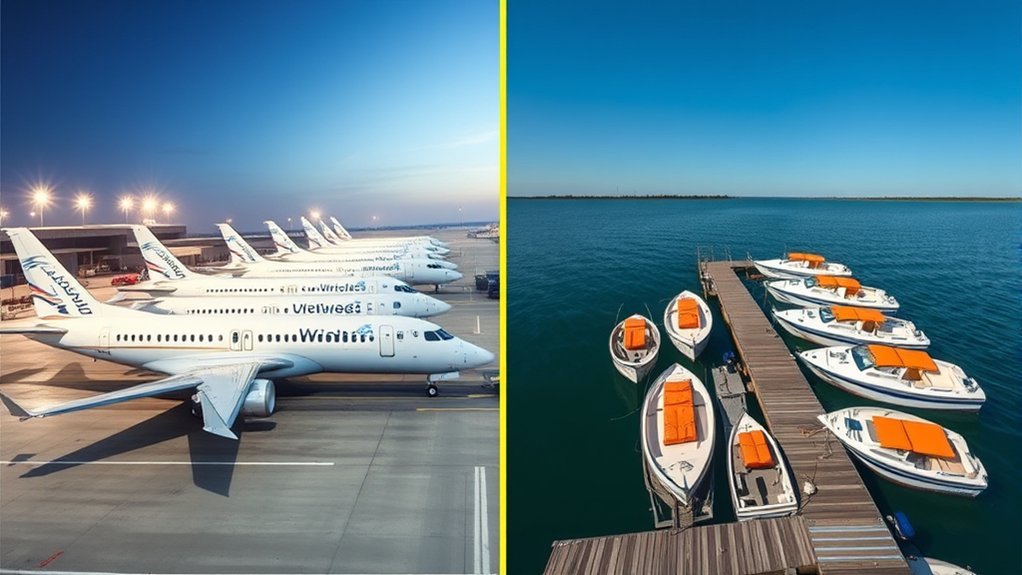
Commercial airlines in the United States operate under detailed Federal Aviation Administration rules covering aircraft maintenance, crew qualifications, training, dispatch, operating procedures, and emergency equipment. The National Transportation Safety Board separately investigates aviation accidents and publishes statistics for scheduled airlines, commuter and charter operations, and general aviation.
Boating rules depend heavily on the type of vessel. The U.S. Coast Guard sets federal requirements for navigation, life jackets, fire protection, distress signals, and other equipment. States also regulate registration, operator age, education, speed, alcohol enforcement, and local waterway use.
Commercial passenger vessels receive more oversight than typical personal boats. Depending on their size, route, passenger capacity, and operation, ferries, cruise ships, and tour boats may be inspected and required to carry trained crew, firefighting systems, lifesaving equipment, emergency instructions, and a valid Certificate of Inspection or comparable international certificate.
Note: A major airline flight should not be compared directly with every activity on the water. A Coast Guard-inspected ferry is a different risk category from an open fishing boat operated by an inexperienced recreational boater.
| Travel Type | Typical Oversight | Main Passenger Risks |
|---|---|---|
| Scheduled commercial airline | Extensive federal operating, maintenance, crew-training, and certification rules | Turbulence injuries, rare accidents, medical events, cabin dryness, and pressure changes |
| Charter or private aircraft | Rules vary by operation; risk should not be assumed to match a major airline | Weather, pilot decision-making, runway conditions, maintenance, and aircraft capability |
| Ferry, cruise ship, or inspected tour boat | Commercial vessel inspections, crew requirements, lifesaving systems, and emergency procedures | Fire, collision, grounding, illness outbreaks, falls, and severe sea conditions |
| Recreational boat | Federal equipment rules plus state and local operating requirements | Drowning, capsizing, collision, falls overboard, alcohol, operator inattention, and changing weather |
Raw annual death totals cannot produce a perfect plane-versus-boat risk rate. A fair calculation would need comparable exposure measures, such as passenger trips, passenger-hours, or passenger-miles. Even with that limitation, scheduled commercial aviation generally offers a stronger safety record than recreational boating.
The U.S. Coast Guard recorded 3,887 reported recreational boating incidents in 2024, involving 556 deaths, 2,170 injuries, and about $88 million in property damage.
Boat Travel Safety Measures: What You Need to Know
Safe boating starts before the vessel leaves the dock. The operator should check the boat, load, weather, fuel, communication equipment, passenger count, and required safety gear. Every passenger should know where the life jackets are, how to put one on, and what to do if someone falls overboard.
Essential Safety Equipment
Federal requirements vary by vessel size, design, propulsion, location, and use. The Coast Guard’s Boater’s Guide to Federal Requirements explains the equipment rules in detail. A recreational boat may need:
- A properly sized, Coast Guard-approved wearable life jacket for each person
- A throwable flotation device on most boats longer than 16 feet, with exceptions for certain craft
- Navigation lights and a sound-producing device
- Visual distress signals on covered coastal and connected waters
- A marine fire extinguisher when the boat has specified engine, fuel, or enclosed-compartment hazards
- A working engine cut-off switch when required
- A first-aid kit, anchor, bailer or pump, and suitable communication equipment
A VHF marine radio is often more useful than a phone offshore because it can reach nearby vessels and rescue authorities at the same time. A phone should still be protected in a waterproof case and kept charged.
Warning: Having a life jacket on board is not the same as wearing it. The Coast Guard recommends wearing one whenever the boat is underway. In 2024, 76% of fatal boating victims with a known cause of death drowned, and 87% of drowning victims with known life-jacket status were not wearing one.
Federal rules generally require children under 13 to wear an approved life jacket on a moving vessel unless they are below deck or inside an enclosed cabin. A state may apply a different child-wear rule on waters under its jurisdiction, so check the local requirement before departure.
Weather Awareness Strategies
Check the local National Weather Service marine forecast, not just a general weather app. Review wind, waves, visibility, tides, currents, thunderstorms, water temperature, and all active advisories or warnings.
| Weather Condition | Safer Response |
|---|---|
| Heavy rain or lightning | Return to a safe harbor when possible; avoid exposed areas and follow emergency guidance. |
| High winds or steep waves | Do not depart if conditions exceed the operator’s skill or the vessel’s safe capability. |
| Fog or poor visibility | Slow down, use navigation lights and sound signals, maintain a lookout, and use radar or charts when equipped. |
| Approaching storm | Head for shelter early rather than waiting until wind, waves, and visibility deteriorate. |
| Low tide or strong current | Review charts and tide information; watch for shoals, grounding hazards, bridges, and restricted channels. |
| Cold water | Wear a life jacket and suitable protective clothing; cold-water immersion can quickly impair breathing and movement. |
There is no universal rule saying that a particular wind speed always creates a certain wave height. Waves depend on wind speed, duration, fetch, current, depth, and local geography. Use the forecast for the exact waterway and vessel type.
File a Float Plan and Brief Your Passengers
Before a recreational trip, leave a float plan with a responsible person on shore. Include the operator’s name, vessel description, passenger list, launch point, route, expected return time, and emergency contacts. Tell that person when to contact authorities if you do not return.
Before departure, show passengers:
- Where life jackets, extinguishers, distress signals, and first-aid supplies are stored
- How to stop the engine and call for help
- Where to sit and how to keep weight balanced
- What to do during a person-overboard, fire, flooding, or abandon-boat emergency
- Why alcohol, standing in unsafe areas, and sitting on the bow or gunwale can increase risk
Pro Tip: Recreational boat owners can request a voluntary Vessel Safety Check through the Coast Guard Auxiliary or another approved participating organization. The check can identify missing or damaged equipment without issuing a citation for a failed inspection.
How to Evaluate a Ferry, Tour Boat, or Charter Operator
Before booking a commercial water trip, confirm that the operator is authorized for the service being sold. Look for a professional safety briefing, visible life jackets, posted passenger limits, clear weather-cancellation rules, and trained crew.
For a small charter or tour boat, ask:
- Is the captain properly licensed for this operation?
- Is the vessel carrying more passengers than its legal limit?
- Does the operator provide child-size life jackets when children are aboard?
- What happens if the marine forecast worsens?
- Where are the exits, flotation devices, fire equipment, and emergency communication devices?
Do not board if the vessel appears overloaded, the operator seems impaired, required safety gear is missing, or the captain dismisses an active weather warning.
How Do Emergency Protocols Compare for Planes and Boats?
Airline passengers receive a standardized safety briefing covering seat belts, exits, oxygen masks, flotation devices when applicable, and brace or evacuation instructions. Transport-category aircraft with more than 44 passenger seats must meet a certification standard showing that the maximum occupant load can evacuate under simulated emergency conditions within 90 seconds.
That 90-second federal benchmark is not a promise that every real evacuation will finish in that time. Fire, smoke, injuries, blocked exits, water, terrain, and passengers attempting to retrieve bags can delay escape.
If an aircraft evacuation is ordered:
- Listen to the crew and use the nearest safe exit, which may be behind you.
- Leave every bag and personal item behind.
- Remove sharp shoes only when instructed.
- Move away from the aircraft after reaching the ground.
- Do not inflate a life vest inside the cabin because it can restrict movement or trap you if water enters.
Emergency procedures at sea depend on the vessel. A cruise ship may use alarm signals, muster stations, lifeboats, life rafts, fire zones, and trained emergency teams. A small recreational boat may have no dedicated crew, which makes the operator’s planning and passenger briefing especially important.
During a boat emergency, passengers may need to put on life jackets, send a distress call, control flooding or fire, remain with a floating vessel, or enter survival craft. Abandoning the vessel is normally a last resort unless fire, sinking, or another immediate danger makes remaining aboard unsafe.
How Does Crew Training Enhance Safety?
Airline pilots, flight attendants, mechanics, and dispatch personnel train for the duties assigned to their roles. Approved programs can include aircraft systems, evacuations, firefighting, decompression, first aid, crew communication, security, and recurrent emergency drills.
Training requirements differ by operation, so there is no single number of hours that describes every airline crew member. What matters to passengers is that scheduled airlines operate within standardized federal training and qualification systems.
Commercial mariners also train for their assigned duties. On inspected passenger vessels, crew members may practice fire response, man-overboard procedures, passenger mustering, launching survival craft, damage control, and abandoning ship. Training aboard a regulated ferry or cruise ship therefore should not be equated with the informal experience of a recreational boat operator.
Weather Considerations: Which Mode Holds Up Better?
Both aviation and marine operators can delay, reroute, divert, or cancel a trip because of weather. The difference is how the vehicle interacts with the conditions. Aircraft can sometimes climb above low weather, but they still face thunderstorms, icing, turbulence, wind shear, crosswinds, poor visibility, and runway limits. Boats remain on the water and are directly affected by waves, currents, wind, lightning, fog, and changing water levels.
Impact of Wind Conditions
Aircraft do not have one universal safe wind limit. Pilots and dispatchers consider the crosswind component, gusts, runway direction, aircraft type, runway condition, airport procedures, and company limits. A flight may be delayed, sent to another runway, diverted, or canceled when those limits cannot be met.
For boats, wind can reduce control and build waves. Small, lightly loaded, open, or top-heavy craft are usually more vulnerable than large ships. The safe decision depends on the boat’s design, loading, operator skill, waterway, distance from shelter, and forecast.
Rain, Fog, and Sea Stability
Rain alone does not determine whether a flight or boat trip is unsafe. Thunderstorms, lightning, poor visibility, wind, hail, icing, and rapidly changing conditions matter more than rainfall by itself.
Aircraft can encounter turbulence even at normal cruising altitude, so passengers should keep their seat belts fastened whenever seated. On a boat, rolling and pitching can affect balance, cause seasickness, shift unsecured equipment, and increase the chance of a fall or person-overboard event.
Fog is especially dangerous on the water because it can hide land, markers, shoals, and other vessels. The National Weather Service advises boaters in fog to slow down, use navigation lights, listen for sound signals, maintain a lookout, and use suitable charts, GPS, or radar when available.
Temperature and Comfort Levels
Airliners provide a controlled cabin, but temperature can still vary by aircraft, seat location, boarding conditions, and air circulation. Aircraft cabin humidity is commonly only about 10%–20%, according to the CDC Yellow Book. This can dry the eyes, nose, throat, and skin.
Boat comfort changes more directly with the outdoor environment. Wind, spray, sun, cold water, rain, and humidity can make conditions uncomfortable or dangerous. Pack layers, sun protection, and waterproof clothing suited to the route rather than relying only on the air temperature at departure.
Safety, Health, and Comfort: Plane vs. Boat Travel
Planes and boats create different health concerns. On an aircraft, cabin pressure is normally equivalent to an altitude of about 6,000–8,000 feet. Most healthy travelers tolerate this without difficulty, but people with certain heart, lung, blood, or cerebrovascular conditions may need medical advice before flying.
Long periods of sitting can also increase discomfort and may contribute to blood-clot risk in susceptible travelers. On a long trip, follow your clinician’s advice, move your legs, and walk when it is safe and permitted.
Boat passengers are more likely to experience motion sickness because of rolling, pitching, and visual motion. The CDC advises that preventive measures work best before severe symptoms begin. Looking toward the horizon, getting fresh air, lying down when safe, avoiding heavy alcohol use, and being well rested may help.
Note: Motion-sickness medicines can cause drowsiness and have medical contraindications. Ask a healthcare professional or pharmacist which option is appropriate, especially for children, pregnant travelers, older adults, or anyone taking other medicines.
On a cruise ship, handwashing is important because gastrointestinal and respiratory illnesses can spread in shared spaces. Wash with soap and water before eating and after using the restroom, and report significant illness to the ship’s medical staff.
Packing for Safety: Essential Items for Planes and Boats
Pack important safety items where you can reach them, but do not block aisles, exits, or access to emergency equipment.
For Air Travel
- Required medicines in your carry-on, in their original or clearly labeled containers when practical
- A refillable water bottle that can be filled after security
- Identification and copies of important travel documents
- A charged phone and permitted portable battery packed according to airline rules
- Warm clothing for cabin-temperature changes
- Compression or mobility items recommended by your healthcare professional
TSA’s rule is called 3-1-1, not 3-3-3. Each carry-on liquid, aerosol, gel, cream, or paste container generally must hold no more than 3.4 ounces or 100 milliliters. The containers must fit inside one clear quart-size bag, with one bag allowed per passenger. Medical and other permitted exceptions have separate screening rules. Review the current TSA liquids guidance before packing.
For Boat Travel
- A wearable life jacket suitable for your size and activity
- Waterproof protection for identification, phones, and documents
- Sun protection, drinking water, and weather-appropriate layers
- Personal medicines and a first-aid kit
- A whistle, light, or other lawful signaling equipment for the trip
- Motion-sickness supplies selected before departure
- A charged phone plus a VHF radio, locator beacon, or other appropriate communication equipment for remote waters
Do not pack safety equipment and assume the trip is covered. Inspect expiration dates, batteries, seals, straps, extinguisher condition, and communication equipment before leaving.
Making the Right Safety Choice for Your Next Trip
For a long-distance trip served by a scheduled airline, flying will usually be the safer and faster choice. For a ferry, cruise, or licensed tour-boat trip, review the operator rather than assuming that all water travel carries the risk of recreational boating.
Use this decision guide:
- Identify the operation. Is it a scheduled airline, charter aircraft, inspected passenger vessel, licensed charter boat, or personal boat?
- Check the operator. Confirm licensing, legal passenger capacity, safety equipment, inspection status when applicable, and cancellation policies.
- Review the weather. Check official aviation or marine information for the route and travel time.
- Consider your health. Account for motion sickness, mobility, cabin pressure, severe congestion, pregnancy, recent surgery, or chronic medical conditions.
- Assess the emergency plan. Know the exits, flotation equipment, muster point, communication method, and crew instructions.
- Trust a cancellation. A delay or cancellation caused by unsafe conditions is a safety measure, not a reason to pressure the operator to depart.
In simple terms, a scheduled commercial flight generally wins the statistical safety comparison with recreational boating. The comparison becomes less clear when a private aircraft is compared with an inspected ferry or large passenger ship. Choose based on the exact operation, not just whether it travels through the air or across water.
Frequently Asked Questions
What is safer, a plane or a boat?
A scheduled commercial airline flight is generally safer than recreational boating. However, the answer changes with the category. An inspected ferry or cruise ship has trained crew and extensive safety systems, while a private plane or unlicensed charter may not match the safety profile of a major airline.
What is the 3-1-1 rule for flying?
The TSA 3-1-1 rule generally allows carry-on liquids, gels, aerosols, creams, and pastes in containers holding 3.4 ounces or 100 milliliters or less. All containers must fit inside one clear quart-size bag, and each passenger may bring one such bag. Medical and other permitted exceptions have separate rules.
Is it safer to fly or travel by boat?
Flying on a scheduled commercial airline is usually safer than traveling in a recreational boat. A regulated ferry or cruise ship is a different comparison because commercial passenger vessels undergo inspections and carry trained crew, emergency equipment, and lifesaving systems.
Why do some travelers avoid seat 11A on a plane?
There is no universal reason to avoid seat 11A. Seat numbers and layouts vary by airline, aircraft model, and cabin configuration. On one plane it may be an ordinary window seat; on another it may be near an exit, galley, lavatory, or missing window. Check the operating airline’s current seat map.
Does every boat passenger need a life jacket?
A recreational boat generally must carry a properly sized, Coast Guard-approved wearable life jacket for every person aboard. Wear requirements depend on age, activity, vessel type, and state law. The Coast Guard recommends wearing a life jacket whenever the boat is underway.
How can I tell whether a boat tour is safe?
Check that the operator is authorized for the trip, follows legal passenger limits, provides an understandable safety briefing, carries suitable life jackets, and has a clear weather-cancellation policy. Do not board an overloaded vessel or one operated by someone who appears impaired or dismisses active weather warnings.
Conclusion
For an ordinary passenger choosing between a scheduled airline and a recreational boat, the plane is generally the safer option. Still, the label alone does not decide the risk. A professionally operated ferry or cruise ship has far more oversight and emergency capability than a personal boat, while a private or charter aircraft may not share a major airline’s safety profile.
Choose a reputable operator, check the weather, follow the safety briefing, use the required protective equipment, and never pressure a pilot or captain to continue in unsafe conditions. Those choices matter whether your trip is in the air or on the water.
Sources
- National Transportation Safety Board — U.S. Civil Aviation Statistical Reviews — aviation accident categories and statistics through 2024.
- U.S. Coast Guard — Recreational Boating Accident Statistics — 2024 boating incidents, deaths, injuries, and property damage.
- U.S. Coast Guard — A Boater’s Guide to Federal Requirements — life jackets, fire extinguishers, distress signals, lights, and other equipment requirements.
- Electronic Code of Federal Regulations — 14 CFR 25.803 — aircraft emergency-evacuation certification requirements.
- National Weather Service — Safe Boating and Marine Forecasts — marine warnings, wind, wave, fog, and storm guidance.
- CDC Yellow Book — Travel by Air and Sea — cabin pressure, dry air, motion sickness, and cruise-travel health guidance.

