
Last Updated on August 25, 2026 by Caleb Warren
Peak power in an electric scooter is the maximum short-term output your motor can deliver, usually well above its rated continuous power. You get this extra electrical burst for quicker acceleration, stronger hill climbing, and better throttle response under heavy rider loads. However, a scooter cannot sustain that output level indefinitely due to motor heat dissipation limits and Battery Management System (BMS) current thresholds. Higher battery voltage supports this peak output more efficiently by pulling fewer amps to achieve the same wattage. Understanding peak versus rated power allows you to judge real-world performance, cut through manufacturer marketing specs, and choose the ideal powertrain for your daily riding conditions.
Quick Answer
Peak power is the maximum burst wattage an electric scooter’s motor and controller can pull for brief periods (typically 5 to 30 seconds) during acceleration or steep climbs. In contrast, rated (continuous) power is the highest wattage the motor can run indefinitely without overheating or damaging electrical components.
Key Takeaways
- Burst vs. Continuous: Peak power delivers temporary torque for fast launches and hills; rated power dictates continuous cruising speed and long-term reliability.
- Calculated by Amps and Volts: Peak wattage is determined by multiplying battery voltage by the motor controller’s maximum current limit (Watts = Volts × Amps).
- Thermal Limitations: Sustained peak draws generate rapid heat in the stator coils, triggering controller thermal throttling or BMS cutoffs.
- Voltage Efficiency: Higher voltage systems (52V, 60V, 72V) produce peak power with lower current draw, reducing resistive heat loss (I²R) and voltage sag.
Disclosure: As an Amazon Associate I earn from qualifying purchases. Some links on this page are affiliate links, at no extra cost to you.
What Is Peak Power in an Electric Scooter?
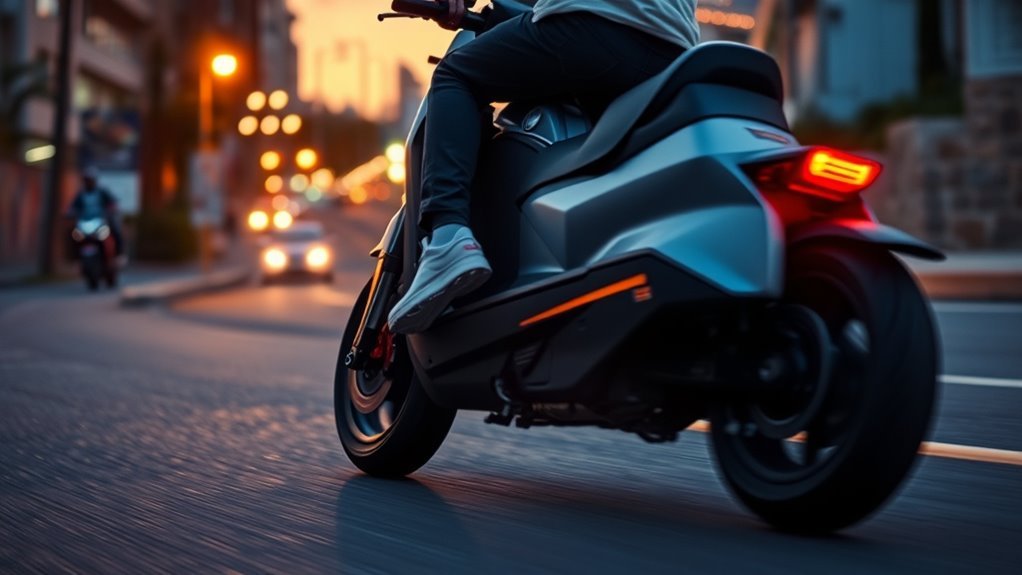
Peak power in an electric scooter is the motor’s maximum short-term output, often reaching 1.5 to 3 times its continuous rated power. It represents a transient operating ceiling rather than a sustainable output level. When you demand rapid acceleration from a dead stop or attack a steep incline, the motor controller draws maximum amperage from the battery pack, delivering a high-current surge directly to the motor phases.
That power surge is what provides immediate launch force, decisive hill-climbing ability, and reliable load handling when carrying heavier gear. For instance, a commuter scooter with a 500W rated motor will frequently hit 900W to 1000W of peak power under full throttle. Peak capability is governed by electrical efficiency and thermal management: a well-engineered brushless DC (BLDC) motor converts this sudden electrical input into mechanical torque with minimal copper loss and controlled heat buildup, giving you authoritative control in heavy stop-and-go traffic.
At a Glance: Rated Power vs. Peak Power
| Core Purpose | Sustained cruising speed and everyday endurance | Burst acceleration, steep hill climbing, and heavy load launches |
| Duration | Continuous (100% duty cycle within thermal limits) | Transient (typically 5 to 30 seconds per surge) |
| Limiting Factor | Motor casing heat dissipation and continuous battery discharge rate | Motor controller max amperage (MOSFET limits) and BMS peak cutoff |
| Typical Multiplier | Baseline (1.0x rated metric) | 1.5x to 3.0x higher than rated wattage |
Peak Power vs. Rated Power Explained
Understanding power ratings helps you accurately interpret scooter performance specifications. In manufacturer spec sheets compliant with international testing frameworks like ISO standards and SAE technical guidelines, you will see both rated power (nominal) and peak power listed side-by-side.
Rated power is the continuous electrical output a motor can sustain indefinitely without its copper windings exceeding safe thermal thresholds (typically under 80°C to 100°C). It serves as the most dependable metric for evaluating battery range, motor lifespan, and flat-ground cruising velocity. Peak power, on the other hand, represents the short-term ceiling determined by the motor controller’s maximum output current:
Peak Power (Watts) = Full Battery Pack Voltage (V) × Controller Maximum Current Limit (A)
For example, a scooter equipped with a 48V battery pack (54.6V at full charge) and a 20A motor controller produces a true peak electrical power of approximately 1,092W, even if its hub motor is nominal rated at 500W. While rated power defines your long-distance cruising baseline, peak power dictates how the machine performs when mechanical resistance spikes.
Pro Tip: When comparing scooters, look closely at the motor controller’s current rating (in Amperes) and system voltage. Some budget brands advertise inflated “peak power” figures that the controller and battery cannot mathematically sustain due to low amperage limits or excessive voltage sag.
How Peak Power Improves Acceleration
Peak power delivers an instant torque boost that allows the motor to overcome mechanical inertia and rider mass far faster than its nominal rating could manage alone. That instantaneous surge translates directly into reduced 0-to-15 mph and 0-to-25 mph times, getting you up to traffic speed with minimal lag.
Instant Torque Boost
When you snap the throttle open, the motor controller draws maximum peak current, producing a steep spike in magnetic flux inside the motor hub. This delivers immediate rotational torque to the wheel. A single 500W-rated motor momentarily delivering 1000W of electrical output can double its starting torque output.
High-performance flagship models utilize dual controllers and high-voltage battery systems to amplify this effect. For example, high-performance hyper-scooters like the Kaabo Wolf King GTR pair dual 2000W nominal motors with high-output 72V controllers capable of surging past 13,000W of peak power, allowing the machine to accelerate from 0 to 30 mph in roughly 3.5 seconds. On any tier of scooter, rapid torque delivery ensures you can merge into vehicle lanes safely and clear intersections without hesitation.
Faster Start-Off Speed
From a complete standstill, electric motors produce maximum torque at zero RPM. Peak power ensures that the motor receives sufficient current to leverage this low-end torque immediately. In urban commuting environments with frequent traffic lights, crosswalks, and congested bike paths, higher peak output eliminates sluggish takeoff response.
Scooters with restricted peak output often hesitate or require a physical kick-start assist when carrying heavier riders. In contrast, generous peak power headroom creates an immediate, linear throttle response that pulls cleanly from 0 mph straight to your chosen cruising speed.
How Peak Power Handles Hills and Load
A scooter’s burst output is the single most critical factor in determining its hill-climbing capability and payload capacity. When climbing an incline, gravity exerts a continuous opposing force proportional to the combined weight of the rider, deck, and cargo. Peak power provides the necessary current surge to prevent the motor’s RPM from dropping below its efficient operating band.
Warning: Continuous peak draws on long, steep climbs generate severe heat inside hub motors. If your scooter bogs down to walking speeds on an incline, release the throttle periodically to prevent motor stator overheating or controller MOSFET failure.
While standard 250W–350W commuter scooters struggle on slopes above 8°–10° (14%–17% grade), a motor capable of delivering 1000W peak output can comfortably scale 15°–20° slopes (26%–36% grade) without stalling. Flagship dual-motor setups delivering 4000W+ peak output can scale extreme terrain up to 30°–35° (~60%–70% grade). Furthermore, peak power reserves ensure that when carrying heavy payloads—such as work backpacks, groceries, or heavier riders—the scooter maintains its baseline acceleration without bogging down.
Why Battery Voltage Matters
Battery voltage plays an essential role in how efficiently an electric scooter delivers peak power. Under Joule’s Law of Heating (Ploss = I²R), resistive heat loss in motor windings and wiring increases with the square of the current (Amperage). Higher-voltage battery architectures achieve the same target wattage with significantly less current.
| Battery Voltage Architecture | Current Needed for 1500W Peak | Thermal & Efficiency Impact |
|---|---|---|
| 36V System (42V max) | ~35.7 Amps | High heat generation, severe voltage sag, rapid thermal throttling |
| 52V System (58.8V max) | ~25.5 Amps | Balanced thermal profile, moderate voltage sag under heavy load |
| 72V System (84V max) | ~17.8 Amps | Minimal resistive heat loss, sustained peak output, superior top-end efficiency |
Higher-voltage packs also minimize voltage sag—the temporary drop in battery voltage that occurs under heavy throttle demands. When voltage remains stable, the motor controller maintains full peak output across a wider portion of the battery’s state of charge, preventing performance drops as the battery drains.
Note: Modern electric scooters certified under UL 2272 electrical safety standards employ smart Battery Management Systems (BMS) that actively monitor individual cell temperatures and current draw to ensure peak bursts stay within safe operating thresholds.
How to Choose the Right Scooter by Peak Power
To choose the right electric scooter, match the motor’s burst output to your specific body weight, local terrain gradient, and traffic demands:
- Lightweight Riders & Flat Commutes (500W to 800W Peak): Ideal for riders under 160 lbs (73 kg) tackling paved city streets, bike paths, and bridges with gentle inclines up to 8°. Popular models in this category include the Segway Ninebot Max series.
- Average Adults & Mixed Terrain (900W to 1500W Peak): The sweet spot for daily commuters weighing 160–220 lbs (73–100 kg). Delivers confident acceleration at green lights and maintains speed on 10°–15° city hills.
- Heavy Riders & Hilly Cities (1600W to 3000W Peak): Essential for riders over 220 lbs (100 kg) or anyone living in steep regions (such as San Francisco or Seattle). Dual-motor configurations in this power bracket distribute torque to both wheels, eliminating wheel slip and motor bogging.
- Off-Road & Enthusiast Performance (3500W+ Peak): Designed for high-speed sport riding, steep off-road trails (25°+ slopes), and aggressive acceleration requirements.
Frequently Asked Questions
What does 500W rated / 1000W peak power mean?
It means the scooter’s motor is engineered to run continuously at 500 Watts without overheating, but its controller can deliver up to 1000 Watts in short bursts for rapid acceleration or hill climbing. The duration of this peak output is limited by controller thermal safety limits and battery discharge capabilities.
How fast will a 500W electric scooter go?
A scooter with a 500W nominal motor typically reaches a top speed between 20 mph and 25 mph (32–40 km/h) on flat pavement for an average-weight adult. Actual top speed is influenced by rider weight, tire pressure, wind resistance, and battery state of charge.
What is the peak power in an electric scooter?
Peak power is the absolute maximum electrical wattage that the battery and controller can feed to the motor during maximum throttle demands. It provides temporary high torque for overtaking, launching from a stop, and maintaining momentum up steep grades.
How fast is a 5000W electric scooter?
Scooters with 5000W+ total power output generally achieve top speeds of 50 mph to 60+ mph (80–96+ km/h). These high-powered machines utilize dual motors, 60V or 72V electrical architectures, and heavy-duty suspension systems designed for high-speed stability and rapid 0–30 mph acceleration.
Conclusion
When evaluating an electric scooter, peak power represents the short-lived surge capacity that propels you up steep grades and accelerates cleanly through urban traffic. While continuous rated power defines long-distance cruising reliability, peak power delivers the instantaneous torque needed under demanding loads. By evaluating both continuous wattage and peak headroom alongside battery voltage and controller amperage, you can accurately assess real-world capabilities and select a powertrain perfectly matched to your weight and route profile.
Sources
- Society of Automotive Engineers (SAE) — Standards for electric drive motor power and torque testing protocols.
- UL Solutions (UL 2272) — Standard for electrical systems for personal e-mobility devices.
- International Organization for Standardization (ISO) — Light electric vehicle powertrain rating and safety guidelines.
- Segway Official Documentation — Nominal vs. peak brushless hub motor specifications and thermal limits.
- Kaabo Electric Scooters — High-voltage dual controller output and acceleration benchmarks.
