
Last Updated on July 24, 2026 by Ethan Caldwell
Seeing “HST Other (BCEFHI)” on a hotel folio can be confusing because the label combines a recognizable Canadian tax term with a code that the bill does not explain. The “HST” portion refers to Harmonized Sales Tax, but “BCEFHI” should not be treated as a standard government tax code unless the hotel confirms that meaning.
Quick Answer
On a Canadian hotel folio, “HST Other (BCEFHI)” likely shows HST tied to a separate billing category, not a new government tax. “BCEFHI” is not a standard CRA code that can be verified from the label alone. Check the nearby charges, apply the province’s rate, and ask the hotel for its code definition.
Key Takeaways
- HST is a tax, while parking, Wi-Fi, dining, spa services, and destination fees are the underlying charges that may be taxed.
- BCEFHI may be an internal hotel, brand, booking-platform, or property-management-system code.
- Current HST rates are 13% in Ontario, 14% in Nova Scotia, and 15% in New Brunswick, Newfoundland and Labrador, and Prince Edward Island.
- British Columbia does not use HST. A hotel there may charge GST, accommodation PST, and local accommodation taxes.
- Ask the hotel for an itemized explanation if the taxable amount or code cannot be matched to another line on the folio.
Disclosure: As an Amazon Associate I earn from qualifying purchases. Some links on this page are affiliate links, at no extra cost to you.
Understanding HST Other (BCEFHI) on Hotel Folios

The safest way to read this line is to separate it into two parts:
- HST means Harmonized Sales Tax. It applies to taxable supplies made in an HST-participating province.
- Other (BCEFHI) appears to be the hotel’s description or system code for the category to which the tax was posted.
The label alone does not prove whether the tax relates to parking, Wi-Fi, food, a resort fee, a third-party service, or an adjustment. You need to compare it with the surrounding folio entries or ask the hotel to identify the taxable subtotal connected to that line.
Warning: Do not assume BCEFHI is a Canada-wide tax abbreviation. The Canada Revenue Agency identifies GST and HST rates and rules, but property-specific folio codes must be explained by the hotel or booking provider that generated the bill.
What Can Be Confirmed From the Label?
If the stay occurred in an HST province, the line may represent HST posted separately from the room-tax line. Hotels sometimes divide transactions into categories such as room revenue, food and beverage, parking, spa services, or other revenue. Their billing software may then calculate and display tax for each category separately.
However, the hotel should be able to tell you:
- What BCEFHI means in its billing system
- Which pre-tax charges were included in the calculation
- Which tax rate was applied
- Whether the line is a new charge, an adjustment, or tax moved from another category
Current GST and HST Rates for Canadian Hotel Stays
The applicable federal tax depends on where the taxable accommodation or service is supplied. The Canada Revenue Agency’s current GST/HST rate table lists the following rates:
| Province or Territory | GST/HST Rate | What to Know |
|---|---|---|
| Ontario | 13% HST | Municipal accommodation tax may also apply in some cities. |
| Nova Scotia | 14% HST | The rate decreased from 15% to 14% on April 1, 2025. |
| New Brunswick | 15% HST | HST combines the federal and provincial portions. |
| Newfoundland and Labrador | 15% HST | Other local or property fees may appear separately. |
| Prince Edward Island | 15% HST | HST may apply to taxable room and ancillary charges. |
| Alberta, British Columbia, Manitoba, Quebec, Saskatchewan, Northwest Territories, Nunavut, and Yukon | 5% GST | Separate provincial or local sales and accommodation taxes may also apply. |
Note: British Columbia is not an HST province. According to the Province of British Columbia’s accommodation-tax guidance, short-term accommodation generally has 5% GST, 8% accommodation PST, and up to 3% Municipal and Regional District Tax in participating areas. Vancouver also has a temporary 2.5% Major Events MRDT through January 31, 2030.
What May Be Connected to an HST Other Line?
“HST Other” should normally be read as tax associated with a taxable billing category. It is not the name of the underlying service. The possible source charge may include one or more of the following:
| Possible Charge | How It May Appear | What to Verify |
|---|---|---|
| Room charge | Room, accommodation, lodging, or nightly rate | Number of nights and agreed nightly rate |
| Parking | Self-parking, valet, garage, or parking service | Whether the hotel or a third party supplied it |
| Internet or communications | Wi-Fi, premium internet, telephone, or business-centre service | Whether the service was used or included in another fee |
| Destination or resort fee | Facility, destination, amenity, or resort fee | Whether it was disclosed before booking and what it includes |
| Food and beverage | Restaurant, room service, minibar, banquet, or lounge | Receipt amount, gratuity, service charge, and tax calculation |
| Spa or recreational service | Spa, treatment, rental, activity, or facility use | Date, service used, and taxable amount |
| Adjustment | Correction, transfer, rebate, credit, or tax adjustment | Whether the amount adds to or reduces the final balance |
The CRA’s travel and convention guidance explains that hotel accommodation and many related travel services are taxable. It also notes that the treatment of third-party services, such as parking supplied through another business, can depend on whether the hotel resells the service or acts as an agent.
Common Misconceptions About HST and Hotel Fees
Misconception 1: HST Other Is an Extra Hotel Fee
HST is a tax. It is not the same as a parking fee, destination fee, spa charge, or room-service charge. The hotel may post HST on those items under a separate tax category, but the tax line should be connected to an underlying taxable amount.
Misconception 2: Every Canadian Province Uses HST
Only Ontario, Nova Scotia, New Brunswick, Newfoundland and Labrador, and Prince Edward Island use HST. Other provinces and territories use 5% GST and may add separate provincial or local taxes.
Misconception 3: Every Tax Line Uses the Same Rate
A folio may contain several taxes with different bases. For example, HST may apply to room and service charges, while a municipal accommodation tax may apply only to the room portion. Provincial accommodation taxes may also follow separate rules.
Misconception 4: “Other” Always Means a Hidden Charge
“Other” may simply be the hotel’s accounting category for charges that do not belong under room revenue. It becomes a problem when the hotel cannot identify the related service, taxable subtotal, or calculation.
How HST Affects Your Total Hotel Costs
HST is normally calculated as a percentage of the taxable subtotal. This means a lower pre-tax room rate can reduce the dollar amount of HST, but it does not change the tax rate.
Simple Ontario Hotel Example
Assume an Ontario hotel folio contains the following taxable charges:
- Room charge: $200.00
- Hotel-operated parking: $25.00
- Taxable subtotal: $225.00
- 13% HST: $29.25
- Total before any separate municipal accommodation tax: $254.25
If the folio shows a separate “HST Other” amount, compare it with the non-room taxable charges. For example, 13% HST on a $25 parking charge would be $3.25. A matching amount may help identify what the tax line represents, although the hotel should still confirm its code.
Pro Tip: Calculate the room tax and ancillary-charge tax separately. This can reveal whether “HST Other” is simply the tax on parking, dining, a destination fee, or another non-room item.
Why Transparency in Hotel Charges Matters
Clear Pricing Structures
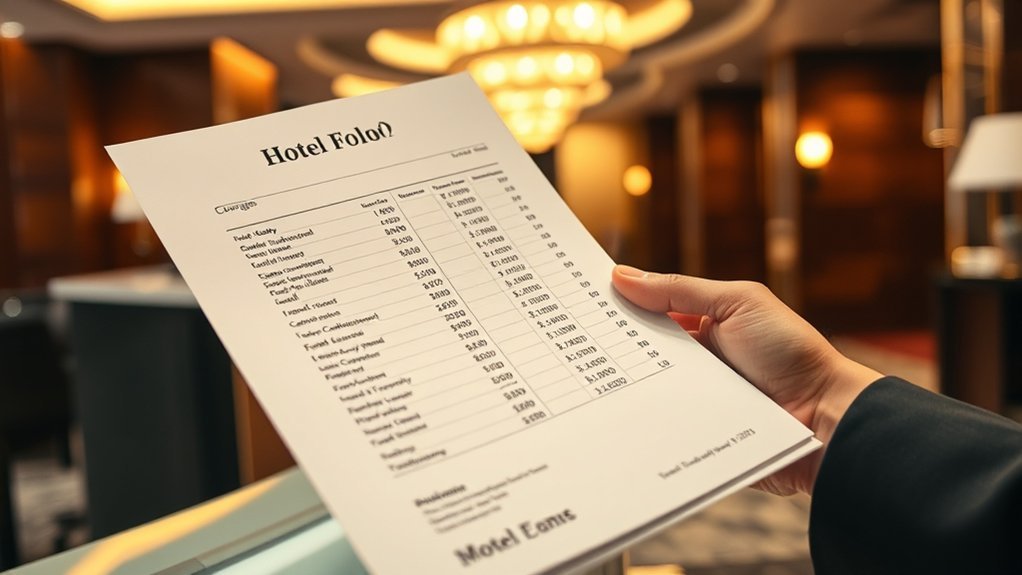
A useful hotel folio separates the room rate, optional services, mandatory fees, taxes, payments, credits, and remaining balance. This lets you compare the final bill with your reservation confirmation and supporting receipts.
Under the CRA’s receipt and invoice rules, businesses must let customers know whether GST/HST is included in the price or added separately. They must also show the applicable rate, the tax amount, or a clear statement that the total includes GST/HST.
Avoiding Hidden Fees
Before booking, review the total price and look for mandatory destination, resort, facility, parking, or service fees. At checkout, make sure those charges match what the hotel disclosed when you reserved the room.
A fee is not automatically incorrect because it appears under “Other.” However, the hotel should be able to explain what the fee covers and why tax was applied.
Enhancing Guest Trust
Clear billing reduces disputes because each charge can be connected to a date, service, rate, or receipt. An unexplained abbreviation does the opposite. When a folio uses a code such as BCEFHI, the hotel should provide a plain-language description when asked.
| Folio Detail | Why It Matters |
|---|---|
| Service description | Shows what you purchased |
| Transaction date | Helps match charges to your stay or receipt |
| Pre-tax amount | Provides the base for checking the tax calculation |
| Tax name and rate | Confirms whether GST, HST, PST, or a local tax was applied |
| Credits and payments | Prevents a deposit or prior payment from being overlooked |
How to Check for Errors on Your Hotel Folio
At a Glance
| Time Required | 5 to 10 minutes |
| Difficulty | Easy |
| Tools Needed | Hotel folio, booking confirmation, service receipts, and calculator |
| Cost | Free |
- Confirm the stay dates. Check that the arrival date, departure date, and number of charged nights are correct.
- Compare the nightly rate. Match each room charge with the rate and room type shown on your booking confirmation.
- Review every non-room charge. Check parking, meals, minibar purchases, spa services, destination fees, and other posted items.
- Identify the province’s tax structure. Determine whether the stay should have HST or 5% GST plus separate provincial or municipal taxes.
- Find the taxable subtotal. Add the charges that appear connected to “HST Other.”
- Recalculate the tax. Multiply the taxable subtotal by the applicable rate. Allow for a one-cent rounding difference.
- Look for duplicates. Check for a service, room night, tax, or fee posted more than once.
- Check credits and deposits. Confirm that advance payments, refunds, loyalty credits, and corrections reduce the balance properly.
- Ask for the BCEFHI definition. Request the hotel’s plain-language description and the charge-category mapping used by its billing system.
- Request a corrected folio. If the hotel confirms an error, obtain a new final folio rather than relying only on a verbal promise.
Warning: If the hotel cannot identify the taxable subtotal or explain the code, do not rely on a guess. Ask the front desk to involve its accounting department or billing manager.
Questions to Ask the Hotel
- What does BCEFHI mean in your billing system?
- Which exact charges produced this HST amount?
- What tax rate did you apply?
- Is this a tax line, a fee, or an adjustment?
- Was any part of the charge supplied by a third party?
- Can you provide an itemized and corrected folio?
Budget Tips for Managing Hotel Taxes
- Compare the final total. A low advertised room rate may not include taxes and mandatory property fees.
- Ask about mandatory fees before booking. Confirm parking, destination, resort, facility, and service fees.
- Use the correct provincial rate. Do not assume every Canadian hotel charges 13% or 15% HST.
- Remember that a lower price lowers the tax amount. Booking a lower pre-tax rate reduces the dollar value of percentage-based GST or HST, although the rate remains unchanged.
- Keep the final folio for business travel. It can help support an eligible business expense or input tax credit claim.
- Confirm long-stay treatment. A hotel stay lasting one month or more is not automatically GST/HST-exempt. The property’s tax status and the nature of the occupancy arrangement can matter.
Business Travel and Input Tax Credits
A business traveler does not automatically receive an HST rebate. According to the CRA’s input tax credit guidance, a GST/HST registrant may be eligible to recover GST/HST paid on travel expenses when the expense relates to commercial activities and all applicable requirements are met.
Keep an itemized folio that shows the hotel’s name, transaction date, taxable amount, GST/HST amount or rate, and other required invoice information. Personal travel costs are not eligible merely because the traveler owns or works for a business.
Note: This article explains hotel-billing terms for general information. Businesses should confirm input tax credit, rebate, and recordkeeping eligibility with the CRA or a qualified tax professional.
Frequently Asked Questions About HST in Hotels
What does HST mean on a hotel bill?
HST means Harmonized Sales Tax. It combines the 5% federal GST with a provincial portion in Ontario, Nova Scotia, New Brunswick, Newfoundland and Labrador, and Prince Edward Island.
What does HST Other mean on a hotel folio?
It usually indicates HST posted to a billing category outside the main room-tax category. The related taxable charge may be parking, dining, a destination fee, a spa service, or another item. The hotel must identify the exact category.
Is BCEFHI an official Canadian tax code?
BCEFHI cannot be verified as a standard CRA tax code from the label alone. Treat it as a hotel-specific, brand-specific, booking-system, or property-management code unless the hotel provides a different documented explanation.
How do you read a hotel folio?
Start with the stay dates and nightly rate. Then review non-room services, fees, taxes, payments, credits, and the remaining balance. Match each line with your reservation or service receipt and ask for an explanation of any unfamiliar code.
What is a folio number on a hotel receipt?
A folio number is the hotel’s reference number for the guest account or billing record. Give this number to the hotel when requesting a charge explanation, correction, duplicate receipt, or updated final bill.
Do hotel classifications or star ratings change the HST rate?
No. Luxury, upscale, midscale, economy, boutique, and extended-stay labels do not set the GST or HST rate. The applicable tax depends on the place and type of supply, although different hotels may charge different taxable services and fees.
Can a business claim the HST paid on a hotel stay?
An eligible GST/HST registrant may be able to claim an input tax credit for the business-use portion of qualifying travel expenses. Eligibility depends on commercial use, documentation, registration status, and other CRA rules.
Sources
- Canada Revenue Agency: GST/HST Calculator and Rates — current provincial and territorial GST/HST rates
- Canada Revenue Agency: Place of Supply in a Province — HST-participating provinces and place-of-supply rules
- Canada Revenue Agency: GST/HST Information for the Travel and Convention Industry — hotel accommodation, related services, third-party transactions, and long-stay considerations
- Canada Revenue Agency: Charge and Collect GST/HST — receipt and invoice disclosure requirements
- Canada Revenue Agency: Input Tax Credits — potential recovery of GST/HST on eligible commercial expenses
- Province of British Columbia: Accommodation Taxes — accommodation PST, MRDT, and Vancouver’s Major Events MRDT
Conclusion
“HST Other (BCEFHI)” most likely represents HST posted under a separate hotel billing category, but BCEFHI is not a standard Canadian tax term that can be decoded reliably without the hotel’s help. Check the province’s correct tax rate, match the amount to nearby taxable charges, and request an itemized explanation if the calculation or code remains unclear.
