

Last Updated on September 11, 2026 by Daniel Globe
The Israelites were an ancient people of the southern Levant whose identity is described through both biblical tradition and historical evidence. The Hebrew Bible traces them to Jacob, also called Israel, and his family. Archaeology instead shows early Israel emerging gradually in Canaan during the late second millennium BCE. Their history later included two kingdoms, imperial conquest, exile, religious change, and the development of Jewish and Samaritan communities.
Quick Answer
The Israelites were an ancient Levantine people associated with the biblical Twelve Tribes and the kingdoms of Israel and Judah. The Bible presents them as descendants of Jacob, while archaeology suggests that early Israel developed largely from communities already living in Canaan. Jews and Samaritans later preserved different parts of this heritage.
Key Takeaways
- According to the Hebrew Bible, the Israelites descended from Jacob, whose name was changed to Israel.
- The earliest widely accepted reference to Israel outside the Bible appears on Egypt’s Merneptah Stele around 1208 or 1207 BCE.
- Archaeologists generally describe early Israelite society as emerging through a complex process within Canaan, not one simple migration or conquest.
- After the united kingdom described in the Bible divided, Israel developed in the north and Judah in the south.
- “Israelite,” “Hebrew,” “Jew,” “Samaritan,” and “Israeli” are related terms, but they are not interchangeable.
- Genetics can reveal regional ancestry and population relationships, but it cannot prove that a person belongs to a particular biblical tribe.
Who Were the Israelites in the Bible and History?

In the Hebrew Bible, the Israelites are the descendants of Jacob, a patriarch whose name was changed to Israel. Jacob’s sons became the ancestors of the tribes that together formed the people of Israel. Their shared story includes the covenant with God, enslavement in Egypt, the Exodus, settlement in Canaan, the monarchy, exile, and return.
That biblical account is a religious and literary tradition as well as a record of how later communities understood their origins. Historians cannot independently verify Jacob, all twelve tribal ancestors, or every event in the narrative. Archaeology provides a different kind of evidence: inscriptions, settlements, pottery, architecture, food remains, and records produced by neighboring kingdoms.
These sources show that a population known as Israel existed in Canaan by the late thirteenth century BCE. They also suggest that Israelite society developed over time from several groups, including people already living in the region. The Bible and archaeology therefore answer different questions. Scripture explains ancestry, covenant, and communal meaning, while archaeology studies material traces of past populations.
Note: Describing a story as a biblical tradition does not dismiss its religious importance. It distinguishes a faith-based account from conclusions that can be tested through inscriptions, artifacts, and archaeological remains.
What Does “Israelite” Mean?
“Israelite” most broadly means a member of the people associated with Israel. In the Bible, the term is tied to Jacob’s descendants and the Twelve Tribes. In historical writing, it usually refers to the people of ancient Israel during the Iron Age, especially before and during the periods of the kingdoms of Israel and Judah.
Genesis connects the name Israel with Jacob’s struggle against a mysterious divine figure. The text explains the name through a wordplay commonly rendered as striving or contending with God and humans. The exact older linguistic origin of the name remains debated, so translations such as “prince of God” should not be treated as certain.
The earliest known appearance of the name outside the Bible is written with a sign indicating a people rather than a city or territory. This suggests that Egyptian scribes recognized a population called Israel in Canaan before Israel became a centralized kingdom.
How Did Israelites Descend From Jacob?
According to Genesis, Jacob was a grandson of Abraham and a son of Isaac. He became the father of twelve sons, and the Bible presents their families as the ancestors of Israel’s tribes. This genealogy gave later Israelites a shared family story even when the tribes lived in different regions or followed separate political leaders.
Jacob’s Renamed Identity
Genesis 32 describes Jacob wrestling through the night with a mysterious figure called a man in the immediate story. Hosea 12 later refers to the figure as an angel. After the encounter, Jacob receives the name Israel because he has striven with divine and human beings and endured.
The account links Israelite identity with struggle, blessing, and covenant. Jacob continues to be called both Jacob and Israel elsewhere in the Bible, so the new name does not simply erase the old one. Instead, the two names connect the patriarch’s personal story with the later people of Israel.
The Twelve Tribes’ Lineage
The Bible names twelve sons of Jacob. Tribal lists are not identical in every passage, however. Joseph is sometimes counted as one tribe, while other lists represent him through his sons Ephraim and Manasseh. Levi may be omitted from territorial lists because the Levites are assigned religious duties rather than one continuous tribal territory.
| Jacob’s Son | Biblical Tribal Association | Important Detail |
|---|---|---|
| Reuben | Reuben | Described as Jacob’s firstborn |
| Simeon | Simeon | Associated with territory within or near Judah |
| Levi | Levi | Often excluded from territorial counts because of priestly duties |
| Judah | Judah | Gave its name to the southern kingdom and later Judeans |
| Dan | Dan | Associated with more than one location in biblical tradition |
| Naphtali | Naphtali | Associated with northern Galilee |
| Gad | Gad | Associated with land east of the Jordan River |
| Asher | Asher | Associated with the northwestern coastal region |
| Issachar | Issachar | Associated with the Jezreel Valley area |
| Zebulun | Zebulun | Associated with northern Israel |
| Joseph | Joseph, or Ephraim and Manasseh | His two sons may each be counted as a tribe |
| Benjamin | Benjamin | Closely associated with the southern kingdom of Judah |
The twelve-tribe structure is central to biblical identity, but historians debate how closely it reflects the political organization of early Israel. The lists may preserve memories of regional alliances, kinship groups, later administrative divisions, and theological ideals as well as literal family descent.
Israel’s Covenant Heritage
In the Bible, descent alone does not fully define Israel. Israelite identity is also tied to a covenant with Yahweh, beginning with promises to Abraham, Isaac, and Jacob and later expressed through the Exodus and the law given through Moses.
The covenant included worship, festivals, ethical duties, food practices, justice, and obligations toward vulnerable members of society. Biblical prophets repeatedly argued that sacrifice and public worship were worthless when separated from justice and loyalty to God. These traditions helped communities preserve a shared identity through political division and exile.
Historical Origins of the Israelites
The Earliest Evidence for Israel
The Merneptah Stele, an Egyptian victory inscription, contains the earliest widely accepted reference to Israel outside the Bible. It dates to about 1208 or 1207 BCE and lists Israel among groups defeated in Canaan.
The inscription does not describe Israel as a kingdom or city. Its Egyptian writing marks Israel as a people, indicating that a recognizable group bearing that name lived in Canaan by the end of the Late Bronze Age. The stele does not explain where that population came from or how it was organized.
The first external reference to Israel identifies a people in Canaan around 1208 or 1207 BCE, centuries before the Babylonian exile and before the earliest surviving biblical manuscripts.
Canaanite Roots, the Exodus, and the Conquest Debate
During the twelfth and eleventh centuries BCE, many small farming settlements appeared in the central highlands of Canaan. Their pottery, building methods, agricultural practices, and other material remains show strong continuity with the broader Canaanite world. This evidence supports the view that many early Israelites came from populations already living in the region.
That does not require every Israelite group to have the same origin. Some communities may have included pastoral groups, displaced villagers, migrants, or people carrying memories of an Egyptian experience. Scholars continue to debate whether the Exodus tradition preserves a smaller historical migration that later became the shared origin story of a larger population.
Archaeology has not confirmed a single rapid military conquest of Canaan matching a literal reading of every event in Joshua. Some cities named in the narrative were destroyed at different times, while others were not fortified or occupied in the required period. The settlement of early Israel is therefore usually understood as a long and uneven process involving migration, social change, local conflict, and the formation of a new identity.
The Kingdoms of Israel and Judah
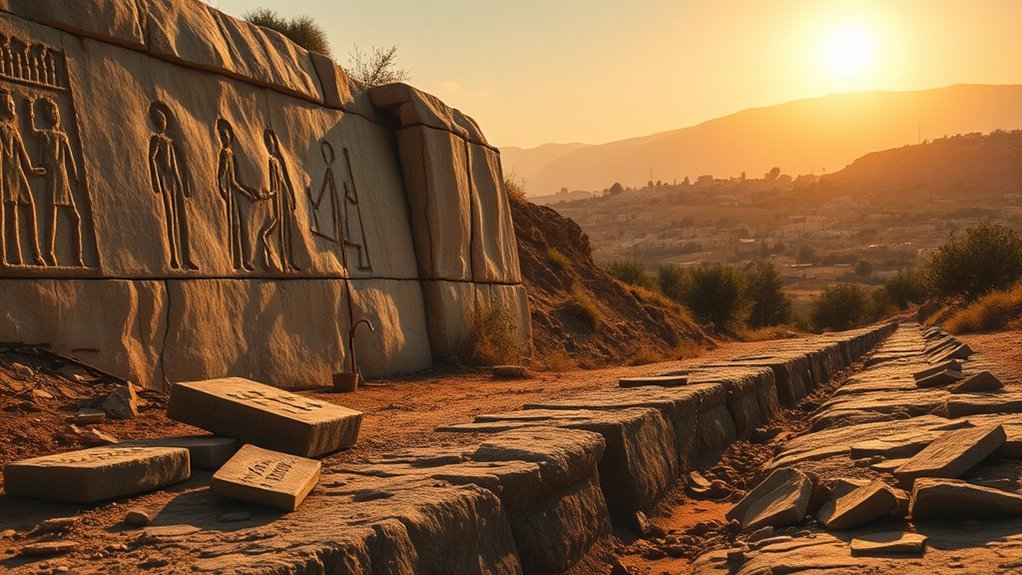
The Bible describes a united kingdom under Saul, David, and Solomon, followed by a division into the northern Kingdom of Israel and the southern Kingdom of Judah. Archaeology confirms that Israel and Judah became separate Iron Age kingdoms, although scholars debate how large, wealthy, and centralized the earlier united monarchy was.
The United Monarchy: Tradition and Historical Debate
In the biblical account, David established Jerusalem as his capital, and Solomon built the First Temple. Later rulers looked back on their reigns as a foundational period of political unity. Inscriptions outside the Bible provide evidence for a Davidic royal dynasty, but the exact borders and administrative strength of the tenth-century kingdom remain disputed.
Some scholars interpret monumental remains as evidence of a substantial early state. Others argue that Jerusalem was a smaller highland center whose power expanded later. The evidence supports the existence of an early Judahite dynasty more securely than it supports every detail of the biblical description.
Northern and Southern Kingdoms
After the division traditionally dated to the late tenth century BCE, the northern kingdom retained the name Israel. It included major centers such as Samaria and drew strength from productive valleys and international trade routes. The southern kingdom, Judah, centered on Jerusalem and included territory associated mainly with Judah and Benjamin.
The two kingdoms shared language, traditions, and devotion to Yahweh, but they also competed politically and maintained different sanctuaries. Their biblical histories contain both cooperation and warfare. Israel was generally larger and wealthier during much of the ninth and eighth centuries BCE, while Judah survived longer as an independent kingdom.
Assyrian and Babylonian Conquests
The Neo-Assyrian Empire captured Samaria around 722 or 721 BCE and ended the northern kingdom. Assyrian policy included deporting part of the conquered population and relocating people from other regions. However, not every northern Israelite was removed. Some remained in the land, some moved into Judah, and others became part of communities whose later histories are difficult to trace.
Judah continued under Assyrian domination and later faced the Neo-Babylonian Empire. Babylonian forces captured Jerusalem, destroyed the First Temple, and deported members of the royal court, elite families, skilled workers, and others in 587 or 586 BCE. Many Judeans remained in the region, while communities also developed in Babylonia and elsewhere.
Israelite Exile and Return
Conquest and exile transformed Israelite and Judean identity. The loss of kingship and the Jerusalem Temple forced communities to preserve tradition through family life, prayer, teaching, written texts, and new forms of leadership. Exile did not affect everyone in the same way, and neither the northern nor southern population disappeared completely.
After Persia conquered Babylon in 539 BCE, Cyrus II permitted displaced communities to restore local sanctuaries and return to their homelands. Some Judeans returned to Jerusalem beginning in the late sixth century BCE, while many others remained in Babylonia. The Second Temple was completed around 516 or 515 BCE under Persian rule.
| Approximate Date | Event | Why It Matters |
|---|---|---|
| 1208/1207 BCE | Merneptah Stele mentions Israel | Earliest widely accepted external evidence for a people called Israel |
| Twelfth–eleventh centuries BCE | Highland settlements expand | Material evidence for communities associated with early Israel |
| Tenth century BCE | Period associated with David and Solomon | Biblical age of the United Monarchy; its scale remains debated |
| Late tenth century BCE | Israel and Judah follow separate political paths | Northern and southern kingdoms develop distinct institutions |
| 722/721 BCE | Assyria captures Samaria | End of the northern Kingdom of Israel |
| 587/586 BCE | Babylon destroys Jerusalem and the First Temple | Beginning of the major Babylonian exile |
| 539–538 BCE | Persia conquers Babylon and authorizes restorations | Return migrations and rebuilding become possible |
| 516/515 BCE | Second Temple completed | Jerusalem again becomes a major center of Judean worship |
The return was not a complete reversal of exile. A lasting Jewish diaspora remained outside Judah, especially in Mesopotamia. Communities in Judah also had to negotiate land, authority, intermarriage, Temple leadership, and relations with neighboring peoples. This period helped shape the form of Judaism known from later centuries.
Israelite Worship and Yahweh
Yahweh was the central national deity of Israel and Judah, but Israelite religion was not identical in every place or century. Biblical texts condemn the worship of Baal, Asherah, heavenly bodies, and other gods, showing that such practices existed among at least some Israelites and Judeans.
Many scholars describe early practice as monolatry: worshippers gave primary or exclusive loyalty to Yahweh without necessarily denying that other divine beings existed. A stronger and more explicit form of monotheism developed over time, especially in exilic and post-exilic texts that declared Yahweh to be the only God.
Religious life included household practices, local shrines, pilgrimage, sacrifice, prayer, vows, music, purification, and festivals. The Jerusalem Temple became especially important in Judah, while northern Israel had royal sanctuaries at places such as Bethel and Dan.
Major biblical observances included Passover, the Festival of Weeks, the Festival of Booths, the Sabbath, and the Day of Atonement. Their precise form changed over time. The law and prophetic writings also connected worship with fair courts, honest trade, care for the poor, and protection of foreigners, widows, and orphans.
Israelites, Hebrews, Jews, Samaritans, and Israelis
These labels overlap, but each developed in a different setting. Using them precisely prevents ancient identities from being confused with modern citizenship or with one another.
| Term | Typical Meaning | Important Distinction |
|---|---|---|
| Hebrew | An early biblical designation used for Abraham, Joseph, Israelites, or people viewed from outside their group | Its exact origin and range of meanings are debated |
| Israelite | A member of ancient Israel or, biblically, a descendant of Jacob | Most useful for the ancient people and Iron Age kingdoms |
| Judean or Jew | Originally someone connected with Judah; later a member of the Jewish people or religion | The term became broader than residence in Judah |
| Samaritan | A member of the Samaritan community centered on the Torah and Mount Gerizim | Samaritans maintain their own Israelite descent traditions and religious institutions |
| Israeli | A citizen or resident associated with the modern State of Israel | A modern nationality, not a synonym for ancient Israelite or Jew |
After the Babylonian exile, “Jew” gradually became a common designation for people connected to Judah and its traditions. It eventually included Jewish communities living far beyond the territory of Judah. “Israel” also remained an important religious name for the Jewish people as a whole.
Samaritans identify themselves as descendants of ancient Israel, especially the tribes of Ephraim and Manasseh, together with a priestly line associated with Levi. Their sacred center is Mount Gerizim rather than Jerusalem. Jewish and Samaritan accounts of their early separation differ, and historians describe Samaritan identity as the result of a long, complex development rather than one event.
What Happened to the “Lost Ten Tribes”?
The phrase “Lost Ten Tribes” refers to the northern tribes after Assyria conquered Israel. It does not mean that every person vanished. Assyria deported selected groups, but many residents remained in the former northern kingdom. Others moved south into Judah or were absorbed into surrounding populations.
Later Jewish, Christian, and other traditions proposed locations for the missing tribes across Asia, Africa, Europe, and the Americas. Most specific identifications cannot be demonstrated historically. Samaritans preserve a direct claim to northern Israelite ancestry, while evidence from settlement and population history also points to continuity among people who stayed in the region.
Ancient Israelite Daily Life and Culture
Most ancient Israelites lived in small agricultural settlements. Households grew wheat, barley, grapes, olives, figs, lentils, and other crops suited to the region. Families also raised sheep, goats, cattle, and donkeys. Rainfall, access to springs or cisterns, soil quality, taxation, and warfare could determine whether a household had enough food.
A common Iron Age house form is often called the four-room house, although actual layouts varied. Such buildings could include living areas, storage space, work areas, and places for animals. Extended families may have occupied connected rooms or nearby homes.
Bread and grain products supplied much of the daily diet. People also consumed legumes, olive oil, fruit, dairy products, wine, and meat when available. Archaeologists study animal bones, seeds, storage jars, grinding stones, ovens, and cooking pots to reconstruct these patterns.
Household production was essential. Women and men participated in farming, food preparation, textile work, pottery, construction, and animal care, though tasks were shaped by age, status, and gender. Weaving and spinning required extensive labor, while specialized crafts included metalworking, stone cutting, seal carving, and large-scale pottery production.
Society was hierarchical. Kings, officials, priests, soldiers, landowners, tenant farmers, laborers, enslaved people, immigrants, and the poor did not share the same power or resources. Biblical laws and prophetic criticism offer evidence of debt, land loss, corrupt courts, and exploitation as well as ideals of communal responsibility.
Writing was used for royal administration, trade, religious texts, seals, letters, and short inscriptions. Literacy was not universal. Scribes and officials had specialized skills, although brief inscriptions show that writing circulated beyond a tiny royal circle in some periods.
What Genetic Studies Reveal About Israelites
Genetic research can compare ancient DNA with DNA from present-day populations, but the evidence for ancient Israelites is limited. Human remains from the Iron Age southern Levant are difficult to sample because preservation is uneven, excavated populations are small, and religious or legal concerns may restrict testing.
Genetics is best at identifying broad population relationships, mixtures, and changes over time. It is much less able to identify the religion, language, political loyalty, or biblical tribe of an individual. Those identities were social and cultural as well as genealogical.
| Research | What It Suggests | What It Cannot Prove |
|---|---|---|
| Direct Iron Age samples | A small number of samples may reveal local and regional ancestry | The ancestry of every Israelite community or tribe |
| 2004 Samaritan and Jewish lineage study | The sampled Samaritan and Jewish paternal lineages showed important affinities, while maternal patterns differed | That every member of either community has identical ancestry |
| 2020 Bronze Age southern Levant study | Several modern Levantine and Jewish populations carry substantial ancestry related to Bronze Age southern Levantine groups, along with later ancestry | Direct membership in ancient Israel or a specific biblical tribe |
| 2025 Cohanim preprint | Priestly families may include several paternal lineages shaped by different historical processes | A final account of priestly origins; the paper was a preprint and not yet peer reviewed |
Warning: A consumer DNA result cannot confirm descent from Jacob, assign someone to a biblical tribe, or determine whether a person is Jewish, Samaritan, or Israelite. Religious and communal membership follows each community’s laws and traditions, not a commercial ancestry percentage.
The strongest conclusion is one of both continuity and mixture. Many present-day populations in the Levant and Jewish diaspora preserve ancestry connected to ancient regional populations, but each also reflects later migrations, marriages, conversions, founder effects, and population changes. No single modern community provides an unchanged genetic copy of an ancient people.
Frequently Asked Questions
When do Israelites first appear outside the Bible?
The earliest widely accepted extra-biblical reference is on the Egyptian Merneptah Stele, dated to about 1208 or 1207 BCE. It identifies Israel as a people living in Canaan but gives little information about their political organization or origins.
Are Israelites and Jews the same?
The terms overlap but are not identical. “Israelite” usually refers to the ancient people of Israel or, biblically, all descendants of Jacob. “Jew” developed from “Judean,” originally linked to Judah, and later became the broader name for the Jewish people and religion.
What happened to the Lost Ten Tribes of Israel?
Assyria deported part of the northern kingdom’s population after conquering Samaria, but many people remained or moved elsewhere, including into Judah. Some groups were absorbed into other populations. Later claims to descend from individual lost tribes are difficult to verify historically.
Are Samaritans descendants of the Israelites?
Samaritans identify as Israelites descended especially from Ephraim, Manasseh, and Levi. Historical and genetic research supports deep regional roots and some shared ancestry with Jewish populations, although Jewish and Samaritan traditions give different accounts of their separation.
Do Ebionites believe Jesus was God?
Ancient Christian writers generally describe the Ebionites as Jewish followers of Jesus who regarded him as a human Messiah rather than a preexistent divine being. Evidence about the group comes mainly from opponents, so scholars treat some details cautiously.
What is the most openly mocked religion?
There is no reliable worldwide ranking of the “most mocked” religion. Experiences vary by country, media environment, political power, and minority status. Surveys may measure discrimination, social attitudes, or acceptance of criticism, but those measures are not the same as a universal ranking of ridicule.
What does God say about Azrael?
The Quran refers to “the angel of death” who takes souls by God’s command, but it does not give that angel the name Azrael. “Azrael” became common in later Islamic and other religious traditions. The figure acts under divine authority rather than independently.
Do Baháʼís believe in Jesus?
Yes. The Baháʼí Faith recognizes Jesus as a Manifestation of God, a divine messenger who revealed God’s will and transformed human spiritual life. Baháʼís also recognize figures including Abraham, Moses, Muhammad, the Báb, and Bahá’u’lláh within a continuing process of revelation.
Conclusion
The Israelites are best understood through several kinds of evidence rather than one simple origin story. The Hebrew Bible presents them as the descendants of Jacob, united by covenant and the Twelve Tribes. Archaeology shows a people called Israel in Canaan by the late thirteenth century BCE and points to strong continuity with the region’s Canaanite population.
Over the following centuries, Israelites formed political communities, developed the kingdoms of Israel and Judah, experienced Assyrian and Babylonian conquest, and adapted their religious traditions to exile and return. Jewish and Samaritan communities later preserved related but distinct forms of Israelite heritage.
Genetic studies add evidence of regional continuity and population mixture, but DNA cannot define an ancient religion, verify biblical genealogy, or assign a person to a tribe. Israelite identity combined ancestry, language, law, worship, political history, and shared memory.
Sources
- University of Chicago Institute for the Study of Ancient Cultures — Ancient Israel: Highlights from the Collections — archaeological evidence, the Merneptah Stele, early settlements, and the origins debate.
- Metropolitan Museum of Art — Phoenicia and the Bible — the kingdoms of Israel and Judah and the Assyrian and Babylonian conquests.
- Cambridge University Press — Monotheism and Narrative Development of the Divine Character in the Hebrew Bible — the long development of biblical monotheism.
- Bible Odyssey — Are the Twelve Tribes of Israel a Myth? — biblical tribal genealogy and questions about its historical reconstruction.
- PubMed — Reconstruction of Patrilineages and Matrilineages of Samaritans and Other Israeli Populations — paternal and maternal relationships among sampled Samaritan and Jewish populations.
- Cell — The Genomic History of the Bronze Age Southern Levant — ancient regional ancestry and its relationship to several present-day populations.
