

Last Updated on September 10, 2026 by Daniel Globe
A cabin backpack is a travel backpack intended for use inside an aircraft cabin instead of as checked luggage. Depending on its loaded size and your ticket rules, it may count as an overhead carry-on or a smaller under-seat personal item. The right model combines airline-friendly dimensions, comfortable straps, practical organization, and a low empty weight.
Quick Answer
A cabin backpack is a soft-sided travel bag designed to travel with you in the aircraft cabin. There is no universal cabin-backpack size: overhead carry-on and under-seat personal-item limits vary by airline, fare, route, and aircraft. Always compare the backpack’s fully packed dimensions and weight with the rules for your exact flight.
Key Takeaways
- A cabin backpack may be an overhead carry-on or an under-seat personal item; those categories have different limits.
- The familiar 22 × 14 × 9-inch limit is used by several U.S. airlines, but it is not a universal rule.
- Capacity in liters does not prove airline compliance. Measure the loaded bag’s outside height, width, and depth.
- Comfort depends on fit, load distribution, back-panel support, and the quality of the shoulder, sternum, and hip straps.
- Keep power banks, medication, travel documents, electronics, and other valuables accessible in case the bag is gate-checked.
Disclosure: As an Amazon Associate I earn from qualifying purchases. Some links on this page are affiliate links, at no extra cost to you.
Definition of a Cabin Backpack
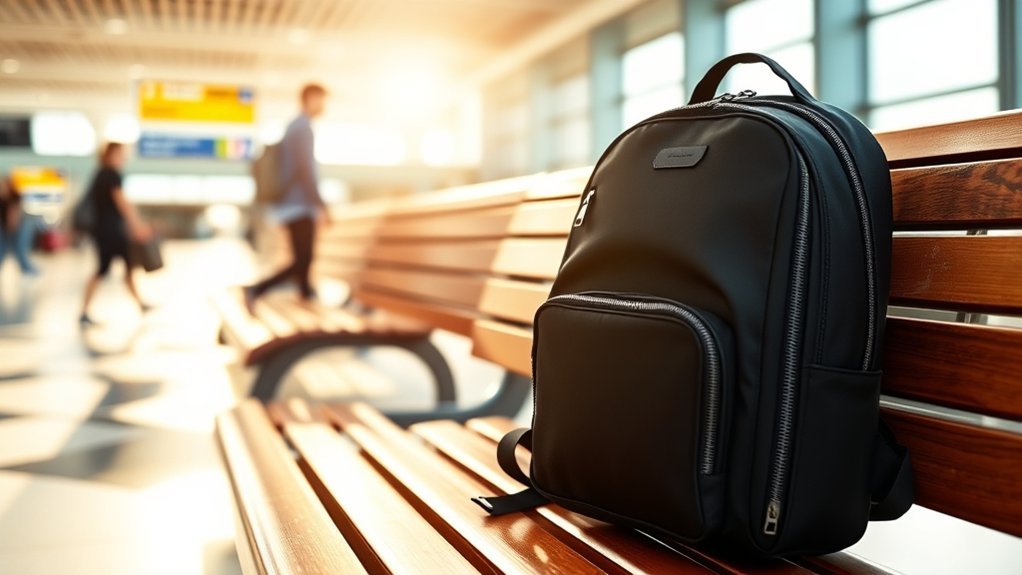
A cabin backpack is a backpack intended to remain with the passenger during a flight. Unlike a checked suitcase, it must fit either in the overhead bin or beneath the seat in front of you, depending on how the airline classifies it.
Many travel models use a rectangular shape to make better use of airline sizers. They may include a clamshell opening, compression straps, a padded laptop sleeve, document pockets, lockable zipper pulls, and a stowable harness. Their soft sides make them easier to compress than rigid luggage, but softness does not guarantee acceptance if the bag is overfilled.
Cabin backpacks are often lighter than wheeled suitcases of similar capacity and provide hands-free mobility in airports, train stations, stairways, and city streets. However, the exact benefit depends on the bag’s empty weight, suspension, fit, and packed load.
Cabin Backpack, Carry-On, and Personal Item: What Is the Difference?
Travelers often use the terms cabin bag, carry-on, and personal item as though they mean the same thing. Airlines usually treat them as separate categories:
- Overhead carry-on: A larger cabin bag intended for an overhead storage bin.
- Personal item: A smaller bag that must fit completely beneath the seat in front of you.
- Travel backpack: A broad product category. A travel backpack is not automatically airline-compliant.
- Cabin backpack: A marketing and descriptive term for a backpack intended for cabin use. Its actual eligibility still depends on the airline’s rules.
Note: The Transportation Security Administration does not set one universal carry-on size for U.S. airlines. TSA advises passengers to check the airline’s dimensions. International allowances can also vary by carrier, route, cabin class, fare, and aircraft.
What Size Is a Cabin Backpack?
There is no single worldwide cabin-backpack size. The International Air Transport Association gives 56 × 45 × 25 cm, or roughly 22 × 18 × 10 inches, as a general carry-on reference used by many airlines, but it also tells passengers to verify the operating airline’s requirements.
In the United States, 22 × 14 × 9 inches is a common overhead carry-on limit. For example, American Airlines and Delta currently publish that maximum for standard carry-on bags. Personal-item limits can be much smaller and differ even among major carriers.
| Example checked July 2026 | Overhead carry-on | Personal item |
|---|---|---|
| American Airlines | 22 × 14 × 9 in, including handles and wheels | 18 × 14 × 8 in |
| United Airlines | 9 × 14 × 22 in | 9 × 10 × 17 in |
| IATA general reference | 56 × 45 × 25 cm, or about 22 × 18 × 10 in | No universal personal-item standard |
These examples can change and may not apply to every fare or aircraft. Check the operating airline rather than relying only on the airline that sold the ticket, especially on codeshare trips.
Liters vs. External Dimensions
A backpack’s liter rating estimates internal capacity. Airline staff and baggage sizers evaluate its exterior measurements. A 40-liter pack is not automatically larger or smaller than another 40-liter model because shape, padding, frames, laptop compartments, and pocket design affect both usable space and outside dimensions.
For that reason, capacity is best used as a packing guide:
- About 15–25 liters: Often suitable for daily essentials or a compact personal item, depending on its shape.
- About 25–35 liters: Common for short trips and minimalist travel.
- About 35–45 liters: Often marketed for carry-on travel, but many models become too deep when fully packed.
- Above 45 liters: More difficult to keep within common cabin limits unless the bag is unusually slim or lightly filled.
These ranges are not airline guarantees. Always use the manufacturer’s exterior measurements and check them again after packing.
How to Measure a Cabin Backpack
- Pack the bag with a realistic travel load.
- Tighten its compression straps without crushing fragile items.
- Place it on a flat surface without leaning on it.
- Measure the longest outside height from top to bottom.
- Measure the widest point from side to side.
- Measure the deepest point from front to back.
- Include stuffed pockets, rigid frames, handles, protective laptop padding, and any other part that cannot be compressed inside the airline sizer.
- Weigh the complete bag if your airline publishes a cabin-weight limit.
Pro Tip: Leave a small margin below the airline’s stated limit. A bag that measures exactly at the maximum when empty may bulge beyond it after you add clothing, cables, a water bottle, or souvenirs.
A backpack is cabin-ready only when its loaded dimensions and weight meet the rules for your exact airline, fare, route, and aircraft.
Key Features of a Cabin Backpack
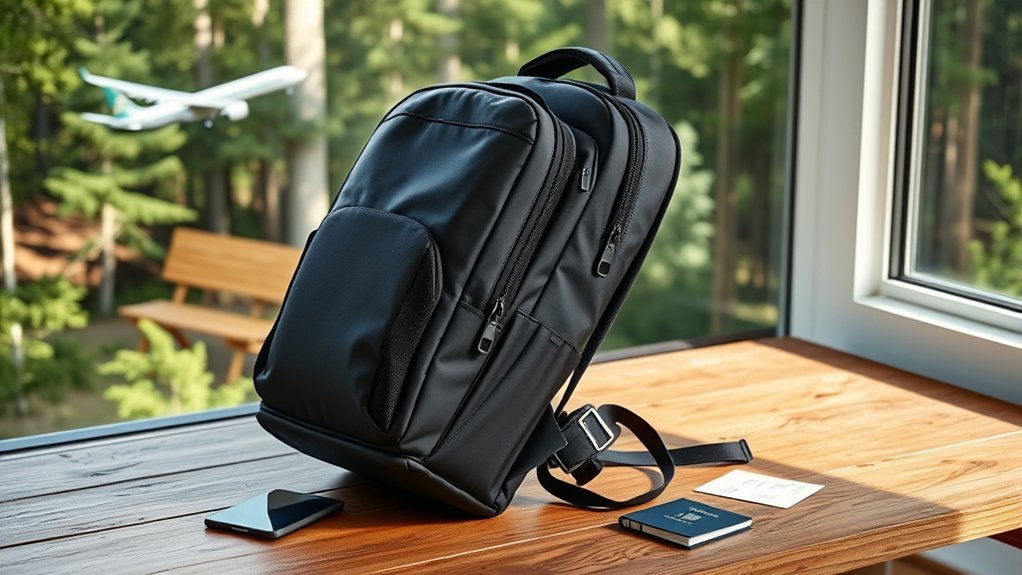
The most useful cabin-backpack features improve comfort, space use, security, and access without adding unnecessary weight. The ideal combination depends on how far you will carry the bag and what you plan to pack.
Ergonomic Design and Comfort
Padded shoulder straps and a supportive back panel can reduce pressure during long walks through airports and cities. A sternum strap helps keep the shoulder straps in position, while a properly fitted hipbelt can transfer part of a heavier load away from the shoulders.
Comfort depends on fit rather than padding alone. The backpack should sit close to your back without pulling backward, and the shoulder straps should follow your shoulders without leaving large gaps. If the bag has a load-bearing hipbelt, it should sit around the upper hip bones rather than across the stomach.
Before buying, test the pack with approximately the same weight you expect to carry. Walk, climb stairs, bend down, and check for rubbing, pressure points, swaying, or restricted arm movement.
Laptop and Tech Compartments
Many cabin backpacks include a padded sleeve for a laptop or tablet. A useful tech compartment should fit the device securely, protect its corners, and remain easy to open during security screening or work stops.
Other helpful features include:
- A false bottom that keeps the laptop from striking the floor when the bag is set down
- Separate pockets for cables, adapters, earbuds, and chargers
- A document sleeve that does not press hard objects against the laptop
- Quick access without opening the clothing compartment
- Water-bottle storage positioned away from electronics
Some backpacks include a USB pass-through port. This is normally a cable connection, not a power source; you still need a separate power bank inside the bag.
Warning: The FAA classifies power banks as spare lithium batteries. Keep them in the aircraft cabin, protect them from damage and short circuits, and remove them before handing over a cabin backpack for gate-checking. Smart luggage with an installed battery may also need a removable battery to be accepted.
Lightweight and Durable Materials
Common cabin-backpack fabrics include nylon and polyester in different weights and weaves. A heavier fabric is not automatically better: fabric quality, coating, seam construction, stitching, zipper design, and reinforcement at stress points all affect durability.
Useful material features include:
- Abrasion resistance on the bottom and corners
- Water-resistant fabric or coating for light rain and spills
- Reinforced seams around handles and shoulder-strap anchors
- Reliable zippers that move smoothly around packed corners
- A light lining that makes small items easier to see
Water-resistant does not mean waterproof. For heavy rain, use an appropriate rain cover or place clothing and electronics in waterproof liners or dry bags.
Opening Style and Compression
A clamshell opening opens like a suitcase and makes clothing easy to organize. A panel-loading bag offers similar access but may not open completely flat. A top-loading model can be lighter and simpler, though items at the bottom are harder to reach.
Internal or external compression straps can reduce shifting and help control depth. They cannot make a rigid frame or overstuffed pocket disappear, so they should not be used to force an oversized bag into compliance.
Security Features
Lockable zipper pulls, concealed passport pockets, and openings positioned against the wearer’s back can make casual access more difficult. These features may discourage opportunistic theft, but no fabric backpack is fully theft-proof.
Keep your passport, wallet, phone, medication, keys, and boarding documents in a pocket you can control. Avoid placing irreplaceable items in an external pocket that can be opened without your knowledge.
Advantages of Using a Cabin Backpack
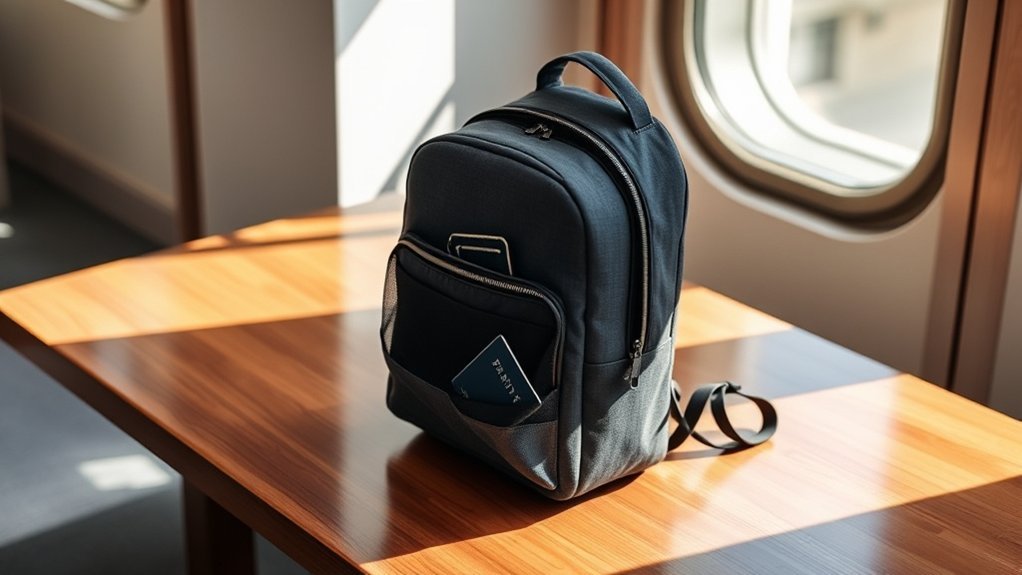
A well-chosen cabin backpack offers several practical advantages:
- Hands-free mobility: Both hands remain available for tickets, phones, handrails, children, or other luggage.
- Easier movement: Backpacks are convenient on stairs, uneven sidewalks, public transportation, and cobblestones.
- Lower empty weight: Many soft backpacks weigh less than similarly sized wheeled cases, leaving more of the allowance for belongings.
- Flexible storage: Soft sides and compression straps can adapt to modest changes in the load.
- Useful organization: Separate compartments can keep clothing, toiletries, documents, and electronics from becoming mixed together.
- Fewer moving parts: A backpack has no wheels or telescoping handle to break.
Disadvantages to Consider
A cabin backpack is not the best option for every traveler. Potential drawbacks include:
- Shoulder or back discomfort if the bag is heavy or poorly fitted
- More back heat than a wheeled suitcase
- Less impact protection for fragile items
- Wrinkled clothing if the load is compressed carelessly
- Reduced convenience for travelers with mobility, shoulder, or back limitations
- Difficult access in narrow top-loading designs
- Dangling straps that may catch unless the bag includes keepers or a stowable harness
A wheeled cabin suitcase may be more comfortable when you travel mainly through smooth airports and hotels. A backpack is often more useful when your route includes stairs, walking, or frequent transfers.
Ideal Scenarios for Cabin Backpack Use
Cabin backpacks are especially useful for short trips, public-transport journeys, multi-city travel, and destinations where wheeled luggage is awkward. They also work well for travelers who want to avoid waiting at baggage claim, provided the fare includes the bag they plan to bring.
Common use cases include:
- Weekend trips: A compact wardrobe, toiletries, electronics, and documents can often fit in one organized pack.
- Budget-airline travel: A correctly sized personal-item backpack may help avoid a larger bag fee, but the fare rules must be checked first.
- Business travel: A structured model can hold a laptop, charger, documents, one or two outfits, and small toiletries.
- City travel: A backpack is easier to carry on stairs and crowded transit than a wheeled case.
- Mixed transportation: It transitions easily between aircraft, buses, trains, ferries, and walking routes.
- Outdoor side trips: Some models can handle easy walks, although a travel backpack is not automatically a technical hiking pack.
Comparison: Cabin Backpack vs. Cabin Suitcase
Choosing between a cabin backpack and a cabin suitcase depends on mobility, packing style, physical comfort, and the surfaces you expect to cross.
Mobility and Convenience
A cabin backpack provides hands-free movement and performs well on stairs, broken pavement, and crowded public transportation. A suitcase removes the load from your shoulders but works best on smooth, level surfaces.
A backpack can also be easier to place in an irregular storage space. However, a full overhead-size backpack should not be assumed to fit beneath a seat. A suitcase generally offers better crush protection and may be easier to roll through a large airport.
Packing and Organization
Clamshell travel backpacks can pack much like suitcases. Traditional top-loading backpacks require more planning because items at the bottom are harder to reach. Rigid suitcases hold their shape and can help reduce compression, while soft backpacks adapt better to uneven loads.
| Feature | Cabin Backpack | Cabin Suitcase |
|---|---|---|
| Mobility | Hands-free and effective on stairs or uneven ground | Easy to roll on smooth floors |
| Physical load | Weight rests on the body | Weight is carried by the wheels while rolling |
| Protection | Flexible, with less crush protection | More structured protection |
| Organization | Varies from one open compartment to detailed travel organization | Usually offers a predictable divided layout |
| Empty weight | Often lighter, depending on frame and harness | Wheels and handles add weight |
| Best suited to | Walking, stairs, public transit, and multi-stop travel | Airports, hotels, smooth paths, and fragile contents |
Packing Tips for a Cabin Backpack
Efficient packing starts with the airline rules, not with filling every available pocket. Confirm the permitted number of cabin items, dimensions, weight, and any fare-specific restrictions before choosing what to bring.
- Place documents and medication in a secure quick-access area. They should remain with you even if the larger bag is gate-checked.
- Pack heavy, dense items close to your back. A laptop, camera, or book carried far from the body can make the bag pull backward.
- Use packing cubes selectively. They organize clothing but add a small amount of weight and can encourage overpacking.
- Roll or fold according to the garment. Rolling works well for casual knits; folding or bundling may protect structured clothing better.
- Fill small gaps without creating bulges. Socks and soft accessories can fit around larger items.
- Keep liquids easy to remove. For U.S. screening, ordinary liquids, aerosols, gels, creams, and pastes generally must be in containers of 3.4 ounces or 100 milliliters or less and fit within the permitted quart-size bag, subject to stated exceptions.
- Protect electronics. Do not place hard plugs or adapters where they can press into a laptop screen.
- Secure loose straps. Use strap keepers or tuck excess webbing away before boarding.
- Compress and remeasure. Check the final depth at the fullest pocket.
- Weigh the complete bag. Include the water bottle, jacket, food, and items you plan to add at the airport.
Note: If a cabin bag is taken at the gate, remove power banks, spare lithium batteries, medication, passports, keys, money, and fragile or valuable electronics before handing it over.
Popular Styles and Designs of Cabin Backpacks
Cabin backpacks come in several designs. Choose the style that matches your trip rather than selecting the model with the highest stated capacity.
Popular Backpack Styles
- Daypacks: Small and lightweight, often with one main compartment. They may qualify as personal items if their loaded dimensions comply.
- Laptop backpacks: Designed around padded electronics storage and useful for business trips, commuting, and short stays.
- Clamshell travel backpacks: Open like suitcases and make clothing easy to organize.
- Convertible backpack-duffels: Include backpack straps and side handles, giving travelers more than one carrying method.
- Sling backpacks: Compact bags for essentials and short outings. Their one-shoulder design is less suitable for heavy loads.
- Hydration packs: Small outdoor packs with reservoir compatibility. They can be useful after arrival but may not offer the rectangular packing space of a travel bag.
Essential Features Overview
The most valuable features depend on the load you carry. For most travelers, the priorities are:
- Dimensions that remain compliant when the bag is full
- A low empty weight
- Comfortable shoulder straps and a stable back panel
- A secure main opening
- Useful compression that does not distort the bag
- An accessible laptop sleeve if electronics are carried
- Handles on more than one side for lifting the bag into a sizer or overhead bin
- A durable bottom panel
- A luggage pass-through sleeve if the backpack will sit on a rolling suitcase
Travel-Specific Designs
Travel-specific backpacks often use a rectangular profile and a wide opening to maximize packing space. Some have stowable shoulder straps so the harness does not snag when the bag is placed in a bin or handed to airline staff.
Expandable compartments can be useful at the destination, but expansion may push the bag beyond its cabin limit. Use the unexpanded dimensions for the flight unless the airline’s allowance clearly accommodates the expanded size.
Considerations When Choosing a Cabin Backpack
1. Check the Most Restrictive Airline
For an itinerary with several airlines, compare the rules for every operating carrier. Select a backpack that satisfies the smallest relevant limit rather than the most generous one.
2. Decide Whether It Must Be a Carry-On or Personal Item
A full-size overhead backpack offers more room but may incur a fee on a restrictive fare. A personal-item backpack is smaller but more likely to remain beneath the seat and within reach.
3. Compare External Measurements
Check the manufacturer’s height, width, and depth rather than relying only on the liter rating. Look for measurements that include handles, frames, and external pockets.
4. Evaluate Empty Weight
A complex harness, heavy fabric, large zippers, and extensive organization can add weight before you pack anything. Balance durability and comfort against the airline’s weight allowance.
5. Test the Fit
Load the bag realistically and wear it for at least several minutes. Adjust the shoulder straps, sternum strap, and hipbelt. Reject a model that creates numbness, sharp pressure, rubbing, or strong backward pull.
6. Choose the Right Opening
Clamshell openings suit travelers who pack clothing like a suitcase. Panel-loading bags balance access and structure. Top-loading packs may suit outdoor use but are less convenient when you need an item from the bottom.
7. Inspect the Organization
Too many small pockets can waste space, while one undivided compartment can become chaotic. Look for enough separation for documents, electronics, liquids, clothing, and small essentials without excessive fabric and zippers.
8. Consider Weather and Security
Choose appropriate water resistance for the conditions you expect. Check whether the main zipper pulls can be secured together and whether important pockets remain close to your body.
9. Check Warranty and Care Requirements
Review the warranty, repair options, replacement parts, and care instructions. A repairable zipper pull or buckle can extend the useful life of the bag.
Maintenance and Care for Cabin Backpacks
Always follow the manufacturer’s label because coatings, foam, frames, adhesives, and hardware differ among backpacks.
- Empty every compartment: Remove loose dirt, crumbs, papers, and forgotten liquids after each trip.
- Brush or vacuum debris: Pay attention to seams, zipper tracks, and pocket corners.
- Spot-clean first: Use a soft cloth or brush with mild soap and lukewarm water if the care instructions allow it.
- Clean zipper tracks gently: Dried dirt can make a zipper difficult to move. Use mild soap, water, and a soft brush unless the manufacturer specifies another method.
- Rinse away soap residue: Remaining detergent can attract dirt or affect some coatings.
- Air-dry completely: Open all compartments and dry the bag in a well-ventilated area away from direct heat and strong sunlight.
- Store it dry: A damp, closed backpack can develop odor, mildew, or coating damage.
- Avoid unapproved treatments: Do not apply waterproofing sprays, bleach, solvents, zipper lubricants, or machine-wash the bag unless the manufacturer permits them.
- Inspect stress points: Check strap anchors, handles, seams, buckles, and zipper sliders before the next trip.
Osprey’s general backpack-care guidance, for example, recommends gentle cleaning and air-drying in a ventilated area out of direct sunlight. Other manufacturers may provide different instructions for their materials and frames.
What Travelers Commonly Notice in Practice
The most noticeable advantage of a cabin backpack is freedom of movement. It is easier to climb stairs, board public transportation, and cross uneven streets without dragging wheels. Travelers also tend to appreciate having documents and electronics in purpose-built compartments.
The main trade-off is physical load. A backpack that feels comfortable for five minutes may become tiring after a long airport connection or walk to a hotel. Overpacking also reduces the benefit of a flexible bag because the front pockets bulge and the harness bears more weight.
Clamshell openings usually work better for travelers who want suitcase-like organization. Top-loading packs may be preferable for outdoor use, but they require more planning. A compact personal-item backpack keeps essentials nearby during the flight, while a full overhead bag provides more capacity but may be moved or gate-checked when cabin space is limited.
The most successful setup is not necessarily the largest bag an airline permits. It is the smallest bag that comfortably holds the necessary items, fits the traveler’s body, and remains within the actual booking rules.
Frequently Asked Questions
Can I use a cabin backpack for day hikes?
Yes, for short and easy walks if the backpack fits comfortably and has suitable water storage, weather protection, and load stability. For long distances, rough terrain, or heavier equipment, a dedicated hiking pack with a fitted suspension, supportive hipbelt, ventilation, and trail-accessible pockets is usually more comfortable.
What is the typical size limit for a cabin backpack?
There is no universal limit. Several major U.S. airlines use 22 × 14 × 9 inches for an overhead carry-on, while personal-item limits are smaller and vary by carrier. International airlines may use different dimensions and weight caps. Check the operating airline and measure the backpack after it is packed.
How many liters should a cabin backpack hold?
Many travelers use approximately 25–35 liters for short trips and 35–45 liters for longer carry-on-only travel. Liters describe capacity, not airline compliance. A deep or heavily padded 40-liter pack may exceed the permitted dimensions, while a streamlined model with the same stated capacity may fit.
Are cabin backpacks suitable for business travel?
Yes. Choose a structured model with a padded laptop compartment, document storage, a wide opening, and enough room for clothing and toiletries. A restrained design and stowable straps can make the backpack easier to carry into meetings and offices.
How do I clean my cabin backpack?
Follow the manufacturer’s care label. Empty the bag, remove loose debris, and spot-clean it with mild soap, lukewarm water, and a soft cloth or brush when permitted. Rinse away residue and air-dry every compartment completely. Do not machine-wash, tumble-dry, bleach, or apply treatments unless the manufacturer approves them.
Can cabin backpacks fit under airline seats?
Only when the fully loaded backpack meets the airline’s personal-item limit and fits completely beneath the seat. A backpack sized for an overhead bin may be too large. Under-seat space can also differ by aircraft and seat position, so check the airline’s current personal-item rules.
What should I remove if my cabin backpack is gate-checked?
Remove power banks, spare lithium batteries, medication, travel documents, keys, money, fragile electronics, and other valuables. FAA guidance requires power banks and spare lithium batteries to remain with the passenger in the cabin rather than in the aircraft’s checked-baggage hold.
Conclusion
A cabin backpack can be a practical alternative to a wheeled suitcase when you value hands-free movement, low empty weight, and flexible organization. The best model is not simply the one with the largest liter rating. It must fit your body, protect the items you carry, and remain within the loaded size and weight limits for your actual flight.
Before traveling, check the operating airline’s current carry-on and personal-item rules, measure the packed bag, and keep batteries, medication, documents, and valuables easy to remove. Those steps prevent most cabin-baggage surprises and make the backpack easier to use throughout the trip.
Sources
- Transportation Security Administration: Carry-On Size Restrictions — confirms that permitted cabin-bag dimensions vary by airline.
- International Air Transport Association: Passenger Baggage Rules — provides general international baggage guidance and emphasizes airline-specific requirements.
- Federal Aviation Administration: PackSafe Lithium Batteries — explains carry-on requirements for power banks and spare lithium batteries.
- Transportation Security Administration: Liquids, Aerosols, and Gels Rule — supports the U.S. carry-on liquids guidance.
- American Airlines: Carry-On Bags — supplies a current example of overhead and personal-item dimensions.
- Osprey: How to Clean Your Backpack — supports gentle cleaning and ventilated air-drying guidance.

