

Last Updated on August 2, 2026 by Daniel Globe
The answer to “What goes around the world but stays in a corner?” is a postage stamp. The stamp remains attached to one corner of an envelope while the envelope travels to its destination. The riddle sounds impossible only because it encourages you to picture the corner of a room instead of the corner of a piece of mail.
Quick Answer
A postage stamp can go around the world while staying in a corner. It remains fixed to the upper corner of an envelope or postcard, but it travels wherever the mailpiece goes. The trick is that “stays in a corner” describes its position on the envelope, not one permanent place in the world.
Key Takeaways
- The standard answer is a postage stamp.
- The envelope moves, while the stamp stays attached to its corner.
- The clue relies on the common practice of placing postage in the upper-right corner of a letter.
- The riddle works by making you interpret the word “corner” in the wrong setting.
What Is the Answer to This Riddle?

The answer is a postage stamp. A stamp is attached to a corner of an envelope or postcard. When the mail is sent to another town, country, or continent, the stamp travels with it without changing its position on the mailpiece.
The envelope travels around the world, but the stamp remains in the same corner of the envelope.
The riddle uses a simple change of perspective. At first, “stays in a corner” may make you imagine a person or object sitting in the corner of a room. Once you think about the corner of an envelope, the contradiction disappears.
Products Worth Considering

Stamps may vary, but will equal or surpass the current Forever one ounce postage rate

20 Forever Stamped Envelopes #10 Self Seal Security Envelopes (4-1/8 x 9-1/2 inch) (Postage Stamp Design Varies)

Enjoy a dreamy floral display with the Celebration Blooms stamp from the U.S. Postal Service.
Why the Answer Is a Postage Stamp
A postage stamp fits every important part of the clue:
- It can travel: The stamp moves with the letter, postcard, or other mailpiece.
- It can go around the world: International mail can carry a stamp across national borders.
- It stays in a corner: The stamp remains attached to the same part of the envelope during the journey.
A stamp is more than decoration. It normally shows that the sender has paid the required postage. In the United States, the Postal Service instructs customers to place a stamp in the upper-right corner of a standard envelope. That familiar placement is what makes the riddle’s clue work so well.
Note: The stamp does not stay in one geographic location. It stays in one position relative to the envelope while the entire mailpiece moves.
A Brief History of the Postage Stamp
The idea behind the riddle became possible only after adhesive postage stamps were introduced. Before modern prepaid postage, postal fees were often collected from the recipient, and rates could be complicated.
British postal reformer Rowland Hill proposed a simpler system in which the sender paid a uniform rate in advance. The Penny Black, issued in Britain in 1840, is widely recognized as the world’s first adhesive postage stamp. It showed that postage had already been paid and became a model for postal systems in other countries.
The United States issued its first federal postage stamps in 1847. Over time, standardized stamp placement also helped postal workers and machines process letters more efficiently.
Products Worth Considering

The Constance Baker Motley stamp is being issued as a Forever stamp. This Forever stamp will always be equal in value to the current First-Class Mail one-ounce price.

6.5" x 5" clear stamp set

Funny Wrong Answers People Gave
Part of the fun is testing answers that satisfy only one part of the clue. People may suggest humorous possibilities such as:
- A pair of shoes: Shoes can travel widely, but they do not normally stay in a corner during the trip.
- A globe: A globe represents the world, but it does not travel around it.
- An airplane passenger: The passenger may travel worldwide, but sitting in a corner is not a fixed part of the idea.
- An envelope: An envelope can travel around the world, but the whole envelope does not remain in one of its own corners.
- A well-traveled introvert: This works as a joke, but not as a precise solution to the wordplay.
- A boxing coach: A boxing coach may stand in a fighter’s corner, but does not necessarily travel around the world.
These answers can be funny, but the postage stamp fits both halves of the riddle more exactly.
Products Worth Considering


Unwind & Engage Your Mind: Lose yourself in hours of relaxing, challenging fun with our 1000-piece adult puzzle—boasting vivid, eye-catching colors that spark focus and calm, perfect for unwinding after a long day or flexing your problem-solving skills.
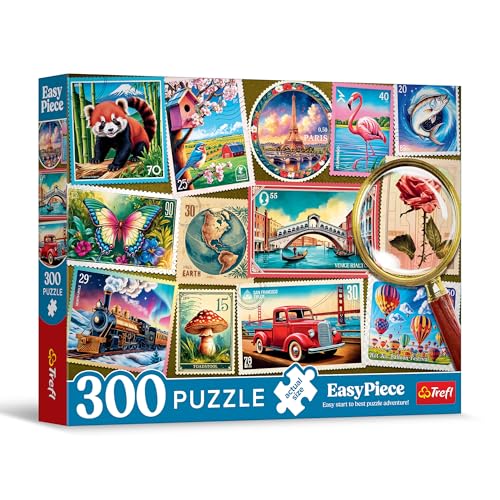
EasyPiece 300 pieces are an easy start to an unforgettable puzzle adventure! With large elements, doing puzzle becomes even more enjoyable and convenient.
How This Kind of Riddle Works

This is a lateral-thinking riddle because the most obvious interpretation leads you away from the answer. The apparent contradiction is created by two assumptions:
- You assume that “around the world” means the object must move independently.
- You assume that “a corner” means the corner of a room or building.
The solution appears when you replace those assumptions. The stamp can be carried by something else, and the corner can belong to an envelope.
How to Solve Similar Riddles
- Identify the apparent contradiction. Ask which parts of the clue seem unable to be true at the same time.
- Look for words with more than one meaning. Common examples include “run,” “light,” “bank,” “key,” and “corner.”
- Question the setting. A corner does not have to be in a room, and running does not always involve legs.
- Consider objects that are carried. Something can travel because it is attached to another object.
- Test the whole clue. The best answer should explain every important word without forcing the meaning.
Pro Tip: When a riddle sounds physically impossible, check whether one key word is being used in an unexpected setting.
Try These Related Riddles
If you enjoyed solving this one, a few other short riddles use the same trick of putting a familiar word in an unfamiliar setting:
- “What has hands but cannot clap?” A clock — its “hands” point to numbers rather than grip anything.
- “What has a neck but no head?” A bottle — “neck” describes its narrow top, not an anatomical feature.
- “What has a face but no eyes?” A clock or a coin — “face” refers to its front surface.
Why People Enjoy Sharing This Riddle
The riddle is popular because it is short, easy to remember, and satisfying to solve. A reader can understand the clue in seconds, suggest an answer, and share it with someone else without needing specialist knowledge.
It also creates two enjoyable reactions. Some people recognize the answer immediately and feel clever. Others begin with literal answers, hear the solution, and appreciate how the word “corner” misdirected them. Humorous wrong answers can keep the conversation going even after the correct answer is known.
The subject also feels familiar. Most people have seen a stamp on an envelope, so the answer does not depend on obscure trivia. The surprise comes from seeing an ordinary object from a different angle.
Frequently Asked Questions
What goes around the world but does not leave the corner?
A postage stamp. It stays attached to the corner of an envelope while the envelope travels to its destination.
What can run but cannot walk?
A river. In this riddle, “run” means to flow rather than to move using legs.
What can travel all around the world without leaving its place?
A postage stamp is the usual answer. Its “place” is the corner of the envelope, and it remains there throughout the journey.
What goes around the world but cannot leave its original location?
A postage stamp fits if “original location” means its position on the envelope. The envelope changes location, but the stamp remains attached to the same corner.
Can an envelope be the answer?
An envelope can travel around the world, but it does not stay in a corner of itself. A postage stamp is therefore the more precise answer.
Why is this called a lateral-thinking riddle?
It encourages you to challenge the first meaning that comes to mind. The trick is to interpret “corner” as part of an envelope rather than part of a room.
Sources
- United States Postal Service: How to Send a Letter or Postcard — confirms where postage is placed on a standard envelope.
- United States Postal Service: Right Spot — explains why upper-right stamp placement helps mail processing.
- Smithsonian National Postal Museum: The World’s First Postage Stamps — documents the Penny Black and the introduction of adhesive postage stamps.
- Smithsonian National Postal Museum: Postal Reforms That Transformed the Mail — explains Rowland Hill’s prepaid-postage reforms.
- Smithsonian National Postal Museum: U.S. Postal Stamps — covers the first United States postage stamps and their development.
Conclusion
The answer is a postage stamp. It travels wherever the envelope goes while remaining attached to the same corner. The riddle works because “corner” first makes you imagine a fixed place in a room. Once you picture an envelope instead, the answer becomes simple. That small change in perspective is what makes the riddle memorable and fun to share.
