
Last Updated on September 11, 2026 by Daniel Globe
A solar charger power bank stores energy in an internal battery and can use sunlight as one way to recharge that battery. However, the small panel built into many pocket-sized models produces very little power. For dependable outdoor charging, you should normally start with a full USB charge and treat the solar panel as backup. A separate folding panel paired with a quality power bank is usually faster and easier to position in the sun.
Quick Answer
Solar charger power banks work, but their built-in panels usually recharge them very slowly. Pre-charge the battery through USB, use solar for emergency top-ups, and choose a separate 15W to 30W folding panel when you need more dependable off-grid charging for phones, lights, GPS devices, or cameras.
Key Takeaways
- A small built-in solar panel is best treated as an emergency backup, not the main way to refill a large power bank.
- Compare battery capacity in watt-hours, not only milliamp-hours, when estimating runtime or checking airline limits.
- A separate folding panel and power bank usually collect more energy and let you keep the battery out of direct heat.
- Check USB-C Power Delivery wattage, total shared output, recharge input, IP rating, weight, and documented safety testing.
- Power banks must normally stay in carry-on baggage when you fly, and units above 100Wh may require airline approval.
Disclosure: As an Amazon Associate I earn from qualifying purchases. Some links on this page are affiliate links, at no extra cost to you.
How Solar Charger Power Banks Work
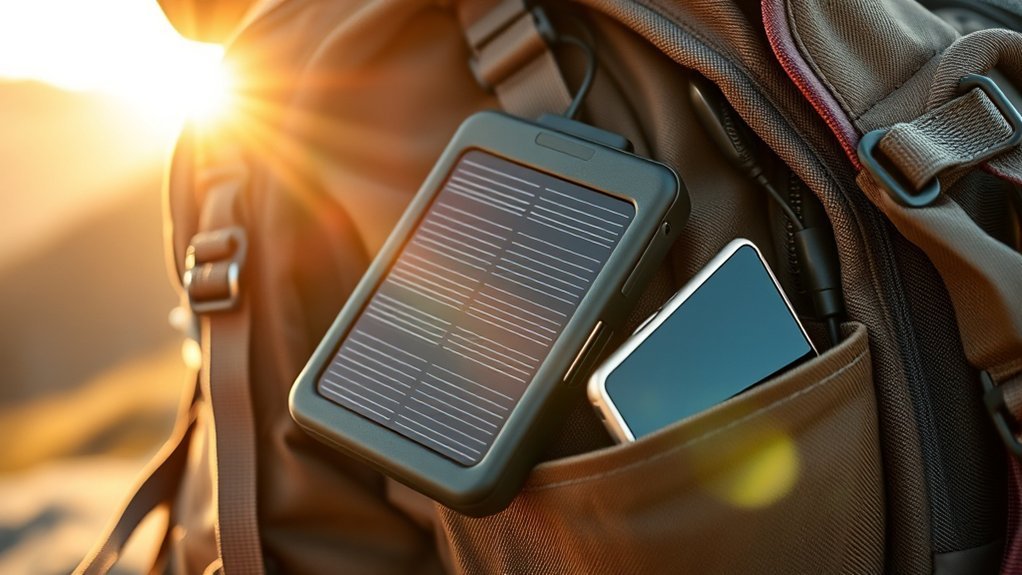
A solar charger power bank combines three main parts:
- Photovoltaic cells convert sunlight into direct-current electricity.
- Charging electronics regulate that power before it reaches the battery.
- An internal rechargeable battery stores the energy and later sends it to your devices through USB ports.
The solar panel does not charge your phone with sunlight stored inside the cells. It produces electricity only while light reaches the panel. The internal battery is what stores energy for use after sunset, inside a tent, or while the panel is packed away.
Solar output changes throughout the day. According to the U.S. Department of Energy, photovoltaic performance is affected by cell temperature, reflected light, electrical characteristics, and operating conditions. Shade, clouds, poor alignment, dirt, and heat can all reduce the power available at the USB port.
A power bank’s advertised capacity is normally shown in milliamp-hours, such as 10,000mAh or 25,000mAh. That number describes the internal cells, but it does not tell you exactly how many times the bank will charge a phone. Some energy is lost while the electronics raise the battery voltage, regulate the output, and move power through the cable.
Warning: Stop using a power bank if it swells, leaks, smells unusual, becomes too hot to handle, makes hissing sounds, or has damaged ports or casing. Move away from flammable material when it is safe to do so, and follow local battery-disposal guidance. Do not puncture, crush, or open the battery.
Solar Charger Power Bank or Power Station?
A solar charger power bank is designed mainly for low-power USB devices. A portable power station stores much more energy and may provide USB, 12V DC, and household-style AC outlets. Between those categories is a third option: a folding solar panel paired with a separate USB power bank.
| System | Best For | Main Advantage | Main Limitation |
|---|---|---|---|
| Integrated solar power bank | Emergency phone top-ups and short trips | One compact unit | Small panel and slow solar refill |
| Folding panel plus power bank | Backpacking, cycling, camping, and camera charging | More panel area and flexible placement | Two pieces to carry and connect |
| Portable power station | Base camps, long outages, laptops, and small appliances | High capacity and several output types | Heavy, expensive, and often restricted on aircraft |
Power Bank Basics
A compact power bank is suitable when your main loads are a phone, headlamp, GPS device, small camera, smartwatch, or rechargeable lantern. Capacity commonly appears in mAh, but output wattage is equally important. A large battery with a weak 5W output may charge your phone much more slowly than a smaller bank with a suitable USB-C Power Delivery port.
- 10,000mAh: A practical size for a day trip or basic phone backup.
- 20,000mAh: Better for several devices or multiple days, but heavier.
- 25,000mAh to about 27,000mAh: Near the upper end of what many travelers choose while remaining close to the common 100Wh airline threshold.
- USB-C input and output: Useful for faster bank recharging and wider device compatibility.
Do not estimate phone charges by dividing one mAh number by another and treating the result as guaranteed. The internal battery and the USB output operate at different voltages, and conversion losses reduce usable energy.
Power Station Uses
A portable power station is more suitable when your equipment includes laptops, drones, medical equipment, communications gear, powered coolers, or devices with AC plugs. Capacity is normally shown in watt-hours, which makes it easier to compare the stored energy with a device’s wattage.
For example, a device drawing 40 watts for two hours needs about 80Wh before allowing for inverter and system losses. A small USB power bank cannot provide that load through an AC outlet because it does not contain an AC inverter. A properly sized power station may be able to run it.
Check continuous output, surge output, usable battery capacity, solar-input limits, connector type, operating temperature, and recharge time. A high-wattage panel cannot safely force extra power into a station whose solar input has a lower voltage, current, or wattage limit.
Choosing the Right Option
- Choose an integrated solar bank when you want one compact emergency device and accept slow solar input.
- Choose a separate folding panel and USB power bank when you need useful daily solar collection without carrying a full power station.
- Choose a power station when you need high storage capacity, AC output, or sustained laptop and equipment charging.
- Skip solar entirely for a short trip when one fully charged conventional power bank already covers your energy budget.
The best system is the smallest one that can cover your expected use plus a reasonable reserve for poor weather, navigation problems, delays, or an unavailable outlet.
Choose the Right Panel Size
Panel size affects how much sunlight the charger can collect, but the wattage printed on the label is measured under controlled conditions. Actual output is normally lower and changes with sun angle, temperature, cloud cover, shade, cable losses, and charging electronics.
These ranges are practical starting points rather than universal rules:
- Tiny built-in panel: Best for maintaining charge or adding a small emergency top-up over time.
- 5W to 10W folding panel: Light and compact, but slow for refilling a large bank.
- 15W to 30W folding panel: A useful range for phones, lights, GPS devices, and a separate USB power bank in good sun.
- 40W to 100W panel: Better for base camps, larger batteries, laptops, or power stations, but less suitable for lightweight backpacking.
Choose the panel only after checking the receiving device’s input. A 30W panel does not guarantee 30W charging if the panel’s USB controller, the cable, or the power bank accepts less.
Pro Tip: A separate panel lets you place the panel in direct sun while keeping the lithium battery in a cooler, shaded location. This is often safer and more efficient than leaving an integrated battery on a hot rock, vehicle dashboard, or exposed campsite table.
Solar Charger Power Bank Specs That Matter
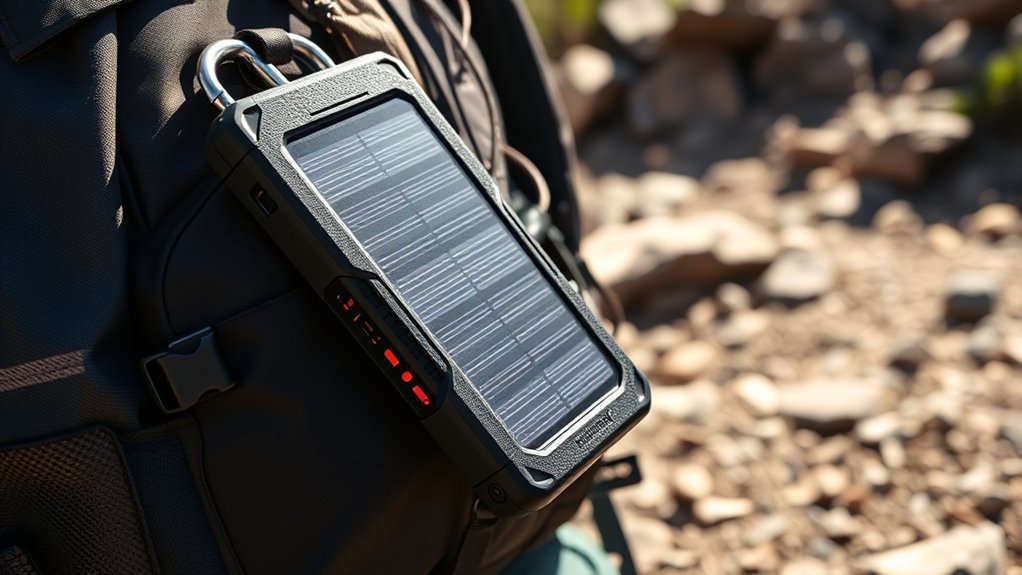
Capacity, solar input, USB output, recharge input, durability, weight, and safety testing determine how useful a solar charger will be in the field. Do not choose a model by its mAh number alone.
Capacity in mAh and Wh
Milliamp-hours are useful when comparing power banks built around similar lithium cells. Watt-hours are better when comparing different battery systems or calculating airline limits.
You can estimate watt-hours with this formula:
Wh = volts × amp-hours
When the label gives mAh:
Wh = volts × (mAh ÷ 1,000)
For example, a 20,000mAh lithium battery rated at a nominal 3.7V is approximately:
3.7 × 20 = 74Wh
Use the Wh value printed by the manufacturer when available. It is more reliable for travel checks than calculating from a marketing capacity that does not show the rated voltage.
USB Output and Power Delivery
Check the wattage of each port and the total output available when several ports are active. A bank advertised as 30W may provide that output only through one USB-C port. Connecting a second device may divide or reduce the available power.
USB Power Delivery allows compatible USB-C products to negotiate supported power levels. You do not normally need to match a fixed voltage manually. However, the charger, device, and cable must all support the required profile.
- Use USB-C PD when your phone, tablet, camera, or laptop supports it.
- Check whether USB-C is input-only, output-only, or bidirectional.
- Confirm whether the advertised wattage applies to one port or all ports combined.
- Use a properly rated cable from a known manufacturer.
- Avoid damaged, loose, overheated, or corroded connectors.
Solar Input and USB Recharge Speed
A power bank has two different charging specifications:
- Solar input tells you how much power the panel may send to the battery in good conditions.
- USB input tells you how quickly the bank can recharge from a wall charger, vehicle adapter, or separate panel with regulated USB output.
USB input is normally much faster and more predictable. Before a trip, fully charge the bank from a wall outlet and test every port and cable. Do not begin a remote trip with an empty bank and expect a tiny integrated panel to fill it during the first day.
Understanding IP Ratings
The IEC 60529 IP Code describes how an enclosure protects against solid objects and water. The two positions have different meanings.
- IPX4: Tested for splashing water, but no dust-protection level is stated.
- IP54: Limited dust ingress protection plus splash resistance.
- IP65: Dust-tight and tested against water jets.
- IP67: Dust-tight and tested for temporary immersion under defined laboratory conditions.
Note: An IP rating is not permission to charge with wet ports, leave a device underwater, or ignore the manufacturer’s instructions. Port covers must usually be closed for the stated protection to apply.
Safety Testing and Recall Status
Prefer a power bank from a traceable manufacturer that provides a model number, Wh rating, warranty, operating-temperature range, and documented third-party safety testing. UL 2056 addresses safety testing for power banks used with low-voltage electronic devices.
Before using an older or secondhand unit, search the exact model number on the U.S. Consumer Product Safety Commission recall database or the equivalent authority in your country. Do not continue using a recalled product simply because it still appears to charge normally.
Best Solar Panel Types for Backpacking
The best panel construction depends on your route, expected weather, and pack weight. Rigidity alone does not determine efficiency. Cell type, surface treatment, wiring, controller quality, temperature, and available area also matter.
- Folding fabric-backed panels: Easy to pack and hang at camp. Hinges, fabric, and cable pockets add some weight.
- Rigid panels: Strong and easy to support at a fixed angle, but awkward to pack and more vulnerable to cracking during transport.
- Semi-flexible panels: Can follow a slightly curved surface, though repeated bending may damage models not designed for constant flexing.
- Integrated multi-panel power banks: More useful than a single tiny panel, but usually heavier than a conventional power bank and still limited by heat around the battery.
- Separate panel and bank: Usually the most flexible backpacking setup because each part can be placed, replaced, or upgraded separately.
Check the folded dimensions, unfolded area, total system weight, attachment points, port protection, cable storage, and minimum light needed before charging begins. Some phones repeatedly connect and disconnect when sunlight changes. Charging a power bank first can provide a steadier buffer.
Real-World Solar Charging Limits
Solar charging works best in strong, direct sunlight with the panel facing the sun. It becomes less predictable under trees, beside canyon walls, behind a vehicle windshield, or during changing cloud cover.
- Rated wattage is not the same as continuous field output.
- Partial shade across one section can reduce the output of more than the shaded area alone.
- High panel and battery temperatures can reduce performance.
- A phone may stop and restart charging when the available current changes.
- USB cables and controller electronics add losses.
- The final part of battery charging may be slower than the early part.
How to Estimate Solar Recharge Time
Start with the battery’s watt-hour rating and divide it by the panel power you realistically expect to reach the battery:
Ideal hours = battery Wh ÷ actual charging watts
Suppose a power bank stores 37Wh and your panel delivers an average of 8W to the bank:
37Wh ÷ 8W = about 4.6 ideal hours
Real charging will take longer because the output changes and the system loses energy. The required sunlight may also be spread across more than one day. If the same bank relies on a tiny panel delivering only 1W under good conditions, the ideal calculation becomes 37 hours before losses.
Panel area matters. A pocket-sized solar strip may preserve a little energy, while a properly positioned folding panel can provide a useful daily refill.
Where Solar Charger Power Banks Work Best
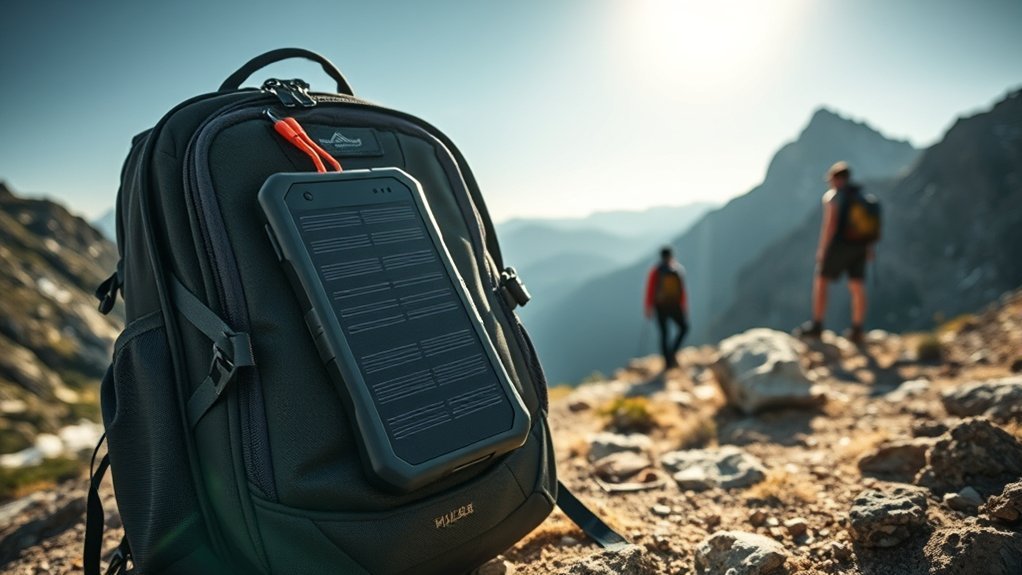
You will get the best results in open locations that provide several hours of unobstructed sunlight. Open campsites, desert routes, beaches, exposed ridges, bicycle tours, and emergency staging areas are generally more suitable than dense forests or narrow canyons.
Best Outdoor Use
Solar charging is most useful when all three conditions are present:
- You will be away from dependable outlets long enough to use the extra panel.
- Your route or campsite receives useful direct sunlight.
- Your daily energy demand is low enough for the panel and battery to cover it.
A phone used mainly for offline maps, occasional photos, and emergency messages needs much less energy than a phone streaming video with the screen at full brightness. Reducing demand can be more effective than carrying a larger panel.
Sunlight and Shade
Place the panel where the entire surface receives direct light. Reposition it as the sun moves when practical. A panel hanging flat against the back of a hiker may face the wrong direction, move through shade, and become partly covered by clothing or gear.
At camp, aim the panel directly toward the sun and support it so wind cannot fold it or pull on the cable. Keep connectors away from wet ground. When using a separate power bank, place the battery in shade with enough airflow and run the cable to the panel.
Do not place the battery inside a sealed black pouch in direct sun. Do not leave it on a vehicle dashboard or inside a closed car, where temperatures can rise quickly.
Trip Type Match
- Day hike: One charged 5,000mAh to 10,000mAh conventional bank may be simpler than carrying solar equipment.
- Weekend trip: A charged 10,000mAh to 20,000mAh bank may cover moderate phone, light, and GPS use without solar.
- Multi-day sunny backpacking trip: A lightweight folding panel and separate bank can extend your reserve.
- Dense forest route: Carry enough stored energy because dependable solar collection may not be possible.
- Bicycle tour: A folding panel can work well at long rest stops or camp, but moving shade and changing angles reduce on-bike performance.
- Base camp or vehicle-supported trip: A larger panel and power station may support laptops, cameras, communications equipment, and lighting.
How to Use a Solar Power Bank Safely
- Inspect the bank. Check the casing, ports, cables, panel surface, and model number. Do not use it if it is swollen, cracked, recalled, wet inside, or physically damaged.
- Read the label. Confirm the capacity in Wh, USB input, USB output, solar-input rating, operating temperature, and IP rating.
- Charge it through USB first. Fully charge the bank from a suitable wall charger before your trip.
- Test your devices. Confirm that your phone, GPS, camera, and cables charge correctly before leaving home.
- Place the panel in direct sun. Keep the full panel clear of shade and point it toward the sun.
- Control battery heat. Shade the battery when using a separate panel. Follow the manufacturer’s instructions for an integrated unit.
- Watch the indicators. Confirm that the LEDs or display show incoming power. Check again after clouds, shade, or repositioning.
- Protect the ports. Disconnect cables before rain unless the manufacturer specifically permits operation in those conditions. Let wet ports dry fully before use.
- Store it safely. Disconnect devices, close port covers, and keep the unit away from sharp equipment and metal objects.
Some products support pass-through charging, which means the bank can receive power while charging another device. Do not assume this is supported. Pass-through charging may create extra heat, reduce charging speed, or be disabled by the manufacturer.
Solar Charger Troubleshooting
The Panel Shows No Input
- Move the entire panel into direct sunlight.
- Change its angle toward the sun.
- Remove dirt, dust, or objects covering the cells.
- Reconnect the cable at both ends.
- Try a known-good cable.
- Check whether the receiving device requires more startup power than the panel currently provides.
- Allow an overheated bank to cool in a safe, shaded location.
The Phone Keeps Connecting and Disconnecting
Changing sunlight can make the panel’s output rise and fall. Some phones respond by repeatedly starting and stopping the charging session. Connect the panel to a compatible power bank first, then charge the phone from the bank. This creates a more stable source, provided the bank supports charging from that panel.
The Bank Charges by USB but Not Solar
Check whether the solar indicator actually confirms charging or only confirms that light reaches the panel. Review the required light level and temperature range in the manual. A damaged panel wire or charge controller may require manufacturer service.
Charging Is Much Slower Than Expected
Check the panel angle, shade, temperature, cable, receiving-port limit, and shared-port output. A 20W panel connected to a 5V/2A input cannot send more than about 10W to that input, even before losses.
The Ports Got Wet
Disconnect all cables and turn the device off when possible. Do not insert objects, apply direct heat, or reconnect power while moisture remains. Follow the manufacturer’s drying instructions. Replace the device if water entered the enclosure or corrosion appears.
How to Extend Battery Life Outdoors
Begin with every device and power bank fully charged. During the trip, reduce unnecessary demand so the stored energy lasts longer.
- Download maps, tickets, permits, and emergency information for offline use.
- Use airplane mode when you do not need a mobile connection.
- Lower screen brightness and shorten the screen timeout.
- Turn off unused background syncing and location access.
- Use battery-saver mode before the phone reaches a critical level.
- Keep batteries away from high heat and direct afternoon sun.
- Use shorter, undamaged cables to reduce clutter and connection problems.
- Charge essential navigation and communication devices before entertainment devices.
You do not need to drain a modern lithium-ion device completely before charging it. Frequent deep discharge and high heat can increase battery stress. Follow the charging guidance provided by the device manufacturer.
For storage, avoid leaving the bank completely empty for months. Recharge and inspect it periodically according to the manual. Recycle unwanted or damaged lithium batteries through an approved battery-recycling program rather than placing them in household trash.
Best Solar Charger Power Banks
There is no single best solar charger for every trip. Products described as solar power banks may be integrated battery units, panel-only chargers, or bundles containing separate components. Confirm what the product actually includes before comparing capacity or price.
Solar Power Bank Basics
A good integrated solar power bank should provide:
- A clearly printed battery capacity in both mAh and Wh.
- USB-C input and output, preferably with documented PD support.
- A stated maximum solar-input wattage.
- A realistic USB recharge time.
- A model-specific IP rating.
- Closed port covers that fit securely.
- Temperature, short-circuit, overcharge, and overcurrent protection.
- A traceable manufacturer, manual, warranty, and recall process.
The panel must be large enough to provide useful input. A single phone-sized panel attached to a high-capacity bank will normally need many hours or days of useful sunlight to refill the battery.
Top Solar Picks and Correct Product Categories
The products below illustrate different categories. They are not interchangeable, and manufacturer specifications do not replace independent field testing.
| Example | Correct Category | Verified Information | Best Fit |
|---|---|---|---|
| Hiluckey 25,000mAh Four-Panel Model | Integrated solar power bank | The manufacturer lists a 25,000mAh battery, four solar panels with up to 6W stated solar power, 15W USB output, and three USB ports. | Users who want one rugged unit and accept slow solar refilling |
| BigBlue SolarPowa 28 | Panel-only USB solar charger | The current no-ammeter version is rated at 28W, lists up to 24W total working power, includes USB-A and USB-C outputs, and has no internal battery. | Charging a separate bank or several small USB devices in good sun |
| Goal Zero Nomad 5 and Flip 12 Kit | Small panel-plus-bank kit | A lightweight kit that separates the solar panel from the storage battery. | Low daily energy use where pack weight matters more than charging speed |
| ALLPOWERS SP012 | 100W folding solar panel | The manufacturer identifies it as a 100W panel rather than a power bank. | Base camps, compatible power stations, and vehicle-supported travel |
| Blavor and older Re-Fuel listings | Model-dependent | Model names, current availability, solar wattage, capacity, and port specifications can vary by listing. Verify the exact model number on the manufacturer’s current page before purchase. | Only after current specifications, support, and recall status are confirmed |
Choosing Capacity Wisely
List each device, its battery size or energy use, and how often you expect to recharge it. Then add a reserve for poor weather and unexpected delays.
- For one phone on a short trip, 10,000mAh may be enough.
- For a phone, headlamp, watch, and GPS device over several days, 20,000mAh may provide a more useful reserve.
- For cameras, drones, tablets, or laptops, calculate demand in Wh and confirm the required output wattage.
- For equipment that must not lose power, do not depend on sunshine as the only charging source.
More capacity also means more weight and a longer recharge time. A large battery paired with a tiny panel can be less useful than a smaller bank paired with a better-positioned folding panel.
How to Choose the Right Model
- Calculate your daily load. Estimate how much energy your phone, GPS, lights, camera, tablet, or laptop will use.
- Choose enough stored capacity. Include a reserve for at least one poor-sun day when the trip risk justifies it.
- Decide between integrated and separate parts. Choose convenience or stronger solar collection.
- Check solar wattage. Confirm the panel’s rated output and the battery’s maximum accepted input.
- Check USB protocols. Look for the USB-C PD profiles and wattage required by your devices.
- Check shared output. Find out what happens when two or three devices charge together.
- Check recharge input. Faster USB input makes it easier to prepare between trips.
- Read the IP rating correctly. Confirm whether dust protection is stated and whether port covers must be closed.
- Review weight and dimensions. Include the panel, bank, cables, adapters, and protective case.
- Check safety documentation. Look for a Wh label, model number, manual, warranty, recognized testing, and current recall status.
- Check airline suitability. Confirm the Wh rating and your airline’s rules before flying.
- Test the complete system. Use the actual panel, cables, and devices in sunlight before relying on them remotely.
Air Travel and Power Bank Safety
The Federal Aviation Administration classifies power banks as spare lithium-ion batteries. They must be carried in the aircraft cabin rather than placed in checked baggage.
- Power banks rated at 100Wh or less are generally permitted for personal use, subject to airline rules.
- Units from 101Wh through 160Wh require airline approval, and the number allowed is limited.
- Power banks above 160Wh are generally forbidden on passenger aircraft.
- Terminals and ports must be protected against short circuits and physical damage.
- Individual airlines and countries may apply stricter limits.
Keep the label readable. A bank with no visible Wh rating may be delayed or refused even when its calculated capacity appears acceptable. Contact the airline before travel when the capacity, label, or product category is unclear.
Do not travel with a swollen, damaged, recalled, or overheating bank. Keep it where you can notice a problem rather than buried under heavy gear. Follow crew instructions immediately if smoke, unusual heat, or fire occurs.
Frequently Asked Questions
Do portable solar power banks really work?
Yes. The battery can charge your devices, and the panel can add energy when it receives enough sunlight. The limitation is panel size. A small built-in panel usually provides a slow emergency top-up, while a larger separate panel can collect much more useful energy.
How should I use a solar power bank for the first time?
Inspect it, read the manual and label, check for recalls, and fully charge it through USB. Test every port and cable with your devices. Then place the panel in direct sun and confirm that the charging indicator shows actual input rather than only light detection.
Can a solar power bank run household appliances?
A small USB solar power bank cannot run normal AC appliances such as refrigerators, heaters, air conditioners, or most power tools. A properly sized solar system with a large battery, suitable inverter, enough continuous and surge output, and compatible panels may run them.
What should I look for when buying a solar power bank?
Check capacity in Wh, solar-input wattage, USB-C PD output, USB recharge speed, shared-port limits, weight, IP rating, operating temperature, model number, safety testing, warranty, and recall status. Confirm whether the product is an integrated bank, a panel-only charger, or a bundle.
How long does a solar power bank take to charge?
Divide the battery capacity in Wh by the actual watts reaching the battery, then add time for changing sunlight and conversion losses. A tiny integrated panel may need several days of useful sun, while a larger folding panel can recharge the same bank much faster.
Can I take a solar power bank on an airplane?
Usually, provided it meets the airline’s capacity rules. Power banks must normally travel in carry-on baggage. Units up to 100Wh are generally permitted, while 101Wh to 160Wh units require airline approval. Check the airline before departure.
Conclusion
A solar charger power bank can keep essential devices running, but the solar panel must be large enough for your energy needs. A tiny integrated panel is useful mainly for emergency top-ups. For regular off-grid charging, a separate folding panel and USB power bank normally provide better panel placement, stronger output, and safer heat management.
Choose by watt-hours, actual solar input, USB-C output, weight, IP rating, safety documentation, and your expected sunlight. Pre-charge before every trip, test the full system, protect the battery from heat and damage, and carry enough stored energy for periods when the sun does not cooperate.
Sources
- U.S. Department of Energy: Solar Photovoltaic Performance and Efficiency Basics – factors that affect photovoltaic output and efficiency.
- Federal Aviation Administration: Airline Passengers and Batteries – carry-on rules, watt-hour limits, and the Wh calculation.
- USB Implementers Forum: USB Power Delivery – compatible power negotiation and USB-C charging capabilities.
- IEC 60529: Degrees of Protection Provided by Enclosures – the official basis for IP dust and water-protection ratings.
- UL Solutions: UL 2056 Power Bank Testing – safety testing for portable power banks.
- U.S. Consumer Product Safety Commission Recall Database – current power-bank recalls and safety notices.
