
Last Updated on July 23, 2026 by Daniel Globe
Italy’s most beautiful small towns reward travelers who slow down. Medieval lanes, vineyard-covered hills, church-filled squares, coastal harbors, and regional food traditions give each place a distinct character. Start with well-known towns such as Assisi, San Gimignano, Pienza, Volterra, Orvieto, or Vernazza, then add quieter stops such as Bevagna, Trevi, Todi, Casole d’Elsa, Monforte d’Alba, or La Morra.
Quick Answer
Italy’s most beautiful small towns include Montepulciano, Volterra, Pienza, San Gimignano, Assisi, Orvieto, Vernazza, Todi, and La Morra. Choose Tuscany for classic hill views, Umbria for quieter medieval centers, Piedmont for wine, and Cinque Terre for the coast. Late spring and early fall usually offer the best balance of weather and crowds.
Key Takeaways
- First-time visitors often find Assisi, Orvieto, San Gimignano, Pienza, and Montepulciano the easiest places to appreciate.
- Tuscany offers the broadest mix of hill towns, wine, art, and scenic drives, while Umbria generally feels quieter.
- Trains work well for Orvieto and the Cinque Terre, but a car is more useful for remote Tuscan and Piedmont villages.
- Book winery visits, check limited-traffic zones, and confirm trail or transport conditions before travel.
| Town | Region | Best For | Best Access |
|---|---|---|---|
| Montepulciano | Tuscany | Wine and Val d’Orcia views | Car or regional bus |
| Assisi | Umbria | Sacred art and medieval streets | Train plus local bus |
| Orvieto | Umbria | Cathedral and underground history | Train plus funicular or bus |
| Vernazza | Liguria | Harbor scenery and coastal walks | Train |
| La Morra | Piedmont | Barolo-country panoramas | Car |
Disclosure: As an Amazon Associate I earn from qualifying purchases. Some links on this page are affiliate links, at no extra cost to you.
Why Italy’s Small Towns Stand Out
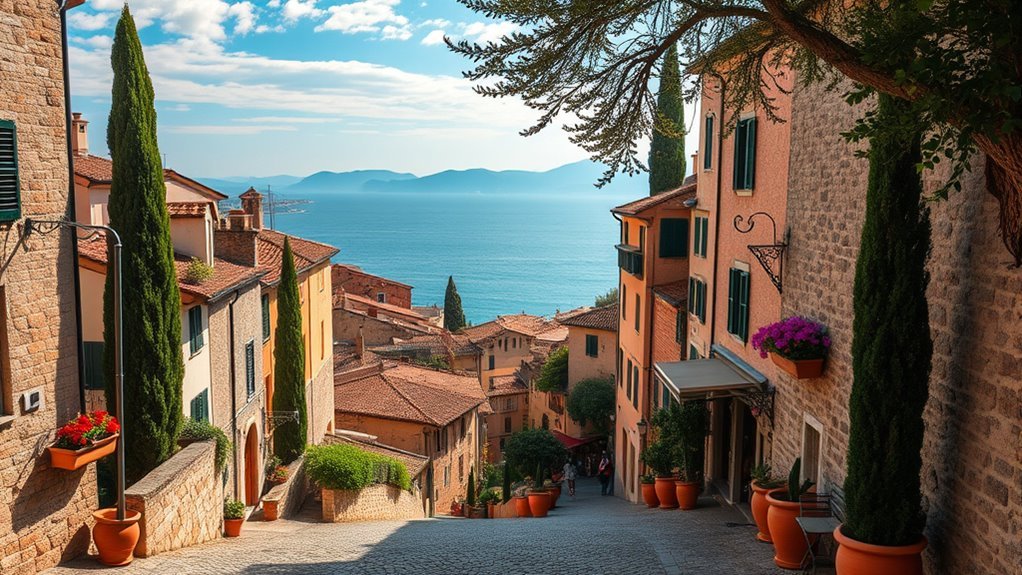
Italy’s small towns stand out because history, craft, food, and daily life remain close together. You may pass medieval walls, Renaissance palaces, family-run shops, produce markets, and a church square within a few minutes. In Volterra, alabaster carving remains part of local identity. In Alberobello, traditional dry-stone trulli shape the townscape. In Piedmont and Tuscany, wine culture is tied to the surrounding farmland rather than separated from it.
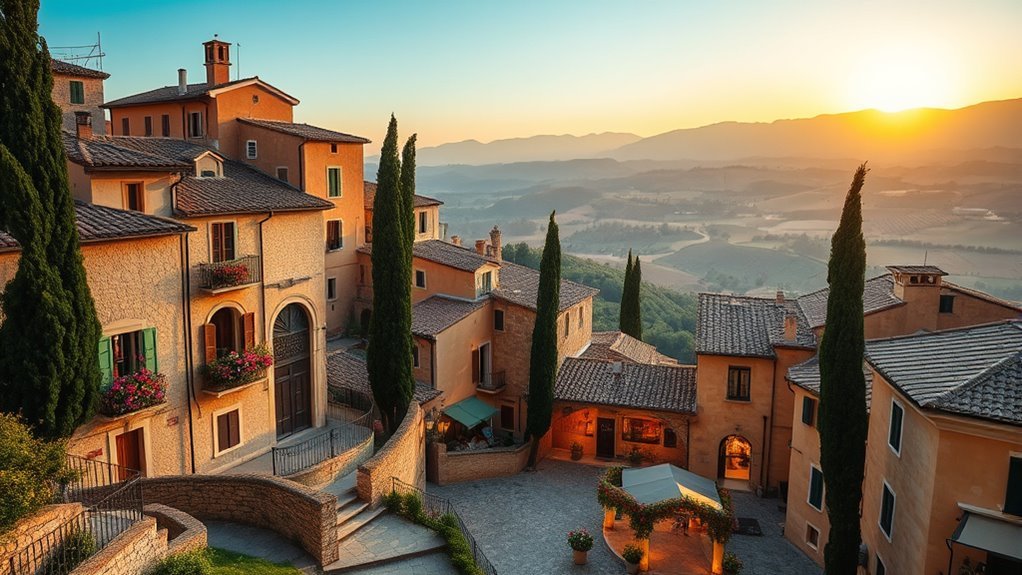
The strongest towns also have a clear relationship with their landscape. Todi, Montepulciano, Pienza, La Morra, and Orvieto sit above valleys or vineyards, while Vernazza is shaped by a steep coast and small natural harbor. Festivals, food traditions, and public squares help these places feel lived in rather than preserved only for visitors.
Best Italian Towns for First-Time Visitors
For a first trip, choose towns that combine memorable sights with manageable transport and enough services for an easy visit. Assisi offers major art and religious history. Orvieto pairs a dramatic cathedral with underground archaeology and convenient rail access from Rome or Florence. San Gimignano has a compact medieval center, surviving tower houses, and clear links to Tuscany’s wider road network. Pienza is ideal for Renaissance architecture, pecorino, and Val d’Orcia scenery, while Volterra adds Etruscan and Roman history.
Montepulciano works especially well for travelers with a car who want wine, views, and a lively historic center. Vernazza is a strong coastal choice, but it is busiest when day-trippers arrive, so staying overnight or visiting early can improve the experience.
Montepulciano: Wine, Views, and Winding Streets
Montepulciano rises above southern Tuscany, with steep streets leading toward Piazza Grande and viewpoints over the Val d’Orcia and Val di Chiana. The historic center is compact but hilly, so comfortable shoes matter. Palaces, churches, wine cellars, and small food shops make it easy to spend a full day without rushing.
The town is associated with Vino Nobile di Montepulciano DOCG. Despite the name, this Tuscan wine is based mainly on Sangiovese, locally called Prugnolo Gentile; it should not be confused with the Montepulciano grape widely grown in Abruzzo. Book formal cellar tours in advance, especially during harvest season, and leave time for a simple tasting in an enoteca if you prefer a shorter visit.
Pro Tip: Park outside the historic center and walk uphill. Many Italian hill towns have restricted-traffic zones, and navigation apps may route visitors toward streets where unauthorized cars are not allowed.
Volterra: Roman Ruins and Artisan Charm
Volterra brings several layers of history into one walkable town. Etruscan gates and museum collections show the settlement’s early importance, while the Roman theater dates to the late first century BC. Medieval streets, defensive walls, and the Piazza dei Priori complete the picture.
Alabaster carving remains Volterra’s best-known craft. You can see finished lamps, bowls, sculpture, and jewelry in shops and, when workshops are open, watch artisans shape the pale stone. Volterra is easier to reach by car than by train because the nearest useful rail connections require an onward bus. The town deserves at least half a day, but a full day allows time for the archaeological sites and museum.
Casole d’Elsa: A Quiet Tuscan Village
Casole d’Elsa is a small walled village west of Siena with broad views across the Val d’Elsa. Its Rocca Senese is a 14th-century fortress that now serves as the town hall, while two round towers belong to the 15th-century defenses. The compact center suits travelers who prefer a quiet stop over a long checklist of famous sights.
Castle and Village Views
The fortress and walls anchor the village, but the main pleasure is walking the lanes and looking across fields, woods, and distant hills. Casole is small enough to explore slowly in one or two hours, though lunch and a museum visit can turn it into a relaxed half-day stop. The elevated setting is especially attractive in the softer light of morning or late afternoon.
Art Centers and Galleries
Art is visible throughout Casole d’Elsa, including contemporary sculptures placed around the village and works connected to the local civic and collegiate museum. Exhibitions and studio access can change by season, so check current opening information before planning a visit around one gallery. Even when indoor spaces are closed, the streets, stone buildings, and outdoor art make the village feel like a small open-air museum.
Trevi: Olive Groves and Hilltop Calm
Trevi sits on a hill above the Umbrian plain near Foligno and Spoleto. Olive groves cover the surrounding slopes, and the town’s food identity is closely tied to extra-virgin olive oil. Inside the walls, narrow streets climb toward Piazza Mazzini and the Cathedral of Sant’Emiliano.
The former convent of San Francesco includes the Museum of Olive Civilization, which helps explain how deeply olive growing shaped the area. Trevi works well as a quiet stop on an Umbrian road trip or as a day trip from a nearby rail-connected base. Train and bus connections vary, so check the current timetable rather than relying on a fixed journey time.
Assisi: Medieval Streets and Sacred History
Assisi is one of Italy’s most important pilgrimage towns and a UNESCO World Heritage site. The Basilica of St. Francis contains major medieval fresco cycles associated with Cimabue, Giotto, Pietro Lorenzetti, and Simone Martini. The stone streets also lead to the Basilica of Santa Chiara, Piazza del Comune, Roman remains, and views toward the Umbrian plain.
| Sight | Why It Matters | Planning Note |
|---|---|---|
| Basilica of St. Francis | Major Franciscan and medieval art site | Dress respectfully and expect security checks |
| Piazza del Comune | Civic heart with Roman and medieval layers | Easy stop during a walking route |
| Rocca Maggiore | Fortress and broad views | Requires an uphill walk |
| Santa Chiara | Key site connected to St. Clare | Combine with the eastern side of town |
| Franciscan landscape | Part of the wider UNESCO property | Allow extra time for sites outside the walls |
Assisi railway station is in Santa Maria degli Angeli below the hill, not inside the medieval center. A local bus connects the station and upper town. Because the streets are steep and paved with stone, travelers with limited mobility should review current shuttle and accessibility information before arrival.
Bevagna: Easy Wandering in Umbria
Bevagna offers a different rhythm from Umbria’s steeper hill towns. Much of its historic center lies on relatively level ground, making it easier to explore on foot. Piazza Silvestri, the churches of San Michele and San Silvestro, Roman remains, and quiet lanes give the town more substance than its small size suggests.
- Walk the center without a strict route and spend time around Piazza Silvestri.
- Look for demonstrations connected to medieval trades and workshops.
- Visit during the Mercato delle Gaite if you want a major historical festival, but expect larger crowds.
Bevagna is less saturated with day-trippers than Assisi, yet it remains close enough to combine with Assisi, Spello, Montefalco, or Perugia. A car is convenient, while regional buses require more timetable planning.
Todi: Squares, Churches, and Scenic Hills
Todi centers on Piazza del Popolo, one of Umbria’s most impressive civic squares. The cathedral, Palazzo del Popolo, Palazzo del Capitano, and Palazzo dei Priori show the town’s medieval political and religious importance. From the square, lanes rise and fall through residential quarters and open toward views of the surrounding hills.
San Fortunato has a striking unfinished façade and a broad staircase, while Santa Maria della Consolazione stands outside the historic walls as a major Renaissance church. Todi is well suited to travelers who want architecture, views, and a slower pace without the visitor pressure found in better-known Tuscan towns.
Orvieto: The Duomo and Underground Caves
Orvieto stands on a high tuff plateau above the Umbrian countryside. Its cathedral is the visual centerpiece, with mosaics, sculpture, and richly decorated Gothic architecture. Below the streets, wells, tunnels, quarries, cisterns, and other man-made spaces reveal how residents used the rock over many centuries.
Duomo Architecture
Construction of Orvieto Cathedral began in 1290. The façade combines mosaics, relief sculpture, pinnacles, and colored stone, while the interior includes the Chapel of San Brizio and frescoes by Luca Signorelli. Orvieto is on Italy’s UNESCO Tentative List, but it is not currently an inscribed World Heritage property, so the cathedral should not be described as having UNESCO status.
- Study the façade from Piazza del Duomo before entering.
- Allow time for the Chapel of San Brizio inside.
- Check current opening hours and religious-service restrictions.
Etruscan Cave Network
Orvieto’s underground system contains more than 1,200 documented cavities, not 1,200 meters of tunnels. The guided Orvieto Underground route introduces a small part of this network, including ancient wells, quarry spaces, medieval pigeon houses, and evidence of olive-oil production. The experience shows how people adapted the soft volcanic rock for water, storage, work, and defense.
Evening Town Atmosphere
Orvieto becomes calmer after many day visitors leave. The cathedral façade catches the last light, restaurant tables fill the lanes, and viewpoints around the plateau open toward the countryside. Staying overnight gives you time to see both the main monuments and the quieter residential streets.
- Walk the lanes around Piazza del Duomo after sunset.
- Reserve an underground tour earlier in the day.
- Try Orvieto Classico wine and regional dishes at a local trattoria.
Vernazza: Cinque Terre’s Harbor Gem
Vernazza is one of the five Cinque Terre villages. Pastel buildings descend toward a small harbor, while the Church of Santa Margherita d’Antiochia stands at the water’s edge. The church is first documented in 1318, though parts of the structure may be older. A climb toward the remains of Doria Castle provides one of the village’s best coastal views.
Train is the practical way to arrive because parking is limited and the road approach is not useful for most day visitors. Spring and fall can be more comfortable than peak summer, but the village may still be busy at midday. Early morning, late afternoon, or an overnight stay usually creates a calmer experience.
Warning: Cinque Terre paths can close after heavy rain, landslides, maintenance, or safety inspections. Check the Cinque Terre National Park before relying on a particular hiking route.
Monforte d’Alba: Views in the Barolo Hills
Monforte d’Alba rises above vineyard-covered slopes in the Langhe. The upper village has steep lanes, historic churches, Palazzo Scarampi, and the small Horszowski Auditorium, an outdoor amphitheater known for music events. The surrounding countryside belongs to one of Italy’s most important wine landscapes.
- Book a winery visit rather than assuming walk-in availability.
- Walk the upper village for vineyard views and quiet streets.
- Leave time for a long lunch or dinner built around Piedmont dishes.
Monforte is small, so one day is enough for the town itself, but two or more nights make sense if you are exploring wineries and nearby villages. A car is the most flexible option, and whoever is driving should avoid tasting more alcohol than local law and safe driving allow.
La Morra: Vineyards and Panoramic Piazzas
La Morra’s main attraction is the viewpoint at Piazza Castello, where vineyards spread across the Langhe and the Alps may appear on a clear day. The medieval street plan, churches, bell tower, wine shops, and surrounding paths make the town a natural stop during a Barolo-country drive.
Because winery visits often require appointments, plan the day around confirmed bookings rather than trying to improvise every tasting. La Morra is also well suited to travelers who prefer scenery and short walks over a long list of monuments.
Best Piedmont Towns for Wine Lovers
Piedmont’s best wine towns offer different experiences within a relatively compact landscape.
- Barolo: Visit the village for its castle-based wine museum, enotecas, and access to Barolo producers.
- Alba: Use the larger town as a dining and transport base, especially during white-truffle season.
- Asti: Explore a historic city linked to sparkling wines and the Palio di Asti.
- La Morra: Choose it for panoramic vineyard views and easy access to nearby producers.
- Monforte d’Alba: Stay for a quieter village atmosphere, strong restaurants, and a central Langhe location.
Do not confuse Barolo, the wine and village, with the wider Langhe area. Distances look short on a map, but narrow roads and tasting appointments can make a full day feel busy. Two winery visits in one day often provide a more enjoyable pace than trying to fit in four or five.
Beautiful Small Towns in Southern Italy
The original selection leans heavily toward Tuscany, Umbria, Piedmont, and Liguria, but southern Italy adds different landscapes and building traditions. Matera in Basilicata is famous for the Sassi cave districts and rock-cut churches. Alberobello in Puglia is known for its trulli, while Ostuni combines whitewashed lanes with views across olive country. Atrani offers a compact Amalfi Coast setting, and Maratea pairs a historic center with mountains and the Tyrrhenian Sea.
These places can require more travel time than central Italian hill towns, so they work best as part of a regional trip rather than a rushed add-on. Matera and Alberobello can be very busy during popular travel periods; staying overnight helps you see them before and after the main day-trip hours.
Why Tuscany Has So Many Beautiful Towns
Tuscany combines a long history of independent city-states, pilgrimage routes, agriculture, trade, and artistic patronage. Medieval towers, defensive walls, Renaissance planning, vineyards, olive groves, and farmhouses create the visual mix travelers now associate with the region. Towns such as Volterra, Montepulciano, Pienza, and San Gimignano each express a different part of that history.
Rich History
Tuscany’s hill towns preserve evidence from several periods rather than one fixed style.
- Volterra combines Etruscan remains, a Roman theater, medieval walls, and later civic buildings.
- Lucca’s fortifications show how defense shaped urban life, though Lucca is larger than most towns in this guide.
- Montepulciano and Pienza show Renaissance architecture and planning.
- San Gimignano’s UNESCO-listed center preserves 14 surviving medieval tower houses from a much larger original group.
The strongest visits connect monuments with the streets, farms, and trade routes that supported them.
Rolling Landscapes
Tuscany’s hills, cultivated fields, vineyards, olive groves, and cypress-lined roads form the setting around many towns. The countryside changes through the year: spring is greener, midsummer can be dry and golden, harvest season brings vineyard activity, and winter offers clearer views with fewer visitors.
| Town | Typical View | Best Light |
|---|---|---|
| San Gimignano | Towers and vineyard ridges | Early morning |
| Pienza | Open Val d’Orcia farmland | Late afternoon |
| Volterra | Wide Tuscan hills | Golden hour |
For photography, allow time to stop safely at formal pullouts or viewpoints instead of blocking narrow roads.
Village Culture
Tuscany’s towns remain active communities with schools, markets, festivals, workshops, and local government. Visitors can support that living culture by buying directly from artisans, eating regional food, respecting church services, and avoiding private doorways or residential lanes when taking photographs.
- Taste pecorino in Pienza and local wine near its production area.
- Watch for established craft traditions rather than generic souvenir shops.
- Check festival dates early because accommodation can fill quickly.
Why Umbria Feels More Local
Umbria has major visitor destinations, especially Assisi and Orvieto, but many of its smaller towns receive fewer international day-trippers than famous Tuscan centers. Bevagna, Trevi, Todi, Spello, and Montefalco provide medieval streets, churches, olive oil, wine, and festivals within a compact region.
Public transport is useful on major routes, but not every hill town has a station in its historic center. Assisi’s station is below the hill, and Gubbio does not have a central rail station, so buses or a car are needed for some itineraries. This is one reason Umbria can feel less crowded, but it also requires more careful planning.
Italian Towns With the Best Scenic Views
For broad landscapes and memorable viewpoints, focus on towns whose historic centers sit above valleys, vineyards, or the sea.
- Montepulciano: Look across the Val d’Orcia and Val di Chiana from streets and viewpoints near the upper town.
- Todi: Combine elevated streets with views across the Umbrian hills.
- Civita di Bagnoregio: Cross the pedestrian bridge to a tuff ridge surrounded by eroded valleys.
- La Morra: Use Piazza Castello for one of the Langhe’s best-known vineyard panoramas.
- Vernazza: Climb above the harbor for a compact coastal view framed by terraced slopes.
Orvieto also has wide viewpoints from its volcanic plateau, while Volterra’s walls frame long Tuscan horizons.
Best Italian Towns for Artisans
Volterra is the clearest choice for a town tied to a specific craft because alabaster has shaped its workshops and identity for generations. Bevagna is strong for demonstrations of medieval trades, especially around the Mercato delle Gaite and its associated craft circuit. Casole d’Elsa blends historic architecture with contemporary sculpture, while San Gimignano has ceramics, leather, and food shops alongside mass-market souvenirs.
Look for workshops where the maker can explain materials and process. A higher price may reflect handwork, local production, and limited output. Ask whether an item was made locally rather than assuming every product sold in a historic center comes from that town.
Best Italian Towns for Food and Wine
Montepulciano combines Vino Nobile with Tuscan dishes, while San Gimignano is linked to Vernaccia di San Gimignano. Pienza is the natural stop for pecorino. In Piedmont, Alba, Barolo, La Morra, and Monforte d’Alba bring together Nebbiolo-based wines, hazelnuts, tajarin pasta, and seasonal truffles. Umbria adds olive oil, legumes, cured meats, truffles, and wines such as Sagrantino from the Montefalco area.
Southern towns broaden the menu. Ostuni and nearby Puglian towns are known for orecchiette, olive oil, vegetables, and seafood, while Matera is associated with crusty local bread and dishes rooted in Basilicata’s farming traditions.
Wine Tasting Spots
The best wine-tasting towns pair a clear appellation with a landscape you can explore responsibly.
- Barolo and La Morra: Book producer visits for Nebbiolo-based Barolo and use village enotecas for shorter tastings.
- Monforte d’Alba: Combine winery appointments with the upper village and a meal.
- Montepulciano: Taste Vino Nobile in cellars or enotecas within the historic center.
- Montalcino: Plan ahead for Brunello di Montalcino producers, many of which sit outside town.
- San Gimignano: Look for Vernaccia di San Gimignano alongside local olive oil and saffron.
Use a designated driver, hire a driver, or choose tastings you can reach on foot. Winery availability varies, and many estates do not accept unannounced visitors.
Local Culinary Specialties
Food changes quickly from one region to another. Tuscany offers ribollita, pappa al pomodoro, pecorino, and meat dishes. Umbria is known for olive oil, lentils, truffles, pork products, and rustic pasta. Piedmont adds tajarin, agnolotti, raw beef preparations, hazelnuts, and truffles. Liguria brings pesto, focaccia, anchovies, and seafood, while Puglia is strong in orecchiette, vegetables, olive oil, and coastal cooking.
Menus are often seasonal. Ask what is local that day instead of treating every regional specialty as available year-round.
Best Hill Town Views in Italy
- Montepulciano offers high streets and terraces overlooking southern Tuscany.
- Todi combines civic architecture with views across the Umbrian countryside.
- Civita di Bagnoregio appears almost suspended above an eroded valley.
- Volterra’s walls and viewpoints open toward broad Tuscan distances.
- San Gimignano’s towers create elevated views over vineyards and farms.
La Morra belongs on the same list for its Langhe panorama, while Orvieto provides a different perspective from the edge of its tuff plateau.
Italian Towns With Rich History
Volterra is one of the strongest choices for layered history because Etruscan, Roman, medieval, and later periods remain visible. Assisi combines Roman foundations, medieval urban form, Franciscan history, and major works of art. Orvieto adds Etruscan origins, a medieval commune, a Gothic cathedral, wells, and underground spaces.
Civita di Bagnoregio shows the long relationship between settlement and an unstable tuff landscape. Matera’s Sassi preserve a complex history of cave dwellings, churches, abandonment, restoration, and modern reuse. These places are most rewarding when you visit a museum or guided site rather than relying only on scenic streets.
Best Italian Towns for Outdoor Exploring
Italy’s small towns can be bases for walking, cycling, and countryside exploration, but route difficulty varies sharply. Vernazza and the Cinque Terre involve steep paths and stairs. Todi, Cortona, Volterra, Monforte d’Alba, and La Morra connect to hilly roads or trails. Bevagna’s flatter setting is better suited to easy cycling than many hill towns.
- Check trail status, weather, elevation, and daylight before setting out.
- Carry water and sun protection in warm months.
- Use proper shoes on stone lanes, loose gravel, and steep paths.
- Do not enter vineyards, olive groves, or farm tracks unless access is clearly public.
A scenic town walk may be enough for a casual traveler, while longer routes require maps and current local information.
When to Visit Italy’s Small Towns
April through June and September through October are popular because temperatures are often more comfortable than midsummer and many services are open. These months are not guaranteed to be quiet, especially in famous towns, during school holidays, or around major festivals. July and August bring heat, longer lines, heavier road traffic, and high demand in coastal areas.
Autumn is strong for wine harvests, olive oil, mushrooms, and truffles, while spring brings greener landscapes and flowers. Winter can offer lower crowds and clear views, but some restaurants, museums, tours, and rural accommodations reduce their hours.
Spring and Fall Travel
Spring and fall are useful planning windows, but conditions differ by region and elevation. A warm day in Puglia may coincide with cool rain in Piedmont or Umbria. Pack layers and check the local forecast shortly before travel.
- Reserve accommodation early for harvest weekends and festivals.
- Expect popular places to remain busy at midday.
- Use early mornings and evenings for quieter streets and softer light.
Avoiding Peak Tourist Seasons
To reduce crowds, avoid building the entire trip around late July and August, especially around Ferragosto on August 15. Easter, long holiday weekends, major religious events, food festivals, and cruise-ship days can also increase visitor numbers. January and February are not automatically months to avoid; they can be quiet and rewarding if you accept shorter hours and winter weather.
The best crowd strategy is often more precise than choosing a month: sleep in the town, visit famous sights near opening time, eat lunch outside the busiest hour, and explore secondary streets while day-trip groups gather in the main square.
How to Get Around Italy’s Small Towns
Walking is the main way to explore historic centers, but steep grades, stairs, cobblestones, heat, and limited shade can make short distances tiring. Trains are useful for Orvieto, Assisi, and the Cinque Terre, though the station may sit below or outside the old town. Check current routes on Trenitalia and confirm the last local bus or shuttle before relying on a same-day connection.
- Use trains for rail-connected towns and coastal villages where parking is difficult.
- Rent a car for remote areas of Tuscany, Umbria, and Piedmont.
- Park outside historic centers and watch for ZTL signs and camera-controlled entrances.
- Choose a small car if you are uncomfortable on narrow roads or tight parking spaces.
- Allow extra time for buses because rural services may be limited on Sundays or holidays.
Note: Accessibility varies widely. Historic paving, steep lanes, stairs, and station locations can create barriers. Review official local mobility information before booking, especially if anyone in your group uses a wheelchair, walker, or stroller.
Where to Base Yourself
A regional base reduces packing and protects the trip from constant driving. Siena or the Val d’Orcia works for southern Tuscany; Perugia or Spello works for central Umbria; Alba works for the Langhe; and La Spezia or Levanto works for Cinque Terre train trips. Stay inside a smaller town when atmosphere matters more than transport convenience.
How Long to Spend in Italy’s Small Towns
Two to four hours is enough for a very small village such as Casole d’Elsa if you only want a walk and coffee. Allow a full day for Volterra, Assisi, Orvieto, Montepulciano, or San Gimignano when museums and major monuments are included. Two nights work well for towns that become more enjoyable after day-trippers leave, including Orvieto, Assisi, Vernazza, and Montepulciano.
Avoid counting every nearby town as a separate stop. One substantial town and one smaller village usually make a better day than three rushed hill centers separated by parking, driving, and uphill walks.
Which Italian Small Town Should You Visit?
Choose Montepulciano for Tuscan wine and hill views, Assisi for sacred art and medieval atmosphere, Orvieto for a cathedral and underground history, and Vernazza for a dramatic harbor. Volterra is best for travelers interested in Etruscan and Roman remains, while Todi and Bevagna suit visitors seeking a quieter Umbrian pace. La Morra and Monforte d’Alba are strongest for wine-country scenery, and Matera offers the most distinctive southern historic landscape in this guide.
Your best town also depends on transport. Without a car, prioritize Orvieto, Assisi, or the Cinque Terre. With a car, Tuscany, inland Umbria, and the Langhe become much easier to explore.
Frequently Asked Questions
What is the most beautiful small town in Italy?
There is no objective winner, but Vernazza is a strong coastal choice, Montepulciano is excellent for classic Tuscan scenery, and Assisi stands out for art and spiritual history. The best answer depends on whether you prefer sea views, vineyards, architecture, food, or quiet streets.
When should you avoid Italy in 2026?
Avoid late July through August if heat, high prices, and crowds would reduce your enjoyment, especially around Ferragosto on August 15. Also check Easter, long holiday weekends, major festivals, and local events. Winter is not automatically a bad time, but some small-town businesses keep shorter hours.
What are the five villages of Cinque Terre?
The five Cinque Terre villages are Monterosso al Mare, Vernazza, Corniglia, Manarola, and Riomaggiore. Trains connect all five, while Corniglia is the only one that sits high above the water rather than directly at sea level.
What are some hidden-gem Italian villages?
Bevagna, Casole d’Elsa, Trevi, Todi, and Monforte d’Alba are quieter alternatives to Italy’s most famous small towns. They are not undiscovered, but they generally offer more room to slow down than heavily visited places such as San Gimignano or Vernazza.
Can you visit Italian small towns without a car?
Yes. Orvieto, Assisi, and the Cinque Terre are practical by train, though Assisi requires a local connection from the station below town. A car is more useful for rural Tuscany, inland Umbria, and Piedmont wine villages.
Which Italian small town is best for a first trip?
Orvieto is one of the easiest first choices because it has direct rail connections, a dramatic cathedral, underground tours, restaurants, and enough sights for a full day or overnight stay. Assisi and San Gimignano are also strong first-time options.
Conclusion
Italy’s small towns are most memorable when you give them time. Montepulciano, Volterra, Assisi, Orvieto, Vernazza, Todi, and La Morra each offer a different balance of scenery, history, food, and local life. Choose a region, stay overnight in at least one town, and leave space for unplanned walks, markets, viewpoints, and meals. A slower route usually creates better memories than a checklist of rushed day trips.
Sources
- UNESCO: Assisi, the Basilica of San Francesco and Other Franciscan Sites — Assisi’s World Heritage status and artistic importance.
- UNESCO: Historic Centre of San Gimignano — the town’s surviving towers and medieval urban heritage.
- Orvieto Underground — the documented network of more than 1,200 underground cavities.
- Cinque Terre National Park — the five villages and protected cultural landscape.
- Consorzio Vino Nobile di Montepulciano — official production rules and grape composition.
- Trenitalia — current rail schedules and journey planning.
