
Last Updated on September 11, 2026 by Daniel Globe
The word matchbox can mean two very different things at airport security: a packet of matches or a Matchbox-style diecast toy. In the United States, you may generally carry one book or packet of safety matches in your carry-on or on your person. You cannot pack any matches in ordinary checked baggage. Small diecast toy planes are generally allowed, although any item may receive additional screening.
Quick Answer
Under U.S. rules, you may bring one book or packet of safety matches in your carry-on bag or on your person. Safety matches cannot go in checked baggage, and strike-anywhere matches are forbidden in both. Ordinary Matchbox-style toy planes are generally permitted in carry-on and checked bags.
Key Takeaways
- The United States permits one book or packet of safety matches in the cabin, not in checked baggage.
- Strike-anywhere matches are prohibited in both carry-on and checked bags.
- “Waterproof” or “stormproof” is a marketing description. The ignition method determines whether the matches qualify as safety matches.
- Remove permitted matches before a carry-on bag is checked at the gate or planeside.
- Small diecast toy planes are normally allowed, but airline size limits and routine security screening still apply.
- International authorities and airlines may use stricter rules than the TSA.
Warning: These are U.S. baseline rules. Your airline, departure airport, connecting airport, or destination country may impose stricter restrictions. Check every part of an international itinerary before packing matches or a lighter.
Disclosure: As an Amazon Associate I earn from qualifying purchases. Some links on this page are affiliate links, at no extra cost to you.
What TSA Allows for Matches
For flights departing from the United States, the TSA permits one book of safety matches as a carry-on item. The FAA PackSafe guidance describes the allowance as one book or packet carried in your carry-on bag or on your person.
A safety match is designed to ignite only when rubbed against its specially prepared striking strip. Keep the permitted packet intact so security officers can identify it easily. Do not pack loose matches, multiple packets, or a large collection and assume they qualify for the single-packet exception.
| Item | Carry-on or on person | Checked baggage |
|---|---|---|
| One book or packet of safety matches | Allowed | Not allowed |
| Strike-anywhere matches | Not allowed | Not allowed |
| Loose or unidentified matches | Avoid; they may not qualify as one packet | Not allowed |
| Ordinary Matchbox-style diecast toy | Generally allowed | Generally allowed |
The simplest U.S. rule is: one packet of safety matches may stay in the cabin, but no matches may travel in ordinary checked baggage.
Why Strike-Anywhere Matches Are Banned
Strike-anywhere matches are prohibited because they can ignite through friction against an ordinary solid surface. That creates a greater risk of accidental ignition during handling, screening, baggage movement, or flight.
Ignition on Almost Any Suitable Surface
Federal hazardous-material regulations define a safety match as one that ignites only on a prepared surface. A strike-anywhere match can ignite when rubbed against a solid surface. You can review these definitions in 49 CFR 173.186.
The difference may appear small, but it changes how easily friction, impact, or rough handling can start a fire. Aircraft cabins and cargo compartments require strict control of ignition sources, so strike-anywhere matches are not accepted in passenger baggage.
TSA Prohibition Rules
TSA and FAA guidance prohibits strike-anywhere matches in both major baggage categories:
- Carry-on baggage: Not allowed.
- Checked baggage: Not allowed.
- On your person: Not allowed.
- Quantity: No passenger exception applies, even for a small packet.
Do not try to repackage or relabel strike-anywhere matches as safety matches. The product’s actual ignition method controls the rule.
Safer Match Alternatives
The most direct alternative is one intact book or packet of genuine safety matches. A permitted lighter may also be an option, but lighter rules depend on the design, fuel, battery, and baggage location.
Do not assume that camping matches, survival matches, flint kits, or magnesium fire starters are automatically permitted. Some kits contain a sharp striker, fuel, pyrotechnic material, or another restricted component. Check the exact product through AskTSA and your airline before traveling.
Safety Matches vs. Stormproof Matches
The words printed on the package do not always determine the baggage rule. “Waterproof,” “windproof,” and “stormproof” describe performance, while TSA and FAA rules focus on how the match ignites.
| Match description | What to check | U.S. passenger rule |
|---|---|---|
| Safety matches | Ignite only on the prepared strip supplied with the packet. | One packet in carry-on or on your person; none in checked baggage. |
| Waterproof or stormproof safety matches | Confirm that they still require the package’s prepared striking surface. | May qualify under the one-packet safety-match allowance. |
| Strike-anywhere matches | Can ignite against an ordinary solid surface. | Forbidden in carry-on and checked baggage. |
| Unclear or mixed labeling | Check the manufacturer’s instructions and ask the airline or TSA. | Leave it at home when the ignition type cannot be confirmed. |
Note: FAA guidance specifically lists waterproof matches with safety matches. A “stormproof” label alone does not make a product permitted or prohibited. Verify whether it is a safety match or a strike-anywhere match.
Products Worth Considering

Includes 25 windproof and waterproof matches, 3 strikers and match case that can hold up to 40 matches
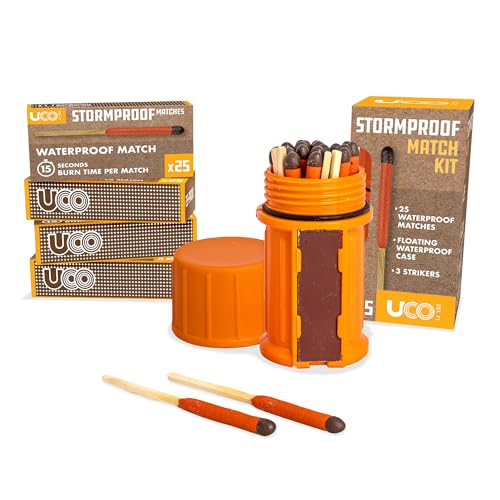
STORMPROOF MATCH KIT: Windproof, waterproof and light up quickly and consistently in driving rain, heavy winds and falling snow, and will relight even after being submerged in water

LONGEST-BURNING WINDPROOF AND WATERPROOF MATCHES: The beefiest, longest-burning windproof and waterproof matches available that will light and stay lit even after being submerged, and includes 12 matches, 3 replaceable strikers, a waterproof case, and two refill packs of 25 replacement matches
How to Pack Matches for Air Travel
Pack no more than one book or packet of safety matches. Keep the packet intact, dry, and protected from crushing or friction. Place it somewhere accessible in your carry-on rather than burying it under tightly packed items.
- Confirm the match type. It must ignite only on its prepared striking surface.
- Carry one packet only. Do not add loose matches or extra packets.
- Keep it in the cabin. Place it in your carry-on or keep it on your person.
- Remove it before gate-checking. A bag placed in the aircraft hold becomes checked baggage.
- Check the airline. An airline can use a stricter policy than the general U.S. allowance.
- Check international segments. Transit-country rules may apply even when you do not leave the airport.
Pro Tip: Keep the FAA PackSafe matches page available on your phone before departure. It can help you identify the rule, although the security officer and airline still make the final operational decision.
Products Worth Considering

LCD DISPLAY & GREEN/RED LIGHT REMINDER - The handheld luggage scale adopts a clear and readable digital LCD display. GREEN/RED light reminds you if the baggage is overweight, preventing overweight baggage charges (Airline weight restriction: 50lb. <50lb: GREEN, >50lb: RED).

Dual Access - Key or 4-Digit Code. This luggage lock gives you two ways to open your bag. Set a resettable 4-digit code with 10,000 possible combinations or use the included keys for quick access. All keys in the same pack are keyed alike, so you always have a backup. The re-lock safety system keeps the key from being removed until the lock is fully closed, helping prevent misplaced keys during travel. The Forge TS-431B Ox Edge lock is built for dependable use on suitcases and travel bags.

TRAVEL WITH LESS WORRY - Protects your car seat from airport dirt and handling while making family travel a little more manageable. Use to gate check when boarding the airplane.
How TSA Screens Matches
Your carry-on passes through normal X-ray screening. An officer may inspect the packet if the image is unclear, the matches appear altered, the quantity looks excessive, or the product cannot be identified as safety matches.
You are not normally required to make a special declaration for one permitted packet of safety matches. However, you should answer questions truthfully and make the packet available if an officer asks to inspect it.
Transparent repackaging is not a published TSA requirement. In fact, keeping the matches in an intact retail book or packet may make their type and quantity easier to recognize. Avoid homemade bundles, loose matches, damaged packaging, or mixed match types.
TSA notes that even a generally permitted item may receive additional screening or be rejected if it triggers an alarm, appears to have been tampered with, or creates another security concern. The final checkpoint decision rests with the TSA officer.
Matches in Carry-On vs. Checked Bags
The baggage location is as important as the match type. One packet of safety matches may remain with you in the cabin, while all matches are prohibited in ordinary checked baggage.
Carry-On Match Rules
- Carry no more than one book or packet of safety matches.
- Keep the packet intact and easy to identify.
- Do not carry strike-anywhere matches.
- Do not assume that every camping or survival match is a safety match.
- Remove the matches if the airline takes your carry-on for gate checking.
The FAA states that when a carry-on is checked at the gate or planeside, permitted matches must be removed and kept with the passenger in the aircraft cabin.
Checked Bag Restrictions
Do not place matches in a suitcase that will travel in the cargo hold. This applies to safety matches, strike-anywhere matches, and loose matches.
| Match type | Checked-bag status |
|---|---|
| Safety matches | Not allowed |
| Waterproof safety matches | Not allowed |
| Strike-anywhere matches | Not allowed |
| Loose matches | Not allowed |
Warning: A gate-checked carry-on is treated as checked baggage. Remove safety matches before handing the bag to airline staff.
Match Rules for International Flights
TSA rules apply to screening for departures from U.S. airports. They do not guarantee that an airline, foreign airport, transit country, or destination country will accept the same item.
Before an international flight, check all four levels:
- Your airline’s dangerous-goods policy
- The rules at your departure airport
- The rules at each connecting or transit airport
- The rules in your destination country
For example, Virgin Australia does not permit safety matches in carry-on or checked baggage. Its published policy permits one box of safety matches on the passenger’s person instead.
That example shows why “allowed in the United States” is not the same as “allowed throughout the itinerary.” When different rules apply, follow the strictest one.
Safer Alternatives to Pack Instead
The lowest-risk option is to leave ignition devices at home and buy an approved product after arriving. When you need an ignition source during travel, compare the exact rules before packing it.
| Option | U.S. guidance | Important limit |
|---|---|---|
| Safety matches | One packet in carry-on or on your person. | Never in ordinary checked baggage. |
| Disposable or Zippo-type lighter | One ordinary absorbed-fuel or butane lighter may generally be carried in the cabin. | Fuel, refills, unabsorbed-liquid lighters, and checked-bag carriage have separate restrictions. |
| Arc or electronic lighter | May be carried in the cabin when it meets FAA battery and activation-protection conditions. | Carry-on only; prevent activation and do not recharge it aboard the aircraft. |
| Torch or jet-flame lighter | Prohibited. | Not allowed in carry-on or checked baggage. |
| Gun-shaped lighter | Prohibited. | Not allowed in carry-on or checked baggage. |
| Magnesium or flint fire-starting kit | No blanket approval should be assumed. | Verify the striker, blade, fuel, and other components separately. |
Review the FAA’s current lighter guidance before choosing an alternative. A product advertised as portable, rechargeable, camping-friendly, or eco-friendly is not automatically approved for air travel.
Products Worth Considering

What Will You Get: BAGSMART 6 set compression packing cubes includes 1 large cube (11.6'' x 12.6''), 2 medium cubes (9.3'' x 13.2''), 2 small cubes (8.3'' x 11.6'') and a drawstring shoe bag (13'' x 17.7''). Different sizes can be used for different packing purposes, helping us quickly sort, organize and find our items while traveling.
【Leather Laptop Backpack for Women】:Laptop backpacks made of soft and durable faux leather and fabric lining,thick shoulder straps,unique leather handles,no-slip zippers.The heavy-duty laptop backpack women features a total of 2 compartments and 11 pockets,making it easy to organize all work necessities,college supplies,and travel essentials,with dimensions of 16.5" x 15.7" x 7.8" and a weight of 2 lbs

【ALL METAL NEW UPGRADE】- All Metal (Zinc Alloy) Housing & Single Jet Flame. The creative classic pocket lighter gives you more applications.(Butane Not Included)
Why Matchbox Planes Cause Confusion
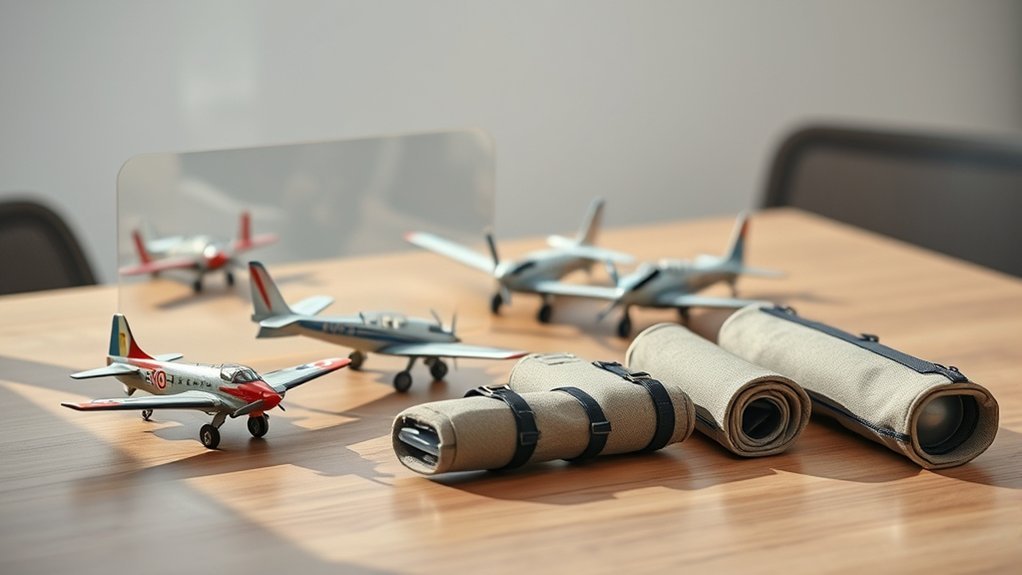
The main source of confusion is the word “Matchbox,” not a special TSA prohibition. A matchbox may refer to a container of matches, while Matchbox is also used for small diecast vehicles and collectibles.
TSA explicitly lists small toy cars as allowed in carry-on and checked baggage. An ordinary diecast toy plane that contains no blade, weapon replica, explosive replica, prohibited battery, or hazardous material is likewise not part of the matches rule.
Like any object, a toy may receive additional screening if its X-ray image is unclear or if it appears altered. That possibility does not mean diecast aircraft are commonly treated as weapons or routinely confiscated.
Note: A toy that realistically resembles a firearm, explosive, or other weapon follows different rules. An ordinary miniature passenger aircraft is not the same as a replica weapon.
What Collectors Need to Know Before Flying
If you travel with a diecast aircraft collection, focus on protecting the models and keeping unrelated restricted tools out of the case.
- Use padded compartments. Separate models so metal parts do not rub together.
- Carry valuable models in the cabin. This reduces the risk of impact damage or loss, subject to your airline’s size and weight limits.
- Keep the collection organized. A neat case is easier to inspect than a dense bundle of loose metal objects.
- Pack hobby knives in checked baggage. Do not leave blades or prohibited sharp tools inside a model case placed in your carry-on.
- Check paints, glues, and solvents separately. Some modeling products are flammable and prohibited in both baggage categories.
- Protect batteries. If a model contains a lithium battery, follow FAA battery rules and prevent accidental activation.
- Document rare pieces. Photographs and an inventory may help with an airline damage or loss claim.
Original retail packaging is optional for ordinary toys, but a fitted protective case can prevent broken wings, bent landing gear, scratched paint, and missing accessories.
Frequently Asked Questions
Are Matchboxes Allowed on Planes?
One book or packet of safety matches is generally allowed in your carry-on or on your person for a U.S. departure. No matches are allowed in ordinary checked baggage, and strike-anywhere matches are prohibited everywhere in passenger baggage. If “Matchbox” means a small diecast toy, an ordinary model is generally allowed in carry-on and checked bags.
Why Avoid Seat 11A on a Plane?
There is no universal reason to avoid seat 11A. Its window position, recline, legroom, noise, and storage depend on the airline and aircraft configuration. Check the seat map for your exact flight. Seat 11A has no connection to TSA match rules.
What Is the 3-3-3 Rule for Flying?
U.S. travelers usually mean the TSA 3-1-1 liquids rule: containers of 3.4 ounces or less, inside one quart-size bag, with one bag per passenger. Solid matches are not governed by the liquids rule. Lighter fuel and refills have separate hazardous-material restrictions.
What Kind of Matches Are Prohibited?
Strike-anywhere matches are prohibited in carry-on and checked baggage. Safety matches are limited to one book or packet in carry-on baggage or on your person. All match types are prohibited in ordinary checked baggage.
Can I Leave Safety Matches in a Gate-Checked Bag?
No. Remove the matches before handing the carry-on to airline staff. Once the bag is moved to the aircraft hold, it is treated as checked baggage, where matches are not permitted.
Are Waterproof or Stormproof Matches Allowed?
They may be allowed only when they qualify as safety matches and ignite solely on a prepared striking surface. If they are strike-anywhere matches or their ignition method is unclear, do not pack them. Airline and international restrictions may be stricter.
Conclusion
For a U.S. flight, you may generally keep one book or packet of safety matches in your carry-on or on your person. Do not place any matches in checked baggage, and never pack strike-anywhere matches in either baggage category. If you are carrying a Matchbox-style toy plane instead, it is generally treated as an ordinary toy rather than a hazardous match product.
Confirm the ignition type, remove permitted matches before gate-checking a bag, and review every airline and international rule on your route. When a camping match, fire starter, or lighter does not fit a clearly published category, ask TSA and the airline about the exact product or leave it at home.
Sources
- Transportation Security Administration: What Can I Bring? — U.S. carry-on and checked-baggage status for safety matches, strike-anywhere matches, lighters, toys, and other items.
- Federal Aviation Administration: PackSafe Matches — one-packet limit, permitted baggage location, gate-check instructions, and strike-anywhere prohibition.
- Federal Aviation Administration: PackSafe Lighters — rules for ordinary, lithium-powered, and torch lighters.
- Electronic Code of Federal Regulations: 49 CFR 175.10 — federal passenger exception for one packet of safety matches or an eligible lighter.
- Cornell Legal Information Institute: 49 CFR 173.186 — legal definitions of safety and strike-anywhere matches.
- Virgin Australia: Dangerous Goods — example of an airline allowing safety matches on the person but not in carry-on or checked baggage.
