
Last Updated on July 25, 2026 by Daniel Globe
PSA Airlines is a regional carrier that operates flights for American Airlines under the American Eagle brand. Travelers may book through American Airlines while seeing “Operated by PSA Airlines” on the itinerary or boarding pass. Evaluating its safety requires looking at FAA oversight, pilot and maintenance rules, its current fleet, and its complete accident history, including the fatal collision involving Flight 5342 in 2025.
Quick Answer
PSA Airlines is an active U.S. Part 121 regional carrier subject to FAA airline rules and oversight. Its record includes the fatal 2025 collision involving Flight 5342. The NTSB attributed that accident mainly to airspace, air traffic control, helicopter, Army, and wider system failures rather than PSA-specific pilot or maintenance actions.
Key Takeaways
- PSA Airlines is a wholly owned American Airlines Group carrier that operates under the American Eagle brand.
- PSA is headquartered in Charlotte, North Carolina, and operates CRJ700 and CRJ900 regional jets.
- As a Part 121 carrier, PSA is subject to FAA certification, training, maintenance, operational, and Safety Management System requirements.
- PSA-operated Flight 5342 was involved in a January 2025 midair collision that killed 67 people.
- The NTSB’s completed investigation focused on systemic FAA, air traffic control, helicopter, Army, and technology failures. It did not identify PSA-specific maintenance or PSA flight-crew performance as a causal factor.
- Passenger reviews can describe service and comfort, but they are not reliable evidence of an airline’s technical safety.
Warning: No airline, regulator, safety record, or article can guarantee that a future flight will be risk-free. The most responsible assessment uses verified regulatory information and acknowledges both serious accidents and the findings behind them.
Disclosure: As an Amazon Associate I earn from qualifying purchases. Some links on this page are affiliate links, at no extra cost to you.
PSA Airlines at a Glance
PSA Airlines is a separate operating airline within American Airlines Group. It is not simply a name used for American Airlines aircraft. PSA supplies its own crews and operates regional flights sold under the American Eagle brand.
American Eagle is a marketing brand used for regional flights operated by PSA and several other carriers. The operating carrier should appear on the booking page, confirmation email, and boarding pass.
Note: A ticket purchased from American Airlines may be operated by PSA Airlines. Look for the words “Operated by PSA Airlines” when checking the flight details.
| Ownership | Wholly owned by American Airlines Group and operating for the American Eagle regional network |
| Headquarters | Charlotte, North Carolina |
| Operating framework | FAA-certificated Part 121 passenger airline |
| Current fleet | 151 CRJ aircraft listed by PSA as of July 2026: 60 CRJ700s and 91 CRJ900s |
| Passenger capacity | 65 seats on PSA’s CRJ700 configuration and 76 seats on its CRJ900 configuration |
| Network | More than 700 daily flights to roughly 100 destinations, according to current company information |
Fleet and schedule figures can change as aircraft enter or leave service and routes are adjusted. PSA’s current company information should therefore be checked when exact numbers matter.
Safety Regulations and Standards
Compliance with Part 121 Regulations
PSA operates scheduled passenger flights under the U.S. airline framework commonly called 14 CFR Part 121. This framework covers areas such as operating procedures, crew qualifications, training, dispatch, aircraft performance, maintenance programs, recordkeeping, emergency equipment, and regulatory oversight.
Part 121 certification does not mean that an accident is impossible. It means that the carrier must establish approved systems and continue meeting the requirements attached to its operating authority. The FAA uses certification, surveillance, inspections, data, and risk-based oversight to evaluate airline compliance.
Safety Management System
Part 121 carriers are required to maintain a Safety Management System under 14 CFR Part 5. According to the FAA’s current SMS guidance, the system is built around four components:
- Safety policy: Management responsibilities, policies, and organizational commitments.
- Safety risk management: Processes for identifying hazards and evaluating risk.
- Safety assurance: Monitoring whether controls work and correcting weaknesses.
- Safety promotion: Training, communication, and employee participation.
An SMS is meant to help an airline identify and control risk before it results in an unwanted event. It is not a promise that every hazard will be identified or eliminated.
A Culture of Safety
PSA states that being “safe and caring” is one of its operating behaviors. That statement can show company intent, but travelers should place greater weight on verifiable evidence such as FAA operating status, required training and maintenance systems, accident investigations, and corrective actions.
A credible safety culture also depends on employees being able to report hazards, management responding to those reports, accurate maintenance records, effective training, and cooperation with regulators and investigators.
Pilot Training and Experience
Airline pilots working in Part 121 operations must meet FAA certification and qualification requirements. First officers generally need an Airline Transport Pilot certificate or a restricted-privileges ATP certificate, depending on their approved education, military, and flight-experience pathway.
The standard ATP pathway generally requires 1,500 hours of flight experience, although qualifying restricted-ATP pathways can allow a pilot to serve as a first officer with fewer hours. Flight time alone is not the complete qualification. Pilots must also satisfy knowledge, medical, practical-test, aircraft-rating, and airline-training requirements.
The FAA’s ATP training information explains the certification framework. Part 121 training also includes aircraft systems, procedures, crew coordination, abnormal and emergency situations, simulator evaluations, recurrent training, and proficiency checks.
PSA’s complete internal training syllabus and individual pilot records are not public. It is therefore more accurate to discuss the regulatory training framework than to claim that every pilot completes a particular company-specific scenario without documentation.

Pro Tip: When comparing flights, check the operating carrier rather than relying only on the airline logo shown during booking. American Eagle flights may be operated by PSA or another regional carrier.
Aircraft Maintenance and Inspections
PSA operates CRJ700 and CRJ900 regional jets. These aircraft were originally part of Bombardier’s CRJ program and are now supported under MHI RJ Aviation.
As the operating carrier, PSA is responsible for maintaining its aircraft in an airworthy condition and following an FAA-accepted or FAA-approved maintenance program. Airline maintenance includes scheduled inspections, required component work, correction of reported defects, recordkeeping, compliance with airworthiness directives, and procedures for determining whether an aircraft may be returned to service.
PSA publicly states that its maintenance technicians work under regulatory standards and that applicable roles require qualifications such as an FAA Airframe and Powerplant certificate. However, the airline does not publicly provide the inspection totals, average downtime figures, or annual completion percentages that appeared in the original article.
| Publicly verifiable item | What is known |
| Aircraft types | CRJ700 and CRJ900 regional jets |
| Current listed fleet | 151 aircraft as listed on PSA’s fleet page in July 2026 |
| Maintenance framework | Part 121 airworthiness, maintenance-program, inspection, documentation, and return-to-service requirements |
| Company inspection totals | No verified public annual totals were found for the figures previously shown in this article |
| Maintenance downtime | No verified public PSA annual average was found |
Maintenance delays, equipment substitutions, and aircraft returning to a gate can be inconvenient, but they can also show that a crew or maintenance team is stopping an operation to investigate a concern. A delay by itself does not prove that an aircraft is unsafe.
Safety Record and Incidents
A responsible review of PSA Airlines must include American Eagle Flight 5342. Any statement that PSA has had no fatal accident under the American Eagle brand is no longer correct.
What Happened to Flight 5342?
On January 29, 2025, PSA Airlines Flight 5342 was approaching Ronald Reagan Washington National Airport after a flight from Wichita, Kansas. The aircraft was an MHI RJ Aviation CRJ700, formerly identified under the Bombardier CRJ program.
The CRJ700 collided over the Potomac River with a U.S. Army Sikorsky UH-60L Black Hawk helicopter. The two pilots, two flight attendants, and 60 passengers on the PSA aircraft died. All three people aboard the helicopter also died, bringing the total to 67 fatalities.
Flight 5342 is an essential part of PSA’s safety history, but the NTSB’s probable-cause findings centered on airspace design, air traffic control, helicopter operations, Army oversight, and broader system failures rather than PSA-specific pilot or maintenance actions.
What Did the NTSB Find?
The National Transportation Safety Board completed its investigation and determined that the probable cause included the FAA’s placement of a helicopter route close to an airport approach path, failure to review and address known risk, and excessive reliance on visual separation.
The NTSB also identified ineffective visual separation by the helicopter crew, air traffic control workload and loss of situational awareness, Army altimeter and safety-management issues, collision-alerting limitations, and inadequate data sharing among organizations.
The findings did not identify a mechanical failure on the PSA aircraft or the actions of the PSA pilots as a cause of the collision. The NTSB did, however, include wider airline scheduling practices and an unsustainable arrival rate at DCA among system conditions that strained the air traffic control operation.
How Should Travelers Interpret the Accident?
The collision was catastrophic and should not be minimized. It also should not be inaccurately presented as proof of a PSA maintenance failure or pilot-training failure when the completed investigation did not reach that conclusion.
Accident history is one part of an airline assessment. Other relevant information includes whether the carrier remains certificated, whether regulators have restricted its operations, the causes identified by investigators, corrective actions, fleet and maintenance requirements, and continuing oversight.
There is no honest method for turning these facts into a guarantee that every future PSA flight will be safe. The balanced conclusion is that PSA remains an operating Part 121 carrier, but its record includes a major fatal accident that passengers deserve to know about.
Emergency Procedures and Protocols
Part 121 airlines must maintain approved training and procedures for emergencies and abnormal events. These can include evacuation, smoke or fire, cabin-pressure problems, medical events, rejected takeoffs, emergency landings, and aircraft-system failures.
Flight attendants are trained primarily as safety crewmembers. Before departure, they check required equipment, secure the cabin, deliver or monitor the passenger briefing, and confirm that exits and aisles are usable. Pilots train for abnormal and emergency situations through ground instruction, simulator sessions, checks, and recurrent training.
Passengers also receive a safety-information card specific to the aircraft. The card explains the location and operation of exits, brace positions, flotation equipment when applicable, oxygen-mask use, and other emergency information.
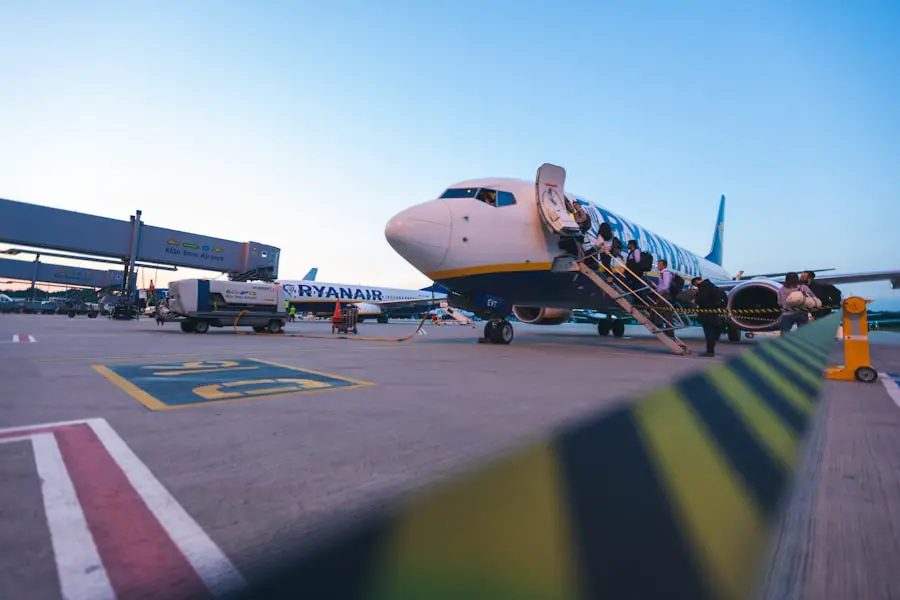
Illustrative airport boarding image. The aircraft shown is operated by Ryanair, not PSA Airlines.
Passenger Feedback and Reviews
Passenger reviews can help travelers understand seat comfort, gate communication, crew courtesy, cabin condition, baggage handling, and disruption management. Those details affect the travel experience, but they should not be treated as a technical safety rating.
A clean cabin does not prove that an aircraft’s internal systems were properly maintained. A delay does not prove that an aircraft was unsafe. An on-time arrival does not prove that every regulatory process was completed perfectly. Customer impressions and aviation-safety evidence answer different questions.
When reading reviews, look for repeated service patterns rather than treating a single positive or negative story as proof of overall safety. For objective safety questions, prioritize the FAA, NTSB, official carrier information, and documented regulatory actions.
Is PSA Airlines Safe for Passengers?
PSA Airlines remains an active U.S. regional airline operating under the FAA’s Part 121 framework. It has required pilot-training, maintenance, operational-control, emergency, and Safety Management System responsibilities. It is also a wholly owned member of American Airlines Group and operates flights marketed as American Eagle.
Its record is not accident-free. Flight 5342 was involved in a fatal midair collision in 2025, and all 67 people aboard the two aircraft died. The completed NTSB investigation attributed the disaster mainly to systemic airspace, air traffic control, helicopter, Army, and technology failures rather than to PSA-specific maintenance or flight-crew performance.
Based on the publicly available evidence, it would be inaccurate to call PSA unsafe simply because it operates regional jets. It would be equally inaccurate to describe it as having no major fatal event or to promise that flying with it is risk-free.
Note: Regional jets operating scheduled passenger service are covered by the same Part 121 regulatory framework as larger U.S. airline aircraft. Their smaller size does not exempt the operator from airline pilot, maintenance, dispatch, emergency, or oversight requirements.
What Passengers Can Do for Their Own Safety
- Read the operating-carrier line: Confirm whether the flight is operated by PSA Airlines or another American Eagle carrier.
- Keep your seat belt fastened: Wear it whenever seated, even when the sign is off, because unexpected turbulence can occur.
- Listen to the briefing: Exit locations and procedures can differ between aircraft.
- Count the rows to the nearest exits: Smoke or darkness can make visual orientation difficult.
- Keep aisles and exits clear: Store baggage only where the crew permits.
- Follow crew instructions: During an abnormal event, rapid compliance is more useful than trying to retrieve belongings or record video.
- Report immediate concerns: Tell a flight attendant about smoke, unusual heat, damaged equipment, or a suspected medical emergency.
Comfort Is Separate From Safety
Comfort products do not change an airline’s technical safety, but they may make a regional flight more pleasant. Travelers who prefer wired audio can review TakeTravelInfo’s guide to wired noise-canceling earbuds for flights. Always keep the volume low enough to hear crew announcements and emergency instructions.
Frequently Asked Questions
Is PSA Airlines a safe airline to fly with?
PSA is an active Part 121 regional airline subject to FAA certification and oversight. Its safety history includes the fatal 2025 collision involving Flight 5342. The NTSB attributed that accident mainly to FAA, air traffic control, helicopter, Army, and wider system failures rather than PSA-specific pilot or maintenance actions. No airline can guarantee a risk-free flight.
Is PSA Airlines the same as American Airlines?
No. PSA Airlines is a separate operating carrier wholly owned by American Airlines Group. PSA flights are marketed under the American Eagle brand and may be purchased through American Airlines, but the itinerary should identify PSA as the operating carrier.
Has PSA Airlines had a fatal accident?
Yes. On January 29, 2025, PSA-operated American Eagle Flight 5342 collided with a U.S. Army Black Hawk helicopter near Reagan National Airport. All 64 people on the CRJ700 and all three people on the helicopter died.
What caused the Flight 5342 collision?
The NTSB identified systemic FAA airspace-design and oversight failures, reliance on visual separation, ineffective visual separation by the helicopter crew, air traffic control factors, Army issues, and collision-alerting limitations. It did not identify PSA-specific aircraft maintenance or PSA pilot performance as a causal factor.
Are PSA’s regional jets less regulated than larger airline aircraft?
No. PSA’s scheduled passenger operations fall under the Part 121 airline framework. That framework includes pilot qualification, training, maintenance, dispatch, emergency, recordkeeping, and oversight requirements. Aircraft size alone does not determine whether the operation is covered by airline regulations.
What aircraft does PSA Airlines operate?
PSA operates CRJ700 and CRJ900 regional jets. Its fleet page listed 60 CRJ700s and 91 CRJ900s, for a total of 151 aircraft, in July 2026. Fleet numbers can change as aircraft are added or removed.
How can I tell whether PSA operates my flight?
Check the flight details on the booking page, confirmation email, American Airlines app, or boarding pass. The wording normally says “Operated by PSA Airlines” when PSA is the operating carrier.
What should passengers do to improve their safety during a flight?
Follow the crew’s instructions, listen to the safety briefing, locate the nearest exits, keep the seat belt fastened whenever seated, leave aisles clear, and report smoke, unusual heat, damaged equipment, or medical concerns promptly.
Sources
- PSA Airlines: Who We Are — ownership, headquarters, operating network, crew bases, and company information.
- PSA Airlines Fleet — current CRJ700 and CRJ900 fleet counts, seating, and aircraft details.
- FAA Part 121 Air Carrier Certification — certification and operating framework for scheduled passenger airlines.
- FAA Safety Management System — current SMS requirements and safety-management components.
- FAA Airline Transport Pilot Training — ATP and restricted-ATP certification information.
- NTSB Investigation DCA25MA108 — Flight 5342 accident facts, probable cause, contributing factors, and recommendations.
