
Last Updated on September 11, 2026 by Daniel Globe
Malaysia Airlines is generally a reasonable choice for international travel, but no airline can promise risk-free flying. A fair safety review should consider its current regulatory oversight, IATA membership, operational auditing, crew training, fleet modernization, baggage policies, and serious accident history. You should also check the operating carrier and current travel rules before every trip.
Quick Answer
Malaysia Airlines is generally a reasonable airline to fly based on current oversight, IATA membership, an IOSA-linked audit framework, regulated crew training, and a modernizing fleet. However, no airline is risk-free. Its history includes MH370 and MH17, so a balanced review must consider both present controls and past events.
Key Takeaways
- Malaysia Airlines remains a current IATA member, and eligible IATA member airlines must maintain IOSA registration.
- Its published fleet includes the Airbus A330neo, A330-200, A330-300, A350-900, Boeing 737-8, and Boeing 737-800 NG.
- MH370 remains unresolved, while investigators found that MH17 was destroyed by a Buk surface-to-air missile.
- Power banks must stay in the cabin, cannot be used or charged in flight, and must not be stored in an overhead compartment.
- MHguardian provides support for young travellers, senior citizens, passengers with reduced mobility, and passengers requiring medical assistance.
Is Malaysia Airlines Safe for International Travel?
As of July 2026, the available public indicators support viewing Malaysia Airlines as a generally reasonable option for international travel. The airline is listed as a current IATA member, operates under Malaysian civil-aviation oversight, uses an established airline training organization, and continues to modernize its aircraft fleet.
Malaysia Airlines is also not among the carriers or national aviation systems named in the European Commission’s June 2026 EU Air Safety List. That is a positive regulatory indicator, but it is not a guarantee that an incident can never occur.
You should also consider the airline’s history honestly. Malaysia Airlines experienced two major losses in 2014. Flight MH370 disappeared for reasons that have not been conclusively established, while Flight MH17 was destroyed by a surface-to-air missile over eastern Ukraine. These events still shape public perception even though they had very different circumstances.
Note: IOSA registration, modern aircraft, regulator oversight, and training programs are useful safety indicators. None of them can prove that an airline has zero risk.
What Safety Certifications and Oversight Apply?
Malaysia Airlines operates within several layers of industry auditing and government oversight. These systems do different jobs, so you should not treat them as interchangeable safety certificates.
IOSA Registration and IATA Membership
The IATA Operational Safety Audit, or IOSA, evaluates an airline’s operational management and control systems. It covers areas such as flight operations, maintenance, crew training, ground handling, dispatch, cargo, security, and corporate safety.
Malaysia Airlines is a current IATA member. IATA requires eligible member airlines to maintain IOSA registration. IOSA moved to a more risk-based audit model in 2024, meaning the audit scope can reflect an operator’s safety profile, operating history, and safety-critical systems.
- IOSA is an operational audit and registration program.
- It does not certify that an airline will never have an accident.
- It provides a standardized way to examine safety-related systems and controls.
- Maintaining IATA membership requires eligible airlines to remain IOSA registered.
CAAM Oversight, EASA TCO Rules, and the EU Safety List
Malaysia Airlines is primarily regulated by the Civil Aviation Authority of Malaysia. Airlines operating commercial flights must meet national requirements for airworthiness, crew licensing, operating procedures, maintenance, safety reporting, and safety management.
The European Union uses a separate Third-Country Operator authorization system for non-EU airlines that fly into, within, or out of covered European territories. This system checks compliance with minimum international safety standards.
The EU Air Safety List serves another purpose. It identifies airlines that are banned or restricted because of serious safety deficiencies. Absence from the list is a positive sign, but it should not be described as an airline-specific EASA safety certificate.
How Does Malaysia Airlines Train Its Flight Crew?
Airline crews must complete initial and recurrent training under regulator-approved programs. This usually includes aircraft systems, normal procedures, abnormal situations, emergency response, crew coordination, evacuation duties, first aid, and regular competency checks.
Recurrent Safety Training
Malaysia Aviation Group operates MAB Academy, which is an Approved Training Organisation recognized by the Civil Aviation Authority of Malaysia. In January 2026, the academy opened a simulator building with six full-flight simulator bays and dedicated training areas. Its facilities include simulators for aircraft such as the Airbus A330neo and Boeing 737-800 NG, along with a water-survival training pool.
These facilities support repeatable training in which instructors can assess crew decisions, communication, aircraft handling, and responses to abnormal conditions. Simulator training also allows crews to practice situations that cannot be safely reproduced during a normal passenger flight.
Crew Competency Standards
Crew competence is not based on one course. Pilots and cabin crew must complete recurring checks and training throughout their employment. The exact program depends on their role, aircraft type, route, and regulatory requirements.
For passengers, the important point is that a training facility or simulator does not replace regulatory oversight. It supports a wider system that includes licensing, medical fitness, operational checks, instructor assessment, reporting, and corrective training where needed.
How Does Malaysia Airlines’ Safety Management System Work?
A Safety Management System, commonly called an SMS, is a structured process for identifying hazards and managing operational risk. It is not limited to responding after an accident. It is intended to help an operator recognize smaller warning signs before they develop into more serious problems.
- Report: Employees and operational systems provide information about hazards, errors, defects, and unusual events.
- Assess: Safety specialists examine the likelihood and possible effect of each risk.
- Control: The operator introduces procedures, training, maintenance action, or other safeguards.
- Monitor: The operator checks whether those safeguards work as intended.
- Improve: Findings from audits, reports, and operational data are used to revise the system.
Public information does not reveal every internal Malaysia Airlines risk assessment or corrective action. You should therefore avoid claims that a specific event was tracked or corrected unless the airline or regulator has published that information.
A strong safety system depends on reporting, investigation, corrective action, and continued monitoring rather than a single certificate or aircraft type.
What Aircraft Are in the Malaysia Airlines Fleet?
The official Malaysia Airlines fleet page currently lists several Airbus and Boeing aircraft families. These include the Airbus A330neo, A330-200, A330-300, A350-900, Boeing 737-8, and Boeing 737-800 NG.
| Aircraft family | Typical role | Passenger takeaway |
|---|---|---|
| Boeing 737-800 NG | Regional and shorter routes | An established narrow-body aircraft used by airlines worldwide |
| Boeing 737-8 | Newer regional operations | Part of the airline’s ongoing narrow-body fleet renewal |
| Airbus A330-200 and A330-300 | Medium- and long-haul routes | Wide-body aircraft used for longer sectors |
| Airbus A330neo | Fleet modernization and longer routes | A newer-generation addition to the wide-body fleet |
| Airbus A350-900 | Long-haul international service | A modern long-range wide-body aircraft |
Aircraft type alone does not determine whether a flight is safe. Maintenance quality, crew performance, dispatch decisions, weather, airport conditions, air-traffic control, route risk, and regulator oversight are also important.
What Is Malaysia Airlines’ Safety Record?
Malaysia Airlines has a long operating history, but its public safety reputation is strongly affected by two disasters in 2014. A responsible assessment should not ignore these events or describe them as if they had the same cause.
What Happened to Flight MH370?
Malaysia Airlines Flight MH370 disappeared on March 8, 2014, while flying from Kuala Lumpur to Beijing. The aircraft has not been fully located, and the official investigation could not establish a definitive reason for its disappearance. Because the main wreckage and flight recorders were not recovered, many important questions remain unanswered.
What Happened to Flight MH17?
Malaysia Airlines Flight MH17 was destroyed over eastern Ukraine on July 17, 2014. The Dutch Safety Board concluded that a warhead launched by a Buk surface-to-air missile system detonated near the cockpit. The investigation found that the flight had been operating normally until the strike.
MH17 was therefore not attributed to an aircraft mechanical failure. However, the disaster led to important international scrutiny of how governments and airlines assess routes over conflict zones.
You can review the official archived investigation material through the Malaysian Ministry of Transport and the Dutch Safety Board.
What Are Malaysia Airlines Check-In and Arrival Times?
Malaysia Airlines recommends arriving at least three hours before an international departure and two hours before a domestic departure. You should allow more time during holidays, airport disruptions, or when you need document checks, special assistance, oversized baggage, or medical clearance.
| Time point | Published guidance |
|---|---|
| International airport arrival | At least 3 hours before departure |
| Domestic airport arrival | About 2 hours before departure |
| Web check-in opens | 48 hours before departure |
| Web check-in closes | 90 minutes before departure |
| Normal boarding gate closure | 30 minutes before departure |
| Passengers needing pre-boarding help | Arrive at the gate 60 minutes before departure |
Pro Tip: Check the “operated by” line on your booking. If a partner airline operates a codeshare flight, that airline’s check-in, baggage, and boarding rules may apply.
What Baggage Items Are Restricted on Malaysia Airlines?
Malaysia Airlines publishes separate rules for checked baggage, cabin baggage, dangerous goods, batteries, smart baggage, and special equipment. Airport-security and destination-country rules may add further restrictions.
Valuables and Fragile Items
Do not place cash, passports, jewellery, precious metals, important business documents, identifying documents, or valuable electronics in checked baggage. Keep essential documents, medicine, and valuable small items with you in the cabin.
The airline may accept some fragile objects when they are properly protected in suitable shipping boxes, tubes, carrying cases, or purpose-built containers. It may require a release form or refuse an item if the packaging is unsuitable.
Dangerous and Restricted Items
- Compressed gases, corrosives, poisons, flammable liquids, explosives, radioactive materials, and undeclared ammunition are restricted or prohibited.
- Self-heating meals and ready-to-eat products with chemical heating packs are prohibited in both checked and cabin baggage.
- Fresh or frozen seafood cannot be checked. Properly packed seafood may be accepted in cabin baggage if it meets weight, size, quarantine, and destination rules.
- Battery-powered smoking devices and spare lithium batteries must not be placed in checked baggage.
- Firearms, ammunition, knives, and similar controlled items require special handling and cannot be carried casually in the cabin.
Review the airline’s current Before You Fly guidance before packing because dangerous-goods rules can change.
What Are Malaysia Airlines’ Battery and Power Bank Rules?
Malaysia Airlines introduced stricter power-bank handling rules effective April 1, 2025. These rules apply in addition to the normal watt-hour limits for lithium-ion batteries.
Warning: Do not use or charge a power bank during the flight. Keep it with you, under the seat, or in the seat pocket. Do not place it in checked baggage or an overhead compartment.
- Cabin only: Power banks and spare lithium-ion batteries are prohibited in checked baggage.
- Maximum quantity: Each passenger may carry no more than two power banks.
- Up to 100 Wh: Normally permitted within the quantity limit.
- More than 100 Wh and up to 160 Wh: Requires airline approval.
- More than 160 Wh: Prohibited.
- No in-flight use: Charging a phone or another device from a power bank is prohibited throughout the flight.
- No overhead storage: Keep power banks where you can see or reach them.
- Protect the device: Use a separate pouch or bag to prevent accidental activation and short circuits.
- Check its condition: Damaged, swollen, leaking, or non-compliant power banks are prohibited.
You can verify the latest limits on the airline’s Additional Restrictions page. On an interline journey, the most restrictive operating-carrier rule may apply.
How Does MHguardian Help Passengers Who Need Assistance?
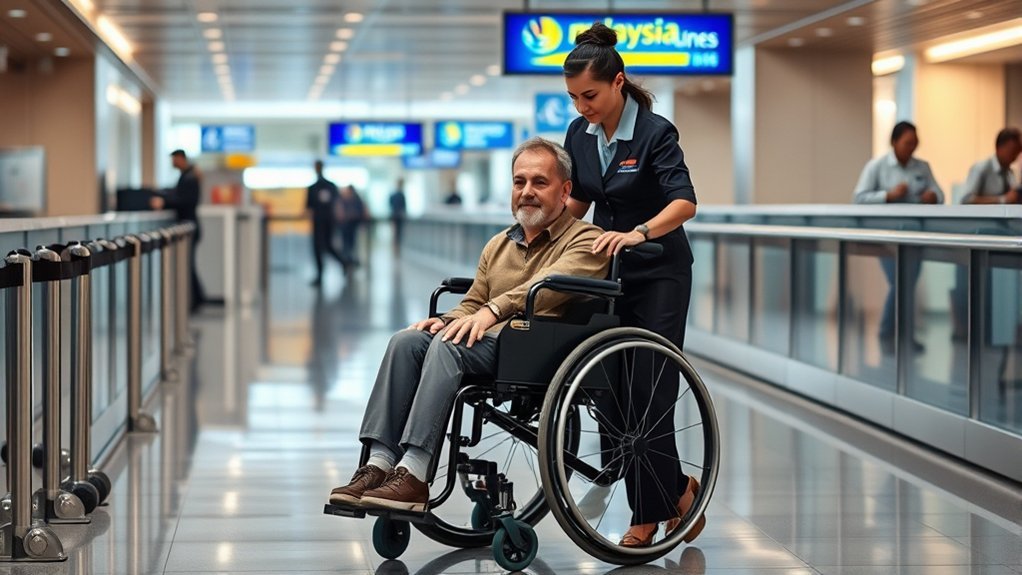
MHguardian is Malaysia Airlines’ assistance program for four main passenger groups: young travellers, senior citizens, passengers with reduced mobility, and passengers who require medical assistance.
Young Travellers
The unaccompanied-minor service is available for eligible children aged 5 to 15 who travel alone or in a different cabin from a parent or accompanying adult. The service must be requested when the ticket is reserved, and the required handling forms must be completed before travel.
Senior and Mobility Assistance
Passengers aged 60 or older may request wheelchair or Meet and Assist services. Wheelchair requests and Meet and Assist services should normally be arranged at least 48 hours before departure.
At Kuala Lumpur International Airport, passengers who have requested assistance can proceed to the designated special-assistance counters. Procedures at other airports may differ.
Medical Assistance and Clearance
Tell the airline about a disability, mobility need, recent illness, medical device, or other special requirement when you book. Some passengers may need a Medical Information Form and airline medical clearance before they can travel.
Medical clearance may be required when a condition could worsen during flight, affect other passengers, require specialized equipment, or create a risk of diversion. Stretcher services, incubators, portable oxygen concentrators, and certain medical devices may require longer preparation periods.
Review the current MHguardian guidance and contact the airline before buying a non-refundable ticket when medical approval may be required.
What Do Passengers Say About Malaysia Airlines Safety?
Passenger reviews can help you judge cabin cleanliness, staff communication, delays, meals, seat comfort, and baggage handling. They are less useful for measuring technical safety because passengers normally cannot evaluate maintenance records, crew licensing, dispatch decisions, or internal risk controls.
When reading reviews, look for repeated and recent patterns rather than one emotional account. Separate service complaints from safety evidence. A delayed meal, old seat, or poor customer-service response can matter to your experience, but it does not by itself prove that an aircraft is unsafe.
For safety questions, give more weight to:
- National regulator action
- IATA and IOSA status
- EU or other government operating restrictions
- Official accident-investigation findings
- Current airline advisories
- The identity of the airline actually operating your flight
How Can You Check Your Flight Before Booking?
- Identify the operating carrier. A Malaysia Airlines flight number may be operated by a partner airline.
- Check current restrictions. Review the latest EU Air Safety List and any government travel advisories relevant to your route.
- Review the route. Weather, airport disruptions, security conditions, and conflict-zone closures can affect operations.
- Confirm the aircraft later. Aircraft assignments can change, so treat the displayed type as provisional.
- Read the baggage rules. Pay special attention to batteries, power banks, medicine, smart bags, and controlled items.
- Arrange assistance early. Request wheelchairs, Meet and Assist, unaccompanied-minor service, or medical clearance within the published time.
- Check flight status. Review the airline’s app or website again before leaving for the airport.
Frequently Asked Questions
Is Malaysia Airlines safe to fly now?
Malaysia Airlines is generally a reasonable current choice based on available oversight indicators, IATA membership, IOSA requirements, regulated training, and its modernizing fleet. No airline is completely risk-free, so check the operating carrier and current route advisories before booking.
Does Malaysia Airlines have a good safety record?
Its record is mixed. The airline has extensive operating experience and current safety-oversight indicators, but MH370 and MH17 remain central to its history. MH370’s cause remains unresolved, while investigators concluded that MH17 was destroyed by a surface-to-air missile.
Which airline has the worst safety record?
There is no permanent, universally accepted “worst airline.” Rankings change according to fleet size, years in service, number of flights, accident definitions, reporting quality, and the period studied. Check current regulator bans and restrictions instead of relying on a single ranking.
How trustworthy is Malaysia Airlines?
Malaysia Airlines is an established international carrier with current IATA membership, a regulated training operation, published safety-related travel rules, and a modernizing fleet. Service quality can vary by route, aircraft, airport, and disruption, so review recent operational information before travel.
Is Malaysia Airlines on the EU Air Safety List?
Malaysia Airlines was not among the airlines or national aviation systems named in the European Commission’s June 2026 list of banned or restricted carriers. The list can change, so check the latest version before relying on it.
Can I use a power bank on a Malaysia Airlines flight?
No. You may carry an eligible power bank in the cabin, but you cannot use or charge it during the flight. It must not be checked or stored in an overhead compartment. Each passenger may carry no more than two, subject to watt-hour limits.
Conclusion
Malaysia Airlines is generally a reasonable option for international travel based on its current IATA membership, operational auditing requirements, regulator oversight, training resources, and fleet modernization. However, responsible safety coverage should not ignore MH370, MH17, or the fact that no airline can eliminate every risk.
Before you travel, confirm the operating carrier, check current advisories, follow the airline’s battery and baggage rules, arrive before the published deadlines, and request MHguardian assistance early when needed. These practical checks give you a more reliable picture than promotional claims or isolated passenger reviews.
Sources
- International Air Transport Association membership requirements — explains the IOSA requirement for eligible IATA members.
- Malaysia Airlines fleet — confirms the aircraft families currently presented by the airline.
- European Commission EU Air Safety List — explains airline bans and operational restrictions.
- Ministry of Transport Malaysia archived accident reports — provides official MH370 and MH17 investigation materials.
- Malaysia Airlines baggage and battery restrictions — supports the current power-bank and dangerous-goods rules.
- Malaysia Airlines MHguardian — explains assistance for young, elderly, disabled, and medical passengers.
