
Last Updated on September 10, 2026 by Daniel Globe
You can leave your electric scooter plugged in overnight if it features a certified Battery Management System (BMS) and a manufacturer-approved charger, but manufacturers and fire safety organizations generally advise against unattended overnight charging. While a functional BMS automatically halts the current once the cells reach full capacity, leaving lithium-ion batteries connected at maximum voltage accelerates long-term cell degradation and introduces severe fire hazards if internal components fail while you sleep.
Quick Answer
Charging an electric scooter overnight is generally safe only on undamaged, UL 2272-certified scooters equipped with a reliable BMS. However, safety organizations like the National Fire Protection Association (NFPA) recommend disconnecting chargers once full. Unattended overnight charging increases thermal runaway risks and accelerates battery capacity loss by holding cells at maximum saturation voltage.
Key Takeaways
- BMS Protection: Modern Battery Management Systems cut incoming current at 100% charge to prevent catastrophic overcharging under normal conditions.
- Lifespan Degradation: Keeping lithium-ion cells parked at 100% state-of-charge ($4.2\text{V}$ per cell) accelerates electrolyte breakdown and reduces total cycle life.
- Fire Safety: Never charge an electric scooter in escape pathways, on flammable surfaces, or in ambient temperatures below 32°F (0°C) or above 113°F (45°C).
- Smart Automation: Use an external mechanical outlet timer or smart plug to cut wall power automatically after 4 to 6 hours.
At a Glance: Electric Scooter Charging Parameters
| Average Charge Time | 4 to 8 hours (commuter models); 8 to 14 hours (dual-motor/large capacity) |
| Safe Charging Temperature | 32°F to 113°F (0°C to 45°C); optimal ambient is 59°F to 77°F (15°C to 25°C) |
| Required Hardware | OEM manufacturer-approved charger, dedicated 110V/220V wall outlet (no extension cords) |
| Safety Certification | UL 2272 (electrical system) / UL 1310 or UL 62368-1 (power supply unit) |
Disclosure: As an Amazon Associate I earn from qualifying purchases. Some links on this page are affiliate links, at no extra cost to you.
Is It Safe to Charge an Electric Scooter Overnight?
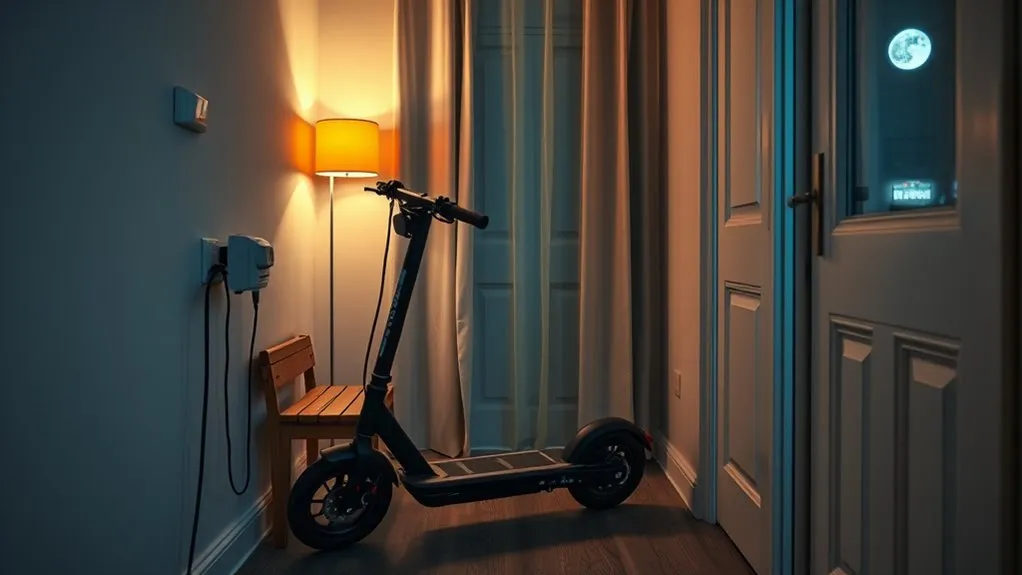
Charging an electric scooter overnight is physically possible with modern hardware, but it carries inherent electrical and chemical risks. Modern electric scooters use high-density lithium-ion battery packs (typically 36V, 48V, 52V, or 60V architectures). When plugged in, the charger operates in a two-stage Constant Current / Constant Voltage (CC/CV) cycle, terminating the primary charge when individual cell voltages hit approximately 4.2V.
If your scooter carries a genuine UL 2272 safety certification, the entire drive system, battery pack, and charger have undergone electrical short-circuit, overcharge, and thermal abuse testing. However, leaving the unit plugged in for hours after reaching 100% capacity keeps the cells under high electrical potential and thermal stress. The U.S. Consumer Product Safety Commission (CPSC) continually warns that unattended charging remains the primary contributing factor in residential micromobility fire emergencies.
Warning: Never leave an electric scooter charging unattended in an entryway, hallway, or near a bedroom exit. If a battery enters thermal runaway, it produces dense toxic gas and violent flame jets within seconds, blocking escape routes.
How Scooter Battery Protection Works
A lithium-ion battery pack consists of dozens of cylindrical cells (such as 18650 or 21700 formats) assembled in series ($S$) and parallel ($P$). The Battery Management System (BMS) acts as the central electronic gatekeeper monitoring this assembly. It performs four essential protective functions during charging:
- Over-Voltage Protection (OVP): Monitors total pack voltage and individual series groups, disconnecting charging input if any cell group exceeds $4.25\text{V}$ to $4.30\text{V}$.
- Cell Balancing: Bleeds small amounts of current from high-voltage cells using passive shunt resistors, ensuring all cell groups charge evenly without drifting out of alignment.
- Over-Temperature Protection (OTP): Utilizes embedded negative temperature coefficient (NTC) thermistors to cut current if battery core temperatures exceed $113^\circ\text{F}\ (45^\circ\text{C})$ or drop below $32^\circ\text{F}\ (0^\circ\text{C})$.
- Short-Circuit and Over-Current Protection (OCP): Uses high-power MOSFET switches to break the circuit instantaneously if unexpected amperage surges or ground faults occur.
“A high-quality BMS prevents electrical overcharging under normal conditions, but it cannot repair physical separator wear, dendrite growth, or thermal buildup caused by external damage.”
Risks of Overnight Charging
Leaving your scooter connected to a wall outlet while sleeping presents technical and safety issues that degrade both the machine and your surroundings:
- Parasitic Reactions at High Voltage: According to battery engineering data from Battery University, holding a lithium-ion cell continuously at its maximum charge limit ($4.20\text{V}/\text{cell}$) accelerates cathode electrolyte oxidation and solid electrolyte interphase (SEI) thickening, permanently reducing storage capacity.
- Thermal Runaway Delayed Response: If a weak cell develops an internal micro-short while charging overnight, heat transfers to adjacent cells. Because you are asleep, early warning signs (sweet chemical odors, hissing, or localized smoke) go unnoticed until active combustion begins.
- Charger Component Failure: Low-cost or aging AC/DC power adapters convert high-voltage alternating current to direct current. The transformer generates significant heat; if its internal flyback regulator fails, unregulated line voltage can flow directly into the scooter’s DC input.
- Overnight Grid Voltage Fluctuations: Late-night residential utility switching and lightning-induced surges can bypass budget chargers lacking robust metal-oxide varistor (MOV) surge suppression.
Note: Most entry-level commuter scooters draw between 1.5A and 2.0A at 42V (roughly 70–84 watts). While this does not overload household circuits, the prolonged heat generation inside the sealed charger brick requires open air circulation.
When Not to Leave It Plugged In
You should strictly avoid unattended or overnight charging under any of the following circumstances:
- Physical Impact or Crash History: If the deck or battery compartment has struck a curb, pothole, or speed bump, internal mechanical cell separators may be compromised.
- Sub-Zero or Freezing Ambient Temperatures: Never charge a battery below 32°F (0°C). Charging cold lithium cells causes permanent lithium plating on the graphite anode, turning dissolved ions into metallic lithium spikes that puncture separators and cause fire.
- Moisture and Water Ingress: If you rode through rain or standing puddles, allow the scooter to dry completely for at least 24 hours. Moisture inside charge ports causes galvanic corrosion and catastrophic arcing.
- Non-OEM or Universal Chargers: Third-party multi-voltage chargers with incorrect polarity, insufficient amperage regulation, or missing temperature shutoffs present extreme fire risks.
- Physical Warning Signs: Swelling deck plates, a loose charge port, excessive heat coming from the foot deck, or flashing error codes on the display.
How to Charge Your Scooter Safely
To maximize electrical safety and prolong the usable service life of your scooter’s battery pack, implement the following charging protocol:
- Allow a 30-Minute Cool-Down: Discharging a battery during a ride raises its internal core temperature. Always wait 30 to 45 minutes after riding before plugging into the wall.
- Connect Charger to Scooter First, Then the Wall: Plug the DC barrel connector or 3-pin aviation plug securely into the scooter charging port before plugging the AC adapter into the wall outlet. This prevents spark erosion at the delicate charging pins.
- Charge on Non-Combustible Flooring: Always position the scooter on concrete, ceramic tile, or an uncarpeted garage floor away from curtains, furniture, paper boxes, and combustible liquids.
- Plug Directly into a Dedicated Wall Outlet: Avoid multi-outlet power strips or light-duty extension cords, which introduce resistance, voltage drop, and electrical fire hazards.
- Disconnect Once the LED Turns Green: Unplug the charger within 30 to 60 minutes after the indicator light switches from red (constant current stage) to green (constant voltage cutoff).
Pro Tip: If your schedule requires charging overnight, plug your charger into a heavy-duty mechanical wall timer or a smart plug rated for 15A. Set the timer to cut power automatically after 4 to 5 hours, eliminating continuous overnight standby voltage.
Signs Your Battery Needs Attention
Lithium-ion cells degrade gradually over 300 to 500 full discharge cycles, but damaged or unstable packs exhibit distinct failure indicators. Stop charging and isolate the vehicle immediately if you notice:
- Sudden Range Collapse: A noticeable drop of 30% or more in travel distance on a familiar route indicates cell group imbalance or dead parallel cell strings.
- Abnormal Heat Generation: If the charging brick is painful to touch or the scooter deck feels warm during or immediately after charging, disconnect power.
- Premature or Incomplete Charge Cycles: The charger turns green in 45 minutes instead of the standard 5 hours, or the scooter shuts off abruptly when accelerating uphill despite the display showing 50% capacity.
- Chemical or Pungent Odors: A distinct sweet, acetone-like, or burning plastic odor indicates venting electrolyte solvent—an immediate precursor to fire.
- Voltage Sag under Load: Voltage reading drops dramatically on the display voltmeter as soon as you press the throttle, indicating severely elevated internal cell resistance ($R_i$).
Charging Habits That Extend Battery Life
Adopting proper battery maintenance strategies preserves performance, maintains range, and avoids expensive pack replacement costs:
- Follow the 20% to 80% Rule: For daily commuting, keep your battery state-of-charge between 20% and 80%. Operating within this mid-range reduces mechanical stress on the cathode and can double your pack’s cycle lifespan from 500 cycles to over 1,000 cycles.
- Top Up Only When Needed: Deep discharges down to 0% trigger low-voltage cutoff stress. Perform shallow top-up charges rather than running the battery empty.
- Store at 50% to 60% Capacity: If you plan to store your scooter for winter or extended periods, charge the pack to approximately 50% to 60% (around $3.80\text{V}$ to $3.85\text{V}$ per cell) and store it in a dry space at 50°F to 70°F (10°C to 21°C). Check and top up the charge once every 30 to 60 days.
- Perform a Monthly Balancing Charge: Once every month, charge the battery to 100% and leave it connected for an additional 1 to 2 hours during daytime supervision to allow the BMS passive shunts to balance lagging cell groups.
Frequently Asked Questions
Can I leave my electric scooter charging overnight?
While a certified Battery Management System (BMS) stops direct overcharging once the pack reaches 100%, fire safety authorities like the NFPA advise against unattended overnight charging. Leaving it plugged in keeps the cells at maximum voltage stress and leaves you unable to respond quickly if a rare electrical or thermal fault develops.
What happens if an electric scooter is not used for a long time?
If left unused for months without maintenance, the battery undergoes parasitic self-discharge. If cell voltages drop below the critical threshold of 2.5V per cell, the copper current collectors dissolve into the electrolyte, causing permanent capacity loss and rendering the pack unsafe to recharge. For long-term storage, keep the battery at 50% to 60% charge and top it up every 30 to 60 days.
What are the chances of an electric scooter catching fire?
The probability of fire in an undamaged, UL 2272-certified electric scooter charged with OEM equipment is exceptionally low. However, fire risk increases drastically when using uncertified aftermarket chargers, charging water-damaged or impact-damaged packs, charging below 32°F (0°C), or modifying battery firmware.
How long can you charge an electric scooter for?
Standard commuter electric scooters take between 4 and 8 hours to reach full capacity using a standard 2A charger. You should disconnect the charger within 1 hour after the charger light turns green. To determine your approximate charging time, divide the battery pack capacity in Amp-hours (Ah) by the charger’s output rating in Amps (A) and add approximately 15% for the constant-voltage saturation phase.
Conclusion
Charging your electric scooter overnight is convenient, and modern battery management systems significantly reduce overcharge risks by cutting current at full capacity. However, routine unattended charging remains inadvisable from both a safety and battery longevity standpoint. Holding lithium-ion cells at maximum voltage for 8 to 10 hours every night accelerates cell degradation, and any hidden physical defect or electrical failure can escalate unchecked while you sleep.
To balance convenience with long-term safety, charge your scooter during waking hours on a non-combustible surface, inspect your cables and connectors regularly, and use a mechanical timer or smart plug if you must charge across evening hours. By practicing disciplined charging habits and avoiding thermal extremes, you protect your battery investment and ensure safe, dependable transportation.
Sources
- UL Solutions — UL 2272 Standard for Electrical Systems for Personal E-Mobility Devices
- National Fire Protection Association (NFPA) — Lithium-Ion Battery and E-Mobility Safety Advisory
- U.S. Consumer Product Safety Commission (CPSC) — Micromobility Safety and Fire Prevention Guidelines
- Battery University — BU-409: Charging Lithium-Ion Cells and Voltage Saturation
