
Last Updated on July 27, 2026 by Daniel Globe
Air France has carried passengers for more than nine decades and remains one of Europe’s largest and best-known airlines. Its safety record is not spotless, but judging an airline today requires more than looking at one historic accident. Current regulatory oversight, independent audits, crew training, maintenance, recent incidents, and how the airline responds to safety findings all matter.
Quick Answer
Yes. Current evidence supports considering Air France a generally safe major airline. It operates under EU aviation rules with French regulatory oversight and currently has a 7-out-of-7 AirlineRatings safety score. Its record is not spotless—Flight 447 and later safety-culture findings matter—but those events should be weighed against current oversight, audits, training, and procedures.
Key Takeaways
- Air France currently holds a 7-out-of-7 safety rating from AirlineRatings.com and is shown there as IOSA-registered.
- Air France was not included in AirlineRatings’ 2026 top 25 safest full-service airlines, although several European peers, including British Airways and Lufthansa, were.
- French airlines operate under EU aviation rules, with France’s DGAC/DSAC responsible for national certification and oversight; ICAO standards are implemented through member states.
- A 2022 BEA investigation called for stricter adherence to procedures after identifying recurring Air France events in which procedural deviations had reduced safety margins.
- Flight AF447 killed 228 people in 2009. In May 2026, a Paris appeals court convicted Air France and Airbus of involuntary manslaughter; further appeals mean the judicial process is not yet final.
Disclosure: As an Amazon Associate I earn from qualifying purchases. Some links on this page are affiliate links, at no extra cost to you.
Is Air France Safe in 2026?
Based on the evidence available in 2026, Air France meets the safety framework expected of a large European airline. AirlineRatings.com currently gives Air France 7 out of 7 for safety. Its breakdown also shows the airline as IOSA-registered and credits it for operating standards and the absence of a recent fatal accident within that rating system’s assessment period.
That score should not be read as a guarantee. Airline safety ratings are private assessment tools, not promises that an accident cannot happen. A better assessment combines current regulatory oversight, incident history, training, maintenance, audit results, and the way an airline responds when investigators find weaknesses.
A 7-out-of-7 individual safety rating and absence from a “top 25 safest airlines” ranking are not contradictory. The two measures answer different questions and use different selection criteria.
Safety Measures and Regulations
Air France operates within the European aviation-safety system. EASA establishes the common European regulatory framework, while national aviation authorities normally handle certification, continuous oversight, and enforcement for airlines based in their country.
For French airlines, the French Directorate General for Civil Aviation, or DGAC, issues the Air Operator Certificate and operating authorizations required for commercial air transport in France. Its Civil Aviation Safety Directorate, or DSAC, carries out technical safety oversight.
ICAO plays a different role. It publishes international Standards and Recommended Practices covering areas such as aircraft operations, licensing, airworthiness, and safety management. Those standards are implemented and enforced through national and regional aviation systems rather than through routine direct ICAO supervision of individual Air France flights.
Air France must also maintain a management system for identifying hazards, assessing risk, monitoring safety performance, reporting occurrences, and managing corrective action. EASA’s rules for complex commercial operators specifically cover safety policy, hazard identification, reporting, safety-performance monitoring, and emergency-response planning. These processes also support monitoring of flight operations.
Note: EASA, the French DGAC/DSAC, ICAO, the BEA, IATA, and AirlineRatings all have different roles. A regulator, an accident investigator, an industry audit program, and a private airline-rating website should not be treated as interchangeable sources.
Fleet and Maintenance
Fleet age and aircraft type are only part of an airline’s safety picture. Maintenance quality, operational procedures, crew performance, oversight, and how an airline manages known risks are equally important.
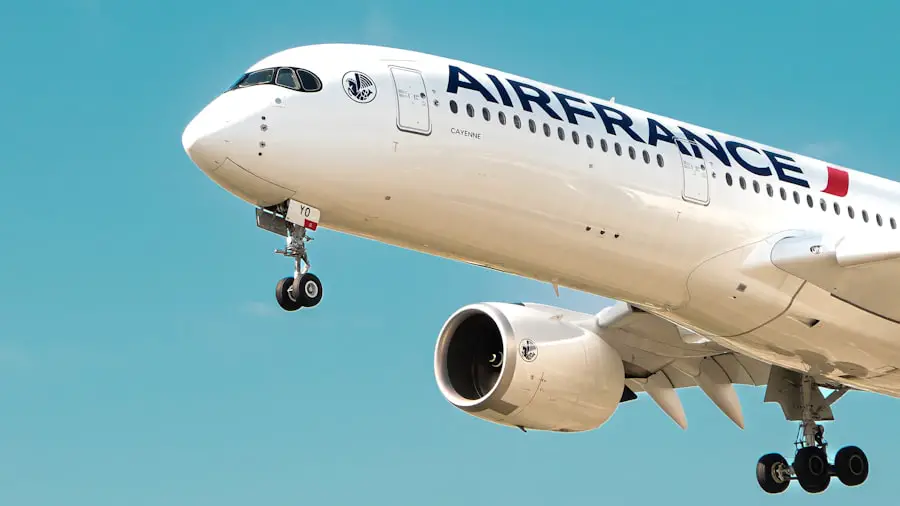
Air France reported 268 aircraft, including HOP!, at December 31, 2025, while continuing to replace older aircraft with newer models. Its operating fleet includes Airbus A220 and A320-family aircraft for shorter routes and Airbus A330, Airbus A350, Boeing 777, and Boeing 787 aircraft in long-haul operations.
The Airbus A350 and A220 are major parts of Air France’s fleet-renewal program. In December 2025, Air France announced that its 50th A220 and 40th A350 had joined the fleet.
Commercial aircraft are maintained under continuing-airworthiness rules that require approved maintenance programs, inspections, qualified personnel, record keeping, and action on airworthiness directives and manufacturer requirements. A modern aircraft by itself is not proof of safety; what matters is how the operator maintains and operates it throughout its service life.
Pilot Training and Standards
Air France flight crews are subject to EASA licensing, aircraft type-rating, recurrent-training, and proficiency-check requirements. One important correction to common descriptions of airline licensing is that not every first officer must already hold a full Airline Transport Pilot Licence.
Under EASA Aircrew rules, an ATPL allows its holder to act as pilot-in-command of an aircraft engaged in commercial air transport. For an aeroplane ATPL, EASA requires at least 1,500 hours of aeroplane flight time, along with specified experience and training requirements.
Airline crews then remain subject to recurrent checks. Current EASA Air Operations rules require recurrent training and checking relevant to the aircraft type. Operator proficiency checks normally have a six-calendar-month validity period, while line checks and emergency and safety-equipment training normally operate on 12-month cycles.
Air France also continues to invest in simulator training. In April 2025, the airline opened new A220 and A350 full-flight simulators at Paris-Charles de Gaulle, bringing its training center to 14 simulators covering the A220, A320, A330, A350, Boeing 777, and Boeing 787 fleets.
Flight-data monitoring is another safety tool. Rather than providing live coaching to pilots, recorded operational data can be reviewed to identify trends, unstable approaches, procedural deviations, or other patterns that may require changes in procedures or targeted training.
Pro Tip: When checking airline-safety claims, look first at the national regulator, EASA or another relevant regulator, accident-investigation authorities, and recognized audit programs. Use private airline rankings as an additional signal rather than the only evidence.
Emergency Response and Preparedness
Emergency planning is part of the management-system framework applied to European commercial operators. EASA guidance for complex operators calls for emergency-response planning that sets out responsibilities and provides for coordination with other organizations where appropriate.
That framework is designed to cover more than an accident. Airlines need procedures for abnormal aircraft events, diversions, emergency landings, evacuations, operational disruptions, dangerous goods, and coordination with airports and outside responders.
Flight crews also undergo recurrent emergency and safety-equipment training. This includes continued practice with aircraft-specific abnormal and emergency procedures rather than relying only on training received when a pilot first qualifies on an aircraft type.
Safety Ratings and Audits
Current Air France Safety Rating
As of July 2026, AirlineRatings.com gives Air France a 7-out-of-7 safety rating. Its current breakdown also lists Air France as IOSA-registered.
IATA describes IOSA, the IATA Operational Safety Audit, as an internationally recognized system for assessing an airline’s operational management and control systems. IOSA does not mean an airline is accident-proof, but it provides an additional standardized audit layer beyond a consumer-facing star score.
Why Air France Is Not in the 2026 Top 25
Air France did not appear in AirlineRatings’ 2026 top 25 safest full-service airlines. Etihad ranked first, followed by Cathay Pacific and Qantas.
That does not cancel Air France’s 7-out-of-7 individual score. The annual top-25 ranking compares a narrower group of highly rated airlines using factors such as recent incident rates, fleet age, serious incidents, pilot training, audits, turbulence-management practices, and other comparative measures.
Several European airlines did make the 2026 list, including TAP Air Portugal at #16, SAS at #17, British Airways at #18, Iberia at #20, and Lufthansa at #21. Air France therefore trails some European peers in this particular ranking even though its individual safety score remains at the maximum level.
Safety Management Practices
Air France is subject to internal and external safety controls rather than a single annual test. These include regulatory surveillance, recurrent crew checks, continuing-airworthiness requirements, occurrence reporting, internal risk management, flight-data analysis, and industry auditing.
AirlineRatings temporarily reduced Air France from seven stars to five in September 2022. Its downgrade article cited both a reported altercation between two pilots on a Geneva–Paris flight and findings from a French BEA investigation concerning procedural discipline.
Transparency and Accountability
A useful feature of the European system is that serious incidents can lead to publicly available investigation reports and safety recommendations. The BEA’s role is to understand what happened and prevent recurrence. Its investigations are separate from criminal proceedings and are not intended to assign legal blame.
This distinction is especially important when discussing Flight 447: the BEA safety investigation, later regulatory actions, and the French criminal court proceedings answer different questions.
Incident and Accident History
Air France’s most serious accident in recent history was Flight AF447 from Rio de Janeiro to Paris. On June 1, 2009, the Airbus A330 crashed into the Atlantic Ocean, killing all 216 passengers and 12 crew members.
The BEA investigation into AF447 examined a chain of events beginning with unreliable airspeed indications after temporary obstruction of the aircraft’s pitot probes by ice crystals. The autopilot disconnected, the crew took manual control, the aircraft entered a stall, and the crew did not recover from it.
The accident led to wide-ranging safety work involving pilot training, unreliable-airspeed procedures, stall recognition and recovery, automation, pitot-probe standards, and human-machine interaction. EASA said after the final report that it had already taken certification and rulemaking actions concerning pitot tubes, icing, and pilot training.
Warning: Accident investigations and criminal court judgments serve different purposes. A BEA safety report identifies causes and lessons to prevent future accidents; a court determines legal responsibility under the applicable law.
The 2026 AF447 Court Ruling
The legal history of AF447 also changed in 2026. On May 21, 2026, the Paris Court of Appeal found Air France and Airbus guilty of involuntary manslaughter, reversing their 2023 acquittal. Each company was fined €225,000.
Both companies indicated that the litigation would continue through appeals to France’s Court of Cassation. That means the May 2026 judgment is a major part of the current record, but the judicial process should not yet be described as finally resolved. A current account of the case is available from Reuters.
Safety Culture and Employee Training
A more recent Air France safety concern came from a BEA investigation into a December 2020 Airbus A330 fuel leak. The crew detected the leak but interrupted the published procedure before the step calling for shutdown of the engine on the suspected side. The aircraft diverted safely to N’Djamena.
When the BEA published its final report in August 2022, it looked beyond that single flight. The agency said several recent Air France investigations showed procedural adaptations or deliberate violations that reduced safety margins. It recommended that Air France continue and, where necessary, expand efforts to put stricter procedural compliance at the center of its safety culture.
The report also noted actions already underway, including changes to flight-analysis follow-up and a planned Line Operations Safety Audit. That context is more useful than simply saying Air France had a “bad safety culture”: the BEA identified a specific procedural-discipline problem and issued a specific recommendation for improvement.
Customer Satisfaction and Feedback
Passenger reviews can tell you about cabin service, delays, baggage handling, seat comfort, and communication. They are much less useful for judging operational aviation safety.
A traveler may have an excellent or terrible customer-service experience without learning anything meaningful about aircraft maintenance, crew proficiency checks, airworthiness compliance, or internal risk management. For that reason, customer-review scores should be kept separate from regulatory and technical safety evidence.
Comparing Air France with Other Airlines
Air France operates within the same broad European safety framework as airlines such as British Airways, Lufthansa, Iberia, SAS, and TAP Air Portugal. The regulatory baseline for major European operators is therefore high, but airlines can still differ in recent incident rates, fleet characteristics, audit findings, training programs, and operational performance.
In AirlineRatings’ 2026 comparison, Air France did not make the top 25, while British Airways ranked #18 and Lufthansa #21. That is a more accurate comparison than saying no major European legacy airlines appeared on the list.
At the same time, AirlineRatings emphasizes that differences among highly ranked airlines can be very small. Its 2026 methodology noted that fewer than four points separated positions one through 14, so a ranking gap should not automatically be interpreted as a dramatic gap in real-world safety.
Air France is also a SkyTeam member alongside airlines such as Delta Air Lines and Korean Air. Alliance membership is useful for network coordination and shared passenger benefits, but it should not be treated as a substitute for each airline’s own regulatory oversight, operating certificate, audits, and safety-management system.
Frequently Asked Questions
Is Air France a safe airline?
Yes. Based on current 2026 evidence, Air France is generally considered a safe major airline. It operates within the EU aviation-safety system and currently has a 7-out-of-7 AirlineRatings safety score. Its history includes serious incidents and accidents, so that rating should not be interpreted as a guarantee of zero risk.
Why is Air France not in the 2026 top 25 safest airlines?
AirlineRatings gives Air France a maximum 7-out-of-7 individual score but did not select it for its separate 2026 top-25 full-service ranking. The annual ranking compares highly rated airlines using additional relative factors, so a carrier can receive 7 out of 7 without making the top 25.
Who regulates Air France?
Air France operates under European Union aviation rules developed within the EASA system. In France, the DGAC and its Civil Aviation Safety Directorate handle national certification and oversight of French commercial operators. ICAO supplies international standards that are implemented through states and regional regulatory systems.
What safety measures does Air France have in place?
Air France is subject to aircraft-maintenance and continuing-airworthiness rules, recurrent pilot checks, occurrence reporting, safety-risk management, flight-data monitoring, emergency-response planning, regulatory surveillance, and external auditing such as IOSA.
Has Air France had any major safety incidents?
Yes. Its most serious recent accident was Flight AF447 in 2009, which killed all 228 people on board. A 2022 BEA report also raised concerns about procedural discipline after reviewing an Air France A330 fuel-leak incident and other recent events.
What happened with Flight 447 in 2026?
On May 21, 2026, the Paris Court of Appeal found Air France and Airbus guilty of involuntary manslaughter over the 2009 AF447 disaster, reversing a 2023 acquittal. Both companies announced further appeals, so the criminal proceedings are not yet finally resolved.
Do all Air France pilots need an ATPL?
No. A full EASA ATPL is the licence that permits a pilot to act as pilot-in-command in commercial air transport. Airline first officers may operate under other qualifying licence and rating combinations while building the experience required for a full ATPL. Pilots are also subject to aircraft type ratings and recurrent operator checks.
Where can I check Air France safety information?
Useful sources include the French DGAC for operator oversight, EASA for European rules, the BEA for French accident and incident investigations, IATA for IOSA information, Air France for current fleet and training data, and AirlineRatings for its private safety score and annual airline rankings.
Sources
- AirlineRatings.com – Air France Safety Rating — current 7-out-of-7 safety score and rating breakdown
- AirlineRatings.com – World’s Safest Airlines for 2026 — 2026 full-service ranking and methodology
- French Directorate General for Civil Aviation – Public or Private Air Transport — French AOC, licensing, and operator-oversight framework
- EASA – Air Operations Rules — recurrent flight-crew training and proficiency-check requirements
- BEA – Air France A330 Fuel-Leak Investigation — 2022 procedural-compliance findings and safety recommendation
- BEA – Air France Flight AF447 Investigation — official investigation record, reports, and safety material concerning the 2009 accident
