
Last Updated on July 28, 2026 by Daniel Globe
Rome has starred in romantic comedies, thrillers, historical epics, and some of Italy’s most influential films. Many famous scenes were shot at real landmarks, including the Trevi Fountain, Bocca della Verità, Piazza Navona, and the Baths of Caracalla. Others only appear to show Rome: filmmakers often used Cinecittà sets, substitute buildings, and digital effects to recreate the ancient city or Vatican interiors.
Quick Answer
The best Rome movie locations to visit include the Trevi Fountain from La Dolce Vita, the Spanish Steps and Bocca della Verità from Roman Holiday, Piazza Navona from The Talented Mr. Ripley, and the Baths of Caracalla from The Great Beauty. Some famous “Rome” scenes, including those in Gladiator and Ben-Hur, were actually created on sets.
Key Takeaways
- The Trevi Fountain, Bocca della Verità, Spanish Steps, Piazza Navona, Baths of Caracalla, and much of EUR are genuine on-location movie sites.
- Gladiator was not filmed inside the real Colosseum, and the 1959 Ben-Hur chariot race was not filmed at Circus Maximus.
- Since February 2, 2026, most non-residents pay €2 to enter the Trevi Fountain’s inner perimeter, although the fountain remains visible for free from outside.
- Many central locations can be combined on foot, while EUR and Cinecittà are easier to visit by Metro.
- Always use official monument and museum websites because entry rules, hours, and ticket availability can change.
Disclosure: As an Amazon Associate I earn from qualifying purchases. Some links on this page are affiliate links, at no extra cost to you.
Top Movie Locations to Visit in Rome
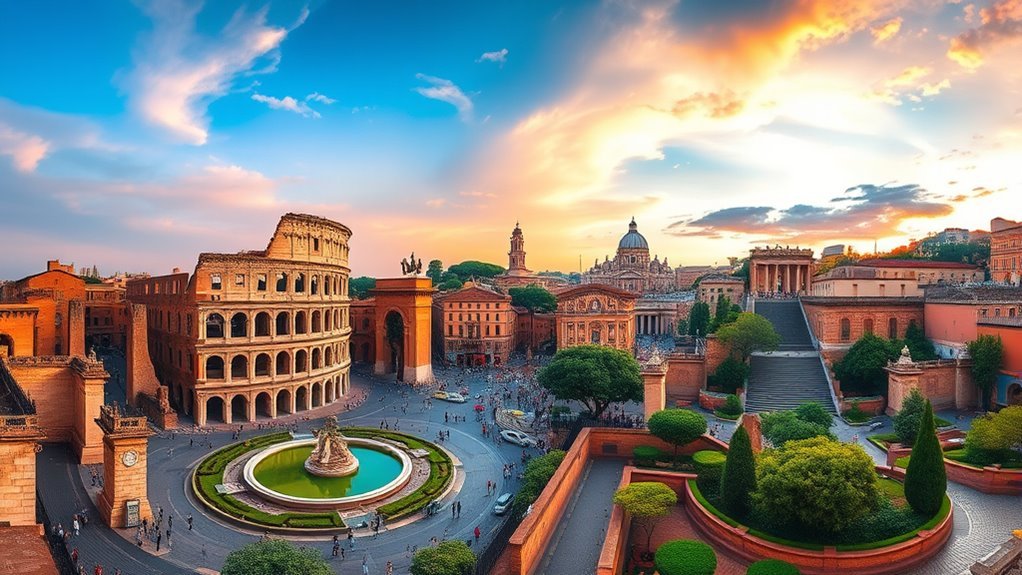
Rome’s best movie-location tour mixes genuine shooting sites with monuments that inspired famous studio recreations. Knowing the difference makes the experience more interesting: you can stand where Audrey Hepburn and Gregory Peck performed in Roman Holiday, then visit the Colosseum while understanding that Ridley Scott’s arena was built in Malta and completed with digital effects.
| Rome location | Film | Filming status | Visitor note |
|---|---|---|---|
| Trevi Fountain | La Dolce Vita | Real filming location | €2 inner-perimeter ticket for most non-residents; exterior view remains free. |
| Bocca della Verità | Roman Holiday | Real filming location | Inside the portico of Santa Maria in Cosmedin; queues are common. |
| Colosseum | Gladiator | Historical inspiration, not the arena filming site | Timed reservations are required; arena access depends on the ticket. |
| Baths of Caracalla | The Great Beauty | Real filming location | Ticketed archaeological site; outdoor areas offer limited shade. |
| Piazza Navona | The Talented Mr. Ripley | Real filming location | Public square with free access; busiest from late morning onward. |
| EUR | L’Eclisse | Real filming district | Reachable by Metro B; buildings are spread across a large district. |
| Pantheon | Angels & Demons | Important story location; production methods varied | Ordinary tourist entry requires a ticket; worship may affect access. |
| Spanish Steps | Roman Holiday | Real filming location | Free to visit, but sitting on the protected steps is prohibited. |
| Circus Maximus | Ben-Hur | Authentic Roman racing site, not the 1959 filming set | The main outdoor archaeological area is generally free to view. |
| Vatican City | Angels & Demons | Story setting; many interiors were recreated elsewhere | Use the official Vatican ticket portal and follow the dress code. |
Note: A movie can feature a real Rome landmark without having filmed every shot there. Wide exterior views, close-ups, interiors, and action scenes may come from different locations or studio sets.
The Trevi Fountain in La Dolce Vita
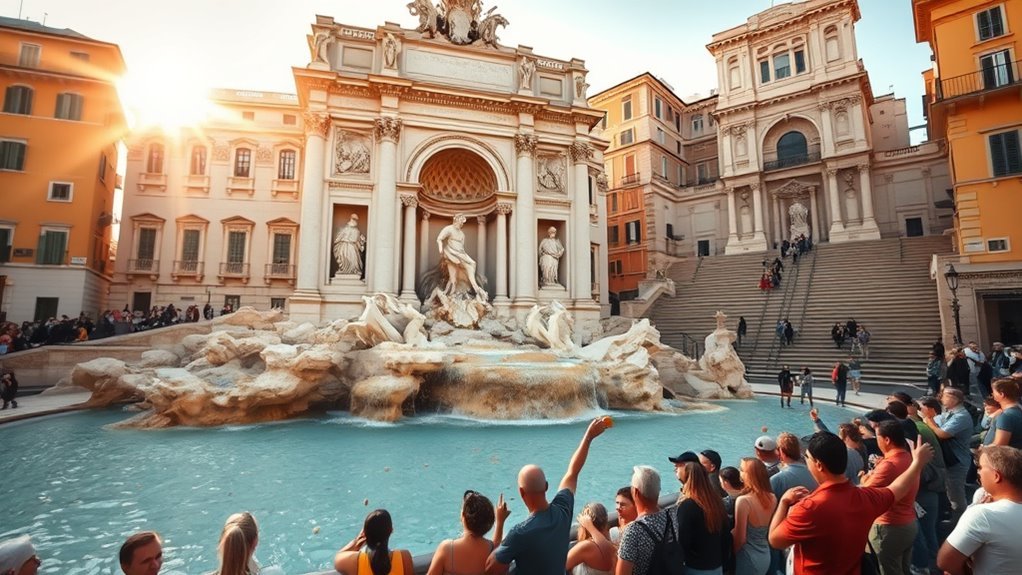
The Trevi Fountain is one of Rome’s most recognizable movie locations. Federico Fellini filmed Anita Ekberg and Marcello Mastroianni in the real fountain for the famous night sequence in La Dolce Vita. The nearly empty square seen in the film bears little resemblance to the crowded site visitors usually encounter today.
Since February 2, 2026, most visitors who are not residents of Rome must pay €2 to enter the fountain’s controlled inner perimeter. The surrounding square and exterior viewpoints remain free. Tickets can be purchased online, through authorized sales points, or by card at the entrance. Check the official Trevi Fountain visitor website before going because operating hours can change.
Warning: Do not enter the water to copy the scene from La Dolce Vita. Wading in the fountain is prohibited and can lead to a substantial fine. Visitors must also avoid sitting on the basin, climbing, eating, drinking, or smoking inside the controlled area.
The Scene’s Cultural Impact
The sequence turned an already famous Baroque fountain into a lasting symbol of postwar Italian cinema. Sylvia’s playful entrance into the water creates an image of glamour and escape, while Marcello’s hesitation reflects the film’s wider conflict between desire and emptiness.
La Dolce Vita drew sharp moral and religious criticism when it appeared in 1960. However, claims that Pope John XXIII personally denounced this specific fountain sequence are often repeated without a dependable primary source. It is safer to say that Fellini’s treatment of sexuality, celebrity, religion, and upper-class life provoked intense public debate.
Fellini’s Artistic Vision
Fellini did not simply record Rome as it looked. He mixed real locations with elaborate studio spaces to create a city that feels both familiar and dreamlike. The Trevi Fountain sequence was filmed at the real monument, but other parts of the movie—especially much of Via Veneto—were carefully rebuilt at Cinecittà.
This mixture of reality and illusion is central to the film. Rome appears beautiful, theatrical, crowded, lonely, sacred, and commercial at the same time. The Trevi Fountain is therefore more than a pretty background: it becomes part of the film’s argument about fantasy and modern life.
Bocca della Verità From Roman Holiday
The Bocca della Verità, or Mouth of Truth, appears in one of the funniest scenes in Roman Holiday. Gregory Peck places his hand inside the marble mouth and pretends that it has been bitten off, startling Audrey Hepburn’s Princess Ann.
The monument sits in the portico of the Basilica of Santa Maria in Cosmedin. It is a large ancient marble disk that was probably used as a Roman drain or sewer cover, although its exact original purpose is not certain. A medieval legend claimed that the mouth would bite the hand of anyone telling a lie.
Historical Significance
The mask was installed at Santa Maria in Cosmedin in the 17th century, but the object itself is much older. Its carved face may represent a river god, faun, or another ancient figure. The liar-biting legend developed long after Roman times and became part of popular folklore.
The site’s connection to Roman Holiday transformed it into an international tourist attraction. The official Turismo Roma guide to the Mouth of Truth provides the latest listed visiting information, although the schedule follows the church and can change.
Impact of the Iconic Scene
The scene works because it combines the monument’s old legend with the relaxed chemistry between Hepburn and Peck. It briefly turns a carved stone disk into a comic test of trust, which fits a story about two characters hiding important truths from each other.
Visitors can place a hand inside the mouth for a photograph, but they should keep the line moving and respect the adjoining church. Early morning is usually the best time to reduce waiting.
Gladiator and the Colosseum: Inspiration, Not Filming Site
The real Colosseum is closely associated with Gladiator, but Ridley Scott did not film the movie’s arena battles inside the monument. Ancient Rome was reconstructed at Fort Ricasoli in Malta, where the production built part of a large Colosseum set. Digital effects completed the missing sections and crowds.
Visiting the Colosseum still gives you the historical setting needed to understand the film’s world. You can see the seating structure, underground service areas, entrances, and scale of the amphitheater that inspired the production design. However, arena-floor and underground access depend on the ticket selected.
Use the official Colosseum ticket and opening-hours page. Colosseum entry requires a timed reservation, tickets are issued in the visitor’s name, and identification may be checked.
Rome on screen is often a collage: one real monument, one studio set, and a layer of digital effects can become a single seamless place.
The Baths of Caracalla in The Great Beauty
The Baths of Caracalla provide the setting for the memorable giraffe sequence in Paolo Sorrentino’s The Great Beauty. The real archaeological complex appears in the film, unlike the digitally reconstructed arenas of Gladiator.
The vast ruins suit Jep Gambardella’s late-night journey through a city filled with beauty, performance, memory, and decay. Once one of imperial Rome’s great public bathing complexes, the baths now form an open archaeological site used for visits and cultural events.
What the Ruins Symbolize
The scene places an impossible, graceful animal among massive Roman remains. The disappearing giraffe suggests that beauty can appear suddenly and vanish just as quickly. The ruins add another layer: even structures designed to project permanence eventually change and decay.
| Element | Role in the Film |
|---|---|
| Ancient ruins | Connect Jep’s private doubts with Rome’s long history. |
| Giraffe | Represents wonder, illusion, and the brief appearance of beauty. |
| Former bath complex | Recalls a public world built around leisure, ritual, and display. |
| Night setting | Makes the familiar archaeological site feel secret and dreamlike. |
Jep’s Existential Journey
Jep moves through Rome as both an insider and an observer. He knows the city’s parties, palaces, and influential people, yet he increasingly questions whether that life has meaning. The Baths of Caracalla place his doubts beside something much larger than his social world.
During a daytime visit, the site feels brighter and more exposed than it does in the film. Bring water, sun protection, and supportive shoes during warm weather because much of the visit is outdoors. Check the Turismo Roma guide to the Baths of Caracalla before traveling.
Piazza Navona in The Talented Mr. Ripley
Piazza Navona is a confirmed Rome filming location in The Talented Mr. Ripley. Tom Ripley and Dickie Greenleaf meet Freddie Miles near Bernini’s Fountain of the Four Rivers. The grand square matches the characters’ wealthy, polished world while adding unease beneath the beauty.
The square was built over the shape of the ancient Stadium of Domitian, which explains its long oval form. Visitors can see Bernini’s central fountain, the Church of Sant’Agnese in Agone, cafés, artists, and performers around the piazza.
| Aspect | Details |
|---|---|
| Film scene | Tom and Dickie meet Freddie near the Fountain of the Four Rivers. |
| Artistic heritage | Bernini’s fountain is one of the best-known works of Baroque Rome. |
| Historical foundation | The piazza follows the footprint of the Stadium of Domitian. |
| Access | The public square is free and open, although surrounding attractions have separate schedules. |
| Best visiting time | Early morning offers quieter photographs and a clearer view of the fountains. |
The national Italy for Movies location guide also identifies the Campidoglio, Imperial Fora, Piazza di Spagna, Piazza Mattei, and Ponte Sant’Angelo among the movie’s Rome locations.
Why Does EUR Stand Out in L’Eclisse?
Michelangelo Antonioni used Rome’s EUR district to express distance, uncertainty, and emotional isolation in L’Eclisse. Its broad roads, modern apartment blocks, water tower, and carefully planned spaces look very different from the narrow streets and layered buildings of central Rome.
EUR was designed for the planned 1942 Esposizione Universale Romana, which never took place because of the Second World War. Its Rationalist architecture still carries visible traces of the Fascist period in which the district was conceived. Today it is a business and residential area with offices, museums, parks, and major event spaces.
The district is a genuine filming environment in L’Eclisse, not merely a symbolic comparison added later. Antonioni uses empty corners, road junctions, unfinished spaces, and severe geometry to make the setting as important as the actors.
EUR is southwest of the historic center and is most easily reached using Metro Line B. Read the official Turismo Roma EUR overview before planning a longer architectural walk.
The Pantheon in Angels & Demons
The Pantheon is a major story location in Angels & Demons. Robert Langdon initially interprets a clue as pointing to Raphael’s tomb inside the building. The mistake sends the investigation in a new direction and establishes Rome’s monuments as parts of the mystery.
The building is also important beyond the movie. Its vast concrete dome, central oculus, and balanced interior demonstrate the skill of Roman engineers. The height of the interior and the diameter of the dome are approximately equal, creating the impression of a complete sphere.
Film-location claims about Angels & Demons require care. Some Rome exteriors were used, but the production also relied on substitute locations, large reconstructions, and digital work. Visiting the Pantheon lets you experience the real place in the story even when an individual shot may have been assembled through several production methods.
Why the Architecture Matters
The oculus is the Pantheon’s only direct source of natural light. As sunlight moves across the interior, it changes how the enormous space feels. This shifting light is well suited to a thriller built around hidden meanings, old symbols, and uncertain interpretations.
The Pantheon is now an active Catholic basilica as well as a monument. Ordinary tourist entry requires a ticket, while schedules can change for worship and special services. Review the official Pantheon visitor information before arriving.
The Pantheon’s Role in the Plot
Langdon goes to the Pantheon while following what he believes is the first step on the Path of Illumination. Raphael is buried there, but Langdon realizes that he has misunderstood the wording of the clue. The mistake increases the urgency of the search and pushes the characters toward another church.
This is a good example of how the film uses real history as a framework for fiction. Raphael’s tomb and the Pantheon are real; the Illuminati conspiracy and the race through the city belong to the story.
The Spanish Steps From Roman Holiday
The Spanish Steps appear in Roman Holiday when Princess Ann enjoys a brief taste of ordinary life in Rome. The sequence helped make Piazza di Spagna one of the movie’s most recognizable locations.
The staircase links Piazza di Spagna with the Church of Trinità dei Monti. At the base stands the Fontana della Barcaccia, designed by Pietro Bernini with contributions traditionally associated with his son Gian Lorenzo Bernini.
The Spanish Steps are free to visit, but visitors must keep moving and must not sit on the protected staircase. Eating on the steps, dragging luggage across them, or damaging the stone can also lead to enforcement action.
Pro Tip: Visit Piazza di Spagna shortly after sunrise, then walk to the Trevi Fountain before continuing to the Pantheon and Piazza Navona. This order covers four major film locations before the busiest part of the day.
Ben-Hur and Circus Maximus
Circus Maximus was ancient Rome’s largest chariot-racing venue, so it is a natural place for fans of Ben-Hur to visit. However, the famous race in William Wyler’s 1959 film was not shot at the surviving archaeological site.
The production built a vast racing set at Cinecittà Studios outside central Rome. The sequence used trained horses, stunt performers, large crowds, and extensive practical construction. Visiting Circus Maximus therefore connects you with the real history behind the spectacle, while Cinecittà represents the movie’s production history.
Today, the long valley of Circus Maximus helps visitors understand the size and shape of a Roman racing ground. It is close to the Palatine Hill, Bocca della Verità, and Baths of Caracalla, making it easy to include in an ancient-Rome movie route.
The Roman Forum’s Significance in Gladiator
The Roman Forum helps explain the political and ceremonial world recreated in Gladiator, but it should not be presented as one of the film’s principal Rome shooting locations. The production created much of imperial Rome at Fort Ricasoli in Malta and extended it digitally.
In the real Forum, visitors can see the remains of temples, basilicas, triumphal routes, government spaces, and public monuments. These ruins provide historical context for the processions, speeches, political rivalries, and displays of power shown in the movie.
A standard combined archaeological ticket may include the Colosseum, Roman Forum, and Palatine Hill, but exact access depends on the selected ticket. Allow enough time for security, uneven ground, sun exposure, and the large size of the site.
Exploring the Vatican in Angels & Demons
Vatican City is central to the story of Angels & Demons, but many scenes set inside Vatican buildings were created elsewhere. The Royal Palace of Caserta represented several grand interiors, while production sets and digital effects recreated other restricted spaces. Some Rome exteriors and public squares were filmed on location.
St. Peter’s Square and St. Peter’s Basilica remain essential stops for fans because they establish the scale and setting of the story. The Vatican Museums and Sistine Chapel also help visitors understand the art, religious history, and ceremonial environment used by the film, even though the production did not simply film every interior as shown.
Buy Vatican Museums admission only through the official Vatican Museums visitor portal. The Vatican warns that look-alike ticket sites may charge much higher prices.
- Shoulders and knees must be appropriately covered for the Vatican Museums, Sistine Chapel, and St. Peter’s Basilica.
- Large bags and unsuitable items may have to be left in the cloakroom.
- Personal photography is generally allowed in the museums without flash, but photography and filming are forbidden inside the Sistine Chapel.
- Tripods, selfie sticks, and professional equipment are restricted.
- Security lines and religious events can affect access.
The Tiber and the Rome of Eat Pray Love
Eat Pray Love uses central Rome, Trastevere, Piazza Navona, Piazza di Spagna, Via del Corso, Campo de’ Fiori, and other city locations during Elizabeth Gilbert’s Italian chapter. The film focuses more on food, friendship, language, and learning to enjoy daily life than on one defining Tiber River sequence.
A walk along the Tiber still fits naturally into an Eat Pray Love-inspired route because it links several neighborhoods and offers quieter views away from the busiest squares. Treat the river as a complementary experience rather than claiming that every bridge, market, or golden-hour view appeared as a named scene.
- Cross toward Trastevere for streets and restaurants similar to those used during Liz’s outings with friends.
- Walk near Ponte Sant’Angelo for views of Castel Sant’Angelo and St. Peter’s dome.
- Continue toward the historic center for Piazza Navona, Campo de’ Fiori, and Via del Corso.
- Use marked crossings and stay on pedestrian paths because the riverside roads carry fast traffic.
- In summer, plan river walks for morning or evening when temperatures are lower.
For verified production locations, consult the Italy for Movies guide to Eat Pray Love.
Via Veneto’s Glamour in La Dolce Vita
Via Veneto represents the celebrity culture, nightlife, cafés, journalists, and photographers associated with La Dolce Vita. The real street remains one of the movie’s most important reference points, but most of Fellini’s Via Veneto scenes were not filmed directly on the avenue.
Production designer Piero Gherardi recreated much of the street at Cinecittà, allowing Fellini to control crowds, lights, traffic, and camera movement. The film also includes a smaller number of genuine exterior views, and the Westin Excelsior remains recognizable.
The distinction does not make the real Via Veneto less relevant. The studio set was designed to capture the atmosphere of the street at its fashionable peak. A visit lets you compare present-day Rome with Fellini’s carefully constructed memory of its nightlife.
The BFI guide to Fellini’s Rome locations identifies which sequences used the real city and which relied mainly on studio reconstruction.
To Rome With Love: Key Filming Spots
Woody Allen’s To Rome with Love uses a wide range of recognizable streets, monuments, and neighborhoods. Unlike ancient epics that had to reconstruct imperial Rome, this modern comedy gains much of its character from real public spaces.
- Piazza Venezia and the Victor Emmanuel II Monument: Major visual anchors in central Rome.
- Trastevere: Narrow lanes, warm-colored buildings, restaurants, and small squares create a more intimate setting.
- Via Veneto: Connects the film with Rome’s long association with celebrity culture.
- Campidoglio and the Cordonata: Michelangelo’s monumental staircase and hilltop square provide a formal view of the city.
- Piazza di Spagna: The Spanish Steps and surrounding streets appear in the film’s portrait of everyday Rome.
The locations are spread across several storylines rather than one continuous route. The official Italy for Movies page for To Rome with Love is a useful starting point for confirming production sites.
Cinecittà and Rome’s Studio-Built Movie Locations
Cinecittà is essential to Rome’s movie history because filmmakers have used its stages and backlots to build places that were too large, busy, fragile, or historically altered to film directly. The studios helped create the Via Veneto of La Dolce Vita and the chariot-racing world of the 1959 Ben-Hur.
This is why a movie-location guide should include both monuments and production sites. The real Colosseum explains the historical arena, while a studio reconstruction explains how the movie image was made. The same is true of Vatican scenes recreated in palaces and soundstages.
Cinecittà is located southeast of central Rome and is served by Metro Line A. Public exhibition areas and tour availability can change, so verify current admission through Cinecittà’s official visitor information before making a special trip.
More Verified Rome Film Locations Worth Visiting
Via Margutta in Roman Holiday
Joe Bradley’s apartment in Roman Holiday is associated with Via Margutta, a quiet street near Piazza del Popolo known for artists’ studios and greenery. It is an easy addition to a Spanish Steps route.
Piazza Mattei in The Talented Mr. Ripley
Tom’s Rome apartment is placed inside Palazzo Costaguti in Piazza Mattei. The small square is also known for the Turtle Fountain and sits close to the Jewish Ghetto.
Campidoglio and the Imperial Fora
After being left alone in Rome, Tom visits the Campidoglio, Capitoline Museums area, and Imperial Fora in The Talented Mr. Ripley. These locations are close enough to combine with a Colosseum visit.
Ponte Sant’Angelo
Tom and Meredith travel across Ponte Sant’Angelo with Castel Sant’Angelo behind them in The Talented Mr. Ripley. The bridge also fits naturally into an Angels & Demons or Vatican-area walk.
Parco degli Acquedotti
The Park of the Aqueducts appears in the opening helicopter sequence of La Dolce Vita. It offers a quieter film location outside the dense historic center and can be reached using Metro Line A followed by a walk.
How to Plan a Rome Movie-Location Route
Historic-Center Movie Walk
Begin at the Spanish Steps, continue to the Trevi Fountain, walk to the Pantheon, and finish at Piazza Navona. From there, continue toward Ponte Sant’Angelo or the Tiber. This route covers locations connected to Roman Holiday, La Dolce Vita, Angels & Demons, The Talented Mr. Ripley, and Eat Pray Love.
Ancient Rome and Aventine Route
Combine the Colosseum and Roman Forum with Circus Maximus, Bocca della Verità, and the Baths of Caracalla. The route connects the real ancient city with films including Gladiator, Ben-Hur, Roman Holiday, and The Great Beauty.
EUR and Cinecittà Route
Visit EUR separately from the historic center because its buildings are spread across a wide district. Metro Line B serves EUR, while Metro Line A serves Cinecittà. Attempting both districts and a full historic-center walk in one day can feel rushed.
Pro Tip: Group locations by neighborhood rather than by movie. Several films use the same squares, so a geographic route reduces backtracking and gives you more time inside ticketed monuments.
Current Visitor Rules and Planning Tips
- Trevi Fountain: Most non-residents need a €2 ticket for the inner perimeter. The exterior view remains free. Do not enter the water or sit on the basin.
- Colosseum: Reserve an entry time through the official system. Carry identification that matches the named ticket.
- Pantheon: Tourist entry requires a ticket. Behave quietly because the building remains a church.
- Vatican Museums: Use only the official ticket portal, follow the dress code, and do not photograph or film inside the Sistine Chapel.
- Spanish Steps: Walking is allowed, but sitting on the staircase is prohibited.
- Bocca della Verità: Access follows the schedule of Santa Maria in Cosmedin and may change for church activities.
- Outdoor ruins: Carry water and sun protection, especially at the Forum, Circus Maximus, Baths of Caracalla, and EUR.
- Accessibility: Ancient paving, stairs, and uneven archaeological ground can present barriers. Check each official site’s accessibility page before booking.
Note: Ticket prices, opening hours, religious closures, restoration work, and security procedures can change. Recheck official websites shortly before your visit rather than relying on an old screenshot or third-party ticket listing.
Frequently Asked Questions
What movies have been filmed in Rome, Italy?
Movies filmed partly in Rome include Roman Holiday, La Dolce Vita, The Talented Mr. Ripley, The Great Beauty, To Rome with Love, Eat Pray Love, and Angels & Demons. Productions often combine real Rome locations with studio sets and substitute buildings.
What is Rome’s most iconic movie location?
The Trevi Fountain is arguably Rome’s most iconic movie location because of Anita Ekberg and Marcello Mastroianni’s scene in La Dolce Vita. The Spanish Steps and Bocca della Verità from Roman Holiday are close rivals.
What famous movie scene was filmed at the Trevi Fountain?
The fountain appears in the famous La Dolce Vita scene in which Sylvia, played by Anita Ekberg, enters the water and calls Marcello to join her. Visitors may not reenact the scene because entering the fountain is prohibited.
Was Gladiator filmed inside the real Colosseum?
No. The production built part of a Colosseum at Fort Ricasoli in Malta and used digital effects to complete the arena and crowds. The real Colosseum remains the historical inspiration for the movie’s setting.
Was the Ben-Hur chariot race filmed at Circus Maximus?
No. The famous chariot race in the 1959 film was shot on a large set at Cinecittà Studios. Circus Maximus is the real ancient Roman racing venue that helps visitors understand the history behind the scene.
What is the most famous landmark in Rome?
The Colosseum is commonly considered Rome’s most famous landmark because of its scale, age, and association with ancient entertainment. For film fans, the Trevi Fountain may be the city’s most instantly recognizable cinematic location.
Conclusion
Rome’s movie locations reveal both the city’s history and the craft behind filmmaking. At the Trevi Fountain, Spanish Steps, Bocca della Verità, Piazza Navona, Baths of Caracalla, and EUR, you can stand in genuine shooting locations. At the Colosseum, Roman Forum, Circus Maximus, and Vatican, the story is more complex: the real monuments inspired scenes that were often completed with studio sets, substitute buildings, and visual effects.
The most rewarding route combines both kinds of places. Visit the monuments, learn how each movie transformed them, and follow current preservation rules so these locations remain available to future visitors.
Sources
- Official Trevi Fountain Visitor Website — 2026 access fee, exemptions, hours, entry process, and visitor rules.
- Parco archeologico del Colosseo — official Colosseum, Roman Forum, Palatine, booking, and ticket information.
- Vatican Museums — official tickets, clothing rules, security, photography, and visitor guidance.
- Turismo Roma: The Mouth of Truth — history, legend, location, and connection to Roman Holiday.
- Italy for Movies: Gladiator — verified production locations and reconstruction of ancient Rome in Malta.
- British Film Institute: Fellini’s Rome — real and reconstructed locations used in La Dolce Vita.
