
Last Updated on July 24, 2026 by Ethan Caldwell
A safer road trip starts before you turn the key. You need a route that suits your vehicle, driving experience, weather, and available services, not simply the shortest line on a map. By comparing a primary route with two practical backups, checking official road information, preparing your vehicle, and planning for delays, you can reduce avoidable risks and respond calmly when conditions change.
Quick Answer
Choose a well-maintained route that matches your vehicle and current conditions. Compare two backup routes, check traffic, closures, and weather shortly before leaving, and program your GPS while parked. Inspect your vehicle, carry emergency supplies, plan rest stops, and share your route and arrival time with a trusted person.
Key Takeaways
- The fastest route is not always the safest. Consider road condition, weather, lighting, traffic, services, and vehicle restrictions.
- Prepare two realistic backup routes and identify the points where you would switch to them.
- Use current transportation-agency, weather, and navigation information instead of relying on old screenshots or saved routes.
- Set your navigation before moving and stop safely before making major route changes.
- Inspect your vehicle, carry suitable emergency supplies, and tell a trusted person when you expect to arrive.
At a Glance
| Time Required | About 20 to 30 minutes, plus extra time for a long, remote, or weather-sensitive trip |
| Difficulty | Easy |
| Tools Needed | Current map or navigation service, official road and weather information, vehicle manual, phone charger, and emergency-kit checklist |
| Cost | Usually free; optional tolls, roadside-assistance plans, satellite services, or emergency supplies may cost extra |
Disclosure: As an Amazon Associate I earn from qualifying purchases. Some links on this page are affiliate links, at no extra cost to you.
Choose the Safest Travel Route
The safest route is the one that best fits the current conditions, your vehicle, and your ability. It may not be the shortest or fastest option. A slightly longer highway route can be a better choice than an unfamiliar back road with poor lighting, limited mobile service, sharp curves, or little winter maintenance.
Compare each route using the following points:
- Road type and condition: Check whether the route includes unpaved roads, seasonal roads, mountain passes, low-water crossings, construction zones, or roads that commonly close.
- Weather exposure: Look for areas affected by snow, ice, flooding, fog, wildfire smoke, high wind, or extreme heat.
- Traffic and road design: Consider complex interchanges, heavy merging, steep grades, narrow lanes, railroad crossings, and frequent stop-and-go traffic.
- Vehicle suitability: Check height, weight, towing, tire, fuel-range, and traction requirements. RVs and trailers may need routes that avoid low bridges, tight turns, or restricted roads.
- Available services: Note fuel or charging stations, rest areas, food, lodging, repair shops, hospitals, and safe public stopping places.
- Driver comfort: Choose a route you can drive confidently. Avoid difficult roads when you are inexperienced, tired, or uncomfortable with the conditions.
In the United States, participating state and local 511 traveler-information services can provide current road and travel conditions. Availability and features differ by jurisdiction, so also check the transportation department for every state or region you will cross.
Pro Tip: Save your preferred route, but review it again on the day of travel. Construction, severe weather, fires, crashes, and seasonal restrictions can make yesterday’s best route a poor choice today.
Map Two Alternate Routes
After choosing your primary route, prepare two realistic backups. They should help you respond to a closure, major crash, severe congestion, charging problem, or sudden weather change. A backup is useful only when it remains suitable for your vehicle and does not take you through a closed or hazardous area.
A useful backup route gives you a safe decision before you reach the closure, not after you are trapped in traffic.
- Mark the decision point: Identify the junction where you must stay on the primary route or move to the backup.
- Check restrictions: Confirm road surface, bridge clearance, weight limits, towing restrictions, tolls, ferry schedules, and seasonal access.
- Find essential stops: Mark fuel, charging, food, restrooms, lodging, and safe rest areas.
- Download the route: Save offline maps or written directions for areas with weak mobile service.
- Keep the routes current: Recheck all three options shortly before leaving and after any long stop.
Do not follow a navigation app onto a flooded, closed, unmaintained, or vehicle-restricted road. Posted signs, law-enforcement directions, and official closure orders take priority over an app.
Check Traffic, Weather, and Closures
Check current conditions when planning the trip, again shortly before departure, and during safe stops on a long journey. Use more than one reliable source when weather or road conditions are changing quickly.
- Traffic and crashes: Review current navigation data and official transportation-agency reports.
- Closures and construction: Check state, provincial, or national road-agency websites and official 511 services where available.
- Weather: Review forecasts, watches, warnings, radar, visibility, wind, and expected precipitation through an official weather service.
- Local emergencies: Look for evacuation orders, wildfire restrictions, flooding, major public events, and emergency-management notices.
The National Weather Service safety portal explains how hazards such as fog, snow, ice, wind, heat, and flooding affect travel. Outside the United States, use the official meteorological and transportation agencies for the countries or regions on your route.
Warning: Delay or cancel the trip when officials advise people to stay off the road. Never drive around a closure barrier or enter floodwater. Water depth, current, road damage, and washouts can be impossible to judge from inside a vehicle.
Plan for Rush Hour Delays
Rush hour does not follow one universal timetable. Peak traffic can change by city, road, weekday, school schedule, holiday, weather, sports event, and construction project. Instead of assuming that a certain hour will be quiet, compare current or typical traffic for your exact corridor and test more than one departure time.
- Allow extra time so congestion does not pressure you to speed or make sudden lane changes.
- Plan fuel, charging, food, restroom, and rest stops before entering a heavily congested area.
- Expect queues near bridges, tunnels, toll plazas, border crossings, airports, and event venues.
- Consider a later departure or an overnight stop when severe congestion would extend the trip beyond your safe driving limit.
- Take regular breaks and change drivers when possible.
Fatigue can be as important as congestion. The National Highway Traffic Safety Administration advises drivers to get adequate sleep and warns that drowsy-driving risk is often higher from midnight to 6 a.m. and during the late afternoon.
Note: Opening a window, turning up music, or relying on an energy drink does not cure serious fatigue. Stop in a safe, legal place and rest before continuing.
Use GPS Without Getting Distracted
Enter the destination and review the route while the vehicle is parked. Mount the device where it does not block your view, connect the charger, set a suitable volume, and silence unnecessary notifications before moving.
- Use spoken directions to reduce the need to look at or touch the screen.
- Ask a passenger to handle route changes when one is available.
- Do not type, zoom, scroll, read messages, or search for stops while driving.
- If the route changes unexpectedly, continue safely until you can stop in a legal location.
- Download offline maps before entering an area with weak service.
- Keep enough awareness of the route to recognize an obviously unsafe or unsuitable instruction.
Hands-free technology is not distraction-free. NHTSA includes interaction with navigation and entertainment systems in its definition of distracted driving.
Distracted-driving crashes killed 3,208 people in the United States in 2024, according to NHTSA.
Warning: Pull over safely before making a major navigation change. Do not stop on a travel lane, narrow shoulder, blind curve, bridge, tunnel, or other place where approaching drivers may not see you.
Pack Route-Specific Emergency Gear
Your emergency kit should match the trip. A short drive through a populated area requires less equipment than a winter journey, desert crossing, remote mountain route, or evacuation. Pack enough to handle a reasonable delay without overloading the vehicle or blocking access to safety equipment.
Essential Emergency Supplies
Keep frequently needed items in a secure and reachable place. Do not leave loose tools or heavy equipment where they could strike an occupant during sudden braking or a crash.
- Charged mobile phone, vehicle charger, and portable power bank
- First-aid kit and necessary prescription medicines
- Flashlight or headlamp with spare batteries
- Reflective warning triangles, reflective vest, and emergency flag
- Drinking water and nonperishable snacks suitable for the trip and likely delay
- Blanket, weather-appropriate clothing, work gloves, and sturdy footwear
- Tire-pressure gauge, vehicle jack, lug wrench, and usable spare tire when supplied
- Jumper cables or a compatible jump pack
- Basic tools and the vehicle owner’s manual
- Paper towels, waste bags, and basic hygiene supplies
- Supplies for infants, older passengers, disabilities, and pets when applicable
For an ordinary trip, carry drinking water for the journey plus a reasonable delay. For disaster or evacuation planning, the CDC recommends at least one gallon of water per person per day for drinking, cooking, and hygiene, with additional water in hot conditions or for certain health needs.
Route Hazard Gear
Add equipment only when it fits the route, vehicle, season, and local rules.
- Winter: Ice scraper, snow brush, shovel, warm layers, traction material, and approved tire chains or cables when required and compatible with the vehicle.
- Heat and desert travel: Extra drinking water, sun protection, light clothing, and a plan for obtaining help without leaving occupants in a dangerously hot vehicle.
- Rain and flooding: Waterproof outerwear, dry clothing, and alternate routes that avoid flood-prone roads and low-water crossings.
- Remote roads: Extra food and water, offline maps, additional charging capacity, and a reliable communication plan.
- Mountain travel: Appropriate tires, adequate fuel or charge, knowledge of steep-grade driving, and awareness of seasonal pass closures.
Practice installing tire chains before the trip if you may need them. Follow the owner’s manual because some vehicles have limited wheel-well clearance or prohibit chains on certain wheels or tire sizes.
Communication Backup Tools
A mobile phone is the main communication tool for most road trips, but it may not work in remote terrain or during a widespread outage. Prepare a backup that matches the level of isolation.
- Download offline maps and save important phone numbers.
- Carry a fully charged power bank and suitable cables.
- Write down the route, emergency contacts, roadside-assistance number, insurance details, and vehicle information.
- Consider a satellite messenger or satellite-enabled emergency feature for genuinely remote travel.
- Carry a whistle, signal mirror, or other visible signaling tool when traveling far from regular traffic.
Note: A satellite device does not replace good planning. Coverage, subscriptions, battery life, emergency-response availability, and supported features vary by device and location.
Prep Your Vehicle Before You Go
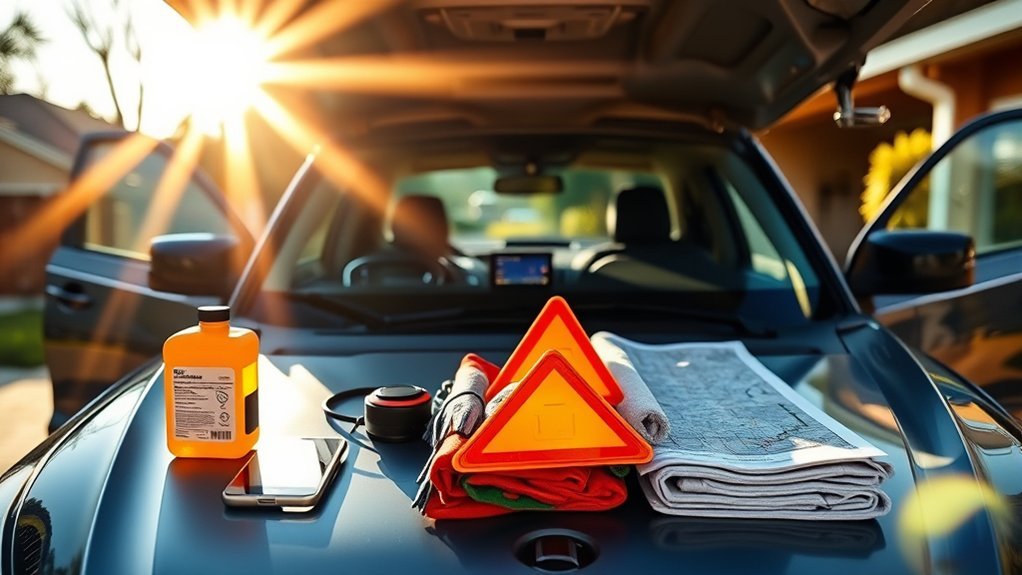
Inspect the vehicle before a long or demanding trip. The NHTSA road-trip checklist recommends checking tires, fluids, lights, batteries, cooling components, wipers, emergency supplies, and open safety recalls.
- Tires: Check cold tire pressure against the driver-door placard or owner’s manual. Inspect tread and sidewalls, and check the spare.
- Brakes: Arrange an inspection if you notice grinding, pulling, vibration, warning lights, reduced braking, or unusual pedal feel.
- Fluids: Check engine oil, coolant, brake fluid, washer fluid, and other vehicle-specific fluids.
- Battery: Check the starting or charging system if the battery is weak, old, or showing warning signs.
- Visibility: Test headlights, brake lights, turn signals, hazard lights, mirrors, cameras, and wipers.
- Safety equipment: Confirm that seat belts, child restraints, the jack, wheel-lock key, tools, and emergency kit are present and usable.
- Fuel or charging: Begin with enough range and plan more than one station or charger on remote routes.
- Recalls: Check the vehicle identification number through the manufacturer or relevant government recall database.
Do not take a road that exceeds the vehicle’s ground clearance, traction, water-fording ability, towing limits, or other manufacturer restrictions. Adding larger tires or recovery equipment does not automatically make a passenger vehicle suitable for off-road travel.
Warning: Do not routinely carry gasoline in the passenger compartment. When extra fuel is truly necessary, follow local laws and the vehicle and container instructions. Use an approved container, secure it against movement, keep it upright, and transport it outside the passenger area. Never fill a portable container while it is inside a vehicle.
Share Your Travel Plan
Give a trusted person enough information to notice a serious delay and contact help when needed. Share the plan privately rather than posting your real-time location or an empty-home schedule publicly.
- Your destination and planned route
- Important stops and overnight locations
- Your departure time and estimated arrival time
- Vehicle make, model, color, and registration details when appropriate
- The names of the people traveling with you
- The time at which the contact should check on you
- Any remote sections where mobile service may be unavailable
Agree on a simple check-in plan. For example, send a message at a planned stop and after arrival. If you change routes, experience a long delay, or stay overnight somewhere unexpected, update the person when it is safe to do so.
Keep emergency contacts and essential medical information accessible to responders, but share private health details only with people who genuinely need them.
Identify Road Hazards and Safe Stops Along the Way
Review the sections of the route that may require more attention. The goal is not to predict criminal activity. It is to recognize road features, visibility limits, traffic conflicts, weather exposure, and places where stopping would be unsafe.
Identify Complex Intersections and Road Features
Look for places where lane choice, sight distance, or traffic movement may be difficult:
- Large roundabouts and multilane intersections
- Closely spaced exits and complicated interchanges
- Railroad crossings
- Steep descents and sharp curves
- Narrow bridges and tunnels
- Work zones and temporary lane shifts
- School zones and busy pedestrian areas
- Low-water crossings and flood-prone roads
Review the lane layout before departure, but follow current signs and signals when you arrive. Slow down early, leave adequate space, and avoid abrupt lane changes if you miss a turn. Continue safely and allow the navigation system to find another route.
Note Visibility Limits and Vehicle Blind Spots
Roadway visibility may be reduced by hills, curves, vegetation, buildings, parked vehicles, work equipment, fog, heavy rain, snow, or bright sun. Bridges can also become icy before nearby road surfaces in cold weather.
Adjust speed to what you can see and stop within, while staying within the posted limit. Increase following distance in poor conditions, use the correct lights, and avoid cruise control on slippery roads. Never depend only on mirrors, cameras, blind-spot alerts, or other driver-assistance systems. Turn your head and check the surrounding area before moving or changing lanes when it is safe to do so.
Mark Safe Pull-Off and Help Points
Before entering a long, remote, or congested section, note where you can stop without creating another hazard.
- Official rest areas and service plazas
- Fuel and charging stations
- Repair shops and roadside-assistance coverage areas
- Hospitals, urgent-care centers, police stations, and fire stations
- Well-lit public parking areas
- Lodging that can be used if the trip must stop overnight
- Locations before known mobile-service gaps
If the vehicle develops a problem, move out of active traffic only when you can do so safely. Turn on the hazard lights, use reflective warning equipment when safe and legal, and contact emergency services or roadside assistance. Do not stand between moving traffic and the disabled vehicle.
Frequently Asked Questions
Can ChatGPT help compare travel routes?
Yes. ChatGPT can help you build a comparison checklist, organize stops, estimate what supplies you may need, and compare route details that you provide. When web search is available, it may also find current sources. However, it should not replace official road agencies, weather warnings, posted signs, vehicle restrictions, or a current navigation service. Verify critical information before leaving.
What should I do if my primary route closes?
Follow closure signs and official instructions. Do not drive around a barrier. Stop in a safe place, check current transportation-agency information, and select a verified backup route suitable for your vehicle. If no safe route is available, wait, return to a safe location, or arrange lodging until conditions improve.
How do I create a safer backup route?
Choose a maintained road that avoids the same closure, weather hazard, or congestion affecting the primary route. Check vehicle restrictions, road surface, fuel or charging access, mobile coverage, services, and current conditions. Mark the junction where you must decide whether to use it.
Is the fastest route always the safest?
No. The fastest route may include heavy merging, difficult intersections, steep grades, poor weather, unpaved roads, limited services, or roads unsuitable for your vehicle. Compare travel time with road condition, visibility, traffic, weather, driver fatigue, and access to help.
Conclusion
A safer route is not simply the shortest path on a screen. Choose roads that suit your vehicle and current conditions, prepare two verified backups, and check official traffic, closure, and weather information before leaving. Program navigation while parked, allow time for rest, inspect the vehicle, and carry supplies that match the route and season. A clear plan helps you avoid rushed decisions and respond safely when the trip changes.
Sources
- Federal Highway Administration: 511 Traveler Information — current travel-condition and route-choice information
- National Weather Service Safety Resources — weather hazards, warnings, and travel-safety guidance
- NHTSA Summer Driving and Road Trip Tips — route planning, vehicle checks, emergency supplies, and safe-driving preparation
- NHTSA Distracted Driving — navigation distraction and current distracted-driving statistics
- CDC Emergency Water Supply Guidance — emergency water quantities and storage considerations
- National Park Service Gas Can Safety — safe portable-fuel-container handling and transportation

