
Last Updated on September 10, 2026 by Daniel Globe
You can check an electric scooter battery’s health without opening the battery pack. Start with the scooter’s exact battery and charging specifications, then look for changes in range, charging behavior, temperature, power delivery, and app or dashboard warnings. A multimeter can add useful information on models with manufacturer-approved test points, but voltage alone cannot tell you the pack’s true capacity. Physical damage, swelling, unusual heat, smoke, leaking, or a strong chemical odor are safety issues, not DIY testing opportunities.
Quick Answer
Check electric scooter battery health by comparing current range and charging behavior with your scooter’s normal baseline, reviewing app or dashboard battery data, inspecting for damage, and checking model-specific voltage information when safe. Do not use a universal voltage-drop or range percentage as a pass/fail rule.
Key Takeaways
- Use your scooter’s manual or manufacturer specifications as the reference for battery voltage, charging time, temperature limits, and storage instructions.
- Range loss is meaningful only when you compare similar routes, speeds, temperatures, tire pressures, loads, and riding modes.
- Some voltage sag during acceleration is normal; there is no universal 1–2V failure threshold for every scooter battery.
- Do not intentionally run a lithium-ion scooter battery to forced shutdown just to test its range.
- Stop using or charging a battery that is swollen, damaged, unusually hot, smoking, leaking, wet internally, or producing an abnormal odor.
- Use only the manufacturer-supplied or specifically approved charger and replacement battery.
At a Glance
| Time Required | 10–20 minutes for inspection and app checks; longer for a controlled range comparison |
| Difficulty | Easy for non-invasive checks; advanced electrical testing should follow manufacturer service instructions |
| Tools Needed | Owner’s manual, manufacturer app if supported, trip meter or GPS distance log, tire gauge; optional digital multimeter only where approved |
| Cost | Usually $0 for basic checks; optional diagnostic tools or professional service add cost |
Warning: Do not open, puncture, modify, bypass the BMS on, or probe inside a sealed lithium-ion battery pack. If the battery is swollen, smoking, leaking, abnormally hot, physically damaged, or has been seriously water-damaged, stop riding and charging it and follow the manufacturer’s safety and disposal instructions.
Disclosure: As an Amazon Associate I earn from qualifying purchases. Some links on this page are affiliate links, at no extra cost to you.
How Battery Health Affects Scooter Range
Battery capacity gradually declines as lithium-ion cells age, so a scooter may eventually travel fewer miles on the same charge. However, range by itself does not prove that the battery is failing. Speed, rider weight, hills, tire pressure, brake drag, riding mode, wind, stops and starts, and ambient temperature can all change how far a scooter travels.
Manufacturer range figures are also measured under specific test conditions. For example, current Segway specifications state the test speed, rider weight, temperature, and pavement conditions used to calculate range. That makes your scooter’s own historical range under similar conditions more useful for battery-health tracking than a generic mileage number.
Watch for a persistent combination of shorter range, sudden power loss, abnormal charging, unexpected shutdowns, or battery-related fault codes. One bad trip in cold weather or on steep hills is not enough to condemn the pack.
Advertised range is a controlled test result, not a direct measurement of battery health.
Check Your Scooter Battery Specs First
Before testing electric scooter battery health, find the exact specifications for your scooter model. Check the label, owner’s manual, official support page, or manufacturer app. You need these numbers because nominal voltage, maximum charging voltage, battery energy, charging duration, and temperature limits vary between models.
- Confirm the battery chemistry and nominal voltage.
- Find the specified maximum charging voltage if the manufacturer publishes it.
- Record battery capacity in amp-hours (Ah) or energy in watt-hours (Wh).
- Check the normal charging duration and charger model.
- Check the approved charging and storage temperature range.
- Find any manufacturer battery-status or error-code information.
Do not assume that every “36V” or “48V” battery behaves the same way. Nominal voltage is a naming/reference value for the pack; it is not a universal minimum resting-voltage threshold.
Note: A battery can show normal-looking voltage while still having reduced usable capacity. Voltage, range, charging behavior, temperature, and load performance need to be considered together.
How to Check Scooter Battery Voltage
Voltage can help diagnose an electric scooter battery, but it must be interpreted against the manufacturer’s specifications and the battery’s current state of charge. Start with the scooter’s app or dashboard if it reports battery voltage. That avoids opening covers or exposing electrical connectors.
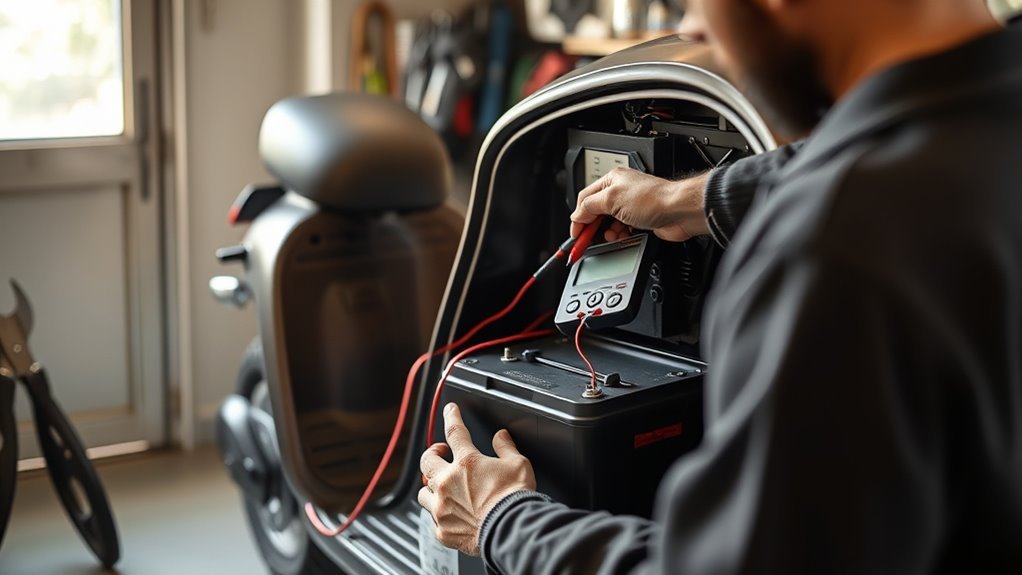
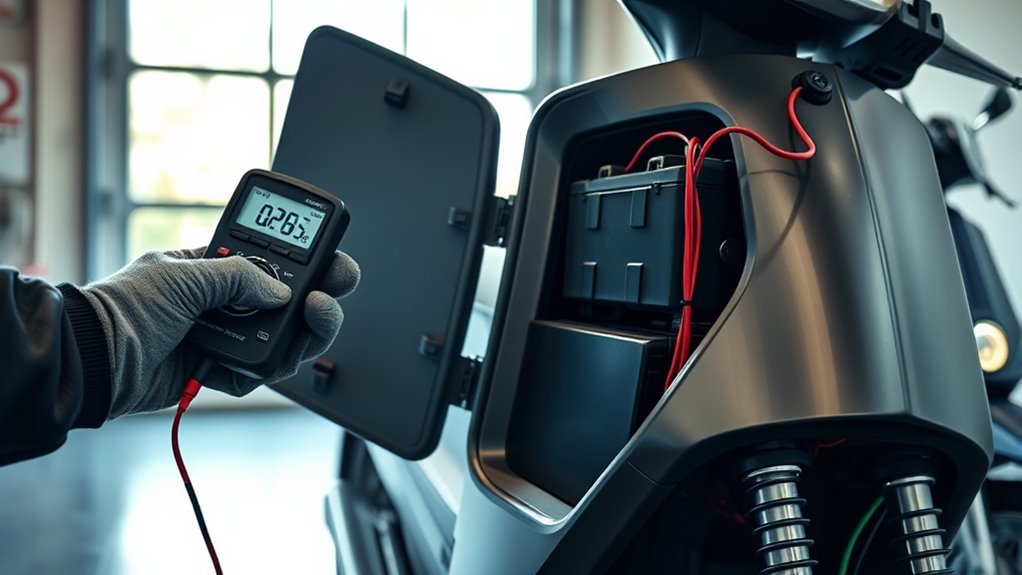
If your manufacturer provides an accessible battery test point or service procedure, a digital multimeter set to DC volts can be used to confirm voltage. Do not dismantle an integrated battery pack or improvise access to live battery conductors.
Voltage Check Tools
Use the least invasive diagnostic method available. Depending on the scooter, useful tools may include:
- The owner’s manual or official service documentation
- The manufacturer’s mobile app, if battery details are supported
- A digital multimeter rated for the voltage being measured
- Insulated probes appropriate for the approved test point
- A record of previous battery readings for comparison
A fully charged reading should be compared with the manufacturer’s specified full-charge or maximum charging voltage where that specification is available. Do not declare a partially discharged battery defective simply because its resting voltage has fallen below the nominal pack label.
Load Test Voltage
Battery voltage normally drops when the motor demands current. This temporary drop is called voltage sag. The amount varies with battery design, state of charge, temperature, pack age, motor demand, and internal resistance, so a fixed 1–2V rule is not appropriate for every scooter.
A useful warning pattern is a battery that looks normal at rest but experiences an unusually large voltage drop, triggers a low-voltage/BMS fault, or shuts the scooter down during acceleration or climbing. If your manufacturer publishes service limits, use those limits. Otherwise, repeated cutouts under normal load deserve professional diagnosis.
Pro Tip: Record voltage, battery percentage, temperature, riding mode, and the symptom at the same time. A repeatable pattern is much more useful than one isolated voltage reading.
Run a Scooter Battery Load Test
The safest home load test for most modern e-scooters is a controlled riding test, not opening the deck and holding the scooter against a wall at full throttle. Fully charge the scooter according to its manual, confirm normal tire pressure and brake operation, then ride a familiar route in normal conditions.
- Start with the manufacturer-defined full charge.
- Use the same riding mode you normally use.
- Choose a safe, familiar route with predictable terrain.
- Watch for sudden battery-percentage drops, error codes, power loss, or shutdowns.
- Note whether problems appear only during hard acceleration or hills.
If the scooter loses power repeatedly under ordinary demand while the display still shows substantial charge, the battery, BMS, connector, controller, or another electrical component may require diagnosis. A professional load/capacity test is the better next step when the battery pack is sealed or the manufacturer does not provide an owner-accessible test procedure.
Spot the Signs of a Bad Battery
A failing battery often produces more than one symptom. Reduced range is common, but charging problems, abrupt shutdowns, unusual heat, battery errors, or physical deformation provide stronger evidence when they occur together.
Reduced Range
Track range on the same or similar route rather than comparing one trip directly with the marketing claim. A persistent decline under matched conditions can indicate capacity loss, especially when tire pressure, temperature, speed, payload, and brake condition have not changed.
- Shorter trips under the same riding conditions
- Battery percentage dropping faster than it used to
- Power reduction earlier in the discharge
- Unexpected shutdowns on hills or during acceleration
- Large differences between repeated, similar tests
There is no universal rule that a battery must be replaced at exactly 70% of advertised range. Confirm the trend and rule out mechanical or environmental causes first.
Slow Charging
Charging that becomes noticeably slower than your scooter’s normal behavior can indicate a battery problem, but it can also come from the charger, charge port, connector, temperature, or BMS. Compare charging time with your model’s official specification and with the scooter’s previous behavior.
Also pay attention to the opposite problem: a battery that appears to reach “full” unusually quickly but then provides very little range may have lost usable capacity.
Heat And Swelling
Swelling, casing deformation, smoke, leaking, unusual odor, or abnormal heat are safety warnings. Do not continue riding merely to see whether the symptom gets worse. Do not puncture the casing, press on a swollen area, open the pack, or attempt cell-level repair.
- Stop charging and using a visibly damaged battery.
- Keep the battery away from ignition sources and combustible materials when this can be done safely.
- Follow the scooter manufacturer’s instructions for damaged batteries.
- Use an approved service or appropriate hazardous-battery disposal channel.
The U.S. Consumer Product Safety Commission recommends using manufacturer-approved replacement battery packs and warns against battery packs that have been modified or reworked by unqualified personnel.
Check Charging Time for Battery Problems
Measure how long your scooter normally takes to charge and compare that with the manufacturer’s stated duration. Do not use a generic six-, seven-, or eight-hour charging rule: scooters with different battery capacities and chargers have different charging times.
Use only the charger supplied with the scooter or one specifically approved for that exact model. The CPSC warns that so-called universal micromobility chargers can be electrically incompatible even if the connector physically fits.
| Charging symptom | Possible causes | Next check |
|---|---|---|
| No charging | Outlet, charger, charge port, connector, BMS, battery fault | Check official charger indicator, port condition, error codes, and manual |
| Much slower than normal | Charger problem, temperature, connection resistance, battery deterioration | Compare with official charge time and repeat under normal temperature |
| Reaches “full” unusually fast but range is poor | Reduced usable capacity, calibration issue, BMS or cell imbalance | Run a controlled range comparison and review battery diagnostics |
| Charging stops with an error | Temperature protection, battery/BMS fault, charger fault | Look up the exact error code before replacing parts |
Stay present while charging, do not charge while sleeping, and unplug the device when charging is complete according to the manufacturer’s instructions.
Test Scooter Range on a Full Charge
A controlled range comparison is one of the most useful non-invasive battery-health checks. Start from a normal full charge, verify tire pressure and mechanical condition, and ride a route that you can repeat under similar conditions.
Full-Charge Range Test
Do not intentionally run the battery until the scooter forces a complete shutdown. Instead, stop at the manufacturer’s low-battery warning or another normal stopping point recommended in the manual.
- Charge normally with the approved charger.
- Record the starting battery percentage and odometer.
- Use consistent speed and riding mode.
- Keep rider/load and tire pressure similar between tests.
- Record temperature, terrain, distance, and remaining percentage.
- Repeat the test before drawing conclusions.
This approach gives you a useful trend without deliberately deep-discharging the pack.
Compare Actual Distance
Your best comparison is the scooter’s earlier performance on similar rides. If you do not have a historical baseline, the manufacturer’s rated range can still provide context, but only if you understand the test conditions behind that number.
For example, a scooter tested at a low steady speed on flat pavement in mild weather may travel much farther than the same scooter ridden quickly in cold weather with repeated stops and hills. A lower real-world result does not automatically indicate a failing battery.
Note Range Drops
Keep a simple log of repeat tests. A gradual decline across months is more consistent with normal battery aging, while a sudden large change deserves closer investigation.
- Record distance and battery percentage used.
- Record temperature and riding mode.
- Check tire pressure before comparing tests.
- Note hills, strong wind, unusually heavy loads, or brake drag.
- Flag sudden shutdowns or unusually rapid percentage drops.
If range deterioration remains after controlling these variables, the battery may have lost usable capacity and should be professionally evaluated if the scooter does not provide a reliable battery-health diagnostic.
Inspect the Battery for Damage
Perform only a visual, non-invasive inspection unless your manufacturer specifically authorizes additional owner maintenance. Look at the scooter deck, removable battery housing if applicable, charging port, visible wiring, and connectors for abnormal changes.
- Bulging or warped battery/deck surfaces
- Cracks, punctures, dents, or impact damage
- Melted connectors or dark heat marks
- Corrosion or damaged wiring
- Water intrusion or signs the pack was submerged
- Smoke, hissing, unusual odor, or abnormal heat
Do not deliberately touch a hot battery to judge its temperature and do not place your face close to the pack to smell it. If a battery appears damaged or unstable, stop using it and follow manufacturer, local fire-safety, and disposal guidance.
Use a Battery Health App
If your scooter has an official app, check what battery information it actually provides. Depending on the model, the app may display state of charge, estimated remaining range, temperature, voltage, fault messages, or other battery-management information.
- Record battery percentage before and after repeat rides.
- Check battery temperature if the app reports it.
- Review battery- or BMS-related error codes.
- Compare voltage readings only with model-specific specifications.
- Install manufacturer firmware updates when recommended.
Do not assume the app is measuring laboratory-grade battery capacity or true state of health. Many scooter apps primarily estimate remaining charge and range rather than directly measuring how many watt-hours the aging battery can still store.
Why Scooter Range Can Drop With a Healthy Battery
Before replacing the battery, rule out conditions that increase energy use. A healthy pack can appear weak when the scooter itself needs maintenance or when riding conditions change.
- Cold temperatures: Lithium-ion batteries can temporarily deliver less range and power when cold.
- Low tire pressure: Higher rolling resistance increases energy consumption.
- Brake drag: A rubbing brake wastes motor energy continuously.
- Higher speed: Aerodynamic drag rises sharply as speed increases.
- Hills and frequent acceleration: Both demand much more current than steady riding.
- Heavier payload: More mass requires more energy, particularly during acceleration and climbing.
- Wind and rough surfaces: Both increase resistance.
- Different riding mode: Sport/performance modes usually consume more energy than eco modes.
Correcting these factors before testing prevents a good battery from being replaced unnecessarily.
Battery, Charger, BMS, or Controller?
Battery symptoms can overlap with other electrical or mechanical faults. Use the pattern of symptoms to decide what should be checked next.
| Symptom | Possible explanation |
|---|---|
| Scooter will not charge at all | Charger, outlet, charge port, BMS, connector, or battery fault |
| Normal display voltage but shuts down under acceleration | Battery voltage sag, BMS protection, loose connection, or controller issue |
| Short range but no electrical errors | Capacity loss, cold weather, tire pressure, brake drag, speed, hills, or payload |
| Charger or charge port gets abnormally hot | Connector resistance, charger fault, damaged port, or electrical fault; stop charging and inspect safely |
| Battery percentage jumps up or down | Estimation/calibration issue, voltage instability, BMS issue, or deteriorated cells |
If basic checks cannot separate these possibilities, professional diagnosis is safer and often cheaper than replacing parts by trial and error.
When to Replace Your Scooter Battery
Replace or professionally evaluate the battery when evidence shows it can no longer operate safely or provide acceptable performance. Physical safety problems take priority over range.
- Swelling, cracking, leaking, burning, smoke, or other physical damage
- Repeated abnormal overheating during normal charging or riding
- Repeated shutdowns or BMS faults under ordinary load
- Persistent range loss confirmed through repeatable testing
- Failure to charge correctly after the charger and connections have been checked
- Manufacturer diagnostic codes indicating battery service or replacement
Do not wait for a damaged lithium-ion battery to fail completely. On the other hand, do not replace a normal battery solely because it failed a generic internet voltage or “70% of advertised range” rule.
Choose a Safe Replacement Battery
Use the exact battery recommended or approved by the scooter manufacturer. Matching nominal voltage alone is not enough; the battery also needs the correct BMS behavior, connector, current capability, charging requirements, enclosure, mounting, and communication system where applicable.
The U.S. Consumer Product Safety Commission recommends approved replacement battery packs and warns against packs rebuilt with repurposed or used cells by unqualified personnel. CPSC also urges consumers to choose micromobility products designed and certified to applicable consensus safety standards.
UL 2272 covers electrical systems for personal e-mobility devices such as e-scooters, while UL 2271 applies to batteries used in light electric vehicle applications. Certification does not make a battery indestructible, but it provides meaningful third-party electrical and fire-safety evaluation.
Dispose of an Old or Damaged Scooter Battery Safely
Do not place an electric scooter lithium-ion battery in household trash or a normal curbside recycling bin. The U.S. Environmental Protection Agency recommends using an appropriate battery recycling or household hazardous-waste collection channel.
Damaged, defective, or recalled lithium batteries require extra care because they have a greater fire risk. Contact the scooter/battery manufacturer or your local hazardous-waste program for instructions before transporting a swollen, leaking, overheated, or otherwise damaged pack.
Frequently Asked Questions
How Do I Know if My Electric Scooter Battery Is Bad?
Look for a repeatable combination of shorter range, abnormal charging, rapid battery-percentage loss, power cutouts, BMS errors, or unusual heating. Swelling, smoke, leaking, or physical damage are immediate stop-use conditions. Rule out tire pressure, brake drag, cold weather, hills, payload, and charger problems before blaming normal range loss on the battery.
How Do I Check EV Scooter Battery Health?
Start with a visual inspection, manufacturer app or dashboard data, charging behavior, and a repeatable range test. Compare any voltage reading with the exact model specifications. Use a multimeter only at manufacturer-approved accessible test points, and do not open a sealed battery pack.
What Is the Average Life of an E-Scooter Battery?
There is no single lifespan that applies to every electric scooter battery. Useful life depends on cell chemistry, pack design, temperature, charging practices, storage, depth of discharge, riding load, and battery-management limits. Judge the pack by its actual capacity, performance, safety condition, and manufacturer guidance rather than a universal number of years or cycles.
Can You Bring a Scooter Battery Back to Life?
A normally discharged battery may recover through normal charging with its approved charger. Do not try to “revive” a lithium-ion scooter pack by bypassing the BMS, applying an improvised power supply, opening the pack, or charging a swollen or damaged battery. A pack that will not accept a normal charge needs qualified diagnosis or replacement.
What Voltage Should a Fully Charged Scooter Battery Read?
Use the specification for your exact battery pack. Nominal voltage and maximum charging voltage are different values, and pack configurations vary. Do not assume that every battery labeled 36V, 48V, or another nominal voltage has the same full-charge value.
Does a Range Drop Always Mean the Battery Is Bad?
No. Cold weather, low tire pressure, brake drag, higher speed, heavier loads, hills, headwind, repeated acceleration, and a different riding mode can all reduce range. Compare several rides under similar conditions before concluding that battery capacity has fallen.
Can I Use a Universal Electric Scooter Charger?
Use only the charger supplied by the manufacturer or one specifically approved for your scooter and battery. A plug that physically fits does not prove that charger voltage, current, communication, polarity, or charging behavior is compatible.
Conclusion
Checking electric scooter battery health is most reliable when you combine several clues instead of relying on one voltage number or one range test. Start with safety, verify the exact specifications for your scooter, track charging and repeatable range, review app or BMS information, and use electrical measurements only where the manufacturer allows them. If the pack is physically damaged, repeatedly overheats, cuts out under normal use, or has confirmed capacity loss, stop guessing and use qualified service or an approved replacement battery.
Sources
- U.S. Consumer Product Safety Commission — Micromobility Battery Charging Safety — approved chargers, supervised charging, replacement batteries, and fire-safety guidance.
- U.S. Consumer Product Safety Commission — Universal Charger Warning — explains why physically compatible micromobility chargers may still be unsafe.
- Segway Ninebot KickScooter Important Information — battery maintenance, temperature, charging, storage, and deep-discharge precautions.
- Segway E2 Pro Specifications — example of model-specific range, charging time, nominal battery voltage, and controlled range-test conditions.
- UL Solutions — Personal E-Mobility Testing and Certification — UL 2272 and related micromobility electrical/battery safety standards.
- U.S. Environmental Protection Agency — Used Household Batteries — lithium-ion battery recycling and disposal guidance.
