Last Updated on July 23, 2026 by Caleb Warren
Riding an electric scooter is manageable for many beginners, but standing on the deck is only part of the skill. You must learn how the throttle responds, how long the scooter takes to stop, and how its small wheels react to bumps. Start in a flat, traffic-free area, wear a properly fitted helmet, and practice at low speed until starting, turning, and stopping feel predictable.
Quick Answer
An electric scooter is not especially hard for many adults to ride, but it requires balance, smooth throttle control, and careful braking. Learning time varies. Practice in a flat, open area until you can start, turn, stop, and avoid obstacles without looking down or making sudden movements.
Key Takeaways
- Electric scooters are easy to operate, but safe riding takes more than knowing where the throttle and brake are.
- Use a staggered stance, bend your knees slightly, keep both hands on the handlebars, and look ahead.
- Practice starts, straight-line riding, wide turns, normal stops, and firmer stops before entering traffic.
- Inspect the brakes, tires, throttle, stem, folding latch, lights, frame, and battery before riding.
- Follow the scooter manual, manufacturer load limit, local laws, and any minimum-age requirements.
At a Glance
| Time Required | One or more short practice sessions; continue practicing until starts, turns, and stops are consistent |
| Difficulty | Easy to moderate, depending on balance, experience, scooter design, and riding conditions |
| Tools Needed | Electric scooter, owner’s manual, properly fitted helmet, closed-toe shoes, and a flat practice area |
| Cost | No added cost if you already own the scooter and safety gear; rental charges and equipment costs vary |
Disclosure: As an Amazon Associate I earn from qualifying purchases. Some links on this page are affiliate links, at no extra cost to you.
Is Riding an Electric Scooter Hard?
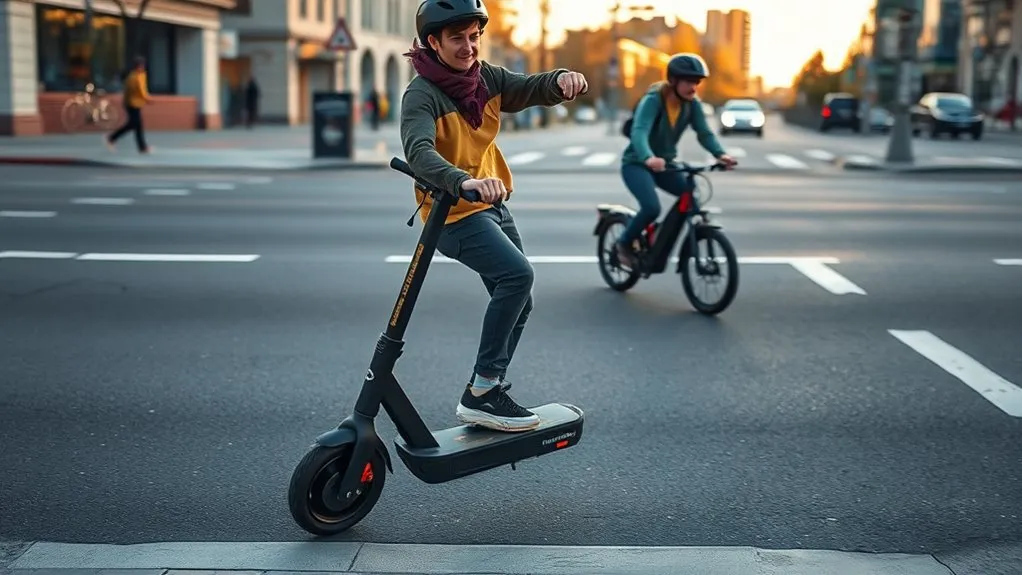
For many adults who can balance comfortably while standing, an electric scooter feels straightforward at low speed. The controls are usually simple, but the scooter can accelerate more quickly than expected, and stopping distance varies between models. Small wheels can also react sharply to potholes, curbs, gravel, sticks, and uneven pavement.
The goal is not to learn within a certain number of minutes. The goal is to control the scooter without panic or hesitation. Before riding near traffic, you should be able to:
- Start without a sudden surge.
- Ride in a straight line while looking ahead.
- Make wide left and right turns.
- Slow down without wobbling.
- Stop at a chosen point.
- Dismount without dropping or twisting the scooter.
- React calmly when you see a bump, pedestrian, vehicle, or other hazard.
The difficult part is not standing on the scooter. It is controlling speed and stopping predictably when the surface or traffic changes.
What Makes an Electric Scooter Easier or Harder to Ride?
Your previous experience matters. Someone who regularly rides a bicycle, skateboard, or kick scooter may adjust faster than someone who has not practiced balance-based activities. However, experience on another vehicle does not replace learning the electric scooter’s controls.
The scooter itself also changes the learning experience:
- Riding mode: A low-speed or beginner mode makes smooth practice easier than the highest performance setting.
- Throttle response: Some throttles add power gradually, while others feel more sensitive.
- Brakes: Mechanical, electronic, regenerative, foot, and combined braking systems do not all respond the same way.
- Tires: Larger pneumatic tires generally absorb rough surfaces better than small solid tires, but every tire type has limits.
- Deck size: A deck with enough room for a stable staggered stance can feel easier to control.
- Scooter weight: A heavy scooter may feel steady while moving but can be harder to push, turn at walking speed, carry, or catch if it tips.
- Handlebar position: Handlebars that are too low, high, narrow, loose, or misaligned can reduce control.
- Terrain: Flat, dry pavement is much easier than hills, wet roads, loose gravel, broken pavement, or crowded paths.
Balance, vision, reaction time, joint mobility, grip strength, and the ability to turn your head while maintaining a straight path also affect suitability. Do not ride if a physical or sensory limitation prevents you from controlling the scooter or monitoring the area around you.
How to Balance on an Electric Scooter
Place one foot toward the front of the deck and the other behind it. Use whichever foot arrangement feels stable and natural. Your feet should form a staggered stance rather than sitting side by side. Once you choose a position, keep it consistent during your first practice sessions instead of switching feet while moving.
Stand upright without locking your knees. Keep them slightly bent so your legs can absorb vibration and small surface changes. Hold both handlebars securely, but avoid stiffening your shoulders or pulling backward on the stem.
Look ahead toward the path you want to follow. Looking down at the front wheel makes it harder to notice pedestrians, vehicles, holes, and other hazards. Use small steering inputs and gentle weight shifts. Sudden handlebar movements can make the front wheel change direction faster than you expect.
Pro Tip: Practice standing on the powered-off scooter while a brake is engaged. Find a comfortable foot position and learn where the throttle, brake, bell, lights, and riding-mode controls are before you move.
Your First Electric Scooter Ride, Step by Step
- Read the owner’s manual. Confirm how the scooter starts, how each brake works, whether it requires a push before the motor engages, and how to select its lowest-speed mode.
- Check the rider limits. Confirm the manufacturer’s minimum age, maximum load, recommended height range, and any restrictions for hills, water, or surface conditions.
- Wear safety gear. Use a properly fitted bicycle helmet and closed-toe shoes. Knee and elbow pads can add protection during beginner practice.
- Choose a practice area. Find a flat, dry, open area away from moving vehicles, pedestrians, curbs, drains, sand, gravel, and potholes. Obtain permission before practicing on private property.
- Select the lowest riding mode. Avoid sport, turbo, or maximum-speed modes during your first sessions.
- Place one foot on the deck. Keep your hands on both grips, look ahead, and push gently with the other foot.
- Add throttle gradually. Apply only enough power to maintain slow forward motion. Do not press the throttle fully to test acceleration.
- Practice straight lines. Keep your shoulders relaxed, knees slightly bent, and eyes forward.
- Practice normal stops. Release the throttle first, then apply the scooter’s brake or brakes progressively according to the manual. Move your weight slightly backward without pulling hard on the handlebars.
- Practice wide turns. Slow before the turn, look through it, steer smoothly, and avoid sharp leaning.
- Practice a firmer controlled stop. At low speed, increase brake pressure smoothly so you learn how the scooter responds without locking a wheel or pitching your body forward.
- Dismount safely. Stop completely before stepping off. Do not jump from a moving scooter unless avoiding a more serious immediate hazard.
Repeat the sequence until you can perform each action without looking down at the controls. Do not move into traffic simply because you can travel in a straight line.
Electric Scooter Safety Gear and Pre-Ride Checks
The U.S. Consumer Product Safety Commission recommends wearing a bicycle helmet, following local traffic laws, checking the scooter for damage, and reviewing the manufacturer’s age and weight limits before riding. Its guidance also warns that small scooter tires can stop suddenly when they hit objects or uneven surfaces. See the CPSC Micromobility Information Center for current safety information.
In the United States, check inside the helmet for a label stating that it complies with the federal bicycle-helmet standard. The helmet should sit level, fit snugly, and remain secure when the chin strap is fastened. Replace a helmet after a significant impact according to the manufacturer’s instructions. The CPSC bicycle helmet guidance explains the required labeling and fitting instructions.
| Check | What to Verify | Do Not Ride If |
|---|---|---|
| Helmet | Snug fit, level position, secure strap, no crash damage | It is cracked, damaged, loose, or cannot be fastened correctly |
| Handlebars and stem | Straight alignment with no looseness, cracks, or unusual movement | The stem twists, rocks, cracks, or does not remain locked |
| Folding mechanism | Latch fully closes and any safety catch engages | The latch is loose, damaged, partly open, or difficult to secure |
| Brakes | Firm, predictable response and normal lever or pedal travel | Braking is weak, delayed, uneven, stuck, or accompanied by damaged parts |
| Throttle | Moves freely and returns immediately when released | It sticks, binds, feels damaged, or powers the scooter unexpectedly |
| Tires and wheels | Correct pressure where applicable, usable tread, no cuts, damage, or loose wheel | A tire is flat, badly worn, damaged, or a wheel feels loose |
| Lights, reflectors, and bell | All required visibility and warning devices work | Conditions require them and they do not work |
| Frame, deck, and cables | No cracks, bent parts, exposed wires, missing fasteners, or slippery contamination | Any structural or electrical damage is visible |
| Battery | Enough charge for the planned route and no swelling, leakage, unusual heat, odor, or damage | The battery or charging port shows damage or abnormal behavior |
| Rider and cargo load | Combined rider, clothing, bag, lock, and cargo weight stays within the manufacturer’s limit | The total load exceeds the published rating |
Warning: Use only the charger supplied with the scooter or a replacement specifically approved by its manufacturer. Do not use a universal charger merely because the plug fits. Charge while you are present, follow the manual, and unplug the scooter when charging is complete. Do not charge a damaged, swollen, leaking, unusually hot, or recalled battery.
Plan your route within the scooter’s available charge instead of relying on an unapproved portable charger. The CPSC has warned that incompatible universal micromobility chargers can create a fire hazard. See its universal charger safety warning.
How to Brake, Turn, and Handle Bumps
Braking
Learn which controls operate the scooter’s mechanical and electronic brakes. Follow the owner’s manual because the correct technique varies by model. In general, release the throttle before braking, apply pressure progressively, and move your weight slightly backward while keeping your knees bent.
Do not rely only on regenerative or electronic braking unless the manufacturer identifies it as the scooter’s complete service-brake system. Test stopping distance at low speed because battery level, rider weight, tires, surface conditions, speed, slope, and brake design can change how quickly the scooter stops.
Turning
Reduce speed before entering a turn. Look toward the exit of the turn, use smooth handlebar input, and make only a small lean. Avoid braking hard while sharply turning because the tires have less grip available for each action.
Bumps and Uneven Pavement
Scan the surface far enough ahead to slow down before reaching a defect. Small scooter wheels can stop suddenly on potholes, raised edges, sticks, stones, drainage gaps, and broken pavement. Approach minor unavoidable bumps slowly, keep both hands on the handlebars, bend your knees, and move your weight slightly backward. Walk the scooter around any obstacle you are not confident crossing.
Hills
Avoid steep hills during beginner practice. Climbing can reduce speed and range, while descending increases stopping distance and brake demand. Never descend faster than the speed at which you can stop within the visible clear path ahead. Walk the scooter if a slope exceeds its manual’s limits or feels difficult to control.
Note: Traffic, helmet, sidewalk, bike-lane, lighting, speed, parking, licensing, and minimum-age rules differ by location. Check the rules for the city, state, province, or country where you will ride.
Common Electric Scooter Mistakes to Avoid
- Pressing the throttle too hard: Sudden acceleration can move your upper body backward and cause a wobble.
- Waiting too long to brake: Leave more space than you think you need, especially on a new scooter or downhill.
- Looking at the front wheel: Keep your eyes on the path so you can identify hazards early.
- Turning sharply at speed: Slow first, then steer smoothly.
- Riding one-handed: Keep both hands on the handlebars. Do not hold a phone, drink, shopping bag, or pet leash while moving.
- Hanging items from the handlebars: Bags can swing, affect steering, or contact a wheel.
- Carrying a passenger: Use one rider per scooter unless the manufacturer explicitly designed and approved the model for more.
- Using a phone or earbuds: Do not text while riding. Avoid anything that blocks traffic sounds or divides your attention.
- Riding after alcohol or drugs: Do not ride while impaired, including when a medicine affects alertness, balance, judgment, or reaction time.
- Ignoring tire pressure: Follow the manufacturer’s pressure range for pneumatic tires and inspect all tires for wear or damage.
- Exceeding the weight limit: Count the rider, clothing, backpack, lock, groceries, and other cargo as part of the total load.
- Riding too fast for visibility: Your speed should allow you to stop within the clear path you can see.
- Assuming drivers can see you: Scooters are small and quiet. Slow near driveways, parking areas, junctions, and vehicle blind spots.
- Ignoring recalls or damage: Stop using the scooter if the stem, folding latch, frame, battery, brake, wheel, or throttle is damaged.
What to Do If the Scooter Feels Unstable
If the Scooter Wobbles
Do not make a sharp steering correction. Ease off the throttle, look ahead, keep your knees bent, and slow down smoothly. Stop in a safe place and inspect the tire pressure, wheels, stem, folding latch, handlebar alignment, and load placement. Do not continue if any part is loose or damaged.
If the Brakes Feel Weak
Reduce speed and stop in a safe area without entering traffic or descending a hill. Check for an incorrectly adjusted brake, damaged cable, fluid leak where applicable, worn component, error message, or contaminated braking surface. Do not ride again until the braking system works as the manufacturer specifies.
If the Throttle Sticks or the Scooter Accelerates Unexpectedly
Release the throttle, apply the brakes progressively, keep both hands on the handlebars, and move toward a safe stopping area. Turn the scooter off after stopping if it is safe to do so. Do not ride it again until the cause has been professionally inspected or corrected according to the manufacturer’s instructions.
If the Battery Runs Low
Reduce unnecessary acceleration, avoid a route that leaves you stranded in traffic, and turn back before the battery reaches a critically low level. If power cuts out, coast and brake to a safe stopping place. Walk the scooter rather than using an unapproved charger or continuing into an unsafe area.
When You Should Not Ride an Electric Scooter
Postpone the ride when:
- The brakes, throttle, steering, folding latch, tires, wheels, frame, lights, or battery are damaged.
- The scooter is subject to an unresolved recall or manufacturer stop-use warning.
- The total rider and cargo load exceeds the manufacturer’s limit.
- You cannot wear a secure helmet or closed-toe shoes.
- You feel dizzy, unusually tired, unwell, impaired, or unable to react normally.
- The surface is icy, flooded, covered with loose gravel, deep sand, mud, wet leaves, or other low-grip material.
- Heavy rain, darkness, glare, fog, or poor lighting prevents you from seeing hazards and being seen.
- The route requires riding somewhere prohibited by local law.
- You have not yet learned how the scooter accelerates and stops.
Frequently Asked Questions
Are Electric Scooters Easy to Ride?
Many adults find the basic controls easy to understand, but safe riding still requires balance, throttle control, braking practice, hazard awareness, and knowledge of local rules. Start in a traffic-free area and remain at low speed until you can start, turn, and stop consistently.
How Long Does It Take to Learn to Ride an Electric Scooter?
There is no reliable universal learning time. Some riders understand the controls during one short practice session, while others need several sessions. Continue practicing until you can look ahead, hold a straight line, turn both ways, stop at a chosen point, and respond calmly to obstacles.
Which Foot Should Be Forward on an Electric Scooter?
Use whichever foot-forward position gives you the most stable staggered stance. There is no universal rule requiring the dominant or non-dominant foot to lead. Choose one position during beginner practice and avoid switching feet while the scooter is moving.
Are Scooters Good for Autistic Kids?
Autism alone does not determine whether a scooter is suitable. A non-motorized kick scooter and an electric scooter also involve very different speeds and risks. Consider the child’s balance, coordination, judgment, impulse control, sensory response, ability to follow safety rules, and the product’s age limit. The American Academy of Pediatrics advises that children under 16 should not operate or ride motorized or electric scooters. Ask the child’s pediatrician or occupational therapist for individualized guidance when developmental, sensory, or motor concerns may affect safe use. See the American Academy of Pediatrics e-scooter guidance.
What Is the Main Problem With Electric Scooters?
There is no single problem. Important risks include rider-control errors, collisions with motor vehicles, poor visibility, small wheels reacting to surface defects, brake or structural faults, incompatible chargers, and damaged lithium-ion batteries. Careful riding and maintenance reduce risk but cannot remove it completely.
Can a 300 Lb Person Ride an Electric Scooter?
Yes, but only when the manufacturer gives that exact scooter a maximum load rating of at least 300 pounds, or about 136 kilograms. Include clothing, bags, locks, and other cargo in the total. Do not assume that a powerful motor or thick frame makes an unrated scooter safe. A heavier load may also reduce acceleration, hill performance, range, and braking margin.
Can You Ride an Electric Scooter in the Rain?
Check the scooter manual and its water-resistance restrictions. Water resistance does not mean waterproof. Wet pavement reduces tire grip and can increase stopping distance, while standing water may hide potholes or damage electrical parts. Beginners should postpone the ride when the surface is wet or visibility is poor.
How Do You Stop an Electric Scooter Safely?
Release the throttle, keep both hands on the handlebars, apply the model’s brake system progressively, bend your knees, and move your weight slightly backward. Avoid grabbing the brake abruptly. Practice at low speed because brake design and stopping distance differ between scooters.
Conclusion
So, how hard is it to ride an electric scooter? For many adults, the basic movement is not difficult, but safe control takes deliberate practice. Start on flat, dry pavement, use the lowest riding mode, wear a properly fitted helmet, and learn the scooter’s throttle and brakes before entering traffic.
Do not judge readiness by time alone. You are better prepared when you can start smoothly, maintain a stable stance, scan the road, turn both ways, stop at a chosen point, and respond calmly to changing conditions. Check the scooter before every ride and stop using it when a safety-critical part is damaged.
Sources
- U.S. Consumer Product Safety Commission: Micromobility Information Center — helmet, inspection, visibility, obstacle, one-rider, manufacturer-limit, and charging guidance.
- U.S. Consumer Product Safety Commission: Bicycle Helmets FAQ — federal helmet requirements, labels, fitting instructions, and replacement warnings.
- CPSC Universal Micromobility Charger Warning — risks of incompatible chargers and guidance on approved replacements.
- American Academy of Pediatrics: Why Children Should Not Ride E-Scooters — child age, helmet, supervision, distraction, passenger, and traffic-safety guidance.
- Centers for Disease Control and Prevention: Dockless Electric Scooter Injury Study — injury-prevention research and helmet-use findings.