
Last Updated on September 27, 2026 by Caleb Warren
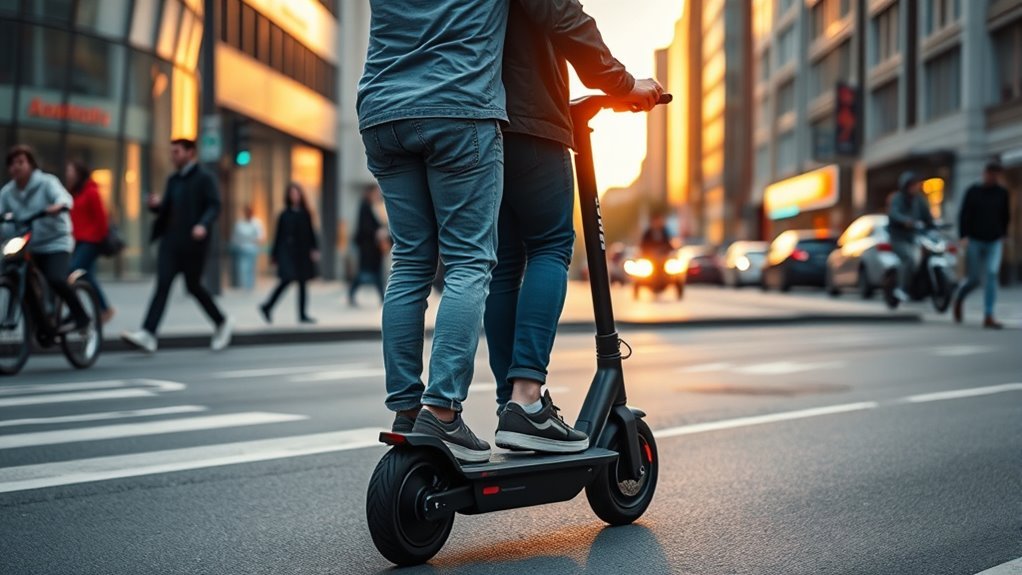
Can two people ride an electric scooter safely? Most standing electric scooters are designed for one person, and carrying a passenger can make the scooter harder to control. Even when two riders fit within the advertised weight limit, the scooter may not be designed or legally approved for passenger use.
Quick Answer
No, two people should not ride a standard electric kick scooter together. Most models are designed for one rider, and extra passengers can affect braking, balance, and steering. Many jurisdictions also prohibit carrying passengers. For shared trips, use separate scooters or a properly equipped two-person vehicle that is legal where you ride.
Last checked: September 28, 2026. Legal requirements and manufacturer specifications were verified against official sources.
Disclosure: As an Amazon Associate I earn from qualifying purchases. Some links on this page are affiliate links, at no extra cost to you.
Can Two People Ride an Electric Scooter?
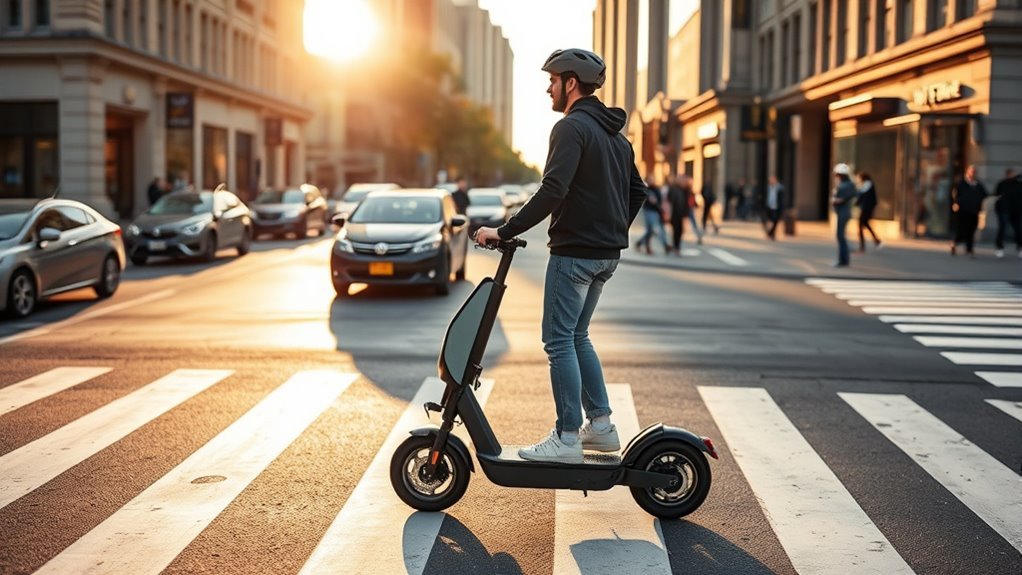
Standard electric kick scooters are intended for one rider. Their decks, steering systems, brakes, and weight ratings are generally designed around that arrangement.
For example, the Segway Ninebot MAX G30P owner’s manual specifies a maximum payload of 220.5 pounds (100 kg) and explicitly prohibits passengers, including children.
That restriction applies even when the combined weight of two people falls below the maximum payload.
There are three separate questions to answer before carrying anyone:
- Capacity: Can the scooter safely support the combined load?
- Design: Is the scooter explicitly manufactured and equipped for two occupants?
- Legality: Does the applicable law permit a passenger on that vehicle?
Meeting one requirement does not automatically satisfy the others. A higher weight rating, wider deck, or powerful motor does not turn a single-rider scooter into a two-person vehicle.
Why Riding Double on an Electric Scooter Is Unsafe
Riding double changes how an electric scooter carries weight and responds to movement. The second rider also occupies space the operator needs for standing, steering, and adjusting balance.
The main risks involve the following components:
- Frame and deck: Additional weight places more stress on structural components and mounting points.
- Stem and handlebars: Passenger movement can make steering corrections harder.
- Motor: A heavier load can reduce acceleration and make climbing hills more demanding.
- Brakes: The braking system must manage more moving mass and energy.
- Tires and suspension: Excessive loading can affect tire behavior, suspension movement, and handling.
These problems become more serious on uneven pavement, steep slopes, wet roads, and during sudden turns.
Warning: Never carry another person on a scooter designed for one rider, even for a short trip. Standing behind the operator, sharing the deck, or holding the handlebars together does not make passenger riding safe.
How Two Riders Increase Stopping Distance
Adding a second rider increases the scooter’s total moving mass. At the same speed, the brakes must absorb more kinetic energy to bring the scooter to a stop.
This can make stopping more difficult, particularly when the added load exceeds the scooter’s design limits. The exact change in stopping distance depends on brake performance, tire grip, speed, road conditions, and weight distribution.
There is no reliable universal percentage that applies to every electric scooter.
| Condition | Effect | Result |
|---|---|---|
| Single rider | Load within intended design | More predictable braking response |
| Two riders | Greater moving mass | More energy for the brakes to absorb |
| Sudden braking | Passenger weight shifts | Greater difficulty maintaining balance |
Braking performance also depends on traction. If a wheel loses grip, squeezing the brake harder may not stop the scooter more effectively.
A passenger can make the situation worse by moving unexpectedly or leaning against the operator during deceleration.
Do not assume that a scooter with powerful brakes can safely carry two people. Its braking system must be appropriate for the manufacturer’s approved passenger load.
What Electric Scooter Weight Limits Mean
An electric scooter’s weight limit describes the maximum permitted payload. It does not tell you how many people the vehicle is designed to carry.
Many commuter scooters have published limits around 220 to 265 pounds, although capacities vary by model. Some specialized models allow greater loads.
For comparison, NIU’s official rider requirements specify a maximum of 120 kg for the kick scooter covered by that guidance.
Always use the rating for your exact model rather than a general figure from another scooter.
How to Calculate Your Total Scooter Load
Your total load includes your body weight, clothing, backpack, and anything else you carry.
- Find the maximum payload in the manufacturer’s manual or specifications.
- Add your weight and the weight of your belongings.
- Compare that total with the published maximum.
For example, a rider weighing 180 pounds with a 15-pound backpack carries a total load of 195 pounds. That is below a 220-pound payload limit.
However, adding a 100-pound passenger would increase the combined load to 295 pounds, exceeding that example limit.
Even when two lighter people remain below the published capacity, passenger riding may still be prohibited.
Excessive weight can also reduce range, acceleration, climbing performance, and control. Do not treat the published maximum as permission to carry a second person.
Where Is Riding Double on Electric Scooters Illegal?
Several jurisdictions explicitly prohibit passengers on electric kick scooters. Rules vary by vehicle classification, location, and whether the scooter is privately owned or rented.
The following examples reflect official guidance and legislation available in September 2026.
| Location | Passenger rule | Important detail |
|---|---|---|
| California | Passengers prohibited | Vehicle Code 21235(e) prohibits operating a motorized scooter with passengers. |
| New York | One person maximum | Vehicle and Traffic Law 1282 prohibits carrying more than one person. |
| Illinois | One person maximum | 625 ILCS 5/11-1518(i) prohibits carrying more than one person on a low-speed electric scooter. |
| United Kingdom | One rider per rental scooter | Government trial guidance also states that privately owned e-scooters cannot be used on public land. |
| Germany | Passenger transport prohibited | Section 8 of the eKFV prohibits passenger transport on covered electric small vehicles. |
| Pennsylvania | Public-use restrictions | PennDOT’s micromobility guidance explains the classification and public-use limitations of electric scooters. |
| Texas | Depends on vehicle classification and applicable rules | Do not assume passenger riding is permitted simply because a particular rule does not mention it. |
These examples are not a complete list of every local restriction. Cities may impose additional requirements, and rental operators can prohibit behavior even where a particular law does not address it directly.
Violations may result in citations, fines, or other consequences. Insurance coverage and liability depend on the circumstances and applicable policy terms, so do not assume every passenger-related incident automatically voids coverage.
Why Two Riders Increase Injury Risk?
Two riders have less room to react independently when something goes wrong. Both can fall if the scooter tips, brakes abruptly, or strikes an obstacle.
The risks are especially concerning because a standing scooter offers little protection during a crash.
Loss Of Balance
A passenger changes the scooter’s weight distribution and restricts the operator’s standing position. That makes balance corrections harder, especially during turns or when crossing uneven pavement.
A second person may also lean unexpectedly, forcing the operator to compensate while steering.
Keeping both people centered, avoiding sudden movement, and staying below the weight limit may reduce some instability. However, these actions do not make an ordinary single-rider scooter suitable for passengers.
Harder Emergency Stops
During hard braking, both riders continue moving forward until the scooter slows them down. A passenger may collide with the operator or cause an unexpected shift in weight.
That movement can make it harder to maintain control and increase the chance of falling over the handlebars.
The added braking demand may also increase heat and mechanical stress. These risks become more concerning when the scooter is overloaded, poorly maintained, or traveling downhill.
For emergency preparedness, keep the scooter within its intended operating conditions and leave enough distance to stop safely.
Are There Electric Scooters Made for Two?
Yes, some electric vehicles sold as scooters are designed to carry two people. However, they are often seated electric mopeds or motorcycle-style vehicles rather than ordinary standing kick scooters.
A genuine two-person design should have the following features:
- A manufacturer-approved capacity for two occupants.
- A suitable passenger seat or designated riding position.
- Passenger footrests and appropriate handholds where required.
- A frame, braking system, tires, and suspension rated for the combined load.
- A vehicle classification that allows passenger transport under local law.
Do not assume that a reinforced frame, extended deck, powerful motor, or advertised high payload makes a standing scooter suitable for tandem riding.
Some vehicles are sold as dual-motor scooters. That term normally describes a scooter with two drive motors, not a scooter approved for two people.
Likewise, attaching a second seat or extending the deck does not establish that a modified vehicle can legally carry passengers.
Choose equipment explicitly designed for the intended occupants and verify its permitted use before purchasing it.
How Passenger Weight Affects Control and Balance
Passenger weight changes the scooter’s center of gravity, which is the point around which its mass is balanced. The location of that weight matters as much as the total amount.
Two people cannot move as independently on a small deck as one rider can.
Center Of Gravity Shift
If a passenger stands behind the operator, more weight may move toward the rear wheel. If the passenger stands in front, they may interfere with steering and the operator’s position.
Either arrangement can change how the scooter responds during acceleration, braking, and cornering.
Limited deck space also makes it harder to place both feet securely. This reduces the room available for correcting balance after hitting a bump or changing direction.
Turning Stability Issues
Turning becomes less predictable when two people move differently. The operator may lean into a corner while the passenger remains upright or shifts in another direction.
These conflicting movements can require sudden steering corrections.
Sharp turns, loose gravel, wet pavement, and potholes further reduce the available margin for error.
Conservative turning and lower speeds reduce some hazards, but they do not remove the risks of carrying an unauthorized passenger.
Braking Distance Increases
Passenger weight can increase the demands placed on a scooter’s brakes. However, the actual stopping distance cannot be predicted from rider weight alone.
Tire grip, road surface, brake condition, speed, and weight distribution all affect the result.
Three situations deserve particular attention:
- Wet pavement: Reduced grip makes wheel slip more likely during braking.
- Downhill travel: Gravity adds to the effort needed to control speed.
- Sudden obstacles: Limited stopping room leaves less opportunity to correct a loss of balance.
These conditions are already demanding for a solo rider. Adding a passenger creates another source of instability.
Safer Alternatives to Riding Double
You can travel together without sharing a single electric kick scooter. The appropriate choice depends on your route, the riders’ abilities, and local transportation rules.
- Two individual scooters: Each person has their own platform, brakes, and steering controls.
- A passenger-rated electric bike: Choose one explicitly designed to carry an additional person, with suitable passenger equipment.
- A two-person electric moped: Use a model legally approved for passenger transport.
- Public transportation: Buses and trains can accommodate people traveling together without sharing a small scooter deck.
- Ride-sharing: A car-based service can be more suitable when one person cannot independently operate a scooter.
Rental scooter services may also allow you to arrange separate vehicles for a shared trip.
For example, Lime’s US scooter rules prohibit carrying a passenger, child, or animal on the same vehicle.
Its Group Ride feature, where available, is intended to arrange separate vehicles rather than allow two people to share one.
How to Ride Together Safely Without Sharing One Scooter
Using two separate scooters allows each rider to control their own speed, balance, and braking. It also keeps each scooter within its intended single-rider arrangement.
Before riding together, follow these steps:
- Choose a legal route suitable for both riders.
- Wear properly fitted helmets and appropriate protective gear.
- Check each scooter’s brakes, tires, lights, and battery condition.
- Agree on a comfortable pace and clear communication signals.
- Practice starting, stopping, and turning in a quiet, suitable area.
- Maintain enough following distance to stop without hitting the other rider.
Do not treat a fixed gap of 3–4 feet as universally safe. Your required stopping space changes with speed, road conditions, visibility, and traffic.
Riding in single file is often more appropriate on narrow routes. Travel side by side only where the available space and local rules permit it.
Keep both hands available for steering and avoid sudden changes in direction.
Note: If a child has balance, coordination, or sensory needs, consult their pediatrician or occupational therapist about suitable activities and equipment. Do not use an adult electric scooter to transport a child as a passenger.
Frequently Asked Questions
Can Two People Ride One E-Scooter?
No, two people should not ride a standard electric kick scooter together. Most models are intended for one person, and adding a passenger can affect braking, steering, and balance. Use separate scooters or a properly equipped vehicle that is approved for two occupants.
Is It Legal to Have Two People on an E-Scooter?
Passenger riding is prohibited on standard electric scooters in several jurisdictions, including California, New York, and Illinois. Other locations have different vehicle classifications and restrictions. A scooter designed for two occupants is not automatically legal for public-road use, so the applicable vehicle rules still matter.
Are Scooters Good for Autistic Kids?
A suitable non-motorized scooter may offer enjoyable movement and opportunities to practice balance and coordination. Choose equipment based on the child’s individual abilities, comfort, and supervision needs. Electric scooters have additional safety risks and age restrictions, and children should never ride as passengers on a single-rider model.
Can Two People Use an Electric Scooter?
Two people can use separate electric scooters, but they should not share a standard single-rider model. If you need one vehicle for both people, choose a passenger-rated electric bike or moped. Confirm its combined weight capacity, passenger equipment, and legal classification before riding.
Conclusion
Most electric kick scooters are designed for one person, and carrying a passenger can compromise balance, braking, and steering. It may also violate local laws or rental agreements.
Check your scooter’s approved rider capacity and weight limit before using it. For shared travel, choose two separate scooters or a legally approved passenger vehicle instead.
Sources
- Segway Ninebot MAX G30P User Manual: Single-rider restrictions, maximum payload, and safety guidance.
- NIU Rider Requirements: Manufacturer-stated weight capacity and rider requirements.
- California Vehicle Code Section 21235: California’s motorized scooter passenger restrictions.
- New York Vehicle and Traffic Law Section 1282: Electric scooter passenger and operating restrictions.
- Illinois Vehicle Code Section 11-1518: Rules governing low-speed electric scooters.
- UK Department for Transport: Using a Rental E-Scooter: Rental scooter passenger restrictions and private scooter rules.
- Germany: eKFV Section 8: Passenger transport restrictions for covered electric small vehicles.
- Pennsylvania Department of Transportation: Micromobility Information Sheet: Vehicle classification and public-use guidance.
- Lime Scooter Rules: Single-rider policy and rental requirements.
- American Academy of Pediatrics: Why Children Should Not Ride E-Scooters: Child safety, age-related guidance, and injury prevention.

