
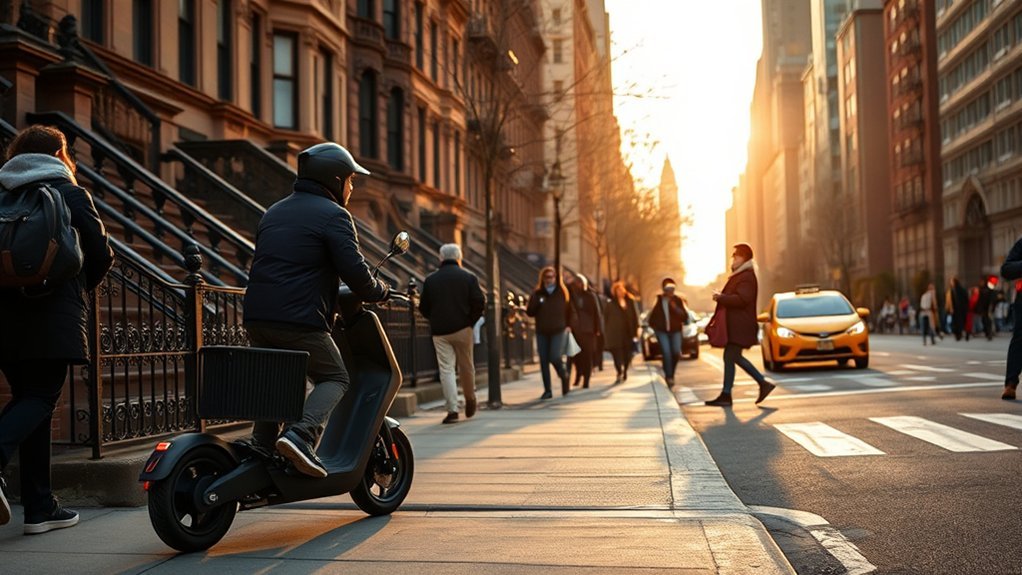
Last Updated on September 10, 2026 by Daniel Globe
No—you can’t ride an electric scooter on a sidewalk in New York City. Under NYC Administrative Code §19-176.2(b), sidewalks are reserved for pedestrians, and riding one there can bring a fine, with the scooter subject to confiscation for repeat or serious violations. You’re expected to use bike lanes or streets with posted speed limits of 30 mph or less instead. If you ride, you also need to follow traffic signals, meet the age requirement, and carry the right safety gear — all covered below.
Quick Answer
No. NYC Administrative Code §19-176.2(b) bans riding electric scooters on sidewalks. Riders must use bike lanes or streets posted at 30 mph or less, stay under the 15 mph legal speed limit, and be at least 16 years old. Sidewalk-riding fines typically run $25–$250.
Disclosure: As an Amazon Associate I earn from qualifying purchases. Some links on this page are affiliate links, at no extra cost to you.
Can You Ride an Electric Scooter on the Sidewalk in NYC?
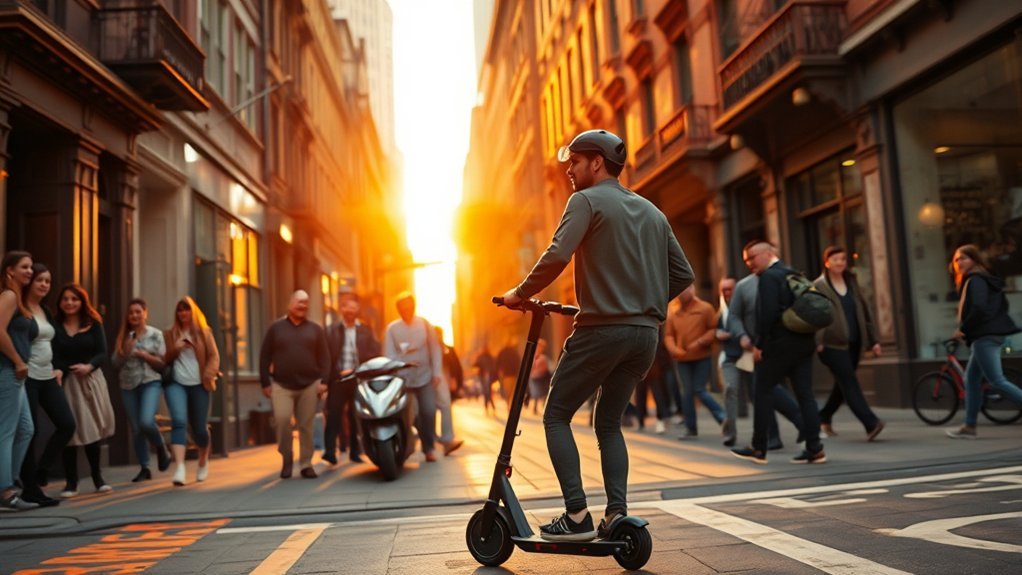
No—riding an electric scooter on a sidewalk in NYC breaks the law. NYC Administrative Code §19-176.2(b) bars sidewalk operation unless a specific local ordinance says otherwise, and city law requires you to keep your scooter in a bike lane or on a street posted at 30 mph or less. The rule exists because sidewalks are built for people walking, not for motorized traffic. Research backs this up: an Insurance Institute for Highway Safety (IIHS) study of injured riders in Washington, D.C. found nearly 3 in 5 were hurt while riding on a sidewalk. You must also be at least 16 and follow the same traffic rules that apply to cyclists. Ignore the sidewalk ban and you risk a fine, and in serious or repeated cases, police can confiscate the scooter.
NYC’s Sidewalk Rules for E-Scooters
NYC’s sidewalk rules are strict: you cannot ride on a sidewalk unless a local ordinance specifically allows it. Under NYC Administrative Code §19-176.2(b), sidewalk-riding citations generally run $25 to $250, depending on whether it’s a first offense or a repeat violation — separately, New York’s civil-fine schedule for most e-scooter infractions (speeding, sidewalk riding, age violations, equipment issues) caps out at $50 per violation, with courts sometimes waiving helmet fines if the rider buys one before their court date. These aren’t arbitrary numbers; they’re built to protect pedestrian safety in a dense city. Treat the sidewalk as off-limits and assume enforcement is real, especially in crowded areas.
Note: You can still park a personal e-scooter on the sidewalk, as long as it doesn’t block pedestrian access, building entrances, or accessibility ramps. The ban is on riding, not parking.
Where You Can Legally Ride in NYC
You can legally ride electric scooters in NYC on streets posted at 30 mph or less and in designated bike lanes. Under New York State Vehicle and Traffic Law §114-e, an electric scooter is defined as a device with handlebars and a floorboard or seat that tops out at 20 mph on motor power alone — but the legal operating limit in NYC is 15 mph, regardless of what the scooter is capable of. Use protected or marked bike lanes when they exist, and don’t ride on sidewalks unless a local ordinance explicitly allows it. E-scooters are also barred from highways, expressways, tunnels, and major bridge pedestrian paths, and some greenways (including sections of the Hudson River Greenway) restrict motorized use under separate state trust regulations, so check posted signage. When parking, keep sidewalks, entrances, and ramps clear.
Who Can Ride an E-Scooter in New York?
You can ride an e-scooter in New York only if you’re at least 16. If you’re 16 or 17, a helmet is mandatory; if you’re 18 or older, it’s strongly recommended but not required. You still need to follow local traffic laws the same way a cyclist does. New York City doesn’t require registration or insurance for personal e-scooters, but local rules still control where and how you ride.
Minimum Age Rules
Riders must be at least 16 years old to operate an electric scooter in New York City; anyone younger is prohibited from riding. If a rider under 16 is stopped and a parent or guardian is present, the summons is directed to the adult. Verify age before you ride — enforcement can hinge on it.
| Rule | Requirement |
|---|---|
| Minimum age | 16 |
| Under 16 | Prohibited |
| 16–17 | Helmet required |
| 18+ | Helmet recommended |
| Road use | Bike lanes or street ≤30 mph |
You’re subject to bicycle-style regulations, so ride in a designated bike lane or on the road, not the sidewalk.
Helmet Requirements
Helmet rules depend on age: riders 16 or 17 must wear one, while it’s recommended (not required) for riders 18 and older. Head injuries make up a large share of e-scooter emergency-room visits, and a systematic review of e-scooter injury studies found only about 4.4% of injured riders nationally were wearing a helmet at the time. Since you don’t need registration or insurance to ride, a helmet is one of the few protections you actually control.
Local Law Differences
New York State sets the baseline, but NYC adds its own practical limits on who can ride and where. Local rules ban sidewalk riding, require bike lanes or streets, and set a minimum riding age of 16, with helmets mandatory at 16–17. Other cities set different rules, so check before you ride elsewhere.
- 16+ only
- No sidewalks
- Bike lanes or streets ≤30 mph
- Helmet required at 16–17
- Sidewalk-riding fines: roughly $25–$250
E-Bikes vs. E-Scooters, and Rental Scooters
NYC treats e-scooters, e-bikes, and mopeds differently, and mixing them up is a common source of confusion — and of illegal, high-speed devices ending up on the street. An e-scooter has handlebars and a floorboard or seat you stand or sit on, capped at 15 mph in operation. E-bikes are pedal-equipped and fall into separate speed classes. Anything capable of significantly higher speeds is typically an unregistered moped or motorcycle, which cannot legally operate on NYC streets or sidewalks at all; the NYC Mayor’s Office has recently issued cease-and-desist orders to online retailers selling these illegal, high-speed motorized devices. Unlike some cities, New York City does not currently have a citywide dockless e-scooter share program — a company-run pilot has operated only in a designated zone of the East Bronx — so if you see a “shared” scooter elsewhere in the five boroughs, it isn’t part of an authorized program.
Pro Tip: New York State requires manufacturers to include an operating manual with battery-charging and storage instructions with every scooter sold. Buy a scooter with UL 2272 certification — the recognized safety standard for e-mobility device batteries and electrical systems — and use only the charger made for that specific device to reduce fire risk.
What Happens If You Ride on the Sidewalk?
Riding an electric scooter on a sidewalk in NYC is a local ordinance violation, and citations generally run $25 to $250 depending on whether it’s a first offense or a repeat one. In crowded districts, officers do enforce the rule, and you may get stopped on the spot; a first-time stop sometimes ends with a warning, but don’t count on it. Police can confiscate a scooter outright for serious or repeated violations. If you’re involved in an accident that causes injury or more than $1,000 in property damage, New York Vehicle and Traffic Law §605 requires you to report it to police within 10 days — that requirement isn’t optional and applies regardless of who’s at fault.
Why Sidewalk Riding Puts Everyone at Risk
Sidewalks are built for pedestrians, not motorized traffic, so e-scooter use there creates real safety risks. The IIHS study cited earlier found e-scooter riders were injured more often per mile traveled than bicyclists, frequently from potholes, cracks, and curbs rather than vehicle collisions — but riding on a sidewalk puts pedestrians in that same collision path. Narrow paths, signage, and uneven pavement force abrupt moves, and pedestrians can step into a rider’s path without warning.
Nearly 3 in 5 e-scooter riders injured in a 2020 IIHS study were hurt while riding on a sidewalk — more than in bike lanes, trails, and roadways combined.
- Sidewalk riding is a local ordinance violation
- Pedestrians don’t anticipate motorized traffic
- Uneven pavement and obstacles reduce control
- Tight space raises collision risk
- Enforcement can bring fines and, in serious cases, confiscation
E-Scooter Safety Gear and Traffic Rules
Wear a helmet if you’re 16 or 17, and consider one even if you’re older — visible, protective gear reduces injury risk. Your scooter should have working brakes, lights, reflectors, and an audible signal. You must obey traffic signals and stop signs, yield to pedestrians, and stay off sidewalks.
Helmet and Visibility
If you’re 16 or 17, a helmet is required; if you’re older, wearing one is still a good idea, especially in traffic or near busy corridors. Choose a helmet that fits snugly and meets a recognized safety standard.
- Wear bright or reflective clothing
- Add lights for dark streets
- Obey traffic signals
- Stop fully at stop signs
- Yield to pedestrians
Brakes, Lights, and Signals
NYC treats your e-scooter as a vehicle, not a toy, so working brakes, lights, reflectors, and an audible signal are all expected equipment. Check brake performance before you ride — weak stopping power increases both your own risk and your exposure to a citation if it leads to a collision. Keep lights bright and reflectors clean so drivers and pedestrians can see you, and use the audible signal to alert others without startling them.
Obey Traffic Signals
At intersections, your e-scooter has to behave like the vehicle it legally is: stop at red lights, honor stop signs, and follow the same rules bicycles do. Avoid sidewalk riding, where citations and, in repeat cases, scooter confiscation are possible.
- Stop fully at signals and signs
- Yield to pedestrians in shared spaces
- Keep brakes, lights, and reflectors working
- Wear a helmet if you’re 16 or 17
- Use extra caution at busy intersections
Warning: E-scooters are not permitted on highways, expressways, in tunnels, or on pedestrian paths of major bridges. Riding in these areas isn’t just a fine risk — it’s genuinely dangerous given the speeds of surrounding traffic.
Safer Alternatives to Sidewalk Riding
Keep your scooter off the sidewalk and in a designated bike lane or on a street posted at 30 mph or less. NYC law bars sidewalk riding, with citations of roughly $25–$250 for violations. Bike lanes also reduce injury exposure: in the IIHS study, only about 1 in 5 injured riders was hurt in a bike lane, trail, or other off-road location, compared with nearly 3 in 5 on sidewalks. You’ll generally get better sightlines, fewer obstacles, and more room to maneuver without forcing pedestrians to react to you. Yield in shared spaces and keep your speed measured.
Frequently Asked Questions
Can you ride an electric scooter on the sidewalk in New York?
No. NYC Administrative Code §19-176.2(b) requires you to use bike lanes or streets posted at 30 mph or less instead of the sidewalk, in order to protect pedestrians.
What happens if I get caught riding on the sidewalk?
You’ll likely face a citation of roughly $25–$250, with the amount depending on whether it’s a first offense or a repeat one. Officers may issue a warning on a first stop, but that isn’t guaranteed, and police can confiscate a scooter for serious or repeated violations.
Are e-scooters street-legal in NYC?
Yes, when ridden in bike lanes or on streets posted at 30 mph or less, kept under the 15 mph legal operating limit, and kept off sidewalks, highways, expressways, and tunnels.
Do I need a helmet to ride an electric scooter in NYC?
A helmet is required if you’re 16 or 17, and strongly recommended if you’re 18 or older. National data shows only about 4.4% of injured e-scooter riders were wearing one at the time of their accident, which is one reason the helmet recommendation for adults exists even though it isn’t mandatory.
Sources
- NYC DOT — Electric Bicycles & More — official speed limits, bike-lane rules, and sidewalk ban
- New York DMV — Electric Scooters and Bicycles — state definition of an electric scooter and the 15 mph legal operating limit
- IIHS — Most e-scooter rider injuries happen on sidewalk, study finds — sidewalk vs. bike-lane injury data
- ScienceDirect — E-scooter injury trends review — national helmet-use rate among injured riders
- NYC Mayor’s Office — Cease-and-Desist Orders on Illegal Motorized Devices (2026) — enforcement context on illegal high-speed devices
Conclusion
So, can you ride an electric scooter on the sidewalk in NYC? No—you can’t. The city treats sidewalks as pedestrian-only space, and riding there can lead to a citation and, in repeat cases, confiscation of your scooter. Stick to bike lanes and streets posted at 30 mph or less, stay under the 15 mph legal speed limit, and meet the age and helmet requirements. In NYC, the sidewalk isn’t a shortcut — it’s a boundary.
