
Last Updated on July 27, 2026 by Daniel Globe
Knowing a little trail-specific Spanish can make hiking in Spain, Mexico, Central America, South America, and other Spanish-speaking destinations much easier. You do not need to be fluent. A few words for trails, directions, weather, injuries, and help can make it easier to read signs, ask a local question, and explain what you need.
Quick Answer
“Hiking” in Spanish is usually senderismo. To say “to hike” or “to go hiking,” a natural phrase is hacer senderismo. You may also hear caminata, excursión, or even trekking, depending on the country and type of outing.
Key Takeaways
- Senderismo is the standard Spanish word for hiking, while hacer senderismo means to go hiking.
- Useful trail words include sendero (trail), mochila (backpack), botas de montaña (hiking boots), cima (summit), and refugio (mountain shelter).
- Learn questions such as ¿Dónde empieza el sendero? (Where does the trail start?) and ¿Cuánto falta para la cima? (How much farther to the summit?).
- For emergencies, know Necesito ayuda (I need help), Estoy perdido/a (I am lost), and No puedo caminar (I cannot walk).
- Language helps, but it does not replace checking trail conditions, carrying navigation and emergency gear, and knowing the official emergency number for your destination.
How to Say “Hiking” in Spanish
The best general translation of hiking is senderismo. The Real Academia Española defines it as an activity that involves walking through the countryside along a set route.
For an action, use hacer senderismo. For example:
| English | Spanish |
| Hiking | Senderismo |
| To go hiking | Hacer senderismo |
| I like hiking. | Me gusta el senderismo. |
| We are going hiking tomorrow. | Mañana vamos a hacer senderismo. |
| Hiking trail | Sendero / ruta de senderismo |
| Hiker | Senderista |
The term is not limited to Spain. Spain’s official tourism portal uses senderismo extensively, and Argentina’s National Parks administration officially refers to “senderismo y trekking”. Regional vocabulary still varies, so you may hear other expressions during your travels.
Senderismo vs. Caminata, Excursión, and Trekking
These terms overlap, but they do not always mean exactly the same thing:
- Senderismo: the clearest general term for recreational hiking on trails or routes.
- Caminata: a walk or longer walk. The RAE definition is broader than hiking, so context matters.
- Excursión / excursionismo: an outing or the activity of taking excursions. Excursionismo can include hiking but is less specific.
- Trekking: an English loanword commonly seen in outdoor tourism in some Spanish-speaking regions, especially for mountain or longer routes. Usage varies.
Note: When you simply need a neutral expression that will be widely understood, use senderismo for the activity and hacer senderismo for the action.
How to Pronounce Senderismo
A simple English-friendly approximation is sen-deh-REES-mo. Put the stress on REES. The single Spanish r is a quick tap rather than a long English-style “r.”
Basic Spanish Vocabulary for Hiking
Learning a compact group of trail words makes signs, maps, ranger instructions, and conversations much easier to follow. Start with the words you are most likely to need during an actual hike.
| Spanish | English | Useful Context |
| senderismo | hiking | The activity |
| senderista | hiker | A person hiking |
| sendero | trail/path | A marked or unmarked path |
| camino | path/road/way | Broader than sendero |
| ruta | route | The planned course |
| inicio del sendero | trailhead/start of the trail | Useful when asking where a hike begins |
| montaña | mountain | Terrain |
| bosque | forest | Terrain |
| cima / cumbre | summit/peak | Destination |
| mirador | viewpoint/overlook | Scenic viewpoint |
| refugio | mountain hut/shelter | Mountain routes |
| señal | sign/marker | Navigation |
| desvío | detour/turnoff | Navigation |
| mapa | map | Navigation |
| mochila | backpack | Equipment |
| botas de montaña / botas de senderismo | hiking boots | Footwear |
| bastones de senderismo | hiking poles | Equipment |
| agua | water | Essential supply |
| comida | food | Essential supply |
Terrain and Weather Words
- rocoso/a — rocky
- empinado/a — steep
- resbaladizo/a — slippery
- barro — mud
- subida — ascent/uphill section
- bajada — descent/downhill section
- río — river
- arroyo — stream
- lluvia — rain
- tormenta — storm
- niebla — fog
- calor — heat
- frío — cold
Essential Phrases for Hiking in Spanish
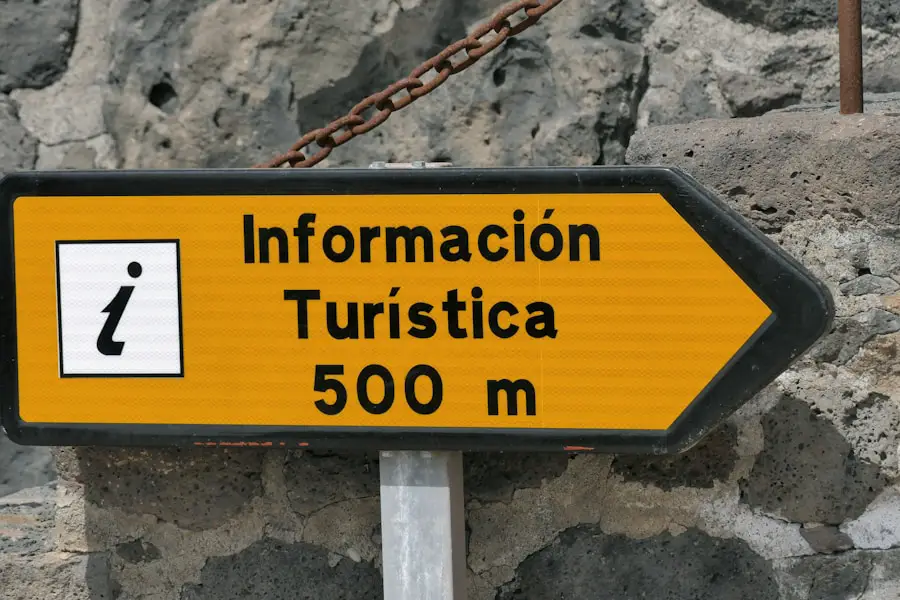
A vocabulary list helps, but complete phrases are much more useful when you need information quickly. These cover common situations at a trailhead, visitor center, refuge, or junction.
| Spanish Phrase | English |
| ¿Dónde está el sendero? | Where is the trail? |
| ¿Dónde empieza el sendero? | Where does the trail start? |
| ¿Está abierto el sendero? | Is the trail open? |
| ¿Qué dificultad tiene? | How difficult is it? |
| ¿Cuánto tiempo se tarda? | How long does it take? |
| ¿Cuánto falta para la cima? | How much farther is it to the summit? |
| ¿Hay un mapa de la zona? | Is there a map of the area? |
| ¿Hay agua potable? | Is there drinking water? |
| ¿Hay cobertura aquí? | Is there cell service here? |
| ¿Puede ayudarme? | Can you help me? |
| Necesito agua. | I need water. |
| Gracias por su ayuda. | Thank you for your help. |
| Fue un placer conocerlo / conocerla. | It was a pleasure to meet you. |
Pro Tip: Save a short phrase list and your route information on your phone for offline access. Mountain and rural trails may have weak or no mobile data service.
Asking for Directions and Navigating Trails in Spanish
| Situation | Spanish Phrase | Trail Navigation Tip |
|---|---|---|
| Finding the route | ¿Dónde está…? (Where is…?) ¿Cómo llego a…? (How do I get to…?) |
Name a clear landmark, trail, refuge, viewpoint, or summit. |
| Checking the route | ¿Este es el sendero correcto? (Is this the right trail?) | Compare the answer with your map and official trail markers. |
| Direction words | izquierda (left) derecha (right) recto (straight) norte, sur, este, oeste (north, south, east, west) |
Repeat important instructions back to the speaker if you are unsure. |
| Trail conditions | ¿Hay algún peligro en el camino? (Is there any danger on the trail?) ¿Está cerrado algún tramo? (Is any section closed?) |
Official closures and ranger instructions take priority over an older map or app. |
| Polite expressions | Por favor (Please) Gracias (Thank you) |
A greeting before asking a question is a simple, respectful habit. |
To ask how to reach a summit, say ¿Cómo llego a la cima? If you need a map, ask ¿Hay un mapa de la zona? You may also hear instructions such as Siga las señales (Follow the signs) or warnings such as Este sendero es peligroso (This trail is dangerous).
When another hiker has recently come from the direction you are heading, ¿Cómo está el sendero más adelante? means “How is the trail farther ahead?” This can help you ask about mud, snow, washouts, steep sections, or other changing conditions.
Note: In Spain, official hiking routes may use GR, PR, and SL trail markings. Not every trail uses the same marking system, so check the destination’s official route information rather than assuming one color system applies everywhere.
Safety Tips and Emergency Phrases in Spanish
Spanish phrases are useful in an emergency, but prevention comes first. Before a hike, check the weather, official trail alerts and closures, route difficulty, daylight, and any permit or registration requirements. The U.S. National Park Service’s Hike Smart guidance also recommends leaving a trip plan, knowing your limits, staying together, and carrying appropriate emergency equipment.
The NPS Ten Essentials include navigation, sun protection, insulation, illumination, first-aid supplies, fire, repair tools, food, water, and emergency shelter. Adapt your gear to the trail, weather, altitude, and local rules.
Warning: Save the official emergency number for your destination before leaving. In Spain, call 112 for an emergency. The European Union confirms that 112 can be called free of charge throughout the EU. Emergency numbers and rescue procedures can differ in other countries.
Emergency Spanish You Should Know
| Spanish | English |
| ¡Ayuda! | Help! |
| Necesito ayuda. | I need help. |
| Estoy perdido / perdida. | I am lost. |
| Me perdí. | I got lost. |
| Estoy herido / herida. | I am injured. |
| Me torcí el tobillo. | I twisted my ankle. |
| No puedo caminar. | I cannot walk. |
| Necesito un médico. | I need a doctor. |
| Mi compañero / compañera está herido / herida. | My companion is injured. |
| Llame a emergencias, por favor. | Please call emergency services. |
| Necesitamos un equipo de rescate. | We need a rescue team. |
| Estoy en el sendero cerca de… | I am on the trail near… |
| Mi ubicación es… | My location is… |
| No tenemos cobertura. | We do not have cell service. |
Some warning phrases are also useful to recognize. Cuidado means “Caution” or “Be careful.” Cuidado con las serpientes means “Beware of snakes,” while Hay un deslizamiento de tierra means “There is a landslide.” If you are hiking with a group, Mantengámonos juntos means “Let’s stay together.”
A Quick Note on Gender and Formality
Some Spanish adjectives change with the speaker’s gender. A man would normally say Estoy perdido or Estoy herido, while a woman would say Estoy perdida or Estoy herida.
You will also see both formal and informal forms. ¿Puede ayudarme? is a polite/formal “Can you help me?” while ¿Puedes ayudarme? is informal. Likewise, Llame a emergencias is a formal request to one person, while Llama a emergencias is informal.
Cultural Etiquette and Interactions with Locals in Spanish-speaking Areas
There is no single set of customs for every Spanish-speaking country. Spain, Mexico, Costa Rica, Argentina, Chile, Peru, and other destinations all have their own regional vocabulary and social habits. A few simple practices, however, travel well.
Begin an interaction with a greeting such as Hola, Buenos días, or Buenas tardes. Use por favor when asking for something and gracias afterward. When you are unsure which level of familiarity to use, polite forms such as ¿Puede ayudarme? are a safe starting point.
Listen for local vocabulary rather than insisting on one textbook term. A person may say sendero, camino, ruta, caminata, or trekking depending on the region and situation.
Respect for the landscape matters just as much as respectful conversation. Follow posted rules, remain on authorized trails where required, avoid disturbing wildlife, and carry your trash out. Argentina’s National Parks administration, for example, tells visitors to remain on authorized trails, check route-specific conditions in advance, complete trekking registration where required, and take generated waste back out of protected areas.
Useful phrases include No debemos dejar basura (We should not leave trash), Debemos cuidar la naturaleza (We should take care of nature), and ¿Hay alguna regla especial para este sendero? (Are there any special rules for this trail?). Words such as flora and fauna are also the same in Spanish.
Useful Resources for Learning Spanish for Hiking
You do not need months of language study before a hiking trip. Focus first on the words that could change what you do on the trail: directions, numbers, time, distance, weather, water, closures, injuries, and help.
Language-learning apps such as Duolingo or Babbel can support general vocabulary and listening practice. For hiking, however, it is also useful to make a custom list based on your destination and save it offline. Practice saying the phrases aloud rather than only recognizing them on a screen.
Online language exchanges, hiking communities, Meetup groups, and Facebook groups can provide opportunities to practice with other speakers. Phrasebooks and offline dictionaries are also useful when mobile data is unavailable.
Pro Tip: Before leaving, practice five questions from memory: where the trail starts, whether it is open, how difficult it is, how long it takes, and whether there are hazards ahead. Those five questions cover many real trailhead conversations.
Pre-Hike Spanish Checklist
- Save your essential Spanish phrases offline.
- Learn how to say the name of your trail, destination, refuge, or summit.
- Practice Spanish numbers and basic time expressions.
- Download or carry an offline map appropriate for the route.
- Check current weather, trail alerts, closures, and registration or permit requirements.
- Save the official emergency number for the country or region you are visiting.
- Tell someone your route and expected return time.
For another practical backpacking-preparation topic, see Best Solar Charger for Backpacking. Keeping electronics powered can be useful on longer outings, but a charger is not a substitute for route knowledge, an appropriate map, backup navigation, or an emergency plan.
Conclusion and Encouragement to Practice Spanish while Hiking
Learning hiking Spanish is less about memorizing hundreds of words and more about knowing the right words at the right moment. Start with senderismo, sendero, basic direction terms, and a small group of safety phrases. Then add vocabulary that matches the type of terrain you expect to encounter.
Using Spanish on the trail can also make travel more rewarding. A simple greeting, a question about the route, or a conversation about the landscape can help you engage more directly with the place you are visiting.
So lace up your hiking boots, grab your backpack, and practice a few phrases before your next adventure. The goal is not perfect Spanish. It is clear, respectful communication combined with good route planning and safe hiking habits.
Love travel? Join Our Facebook Community
Frequently Asked Questions
What is the translation of “hiking” in Spanish?
The standard translation is senderismo. It refers specifically to recreational walking or hiking along outdoor routes or trails.
How do you say “go hiking” in Spanish?
Hacer senderismo is a natural way to say “to go hiking.” For example, Mañana vamos a hacer senderismo means “Tomorrow we are going hiking.”
How do you pronounce “senderismo” in Spanish?
A simple pronunciation guide for English speakers is sen-deh-REES-mo, with the stress on REES. The single Spanish r is pronounced with a quick tap.
Are there other ways to say “hiking” in Spanish?
Yes. You may hear caminata, excursión, excursionismo, or trekking. Their meanings overlap, but regional usage and the type of outing matter. Senderismo is a reliable neutral term for recreational hiking.
Is “senderismo” commonly used in Spanish-speaking countries?
Yes. It is a standard Spanish term and appears in official hiking information in countries such as Spain and Argentina. Local speakers may still prefer other expressions in everyday conversation.
What is “hiker” in Spanish?
Senderista means “hiker.” The same form can refer to a male or female hiker: el senderista or la senderista.
How do you say “hiking trail” in Spanish?
Sendero means trail or path. You may also see ruta de senderismo, which means hiking route or hiking trail.
What Spanish phrases are most important in a hiking emergency?
Start with ¡Ayuda! (Help!), Necesito ayuda (I need help), Estoy perdido/a (I am lost), Estoy herido/a (I am injured), No puedo caminar (I cannot walk), and Mi ubicación es… (My location is…). Also know the official emergency number for your destination.
Sources
- Real Academia Española — “senderismo” — authoritative definition of the primary Spanish term for hiking.
- Spain.info — Senderismo y rutas en España — official Spanish tourism terminology, trail information, and hiking guidance.
- Argentina National Parks — Senderismo y trekking — official terminology and recommendations for hiking in protected areas.
- European Union — 112 Emergency Number — official guidance on the European emergency number.
- U.S. National Park Service — Hike Smart — route planning, weather, trip-plan, and hiking-safety guidance.
- U.S. National Park Service — Ten Essentials — recommended categories of emergency and hiking equipment.
