
Last Updated on July 29, 2026 by Daniel Globe
The Egypt to Canaan journey is one of the Bible’s best-known travel narratives, but a modern map can show only part of the picture. Exodus, Numbers, Deuteronomy, and Joshua preserve the order of many camps and major events. They do not identify every site, give a total mileage, or settle the exact locations of the sea crossing and Mount Sinai.
Quick Answer
The biblical journey ran from Rameses in Egypt to Succoth, the Sea of Reeds, the wilderness, Mount Sinai, Kadesh-barnea, the plains of Moab, and the Jordan River. Scripture gives a 40-year span, but the exact crossing site, mountain location, mileage, and modern map route remain debated.
Key Takeaways
- The Bible records a clear sequence of major stops, but many ancient place names cannot be matched to one confirmed modern location.
- The often-cited dates of 1446 BC for the Exodus and 1406 BC for the Jordan crossing belong to an early-date interpretation, not a scholarly consensus.
- The Israelites reached the Wilderness of Sin on the fifteenth day of the second month and Sinai in the third month, but Scripture does not label the sea crossing “Day 25” or Sinai “Day 47.”
- Israel stayed near Sinai until the twentieth day of the second month in the second year, a period of roughly eleven months rather than a securely calculated 343 days.
- The 38-year statement in Deuteronomy measures the time from leaving Kadesh-barnea to crossing the Zered Valley. It does not say the nation remained at Kadesh for all 38 years.
What’s in This Article
- Egypt to Canaan Map Overview
- How Long Was the Exodus Route?
- Key Stops on the Exodus Route
- Red Sea Crossing and Sinai Route
- Mount Sinai and the Law
- Kadesh Barnea and the Wilderness Years
- Alternative Exodus Route Theories
- Jordan River Crossing and Jericho
- Exodus Timeline
- What the Map Reveals About the Exodus
- Frequently Asked Questions
Disclosure: As an Amazon Associate I earn from qualifying purchases. Some links on this page are affiliate links, at no extra cost to you.
Egypt to Canaan Map Overview
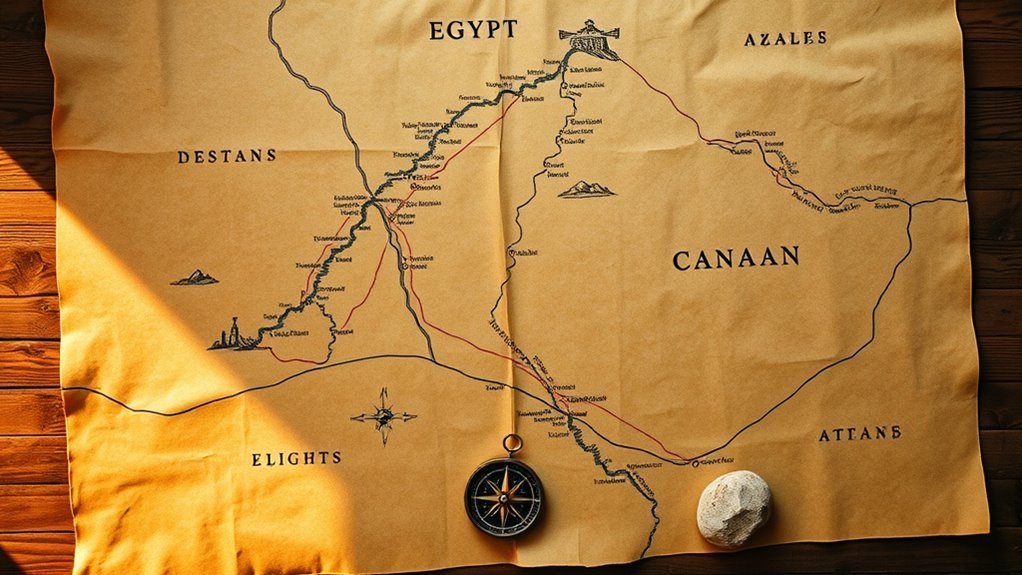
The biblical route begins at Rameses and moves first to Succoth. Exodus 12:37 describes about 600,000 men on foot, besides women and children, along with a mixed group and livestock. That number belongs to the biblical account. Any estimate of a total population of two million or more is a later calculation, not a figure stated directly in the text.
From Succoth, the narrative moves to Etham, Pi-hahiroth, the sea, Marah, Elim, the Wilderness of Sin, Rephidim, and Sinai. Later books trace the journey through Kadesh-barnea, the region of Edom and Moab, the plains east of the Jordan, and finally Gilgal near Jericho. Numbers 33 provides the fullest camp-by-camp itinerary.
Note: A route map should separate what the biblical text names from what modern researchers propose. Solid labels can mark the recorded sequence, while dashed lines or question marks should mark uncertain modern identifications.
The article’s earlier claim that “archaeological evidence” proves a specific migration route was too strong. No direct archaeological discovery confirms the full Exodus journey as described. Some scholars nevertheless argue that Egyptian names, geography, and cultural details may preserve historical memories behind the narrative.
How Long Was the Exodus Route?
The Bible gives several calendar markers, but it does not provide a verified total distance or a day-by-day schedule for the whole route. Numbers 33:3 places the departure on the fifteenth day of the first month. Exodus 16:1 places the arrival in the Wilderness of Sin on the fifteenth day of the second month. Exodus 19:1 says Israel reached the Wilderness of Sinai in the third month, without naming a universally agreed day of that month.
Israel remained in the Sinai region until the cloud lifted on the twentieth day of the second month in the second year, according to Numbers 10:11–12. That supports a stay of roughly eleven months. An exact total such as 343 days depends on assumptions about the arrival day and calendar counting, so it should not be stated as certain.
After Sinai, Deuteronomy 1:2 describes an eleven-day journey from Horeb to Kadesh-barnea by the Mount Seir route. The narrative includes several events and camps, but it does not support the earlier claim that this leg took eleven months. Deuteronomy 2:14 then measures 38 years from the departure from Kadesh-barnea until the crossing of the Zered Valley.
Note: The date 1446 BC comes from reading the 480 years in 1 Kings 6:1 as a literal chronological span before Solomon’s fourth year. Other interpreters place the Exodus in the thirteenth century BC, often in the period of Ramesses II. The date remains debated.
Key Stops on the Exodus Route
The route is easiest to understand as a sequence of named stages rather than a single precise line on a modern road map.
| Stop or Region | What Happens There | Primary Reference | Modern Location |
|---|---|---|---|
| Rameses to Succoth | The departure from Egypt begins. | Exodus 12:37; Numbers 33:3–5 | Rameses is commonly linked with the eastern Nile Delta; Succoth remains debated. |
| Etham and Pi-hahiroth | Israel turns and camps beside the sea before Pharaoh’s pursuit arrives. | Exodus 13:20–14:9 | Uncertain; usually placed near Egypt’s eastern frontier. |
| Sea of Reeds | The Israelites cross on dry ground in the biblical account. | Exodus 14–15 | No crossing site has been confirmed. |
| Marah and Elim | Bitter water is made drinkable at Marah; Elim has springs and palms. | Exodus 15:22–27 | Uncertain. |
| Wilderness of Sin | The people complain about food, and the manna account begins. | Exodus 16:1–36 | Somewhere between Elim and Sinai; exact location unknown. |
| Dophkah and Alush | Numbers lists these as camps before Rephidim. | Numbers 33:12–14 | Unknown. The water crisis belongs to Rephidim, not Dophkah. |
| Rephidim | Water comes from the rock, and Israel fights Amalek. | Exodus 17 | Uncertain. |
| Sinai or Horeb | The covenant, Ten Commandments, laws, and tabernacle instructions are given. | Exodus 19–40 | Jabal Musa is traditional, but no location has universal agreement. |
| Kadesh-barnea | The scouts return, the people rebel, and entry into Canaan is delayed. | Numbers 13–14; Deuteronomy 1 | Commonly placed near the northeastern Sinai and Negev border region, but the exact location remains debated. |
| Mount Hor | Aaron dies in the fortieth year after Israel leaves Kadesh. | Numbers 20:22–29; 33:37–39 | Uncertain; traditionally linked with a mountain near Petra. |
| Plains of Moab | Israel camps east of the Jordan before entering Canaan. | Numbers 22–36 | East of the Jordan opposite Jericho. |
| Jordan, Gilgal, and Jericho | Israel crosses the Jordan, sets up memorial stones, and approaches Jericho. | Joshua 3–6 | The Jordan Valley near Jericho. |
Red Sea Crossing and Sinai Route
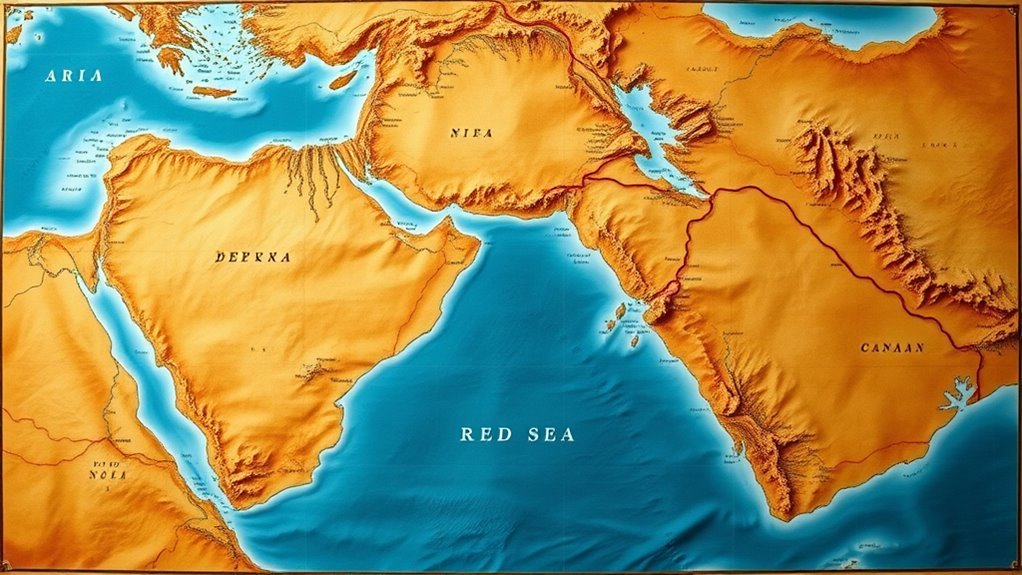
Many English Bibles call the crossing place the Red Sea, while the Hebrew expression Yam Suph is often rendered Sea of Reeds. Research on Egyptian place names has led many scholars to look near the marshes and lakes east of the Nile Delta. Other proposals place the crossing near the Gulf of Suez or, in less widely accepted reconstructions, near the Gulf of Aqaba and the Straits of Tiran. No proposal has produced a confirmed crossing site.
Exodus itself does not call the crossing “Day 25.” A traditional Jewish chronology places it on the seventh day after departure, while some modern route charts use different calculations. The safest wording is that the crossing occurred early in the journey, after the camps at Succoth, Etham, and Pi-hahiroth.
After the crossing, the sequence moves through Marah and Elim to the Wilderness of Sin. The people reach that wilderness on the fifteenth day of the second month, where the manna account begins. The later water crisis occurs at Rephidim, followed by the battle with Amalek. The pillar of cloud by day and fire by night serves as the narrative’s continuing sign of divine guidance.
The itinerary preserves the order of the journey more clearly than it preserves the modern coordinates.
Mount Sinai and the Law
Exodus 19 says the Israelites arrived in the Wilderness of Sinai in the third month after leaving Egypt. The chapter does not require the exact labels “Day 47” or “Sivan 1.” Those dates come from one reconstruction of the calendar.
God then tells Moses to consecrate the people “today and tomorrow” so they will be ready on the third day. The theophany follows, and Exodus 20 records the Ten Commandments. This sequence is clear, but assigning it to a precise date such as Sivan 3 depends on the assumed arrival day.
Moses remains on the mountain for 40 days and 40 nights in Exodus 24:18. The Sinai narrative also includes the golden calf, Moses’ intercession, a renewed covenant, and another 40-day period in Exodus 34:28. The law section therefore cannot be reduced to one uninterrupted 40-day delivery of every command.
Israel stays near Sinai until the second year, second month, twentieth day, when the camp sets out toward the Wilderness of Paran. This extended stay allows the covenant, priesthood, tabernacle, and camp organization to shape the community before the journey resumes.
Pro Tip: Use Exodus 19–40 to study what happened at Sinai, then use Numbers 10 and Numbers 33 to place those events within the travel sequence.
Kadesh Barnea and the Wilderness Years
Kadesh-barnea becomes the turning point in the journey. Moses sends 12 men to scout Canaan for 40 days. Joshua and Caleb urge the people to trust God and enter the land, but the other scouts spread fear. The community rebels, and Numbers 14 links the 40-day scouting mission with a judgment of 40 years in the wilderness.
The earlier article incorrectly treated the next 38 years as a stationary camp at Kadesh. Deuteronomy 2:14 is more precise: 38 years passed from leaving Kadesh-barnea until crossing the Zered Valley. The books of Numbers and Deuteronomy describe movement through wilderness regions rather than one continuous stay at the same camp.
Numbers 20 records another period at Kadesh, where Miriam dies and the people face a water crisis. Moses strikes the rock, and the chapter says he and Aaron will not lead the assembly into the land. Edom then refuses Israel passage through its territory, forcing the route to turn away.
Aaron dies later at Mount Hor in the fortieth year, after Israel has left Kadesh. The bronze serpent episode comes after Mount Hor while the people travel around Edom. These events should not be placed in an eleven-month journey from Sinai to Kadesh.
Alternative Exodus Route Theories
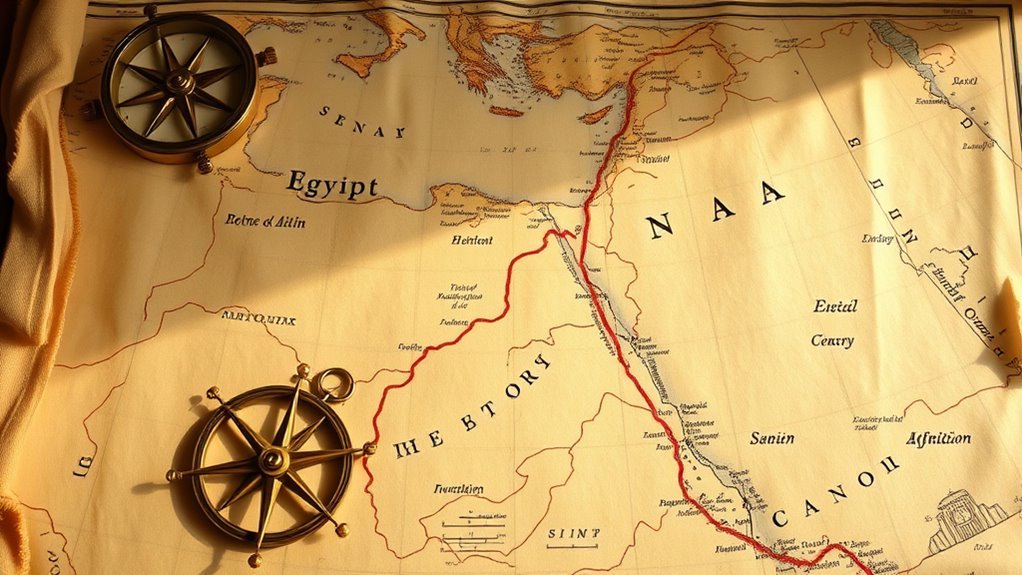
Route theories differ because several key sites remain unidentified. The locations of Succoth, Etham, Pi-hahiroth, the Sea of Reeds, Rephidim, and Mount Sinai affect every line drawn afterward. A map that fixes one disputed site usually commits to a whole chain of related assumptions.
Why the Direct Coastal Route Was Not Used
The road along the Mediterranean coast was the shortest known route from Egypt toward southern Canaan. It was also a controlled military corridor with forts and garrisons. Exodus 13:17 states that God did not lead Israel by “the way of the land of the Philistines,” although it was near, because the people might face war and return to Egypt.
For that reason, the coastal road is best used as a comparison route, not presented as the main route in the biblical account. Its importance lies in showing why the journey turned toward the wilderness instead of moving straight northeast.
Sinai Peninsula and Other Wilderness Proposals
The traditional route runs south through the Sinai Peninsula to Jabal Musa, the mountain long identified in Christian tradition as Mount Sinai. Other proposals place the mountain in central or northern Sinai, the Negev or Edom region, or northwestern Arabia. The precise location remains uncertain, and no site has gained universal archaeological agreement.
The Straits of Tiran crossing and Jabal al-Lawz route form one modern alternative reconstruction. They should be labeled as disputed proposals rather than as the established path. The same caution applies to any map that claims a precise 700 km journey, a 19 km sea crossing, or a fully verified set of daily camps.
Historical interpretation is also debated. No Egyptian inscription directly records the full biblical Exodus, and archaeology has not confirmed a mass movement on the scale implied by a literal reading of the population figures. Some scholars see the story as preserving memories of smaller groups, labor movements, or escapes from Egypt that later became part of Israel’s national tradition.
Jordan River Crossing and Jericho
Joshua 4:19 places the Jordan crossing on the tenth day of the first month. The text says the people crossed on dry ground and camped at Gilgal, where Joshua set up 12 stones taken from the river. In the early-date chronology, this event is often placed around 1406 BC. That BC date remains conditional on the debated 1446 BC Exodus date.
Jericho is the first fortified city in the Joshua narrative. Joshua 6 describes six days of marching around the city once per day, followed by seven circuits on the seventh day. At the trumpet blast and the people’s shout, the wall falls in the account. Archaeological interpretations of ancient Jericho’s destruction layers and their dating remain disputed, so the article should distinguish the biblical narrative from claims of modern proof.
The final approach matters geographically. Israel enters Canaan from the east, after camping in the plains of Moab, rather than arriving by the direct Mediterranean coastal road. The Jordan crossing, Gilgal memorial, and Jericho sequence complete the route described from Egypt to Canaan.
Exodus Timeline
The most defensible timeline uses the calendar markers stated in the biblical text and labels later BC conversions as interpretive.
| Event | Biblical Time Marker | Reference |
|---|---|---|
| Departure from Rameses | Fifteenth day of the first month | Numbers 33:3 |
| Arrival in the Wilderness of Sin | Fifteenth day of the second month | Exodus 16:1 |
| Arrival in the Wilderness of Sinai | Third month; exact day debated | Exodus 19:1–2 |
| Preparation and covenant at Sinai | Two days of preparation; theophany on the third day | Exodus 19:10–20:21 |
| Departure from Sinai | Second year, second month, twentieth day | Numbers 10:11–12 |
| Scouts survey Canaan | 40 days; judgment expressed as 40 years | Numbers 13:25; 14:33–34 |
| Kadesh-barnea to the Zered Valley | 38 years | Deuteronomy 2:14 |
| Aaron dies at Mount Hor | Fortieth year, fifth month, first day | Numbers 33:38–39 |
| Jordan crossing and camp at Gilgal | Tenth day of the first month | Joshua 4:19–20 |
Within the early-date model, interpreters often convert the first and last markers to about 1446 BC and 1406 BC. A thirteenth-century model produces later BC dates. Because the starting date is disputed, the article should not present one conversion as universally confirmed.
What the Map Reveals About the Exodus
A careful map reveals three dependable patterns. First, the route does not follow the shortest coastal road. Second, Sinai and Kadesh-barnea function as major turning points. Third, the final approach comes from the east through the Transjordan and the plains of Moab before the Jordan crossing.
The map also reveals the limits of reconstruction. You can plot the order of camps from Numbers 33, but you cannot place every camp with equal confidence. Rameses, the Jordan Valley, Moab, and Jericho fit broad known regions. Pi-hahiroth, Rephidim, Mount Sinai, and many wilderness camps remain uncertain.
- Use the text for sequence: trace the named camps in their recorded order.
- Use archaeology for context: compare ancient roads, forts, settlements, and place names without claiming more than the evidence supports.
- Use dashed lines for proposals: show readers where the map depends on a theory rather than a confirmed site.
Within the biblical story, the journey carries a theological meaning as well as a geographic one. The sea represents deliverance, Sinai represents covenant, Kadesh represents rebellion and delay, and the Jordan represents entry into the promised land. A trustworthy article can explain that meaning without turning disputed coordinates into established facts.
Frequently Asked Questions
What route did the Israelites take from Egypt to Canaan?
The biblical sequence begins at Rameses and Succoth, moves to Etham and Pi-hahiroth, crosses the Sea of Reeds, and continues through Marah, Elim, the Wilderness of Sin, Rephidim, and Sinai. It later runs through Kadesh-barnea, wilderness areas around Edom and Moab, the plains of Moab, the Jordan River, Gilgal, and Jericho. Several modern locations remain uncertain.
How long did the journey from Egypt to Canaan take?
The biblical narrative gives a 40-year wilderness period. Israel reached the Wilderness of Sin one month after departure, reached Sinai in the third month, and left Sinai in the second month of the second year. Deuteronomy then measures 38 years from leaving Kadesh-barnea to crossing the Zered Valley.
How far was the Egypt to Canaan journey?
The Bible does not state a total distance. Mileage changes sharply depending on where a map places the Sea of Reeds, Mount Sinai, Kadesh-barnea, and the wilderness camps. The often-repeated figure of about 700 km belongs to one route reconstruction and should not be presented as a settled biblical or archaeological measurement.
Where exactly did the Israelites cross the Red Sea?
No crossing location has been confirmed. Proposals include ancient lakes and marshes east of the Nile Delta, areas near the Gulf of Suez, and alternative sites near the Gulf of Aqaba. The Hebrew name Yam Suph is often understood as “Sea of Reeds,” which is one reason many scholars focus on Egypt’s northeastern lake region.
Where was Mount Sinai?
The exact location is unknown. Jabal Musa in southern Sinai is the best-known traditional identification. Other proposals place the mountain elsewhere in Sinai, in the Negev or Edom region, or in northwestern Arabia. No site has universal scholarly or archaeological acceptance.
Why did the Israelites spend 38 years in the wilderness?
Numbers 13–14 links the delay to Israel’s rebellion after the scouts returned from Canaan. Deuteronomy 2:14 says 38 years passed from the departure from Kadesh-barnea until the crossing of the Zered Valley, when the former generation of fighting men had died. The verse does not say Israel stayed at one Kadesh camp for the entire period.
How many people left Egypt in the Exodus?
Exodus 12:37 says about 600,000 men on foot left Rameses, besides women and children. Numbers 1:46 gives a census of 603,550 men eligible for military service. A total population above two million is an inference from those figures, not an explicit biblical total, and scholars debate whether the numbers should be read literally, rhetorically, or through a different meaning of the Hebrew term translated “thousand.”
Did the Exodus happen in 1446 BC?
1446 BC is the common early-date calculation based on the 480 years in 1 Kings 6:1 and a temple-building date near 966 BC. Other scholars favor a thirteenth-century setting connected with the city of Rameses. No date has achieved consensus, so 1446 BC should be labeled as one chronological framework.
Conclusion
The most reliable Egypt to Canaan map starts with the biblical sequence and marks disputed locations honestly. Scripture supports a 40-year journey, major camps at Sinai and Kadesh-barnea, an eastern approach through Moab, and a Jordan crossing on the tenth day of the first month. It does not establish a 700 km total, a Day 25 crossing at the Straits of Tiran, or 38 stationary years at Kadesh. Read Numbers 33 beside Exodus 12–19, Deuteronomy 1–2, and Joshua 3–6 to trace the route without confusing interpretation with certainty.
Sources
- Exodus 12–20, ESV — departure, first camps, sea crossing, Wilderness of Sin, Rephidim, and Sinai events.
- Numbers 33, ESV — the main itinerary from Rameses to the plains of Moab and the date of Aaron’s death.
- Deuteronomy 1–2, ESV — the eleven-day Horeb-to-Kadesh reference and the 38-year Kadesh-to-Zered period.
- Joshua 4–6, ESV — Jordan crossing, Gilgal memorial stones, and the Jericho narrative.
- Introduction to Exodus, ESV Global Study Bible — overview of the early- and late-date debate and route uncertainty.
- What We Know about the Egyptian Places Mentioned in Exodus, TheTorah.com — Egyptian toponyms, the Sea of Reeds translation, and proposed northeastern Egyptian geography.
