
Last Updated on September 10, 2026 by Daniel Globe
Whether you need a license plate for your electric scooter depends on where you ride, how fast the vehicle travels, its motor wattage, and whether it is classified as a low-speed micromobility device or a motor vehicle. In the vast majority of U.S. states and European jurisdictions, standard stand-up electric scooters capped at 15 to 20 mph do not require license plates, vehicle registration, or formal title documentation. However, if your scooter features a seat, exceeds 750 to 1,000 watts of motor power, or reaches speeds above 20 to 30 mph, state laws often reclassify it as a moped, motorized bicycle, or electric motorcycle—triggering mandatory DMV registration, license plates, and insurance.
Quick Answer
Standard stand-up electric scooters with a top speed of 15–20 mph and motors under 750W do not require license plates or DMV registration in most U.S. states. However, high-powered or seated scooters exceeding state speed or power thresholds are legally classified as mopeds or motorcycles, requiring vehicle registration, license plates, and valid operator credentials.
Key Takeaways
- Standard E-Scooters Are Plate-Free: Low-speed standing e-scooters (under 20 mph) are generally treated like bicycles and exempt from DMV registration.
- Speed & Wattage Thresholds: Exceeding 20 mph or 750–1,000W typically pushes an e-scooter into the moped or motorcycle legal category.
- Driver’s License Rules Differ: States like California require a valid driver’s license or permit to ride, even though plates and registration are not required.
- Local Municipalities Set the Final Rule: City codes often restrict sidewalk riding, enforce speed limits, and set parking boundaries regardless of state-level exemptions.
Disclosure: As an Amazon Associate I earn from qualifying purchases. Some links on this page are affiliate links, at no extra cost to you.
Do Electric Scooters Need License Plates?
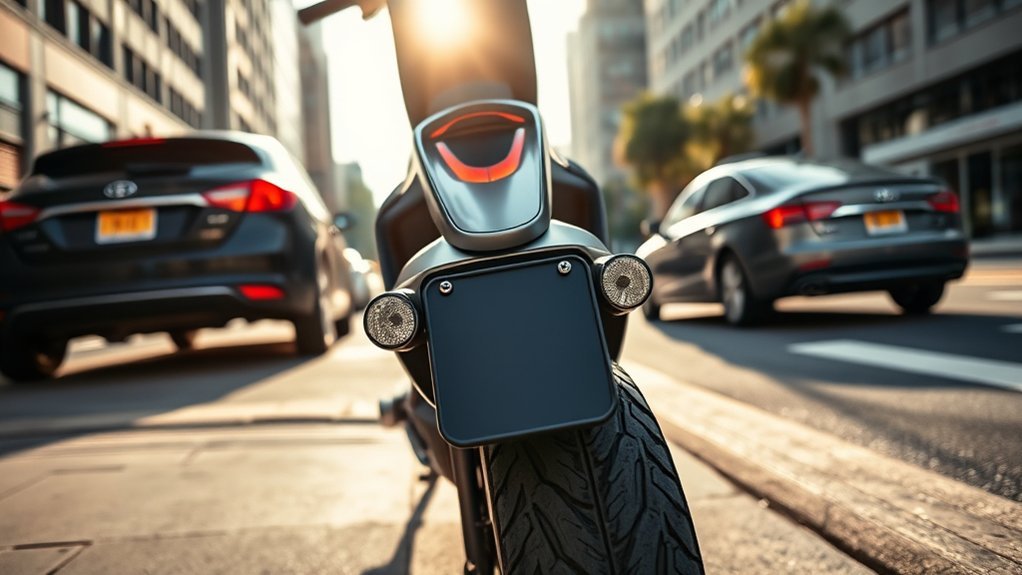
For the average commuter riding a commercial stand-up electric scooter, the answer is almost always no. Most state vehicle codes classify low-speed electric scooters as personal mobility devices rather than motor vehicles. Because they are designed to travel at moderate speeds on bike lanes and local roads, state departments of motor vehicles (DMVs) do not issue titles, vehicle identification numbers (VINs) for standard registration, or metal license plates for them.
The legal boundary changes rapidly when high-performance models enter the equation. When an electric two-wheeled vehicle exceeds standard consumer thresholds—typically a top speed of 20 mph on level ground or a motor rating over 750 watts—it ceases to be a basic micromobility device under the law. At that stage, traffic authorities categorize the vehicle alongside mopeds, motor-driven cycles, or light motorcycles, all of which require state registration, visible license plates, and minimum liability insurance coverage.
How Electric Scooter Classification Affects Plates and Registration
Vehicle classification dictates whether your ride stays completely paperwork-free or requires a trip to the DMV. Transportation departments use three primary metrics to classify two-wheeled electric transport: design configuration (standing vs. seated), maximum engineered speed, and continuous motor power output.
Note: Federal standards established by the Consumer Product Safety Commission (CPSC) regulate manufacturing safety, but operational requirements—such as license plates, street legality, and operator licensing—are strictly governed at the state and municipal levels.
| Vehicle Class | Typical Specs | License Plate Required? | DMV Registration? |
|---|---|---|---|
| Stand-Up E-Scooter | Max 15–20 mph, motor ≤750W | No | No |
| Seated Scooter / Light Moped | 20–30 mph, integrated seat, 750W–1500W | Yes (in most states) | Yes |
| High-Speed Electric Scooter | 30+ mph, dual motors (>2000W) | Yes (Motorcycle classification) | Yes |
State-by-State Electric Scooter Registration and Plate Rules
Because traffic laws are decentralized across the United States, states have enacted distinct legislative frameworks for micromobility. Below is an overview of how key states handle registration, license plates, and driver credentials for electric scooters.
Detailed State Legal Breakdown
- California: Under California Vehicle Code (CVC) § 21235 and § 407.5, a motorized scooter is defined as a two-wheeled device with handlebars, a floorboard designed to be stood upon while riding, and an electric motor. Stand-up scooters do not require DMV registration or license plates. However, riders must possess a valid driver’s license or instruction permit, wear a helmet if under 18, and stay off roadways with speed limits exceeding 25 mph unless riding in a designated Class II or Class IV bike lane.
- Texas: Under Texas Transportation Code § 551.351–.353, electric scooters are classified as “motor-assisted scooters” provided they have a motor under 750W. They are completely exempt from title, registration, and license plate requirements. Texas grants scooter operators the same rights and responsibilities as traditional bicyclists.
- Florida: Under Florida Statutes § 316.2128, electric micromobility devices and motorized scooters have the same operational rights as bicycles. Riders do not need vehicle registration, license plates, or insurance, but they must be at least 16 years old to operate them on public rights-of-way.
- North Carolina: Under NC General Statutes § 20-4.01(7b), stand-up electric scooters are classified as electric personal assistive mobility devices and do not need plates. However, if a scooter includes a seat and reaches speeds over 20 mph, North Carolina treats the device as a moped, requiring state registration, a metal plate, and liability insurance.
- Hawaii: Under Hawaii Revised Statutes § 249-14, low-speed mopeds must be registered through county director of finance offices and display an official registration decal. Traditional stand-up kick e-scooters are subject to strict municipal traffic codes, particularly in Honolulu, where sidewalk use in business districts is strictly banned.
- New York: New York State legalized electric scooters up to 20 mph on streets with speed limits of 30 mph or less. Stand-up e-scooters do not require DMV registration or license plates, though riders must be at least 16 years old.
Local Municipal Variations and Sidewalk Bans
State legislation establishes the baseline, but local city and county ordinances frequently modify the rules. Even when a state explicitly waives license plate and registration requirements, individual city councils maintain the legal authority to:
- Prohibit electric scooter operation on pedestrian sidewalks.
- Impose local speed limits (often 10–15 mph) inside downtown zones.
- Require geofenced low-speed zones or mandatory parking corrals.
- Restrict or ban commercial dockless rental fleets from operating on public property.
Pro Tip: When commuting into a major metropolitan center or university campus, check the city’s municipal code or campus transit policy. Municipal boundaries can change street legality without notice, even if your scooter is fully compliant under state statute.
When Electric Scooters Need a Driver’s License
While standard electric scooters rarely require a license plate, operator credentialing is an entirely separate legal requirement. State approaches to driver’s license mandates generally fall into three categories:
- Driver’s License Strictly Required: California, Massachusetts, and Arkansas require riders to carry a valid driver’s license or learner’s permit regardless of age.
- Minimum Age with No License Required: States such as Florida, Texas, and New York set a minimum operating age (typically 16 years old) but do not require riders to hold an active motor vehicle license.
- Rental Fleet Requirements: Commercial dockless scooter operators (such as Lime and Bird) enforce their own contractual terms of service, universally requiring users to be at least 18 years old and scan a valid government-issued driver’s license before unlocking a device.
What Happens If You Skip Registration on Non-Compliant Scooters?
Riding a standard low-speed e-scooter will not result in registration citations because the law does not require it. However, if you ride an unregistered high-speed, high-wattage, or seated scooter that legally qualifies as a moped or motorcycle on public roads, law enforcement officers can issue citations for operating an unregistered motor vehicle.
Warning: Operating a modified or high-speed electric scooter (capable of 30+ mph) on public roadways without required DMV plates, registration, and insurance can result in immediate vehicle impoundment, towing fees, and traffic misdemeanor citations for driving an unregistered vehicle.
Common legal consequences of riding a non-compliant or improperly registered vehicle include:
- Traffic Infraction Fines: Fines for operating an unregistered motor vehicle typically range from $100 to $500 depending on the jurisdiction.
- Vehicle Impoundment: Officers may impound any unplated vehicle operating on roadways where vehicle registration is mandatory. Retrieving the scooter requires paying municipal towing and daily storage fees.
- Moving Violations and Driving Record Points: If cited for operating an unregistered vehicle or driving without the proper license endorsement (such as a motorcycle endorsement), points may be assessed against your standard driver’s license.
Electric Scooter Laws by Speed and Power Thresholds
Speed caps and motor wattage thresholds are the most common triggers for licensing and plate mandates across global and domestic transportation frameworks.
“The majority of U.S. states set the legal ceiling for low-speed electric scooters at 20 mph and 750 watts. Exceeding either limit fundamentally changes the vehicle’s legal status from a bicycle equivalent to a regulated motor vehicle.”
Speed-Based Regulatory Bands
- Low-Speed Band (Up to 15–20 mph): Permitted in bike lanes and roadways in most states. Treated like bicycles with no plates or registration required.
- Intermediate Band (20–30 mph): Many states classify these devices as mopeds or motorized cycles, requiring DOT-approved lighting, horn, mirror, registration decal, and a driver’s license.
- High-Speed Band (Over 30 mph): Regulated strictly as motorcycles under federal and state motor vehicle safety standards. Requires VIN verification, turn signals, mirrors, license plates, motorcycle endorsement, and vehicle insurance.
Power Thresholds and Motor Wattage
Motor wattage limits prevent overpowered motorized vehicles from sharing infrastructure with pedestrians and non-motorized cyclists. Most state statutes define an electric scooter motor as having a maximum continuous output of 750 watts (approximately 1.0 horsepower). States that allow up to 1,000 watts (such as California under CVC § 407.5) still enforce a strict mechanical speed cap of 15 mph on public roads.
European and International Comparisons
In the European Union and the United Kingdom, micromobility regulations are generally stricter than in the United States. Under EU standards, privately owned electric scooters are commonly restricted to a maximum assisted speed of 25 km/h (15.5 mph) with maximum continuous rated power of 250W–500W. Countries like Germany require personal electric vehicles (eKFV regulations) to carry an official insurance sticker (Versicherungskennzeichen), which serves as a miniature adhesive license plate showing proof of valid third-party liability coverage.
How to Verify Your Local Scooter Laws
Before purchasing or commuting on an electric scooter, follow these steps to ensure you remain fully compliant with all municipal and state vehicle regulations:
- Consult Your State DMV / DOT Portal: Search for your state’s explicit definition of “motorized scooter,” “motor-assisted scooter,” or “electric personal assistive mobility device.” Verify maximum allowed motor wattage and speed limits.
- Check Municipal City Codes: Review city traffic ordinances for specific prohibitions on sidewalk riding, park path restrictions, and mandatory helmet rules.
- Inspect the Manufacturer’s Specification Label: Check the scooter’s deck or motor hub for the factory specification plate. Confirm that the wattage rating and top speed match your state’s legal exemption threshold.
- Review Shared Mobility Guidelines: If using rental scooters, check the in-app local operating rules, which provide a reliable summary of local geofenced zones, no-ride areas, and parking restrictions.
Plates, Insurance, and Helmet Rules Overview
Beyond license plates and registration, staying street-legal requires adhering to equipment, insurance, and helmet mandates.
- Insurance Requirements: Standard standing e-scooters do not require liability insurance in nearly all U.S. states. However, if your scooter is classified as a moped, motorized bicycle, or motorcycle due to higher speeds, state financial responsibility laws require minimum liability coverage.
- Helmet Mandates: While adults over 18 are exempt from helmet mandates in many states, riders under 18 are legally required to wear a certified bicycle or motorcycle helmet in states like California and New York. Regardless of legal minimums, wearing an ASTM F1447 or CPSC-certified helmet is strongly recommended for all riders.
- Lighting and Visibility: For night riding, state laws universally require a front white headlight visible from at least 500 feet and a rear red reflector or brake light visible from 300 to 500 feet.
How Electric Scooter Laws Are Changing
As micromobility devices grow in popularity, transportation departments are continuously updating outdated vehicle codes. Key legislative trends reshaping scooter regulation include:
- Standardization of Class-Based Micromobility: More states are adopting tiered definitions that clearly separate low-speed stand-up scooters from high-powered seated e-mopeds.
- Increased Enforcement on High-Speed Grey-Market Scooters: Cities are tightening enforcement on modified and dual-motor scooters capable of 40–50 mph operating illegally in bicycle lanes and pedestrian spaces without plates.
- Mandatory Insurance Pilot Programs: Several global jurisdictions are evaluating mandatory mini-insurance decals similar to Germany’s model to ensure liability coverage in pedestrian-scooter collisions.
Frequently Asked Questions
Do you have to have a license plate on an electric scooter?
In most U.S. states, you do not need a license plate for a standard stand-up electric scooter with a top speed of 15–20 mph and a motor under 750W. License plates and DMV registration are only required if your scooter exceeds state speed and power limits, qualifying it as a moped, motorized cycle, or motorcycle.
What happens if I get caught riding an unregistered electric scooter?
If your scooter is a standard low-speed model, it is legally exempt from registration. However, if you operate an overpowered or seated scooter that legally requires registration without a plate, you may receive a traffic citation for driving an unregistered vehicle, face fines between $100 and $500, and risk having the vehicle impounded.
What are the rules for electric scooters in Florida?
Under Florida Statute § 316.2128, electric scooters have the same rights and duties as bicycles. You do not need a license plate, vehicle registration, driver’s license, or insurance. Riders must be at least 16 years old, and scooters are permitted on bike lanes and streets with appropriate speed limits.
Are scooters street legal in Louisiana?
Yes, electric scooters are street-legal in Louisiana. Under state law, low-speed electric scooters can operate on sidewalks, bicycle paths, and roadways with posted speed limits of 25 mph or less. Operators must follow standard bicycle traffic laws, and helmets are mandatory for riders under the age of 17.
Can you ride an electric scooter on the sidewalk?
Sidewalk rules are established by local municipal codes rather than federal law. Many cities (such as Los Angeles, New York, and Honolulu) strictly ban electric scooters on sidewalks to protect pedestrians, requiring riders to use dedicated bike lanes or the right-hand side of public roadways.
Conclusion
For most commuters, owning and operating a standard stand-up electric scooter requires no license plates, vehicle registration, or state paperwork. By keeping your scooter’s maximum speed within standard limits (15 to 20 mph) and adhering to local road rules, you can enjoy convenient, low-cost transportation without DMV intervention. However, if you plan to ride a high-performance or seated electric scooter, take the time to review your state’s motor vehicle statutes and city municipal codes to ensure your ride meets all registration, licensing, and safety equipment requirements before you hit the road.
Sources
- California Department of Motor Vehicles — California Vehicle Code § 21235 & § 407.5 Operation of Motorized Scooters
- Texas Legislature Online — Texas Transportation Code Chapter 551 Operation of Bicycles, Electric Bicycles, and Motor-Assisted Scooters
- The Florida Senate — Florida Statutes Title XXIII Chapter 316.2128 Micromobility Devices and Motorized Scooters
- North Carolina General Assembly — North Carolina General Statutes § 20-4.01 Motor Vehicle Definitions and Moped Regulations
- U.S. Consumer Product Safety Commission — Micromobility Safety Standards and Federal Guidelines
