
Last Updated on September 10, 2026 by Daniel Globe
In Colorado, you do not need a motorcycle license or a specialized motorcycle endorsement to operate an electric low-power scooter. As long as your electric scooter produces 4,476 watts (approximately 6 horsepower) or less, Colorado law classifies it as a low-power scooter rather than a motorcycle. To ride legally on public roadways, you only need a standard, valid Colorado driver’s license (or minor driver’s license), state registration, and minimum liability insurance.
Quick Answer
You do not need a motorcycle license or “M” endorsement for an electric scooter in Colorado if its motor does not exceed 4,476 watts (or 50cc for gas engines). You must, however, hold a valid driver’s license, register the vehicle with the Colorado DMV for a $5.49 three-year decal, carry standard motor vehicle liability insurance, and ride only on streets posted at 30 mph or less.
Key Takeaways
- No Motorcycle Endorsement: Electric scooters up to 4,476 watts require only a standard driver’s license or minor driver’s license under C.R.S. § 42-2-103.
- Registration & Decal: Low-power scooters must be registered using Form DR 2701. Registration costs $5.49 and is valid for three years.
- Mandatory Insurance: Operators must carry standard auto liability insurance ($25,000 bodily injury per person, $50,000 per accident, and $15,000 property damage).
- Roadway Limits: Permitted on bike lanes and public streets with speed limits of 30 mph or less (up to 35 mph where local ordinances allow); prohibited on interstate highways.
- Helmet Requirements: Riders under 18 must wear a DOT-approved helmet; helmets are optional but strongly recommended for adults 18 and older.
Disclosure: As an Amazon Associate I earn from qualifying purchases. Some links on this page are affiliate links, at no extra cost to you.
What Counts as a Low-Power Scooter in Colorado?
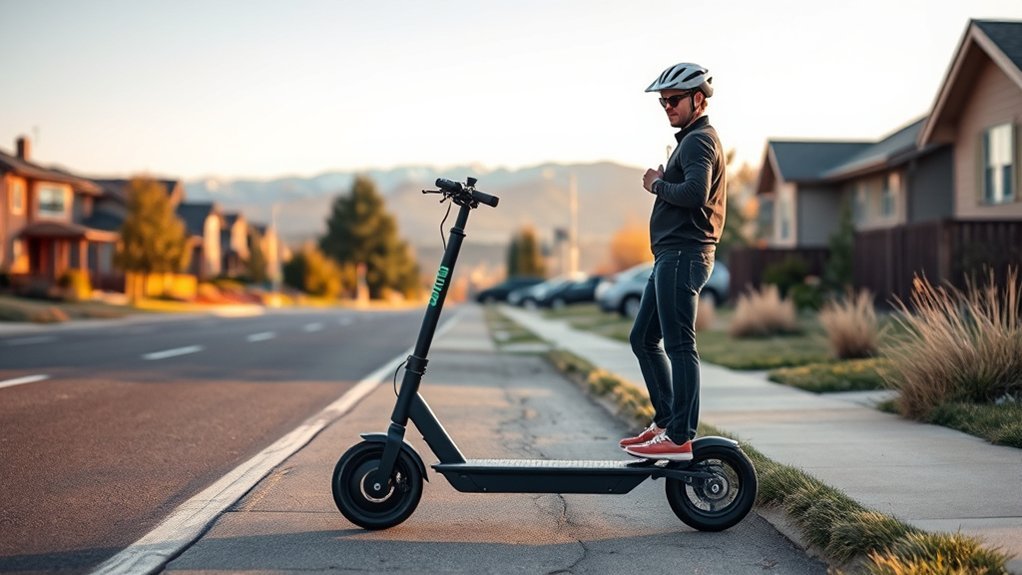
Under Colorado Revised Statutes (C.R.S. § 42-1-102(48.5)), a low-power scooter is defined as a self-propelled vehicle designed primarily for roadway use with no more than three wheels in contact with the ground. To fit into this statutory category, the vehicle must meet strict mechanical limits:
- Electric Motors: A maximum power output of 4,476 watts (about 6.0 horsepower).
- Internal Combustion Engines: A maximum cylinder capacity of 50 cubic centimeters (50cc).
- Transmission: Does not require a manual clutch.
- Legal Exclusions: It is legally distinct from a standard bicycle, electric-assisted bicycle (e-bike), toy vehicle, electric personal assistive mobility device (EPAMD), or wheelchair.
If your electric two-wheeler or three-wheeler stays within these limits, it is legally regulated as a low-power scooter. Exceeding either 50cc or 4,476 watts reclassifies the vehicle as a full motorcycle, which triggers mandatory motorcycle registration, title requirements, and an “M” endorsement on your driver’s license.
Note: Under Colorado Senate Bill 19-054, lightweight stand-up electric scooters (such as commercial shared scooters) are granted the operational rights and duties of bicycles. The registration, licensing, and insurance rules discussed below apply specifically to sit-down electric mopeds and low-power scooters under state motor vehicle statutes.
Do You Need a Motorcycle License?
No. You do not need a motorcycle license, motorcycle permit, or motorcycle endorsement to operate a low-power electric scooter in Colorado. The state exempts vehicles meeting the low-power threshold from motorcycle licensing standards while retaining basic motor vehicle oversight.
At a Glance
| Time Required | 1 to 3 weeks for DMV processing and decal delivery |
| Difficulty | Easy (mail-in form or in-person registration) |
| Tools Needed | Form DR 2701, Form DR 2841, Proof of Insurance, Valid ID |
| Cost | $5.49 state registration fee (valid for 3 years) |
Driver’s License Requirements
To operate a low-power scooter on public streets, you must hold a valid standard Colorado driver’s license, a minor driver’s license, or a valid out-of-state driver’s license. Individuals with an instruction permit may only ride if supervised according to standard permit restrictions.
| Vehicle Category | Motor Limits | License Required | Registration & Decal |
|---|---|---|---|
| Electric Low-Power Scooter | ≤ 4,476 Watts (≤ 50cc) | Standard Driver’s License | 3-Year Decal ($5.49) |
| Motorcycle / High-Power Scooter | > 4,476 Watts (> 50cc) | Motorcycle Endorsement (“M”) | Standard License Plate & Title |
| Electric Bicycle (E-Bike) | ≤ 750 Watts | None Required | None |
Power & Speed Boundaries
If you purchase an electric scooter rated above 4,476 watts, Colorado treats it as a full-fledged motorcycle. You cannot register it under the low-power decal system, and riding it without an “M” endorsement on your driver’s license exposes you to Class A traffic infraction citations and potential vehicle impoundment.
Statutory Framework
Colorado’s tiered vehicle definitions ensure that small, lightweight commuter vehicles are accessible without the training hurdles of full motorcycle licensing. However, the state balances this access by requiring proof of financial responsibility (insurance) and basic traffic law competency through a standard driver’s license.
What License, Insurance, and ID Do You Need?
To ride lawfully on public roadways in Colorado, you must fulfill four core legal requirements before hitting the road:
- Valid Driver’s License: A current Colorado adult or minor driver’s license.
- Secure and Verifiable Identification: Proof of legal identity via Colorado Form DR 2841 when submitting your registration paperwork.
- Low-Power Scooter Decal: A valid three-year registration sticker affixed to the scooter frame.
- Proof of Motor Vehicle Insurance: Active insurance coverage meeting Colorado’s statutory minimums.
Warning: Colorado law enforces mandatory auto-equivalent liability coverage for low-power scooters under C.R.S. § 42-7-103. Riding without insurance can lead to a minimum $500 fine, 4 points on your driver’s license, and license suspension.
Your insurance policy must satisfy the following minimum liability limits:
- $25,000 for bodily injury or death to one person in any single accident.
- $50,000 for bodily injury or death to all persons in any single accident.
- $15,000 for property damage in any single accident.
Where Can You Ride a Low-Power Scooter?
Colorado establishes clear roadway rules for low-power scooters to maintain smooth traffic flow and rider safety. Low-power scooters are permitted in dedicated bike lanes and on streets with posted speed limits of 30 mph or less.
Legal Riding Areas & Local Ordinances
When operating on legal roadways, riders must stay as far to the right side of the road as practicable, obey all standard traffic control signals, and use designated bike lanes where available. Certain municipalities allow low-power scooters on roads posted up to 35 mph if a bike lane is present, but local rules vary:
- Denver: Sidewalk riding is strictly prohibited; riders must use bike lanes or roadways posted at 30 mph or lower.
- Boulder: Multi-use paths may restrict motorized low-power scooters; riders should prioritize bike lanes on low-speed streets.
- Colorado Springs: Select arterials with speed limits up to 35 mph allow scooter travel within marked bike lanes.
Pro Tip: When making a left turn on a multi-lane roadway with a low-power scooter, avoid cutting across fast traffic. Instead, use the “box turn” method: ride straight through the intersection on the right, stop at the far corner, pivot to face the new direction, and proceed when the traffic signal turns green.
Prohibited Roadways
Due to low operational speeds, low-power scooters are prohibited on high-speed and limited-access roadways across the state.
| Route Type | Status | Legal Note |
|---|---|---|
| Interstate Highways | Prohibited | Never permitted under any circumstance. |
| Limited-Access Expressways | Prohibited | Roads with posted speed limits exceeding 30/35 mph. |
| Sidewalks | Generally Prohibited | Allowed only when parking or where local municipal code permits. |
| Pedestrian Crosswalks | Walk Only | You must dismount and walk your scooter across pedestrian crosswalks. |
What Safety Gear Is Required?
Colorado law sets baseline safety gear and equipment specifications under C.R.S. § 42-4-1502 to protect riders sharing the road with standard passenger traffic:
- Helmets: Operators and passengers under 18 years of age must wear a DOT-approved motorcycle or motor vehicle safety helmet. Helmets are optional for riders 18 and older.
- Eye Protection: Colorado recommends eye protection (goggles, glasses, or a helmet face shield) while operating on public roadways.
- Headlamp: A white front light visible from a distance of at least 500 feet.
- Tail Light / Reflectors: A red rear reflector or lamp visible from at least 500 feet to the rear.
- Braking System: Brakes capable of stopping the scooter within 25 feet from a speed of 20 mph on dry, level pavement.
- Audible Warning: A horn or bell capable of emitting an audible sound from at least 100 feet.
“Every low-power scooter operated upon any roadway in Colorado must maintain functioning headlamps, rear reflectors, and adequate braking systems at all times.” — Colorado Department of Revenue
How Do You Register a Low-Power Scooter?
Low-power scooters in Colorado do not receive standard metal license plates or vehicle titles. Instead, the Colorado Department of Revenue Division of Motor Vehicles (DMV) issues a three-year registration decal. Follow these steps to register your scooter:
- Obtain Form DR 2701: Download and complete the state’s Application for Low-Power Scooter Registration.
- Provide Proof of Ownership: Include the manufacturer’s bill of sale, invoice, or previous registration showing the vehicle identification number (VIN) or serial number.
- Attach Proof of Insurance: Provide a copy of your active Colorado motor vehicle liability insurance card.
- Complete Form DR 2841: Attach a Secure and Verifiable ID form along with a copy of your valid driver’s license.
- Pay the Fee: Include the state fee of $5.49 (check or money order payable to the Colorado Department of Revenue).
- Submit the Application: Mail the packet to the Colorado DMV address listed on Form DR 2701, or submit it in person at participating county motor vehicle offices.
Once received, attach the three-year registration decal securely to the frame of your scooter where it remains clearly visible from the rear.
Frequently Asked Questions
What happens if I get caught riding an unregistered or uninsured scooter in Colorado?
Operating an unregistered low-power scooter or riding without insurance is a Class B traffic infraction. You face statutory fines starting at $500 for driving without insurance, 4 points against your driver’s license, court surcharges, and potential vehicle impoundment.
What kind of scooter does not require a driver’s license in Colorado?
Electric bicycles (e-bikes) with motors up to 750W and stand-up commercial micro-mobility electric scooters regulated under bicycle-equivalent rules do not require a driver’s license. However, sit-down low-power scooters (mopeds) up to 4,476W or 50cc require a valid driver’s license.
Can I ride a low-power scooter on Denver or Boulder bike paths?
Low-power scooters are permitted in on-street striped bike lanes. However, off-street recreational trails and multi-use paths (such as the Cherry Creek Trail in Denver or Boulder Creek Path) generally prohibit gas-powered and high-wattage motorized scooters. Check local municipal park codes before riding on off-street multi-use paths.
Do I need a title for a low-power scooter in Colorado?
No. Colorado does not issue titles or metal license plates for vehicles classified as low-power scooters (under 50cc or 4,476W). You only need to register the vehicle with the state DMV to obtain a three-year validation decal.
Conclusion
Operating an electric scooter in Colorado provides an efficient way to travel without the expense and testing requirements of a specialized motorcycle license. As long as your scooter’s power output remains at or below 4,476 watts (or 50cc for combustion engines), you can ride legally using your standard Colorado driver’s license. To stay compliant with Colorado state law, make sure to submit Form DR 2701 for your $5.49 three-year registration decal, carry active 25/50/15 liability insurance, equip required lighting, and restrict your travel to bike lanes and roads posted at 30 mph or less.
Sources
- Colorado General Assembly — C.R.S. Title 42 Vehicles and Traffic Definitions (§ 42-1-102 & § 42-2-103)
- Colorado Department of Revenue (DMV) — Form DR 2701 Application for Low-Power Scooter Registration
- Colorado Revised Statutes — C.R.S. § 42-7-103 Motor Vehicle Financial Responsibility & Insurance Requirements
