
Last Updated on September 10, 2026 by Daniel Globe
In the Philippines, whether you need a driver’s license or registration for an electric scooter depends entirely on your vehicle’s maximum design speed and motor classification under Land Transportation Office (LTO) guidelines. Standard stand-up electric kick scooters and low-speed electric mobility devices capped at 25 km/h (15.5 mph) are generally exempt from LTO registration and driver’s licensing requirements. However, faster models exceeding 25 km/h fall under stricter light electric vehicle regulations, requiring a valid driver’s license, mandatory vehicle registration, and compliance with national and local road restrictions.
Quick Answer
No license is required if your electric scooter is a Personal Mobility Device (PMD) or Category L1a vehicle with a maximum speed of 25 km/h or below. You may ride on barangay roads and designated bike lanes without LTO registration. If your e-scooter reaches 26 to 50 km/h (Category L1b) or higher, you must hold a valid driver’s license (DL Code A) and register the unit with the LTO.
Key Takeaways
- Sub-25 km/h Exemption: E-scooters capped at 25 km/h do not require an LTO driver’s license or motor vehicle registration.
- Registration for Fast Models: E-scooters reaching speeds between 26 km/h and 50 km/h are classified as Category L1b LEVs, requiring registration and a driver’s license.
- Road Access Limits: Unregistered low-speed e-scooters are restricted to barangay roads, local streets, and dedicated bike lanes. They are prohibited on major national highways under MMDA Regulation No. 24-022.
- Mandatory Protective Gear: Riders must wear protective helmets (bicycle/skate helmets for sub-25 km/h units; DTI/ICC-certified motorcycle helmets for Category L1b and above).
Disclosure: As an Amazon Associate I earn from qualifying purchases. Some links on this page are affiliate links, at no extra cost to you.
Do You Need a License for an Electric Scooter?
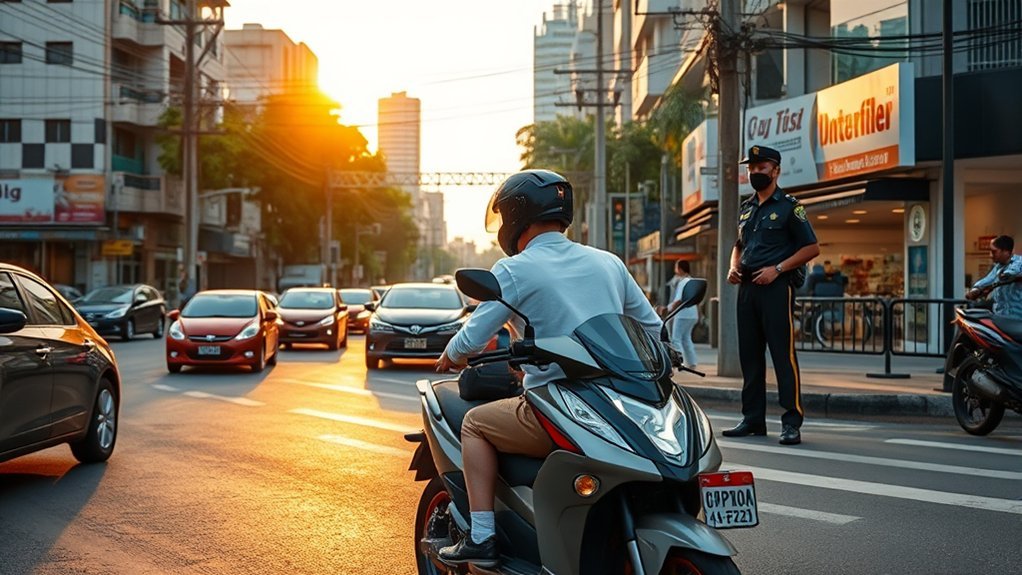
You do not need a driver’s license to operate a standard electric kick scooter in the Philippines, provided its maximum speed does not exceed 25 km/h. Under Land Transportation Office (LTO) Administrative Order No. 2021-039, personal light electric mobility devices within this low-speed threshold are exempt from driver licensing and mandatory motor vehicle registration. These units are recognized as micro-mobility alternatives intended for short-distance commutes, local neighborhood travel, and dedicated active transport infrastructure.
Operating an exempt e-scooter does not eliminate your responsibility to follow road safety protocols. Riders must obey local municipal traffic ordinances, observe right-of-way rules, use hand signals when turning, and yield to pedestrians at all crosswalks. Additionally, local government units (LGUs) reserve the authority to enforce localized ordinances, such as minimum age restrictions (commonly 16 years old) or mandatory daytime headlight usage.
Pro Tip: Keep a copy or digital photo of your electric scooter’s manufacturer spec sheet on your phone. If stopped at a local checkpoint, this verifies that your vehicle’s motor wattage and factory-set maximum speed fall below the 25 km/h threshold.
Which Electric Scooter Types Don’t Need Registration?
Under the regulatory framework aligned with the Electric Vehicle Industry Development Act (RA 11697 / EVIDA), electric micro-mobility devices are categorized based on weight, motor power, and maximum design speed. Low-speed models intended for personal transport do not require formal documentation through the LTO.
Registration-Exempt Scooter Types
The following personal mobility devices and light electric vehicles (LEVs) can be operated on public roads without registration paperwork:
- Electric Kick Scooters: Stand-up two-wheel scooters with a maximum speed cap of 25 km/h.
- Personal Mobility Devices (PMDs): Low-power electric balance boards, self-balancing unicycles, and small assistive mobility units (typically under 300 watts or capped at 12.5 to 25 km/h).
- Electric Bicycles (E-Bikes): Pedal-assist or throttle-equipped two-wheel bicycles with a top design speed not exceeding 25 km/h.
- Category L1a E-Mopeds: Low-speed two-wheel electric mopeds engineered to max out at 25 km/h.
Low-Speed LEV Categories and Classifications
The table below summarizes the LTO classification standards governing two-wheeled electric personal mobility vehicles in the Philippines:
| Category | Speed Threshold | LTO Registration | Driver’s License | Authorized Road Access |
|---|---|---|---|---|
| Personal Mobility Device (PMD) | Up to 25 km/h | No | No | Bike lanes, barangay roads, private roads |
| Category L1a (Low-Speed LEV) | Up to 25 km/h | No | No | Bike lanes, barangay roads, local streets |
| Category L1b (Light E-Scooter/Moped) | 26 km/h to 50 km/h | Yes | Yes (Code A) | Outer lanes of local/national secondary roads |
| Category L3 (High-Speed E-Motorcycle) | Over 50 km/h | Yes | Yes (Code A) | Standard public road network (highways excluded unless ≥400cc equivalent) |
Which E-Scooters Need Registration and a License?
High-powered electric scooters that exceed standard commuter specs cross the threshold from micro-mobility devices into regulated motor vehicles. If your unit can reach speeds greater than 25 km/h, the LTO classifies it as a full-fledged motor vehicle requiring strict operator credentials and safety compliance.
Speed-Based Categories
LTO regulations divide regulated electric two-wheelers into two main groups:
- Category L1b (26 km/h to 50 km/h): Medium-speed electric scooters and light mopeds. Operators must hold at least a Non-Professional Driver’s License with Driver’s License (DL) Code A or A1. The vehicle itself must be officially registered and assigned an LTO plate or registration sticker.
- Category L3 (Exceeding 50 km/h): High-performance electric two-wheelers. These are treated with the exact same legal requirements as internal combustion engine (ICE) motorcycles, demanding standard registration, complete third-party liability (CTPL) insurance, and full motorcycle licensing.
Road Use Rules
For registered Category L1b and L3 units, road use is permitted on city roads and provincial highways, provided the rider sticks to the outermost lane (or designated motorcycle lanes where applicable). Riding unregistered high-speed units on public secondary or primary highways is illegal and subjects the vehicle to immediate impoundment by traffic enforcement agencies.
Registration Requirements for High-Speed E-Scooters
To register a high-speed e-scooter or e-moped (Category L1b/L3) with the LTO, you will need the following documentation:
- Original Sales Invoice and Certificate of Stock Reported (CSR) from the dealer or importer.
- Valid Certificate of Cover (COC) for Compulsory Third-Party Liability (CTPL) Insurance.
- Motor Vehicle Inspection Report (MVIR) confirming roadworthiness, operational dual brakes, front headlights, rear brake lights, and turn signals.
- Valid Government-Issued ID and Tax Identification Number (TIN).
Warning: Dual-motor performance scooters (such as 1000W+ models capable of 60–80 km/h) are not treated as casual toys. Operating these units on major roads without an LTO license and registration carries severe penalties, including vehicle impoundment and fines for operating an unregistered motor vehicle.
Where Can You Ride an Electric Scooter?
In the Philippines, legal road access for standard, sub-25 km/h electric kick scooters is limited to specific transport pathways designed to separate low-speed micromobility from heavy automotive traffic:
- Barangay Roads and Local Streets: Minor residential streets where speed limits are naturally low.
- Designated Bicycle Lanes: Protected and painted bike lanes along city and national roads (e.g., active transport lanes established by the Department of Transportation).
- Private Compounds and Gated Subdivisions: Private roads subject to Homeowners Association (HOA) rules.
- Campus and Business District Pathways: Designated mixed-use zones in commercial centers like Bonifacio Global City (BGC), Makati Central Business District, and Ortigas Center, subject to estate security guidelines.
Under Metropolitan Manila Development Authority (MMDA) Regulation No. 24-022, light electric vehicles, e-bikes, and e-scooters are strictly prohibited on major national, circumferential, and radial roads across Metro Manila unless directly crossing or using a physically separated bicycle lane. Prohibited corridors include:
- EDSA (Epifanio de los Santos Avenue)
- C-5 Road (Circumferential Road 5)
- Commonwealth Avenue
- Roxas Boulevard
- Quezon Avenue
- Taft Avenue
- Shaw Boulevard
- Marcos Highway
What Helmet Rules Apply to E-Scooter Riders?
Wearing a protective helmet is legally mandatory for all electric scooter riders across the Philippines, regardless of vehicle speed or whether the scooter requires registration. However, the required helmet certification depends on the vehicle category:
- Personal Mobility Devices & Low-Speed E-Scooters (≤25 km/h): Riders may wear certified bicycle helmets, skate helmets, or protective micro-mobility headgear that fastens securely under the chin.
- Category L1b and L3 E-Scooters (26 km/h and above): Riders are legally mandated under Republic Act No. 10054 (Motorcycle Helmet Act) to wear a certified motorcycle helmet bearing a genuine Philippine Standard (PS) mark or Import Commodity Clearance (ICC) sticker.
Note: Construction hard hats, decorative novelty caps, and unstrapped helmets do not meet legal standards and will result in traffic citations during municipal roadside inspections.
What Happens If You Break E-Scooter Rules?
Enforcement of e-scooter regulations is carried out jointly by the LTO, the MMDA, and Local Government Unit (LGU) traffic enforcement bureaus (such as Manila Traffic and Parking Bureau or QC-DPOS). Violations carry standardized fines and potential vehicle confiscation.
| Violation Type | Enforcing Agency | Typical Fine / Action |
|---|---|---|
| Riding on prohibited national roads (MMDA corridors) | MMDA / Local Police | PHP 2,500 fine; impoundment if driver is unlicensed |
| Operating an unregistered Category L1b/L3 unit | LTO / PNP-HPG | PHP 2,000 to PHP 10,000 fine + vehicle impoundment |
| Riding without a compliant protective helmet | LTO / LGU Traffic Units | PHP 1,500 (1st offense) up to PHP 5,000 + citation |
| Driving without a valid driver’s license (fast LEVs) | LTO / Traffic Enforcers | PHP 3,000 fine + vehicle impoundment |
How Might LTO E-Scooter Rules Change?
The regulatory framework for electric mobility in the Philippines continues to evolve under the comprehensive rollout of the Electric Vehicle Industry Development Act (RA 11697). As urban density increases and micro-mobility usage surges across Metro Manila and other key cities like Cebu and Davao, government agencies are refining enforcement standards.
Electric micro-mobility rules are evolving to integrate low-speed personal mobility into active transport corridors while restricting high-speed models on shared thoroughfares.
Future policy updates under consideration by transport regulators include:
- Mandatory Point-of-Sale Registration: E-scooter dealers and importers may be required to register units directly at the point of sale, classifying them automatically by top design speed before release to consumers.
- Enhanced Active Transport Infrastructure: Expanding dedicated, physically segregated bike lanes along national roads to provide legal, safe transit routes for low-speed commuters.
- Standardized LGU Harmonization: Creating a unified metro-wide ordinance to eliminate conflicting municipal rules across different cities within Metro Manila.
Frequently Asked Questions
Do you need a license to drive an electric scooter in the Philippines?
No, you do not need a driver’s license if your electric scooter has a maximum speed of 25 km/h or less (Personal Mobility Device or Category L1a). However, if your electric scooter can travel between 26 km/h and 50 km/h (Category L1b) or faster, you must hold a valid LTO Driver’s License with DL Code A.
What happens if I get caught on my electric scooter on a national road?
If caught riding on prohibited major national roads in Metro Manila (such as EDSA, C5, or Commonwealth Ave) without an authorized bike lane, you will receive an MMDA traffic citation with a PHP 2,500 fine. If your vehicle is classified as a high-speed unit and you cannot present a valid driver’s license and registration, your e-scooter will be impounded.
Where is an ebike or e-scooter not allowed in the Philippines?
Electric kick scooters and e-bikes are not allowed on major arterial thoroughfares, radial roads, circumferential highways, and expressways. They are strictly restricted from sidewalk riding in commercial zones unless designated as shared pedestrian-micromobility paths.
Can you drive a scooter in the Philippines with a license from another country?
Yes. Foreign tourists and non-residents can use a valid foreign driver’s license with motorcycle authorization for up to 90 days from their date of arrival in the Philippines. If the license is not in English, an official English translation or an International Driving Permit (IDP) from your home country is required.
Conclusion
Navigating electric scooter regulations in the Philippines comes down to one clear metric: speed and classification. If you ride a standard commuter kick scooter capped at 25 km/h, you can commute license-free and registration-free along barangay roads and dedicated bike lanes. If you upgrade to a high-speed e-scooter capable of exceeding 25 km/h, treat it like a motorcycle: secure your LTO driver’s license, register the vehicle, wear a certified motorcycle helmet, and keep off prohibited pedestrian footpaths and primary highways. Staying informed on LTO and MMDA updates ensures your daily ride remains safe, legal, and hassle-free.
Sources
- Land Transportation Office (LTO) — Administrative Order No. 2021-039: Consolidated Guidelines in the Classification, Registration, and Operation of Electric Vehicles.
- Metropolitan Manila Development Authority (MMDA) — MMDA Regulation No. 24-022: Prohibiting E-Bikes, E-Trikes, and Light EVs on Major National Roads in Metro Manila.
- Official Gazette of the Republic of the Philippines — Republic Act No. 11697: The Electric Vehicle Industry Development Act (EVIDA).
- Official Gazette of the Republic of the Philippines — Republic Act No. 10054: Motorcycle Helmet Act of 2009.
