
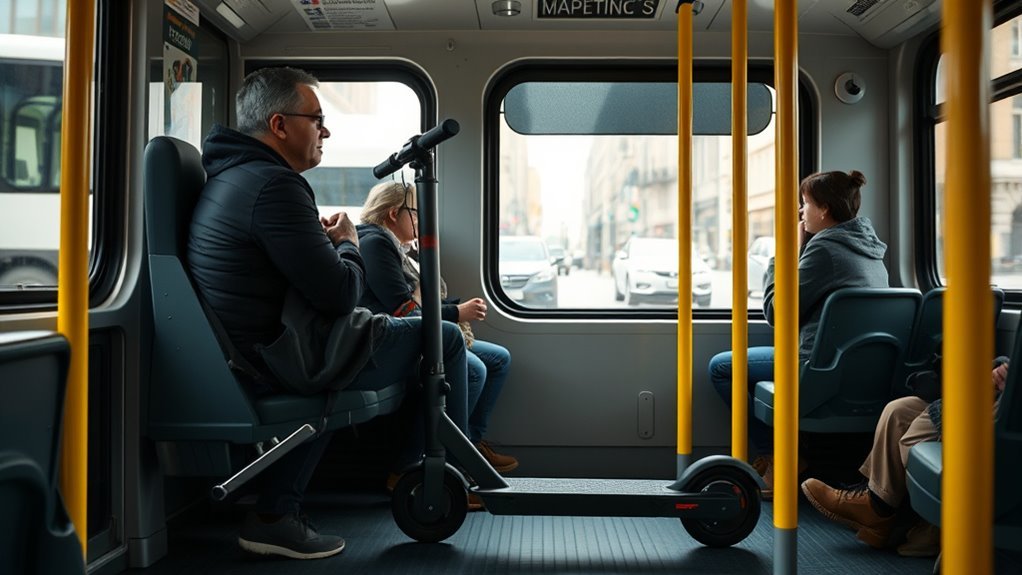
Last Updated on September 27, 2026 by Caleb Warren
You can take an electric scooter on a bus when the operator permits it and your scooter meets its safety and storage rules. Some systems accept folded scooters, while others restrict them or prohibit them completely. The rules also depend on whether you’re using a city bus, express bus, or long-distance coach.
Quick Answer
Yes, many transit agencies allow personal electric scooters on buses if they are folded, switched off, and stored safely. However, there is no universal weight or battery limit. Some operators prohibit scooters entirely, including folded models. Check the specific operator’s policy, secure your scooter before boarding, and keep doors, aisles, and accessibility spaces clear.
Key Takeaways
- New York City allows qualifying folded personal electric vehicles on non-express MTA buses but prohibits them inside express buses.
- Chicago CTA permits personal folding scooters and requires them to be folded during rush periods or crowding.
- LADOT DASH has a published 55-pound scooter limit, while other operators use different standards.
- London TfL and Barcelona TMB prohibit recreational electric scooters on their transport networks.
- Recreational e-scooters and mobility scooters used by passengers with disabilities are treated differently.
Disclosure: As an Amazon Associate I earn from qualifying purchases. Some links on this page are affiliate links, at no extra cost to you.
Can You Take an Electric Scooter on a Bus?
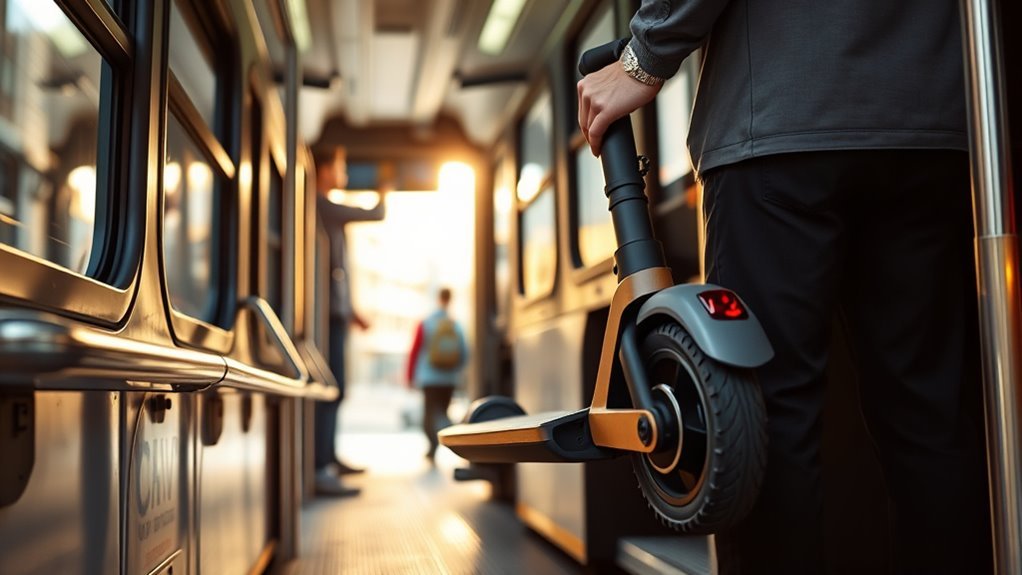
Yes, but permission depends on the specific bus operator and type of service. A folding electric scooter is generally easier to accommodate because it can be carried like luggage without taking up an entire standing area.
For example, New York’s Metropolitan Transportation Authority (MTA) permits qualifying folded personal electric vehicles on buses other than express buses. Its official personal electric vehicle policy requires them to be folded, secured, and kept out of passengers’ way.
However, folding alone does not guarantee permission. The operator may also consider the scooter’s battery, dimensions, condition, and available storage space.
You should distinguish between three types of transportation:
- Local city buses: May allow folded personal scooters under specific storage and safety conditions.
- Express buses: May have stricter restrictions because of their seating arrangements and luggage space.
- Long-distance coaches: May classify scooters as special baggage and impose separate battery or luggage requirements.
A recreational stand-up electric scooter is also different from a mobility scooter used by someone with a disability. Accessibility equipment generally follows separate transport procedures.
Which Scooter Rules Do Bus Systems Use?
Bus operators set their own rules for folding, weight, battery safety, and storage. There is no single standard that applies to every city or transportation company.
The most common requirements concern the following:
- Folding: The scooter must be folded or made compact where the operator requires it.
- Weight: The device must meet any published limit and be manageable during boarding.
- Dimensions: It must fit an approved storage location without obstructing passengers.
- Battery safety: Damaged batteries and unsafe electrical equipment may be prohibited.
- Power: The scooter should remain switched off throughout the journey.
- Storage: Doors, aisles, emergency exits, and accessibility areas must remain clear.
Chicago’s CTA Bike & Ride policy permits personal folding scooters on buses and trains. Personal e-scooters must be folded during rush periods or when vehicles are crowded.
In Los Angeles, the rules vary by operator. Under the LADOT Transit Code of Conduct, scooters brought onto DASH buses must weigh 55 pounds or less. They must also be folded and kept under a seat or in front of their owner without creating an obstruction.
That DASH requirement does not automatically apply to every bus operated by LA Metro or another Los Angeles transit provider.
Likewise, there is no confirmed universal 300-watt-hour battery limit or standard 30 × 20 × 10-inch scooter allowance across bus systems.
The practical rule is to use your exact operator’s published limits rather than a general number from another city.
Fold Your Scooter Before Boarding
Fold your scooter before entering the bus when the operator requires it. Doing this at the stop prevents delays and makes it easier to carry and position your scooter safely.
Before departure, practice the folding process and make sure you can manage the scooter without assistance.
Fold It Fully
Follow your scooter manufacturer’s folding instructions and make sure the entire mechanism closes correctly. A partially folded scooter can swing open unexpectedly or catch on another passenger’s belongings.
- Switch off the scooter.
- Lower the handlebars or stem according to the manufacturer’s instructions.
- Engage the folding mechanism.
- Secure the folded position using the built-in latch.
- Check that loose accessories cannot swing or fall.
- Lift the scooter using its designated carrying point.
If your scooter cannot fold, do not assume you can wheel it directly onto the bus. Some agencies permit only folding devices inside their vehicles.
For example, King County Metro’s published scooter policy allows folding scooters when they can be stored safely outside the aisle.
Check Locked Latches
After folding your scooter, check that the locking mechanism is fully engaged. The stem should not move freely or unfold when you lift the scooter.
Inspect the latch for looseness, damage, or unusual movement before traveling.
If the locking mechanism does not hold securely, repair it before using the scooter again. A loose latch can create problems while carrying the device and may also affect riding safety.
Do not use improvised straps as a substitute for a damaged manufacturer-specified locking mechanism.
Clear Aisle Space
Your folded scooter must not block other passengers from moving through the bus. This includes the entrance, center aisle, emergency exits, and wheelchair access areas.
Keep the scooter close to you and maintain control of it throughout the journey.
Tokyo’s Toei Transportation provides a useful example of more specific luggage requirements. Its official bus FAQ states that permitted carried items must meet these limits:
- Combined length, width, and height of no more than 250 cm.
- Maximum length of 2 meters.
- Maximum weight of 30 kg.
- Wheeled items such as kickboards must be secured inside a suitable bag.
- Passengers must keep one hand available to hold a handrail.
Toei may still restrict items during crowded periods or when staff identify a safety concern. Its general luggage policy should not be treated as unconditional approval for every battery-powered scooter.
Why Bus Drivers Can Refuse Your Scooter
A driver may refuse a scooter when it violates the operator’s conditions or creates a genuine safety concern. Meeting the published size requirements does not guarantee that the bus has enough room to accommodate it.
Common reasons include obstruction, unsafe storage, damaged equipment, and restrictions on particular vehicle types.
| Refusal basis | Practical effect |
|---|---|
| Aisle or exit obstruction | Boarding may be refused until the obstruction is resolved. |
| Excess weight or size | The scooter may exceed the operator’s published limits. |
| Battery condition concern | A damaged or visibly unsafe battery may prevent carriage. |
Drivers must also consider sudden braking and the movement of unsecured items. A scooter that slides or tips over could injure another passenger.
These decisions should follow the operator’s applicable safety and accessibility requirements. A refusal involving a disability-related mobility device may require a different review from an ordinary recreational scooter.
What Battery Rules Apply on Buses?
Battery rules depend on the transport operator. Some agencies specify certification requirements, while others apply general restrictions concerning damaged batteries or hazardous equipment.
The safest preparation is to confirm your battery’s condition and follow the operator’s instructions for transporting the complete scooter.
Check the battery label or manufacturer’s specifications for its capacity, usually expressed in watt-hours (Wh). If the operator publishes a capacity limit, compare that value with your scooter’s actual specification.
Do not assume a 300 Wh limit applies to all buses. Likewise, removing a battery does not automatically make a prohibited scooter acceptable.
Battery capacity, certification, and physical condition are different requirements. A scooter must meet whichever conditions its operator actually specifies.
Follow these precautions before boarding:
- Switch off the scooter and keep it off during transit.
- Inspect the battery housing for cracks or visible damage.
- Check for swelling, leakage, unusual odors, or excessive heat.
- Keep exposed electrical connectors protected.
- Do not charge the scooter unless the operator expressly permits it.
- Do not attempt to disconnect a battery that the manufacturer does not design for user removal.
Warning: Do not transport or operate a scooter with a swollen, leaking, smoking, or unusually hot battery. The U.S. Fire Administration’s battery safety guidance identifies these as potential signs of lithium-ion battery failure. If a battery starts smoking or burning, move away, alert others, and contact emergency services.
Never treat an ordinary bus outlet as a scooter charging point. For example, MTA expressly prohibits charging personal electric vehicles anywhere on its buses or transit property.
E-Scooter Bus Rules by City
Electric scooter rules differ considerably between transit networks. Some accept folded scooters as personal belongings, while others prohibit them even when they are compact and switched off.
The following comparison summarizes the published policies of specific operators, not every transit company serving each city.
| City / Operator | Rule |
|---|---|
| New York City — MTA | Qualifying folded personal electric vehicles are permitted inside non-express buses. All PEVs are prohibited inside express buses. |
| Los Angeles — LADOT DASH | Scooters must weigh 55 pounds or less, be folded, and fit safely under a seat or in front of their owner. |
| Chicago — CTA | Personal folding scooters are allowed. Personal e-scooters must be folded during rush periods or crowding. |
| Seattle area — King County Metro | Folding scooters may travel inside when stored compactly and outside the aisle. |
| London — TfL | E-scooters are prohibited on TfL services, including when folded. |
| Barcelona — TMB | Recreational electric scooters and similar electric personal mobility vehicles are prohibited. |
| Tokyo — Toei Bus | Kickboards are covered by carried-luggage rules requiring secure storage in a suitable bag, subject to size, weight, and safety restrictions. |
Two restrictions deserve particular attention.
London: Transport for London prohibits e-scooters on its services regardless of whether they are folded. Its official cycling and transport rules distinguish e-scooters from folding bicycles and mobility scooters.
Barcelona: TMB’s published transport restrictions prohibit recreational electric scooters and similar electric personal mobility vehicles on its network. The restriction does not apply in the same way to approved mobility devices used by passengers with reduced mobility.
Therefore, a scooter accepted on a bus in Chicago may be prohibited on a bus in London or Barcelona.
How to Board and Store Your Scooter
Boarding is easier when your scooter is already folded and you know where it can be placed. Your goal is to keep the device stable without interfering with other passengers.
Use the following process when your transit operator permits the scooter:
- Confirm the service: Identify whether your journey uses a local bus, express bus, or coach.
- Check the scooter: Confirm its folded dimensions, weight, and battery condition.
- Fold it at the stop: Secure the stem and any loose accessories before boarding.
- Power it off: Do not operate the motor inside the vehicle.
- Board carefully: Carry the scooter using its designated carrying point when required.
- Choose an approved position: Use the designated storage area or another location permitted by the driver.
- Keep it secure: Hold or position the scooter so it cannot roll, slide, or tip during braking.
- Exit safely: Wait until the bus stops before lifting the scooter and moving toward the door.
Never assume you can use the front bicycle rack. Those racks have specific design and weight requirements, and some operators prohibit scooters on them.
For example, METRO RTA’s published riding rules allow qualifying electric scooters on the front bike rack but prohibit recreational electric scooters inside the bus, even when folded.
Its rack-mounted devices must weigh no more than 55 pounds and meet the agency’s size, battery, and securing requirements.
This illustrates why a bus rack and interior storage should be treated as separate options.
When Scooters Aren’t Allowed on Buses
A scooter may be prohibited because of an operator-wide ban, a particular bus service, or an unsafe condition. Restrictions can also apply during crowded periods.
Knowing the difference helps you determine whether another departure, a different service, or another transportation method is appropriate.
Driver Safety Decisions
A driver can make a safety decision based on the actual conditions inside the vehicle. This may include the available storage space, crowding, and whether your scooter can remain secure.
Follow the published transport rules and the driver’s lawful safety instructions.
If boarding is refused:
- Ask which rule or safety concern applies.
- Do not attempt to force the scooter onto the bus.
- Note the route, vehicle number, and time.
- Contact the transit agency if you believe its published policy was applied incorrectly.
When the problem is crowding rather than a permanent prohibition, a later bus may offer enough space.
Peak Hour Restrictions
Peak-hour restrictions are not consistent across transit systems. Some operators require scooters to be folded during busy periods, while others may refuse an item when the bus cannot accommodate it safely.
| City / Operator | Rule | Effect |
|---|---|---|
| Chicago — CTA | Personal e-scooters must be folded during rush periods or crowding. | Keep the scooter compact and stored safely. |
| New York City — MTA | Qualifying folded scooters may travel on non-express buses, subject to applicable transport restrictions. | Express buses remain prohibited regardless of departure time. |
| Los Angeles — LADOT DASH | Scooters must meet folding, weight, and safe-storage requirements. | A crowded bus may not have suitable storage space. |
| Other systems, including Tokyo Toei | Crowding and operator-specific restrictions apply. | Boarding may be declined when an item creates a safety concern. |
Do not assume that traveling outside rush hour overrides a permanent scooter prohibition.
Oversized or Damaged Scooters
Oversized and damaged scooters may be refused because they cannot be carried or stored safely. The actual size and weight limits depend on the operator.
Potential problems include:
- A scooter that cannot fold when folding is required.
- A frame that exceeds the operator’s dimensions.
- A weight above the published allowance.
- A folding latch that cannot secure the scooter.
- A damaged battery or exposed electrical connection.
- Loose accessories that may fall during the journey.
If the scooter is too large for the permitted space, do not try to place it across the aisle or occupy a wheelchair securement location.
Note: A mobility scooter used by someone with a disability is not the same as a recreational stand-up scooter. Accessibility policies may provide ramp access and securement arrangements. If you use a mobility scooter, ask the transit operator about its specific accessibility procedures rather than applying ordinary recreational scooter limits.
Frequently Asked Questions
Can I Bring an E-Scooter on a Bus?
Yes, if the operator permits personal electric scooters and your device meets its conditions. Many systems require folding, safe storage, and the motor to remain switched off. Some services prohibit scooters entirely, so permission on one bus route does not guarantee permission on another.
Can You Get on a Bus With an E-Scooter That Does Not Fold?
Only if the operator expressly allows non-folding scooters. Many transit systems require recreational scooters to fold before entering the bus. A non-folding model may be refused because of its dimensions or storage requirements. Never assume that an available wheelchair space can be used for an ordinary recreational scooter.
Can I Bring My Electric Scooter on a Greyhound Bus?
For Greyhound in the United States, recreational electric scooter acceptance should be confirmed directly before booking. Its general baggage policy does not establish unconditional permission for battery-powered scooters. Ask whether your specific device and battery are accepted and whether storage must be inside the cabin or luggage compartment. Greyhound Australia separately prohibits recreational e-scooters.
How Do You Put an Electric Scooter on a Bus?
Switch off the scooter, fold it completely, and engage its locking mechanism before boarding when required. Carry it using the designated carrying point and place it in an approved storage position. Keep it stable during the journey and make sure other passengers can reach the doors and exits without obstruction.
Can You Bring an Electric Scooter on a Bus Bike Rack?
Only if the operator allows scooters on its racks and the device fits the rack’s requirements. Bicycle racks are not automatically suitable for electric scooters. Some agencies permit qualifying scooters on racks while prohibiting them inside the bus. Others allow interior storage but have separate rack restrictions.
Are Mobility Scooters Allowed on Buses?
Mobility scooters used by passengers with disabilities are generally handled under separate accessibility policies. For example, Greyhound in the United States provides wheelchair lifts and arrangements for qualifying mobility scooters. Dimensions, securement, and available accessibility spaces still matter, so passengers should provide their device details when arranging travel.
For long-distance journeys, consult the operator’s baggage and accessibility conditions before buying your ticket. Greyhound’s U.S. baggage policy covers general and bulky luggage, while its accessibility guidance addresses mobility scooters and other assistive devices separately.
Greyhound Australia’s official travel FAQ expressly states that lithium battery-powered transport devices, including recreational e-scooters, are not permitted on its services.
Conclusion
You can bring an electric scooter on many buses, but permission depends on the operator and the specific service. Folding and switching off your scooter are useful precautions, not guarantees of acceptance.
Before traveling, confirm the actual transport rules, inspect your scooter, and make sure you can store it without blocking passengers or exits. If your route includes multiple operators, check each one separately so you do not discover a restriction halfway through your journey.
Sources
- Metropolitan Transportation Authority: Personal electric vehicle transport, folding requirements, express bus restrictions, and charging prohibition.
- Chicago Transit Authority: Personal scooter transport and folding requirements during rush periods.
- LADOT Transit: DASH scooter weight, folding, and storage rules.
- King County Metro: Folding scooter transport and driver safety decisions.
- Toei Transportation: Tokyo bus luggage dimensions, weight, and secure-storage requirements.
- U.S. Fire Administration: Lithium-ion battery safety and warning signs.
- Transport for London: Electric scooter prohibition and distinctions between transport devices.
- Transports Metropolitans de Barcelona: Electric personal mobility vehicle restrictions.
- METRO RTA: Recreational scooter restrictions and bicycle-rack requirements.
- Greyhound U.S. Baggage Policy: General and bulky luggage conditions.
- Greyhound Accessibility Policy: Mobility scooter boarding and storage arrangements.
- Greyhound Australia: Restrictions on lithium battery-powered transport devices.

