Last Updated on September 27, 2026 by Caleb Warren
You can ride an electric scooter on gravel, but the surface makes steering, braking, and balance less predictable. Packed gravel is easier to manage than deep, loose stones, and your scooter’s tires and suspension make a significant difference. Before leaving pavement, check whether your scooter is designed for mixed terrain and learn how to adjust your riding technique.
Quick Answer
Yes, an electric scooter can handle some gravel if its manufacturer permits that terrain. Larger pneumatic tires, effective suspension, and responsive brakes help you maintain control. Reduce your speed before entering gravel, avoid sudden movements, and allow extra stopping distance. Walk the scooter when stones are deep, wet, or too loose to maintain traction.
Disclosure: As an Amazon Associate I earn from qualifying purchases. Some links on this page are affiliate links, at no extra cost to you.
Can You Ride an Electric Scooter on Gravel?
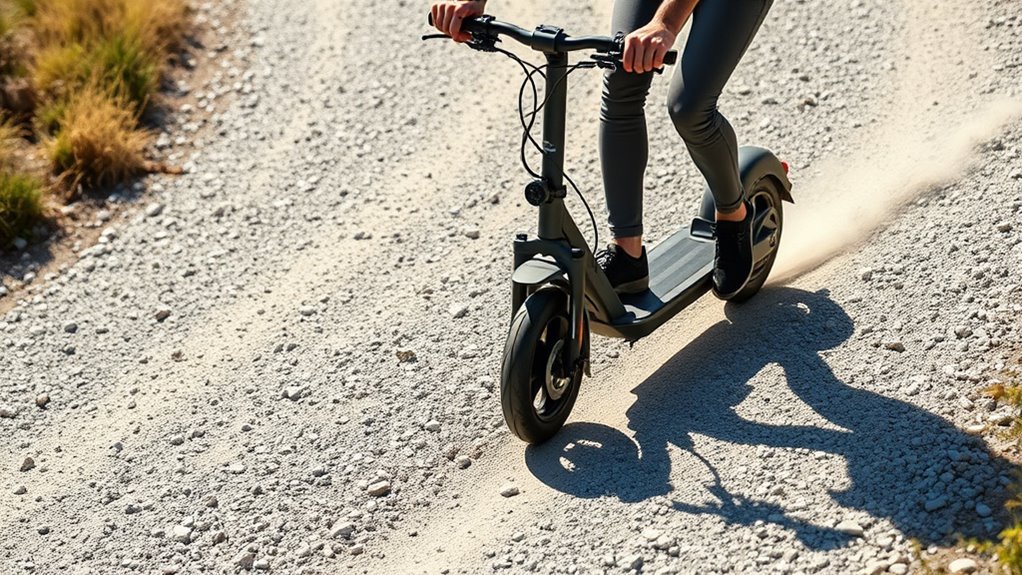
Yes, but the type of gravel matters. A firm, compacted path may be manageable on a suitable electric scooter, while deep stones can make the front wheel slide or turn unexpectedly.
Before riding, consult your scooter’s instructions to confirm its intended terrain. A scooter designed only for smooth pavement should not be treated as an off-road vehicle.
The U.S. Consumer Product Safety Commission’s scooter safety guidance warns that small wheels can stop suddenly when they encounter obstacles or uneven surfaces.
The following comparison helps you judge whether a gravel route is suitable.
| Surface | Main concern | Recommended approach |
|---|---|---|
| Firm, packed gravel | Vibration and reduced grip | Ride slowly if your scooter permits it. |
| Loose gravel | Wheel spin and unpredictable steering | Avoid it if you cannot maintain a stable line. |
| Deep stones or severe ruts | Front-wheel deflection or sudden stopping | Get off and walk the scooter. |
| Wet gravel or mud | Reduced traction and possible hidden obstacles | Choose a firmer, drier route. |
Why Gravel Makes Scooters Less Stable
Gravel reduces scooter stability because individual stones can move beneath the tires. Unlike smooth pavement, it does not provide a consistent surface for accelerating, cornering, or braking.
Three problems are especially important:
- Reduced traction: Tires can spin or slide rather than grip the ground.
- Unpredictable steering: Larger stones and ruts can push the front wheel away from your intended direction.
- Longer stopping distances: Loose material can reduce available braking grip, even when the brakes work properly.
Smaller wheels are more easily disturbed by obstacles. Solid tires also transmit more vibration because they lack the cushioning provided by compressed air.
Repeated impacts may increase wear on tires, suspension parts, fasteners, and wheel bearings. Rough terrain also places more physical demand on the rider.
What Electric Scooter Features Help on Gravel
The most useful gravel-riding features are suitable pneumatic tires, larger wheels, effective suspension, and brakes you can control smoothly. Motor torque and frame strength also matter, particularly on hills.
No single feature makes loose gravel safe. The scooter needs to work as a complete system.
Tire Grip Matters
Pneumatic tires contain air, allowing them to absorb small impacts and conform to uneven ground. They generally provide a more comfortable ride on gravel than solid tires.
Look for these characteristics:
- Larger wheels that can roll over small stones and surface gaps more easily.
- Wider tires suited to the scooter’s frame and intended terrain.
- All-terrain tread appropriate for loose surfaces.
- Sound sidewalls without cuts, cracks, or bulges.
- Correct inflation based on the manufacturer’s specification.
Deep tread can help on loose ground, but an aggressive pattern is not automatically better on every surface. Tire design and rubber compound also affect grip.
Do not deliberately underinflate your tires to increase their contact area. Excessively low pressure can cause poor handling, tire damage, and additional rolling resistance.
Solid tires resist punctures, but they generally offer less cushioning. If your regular route includes gravel, pneumatic tires are usually the more suitable option.
Suspension Improves Control
Suspension absorbs impacts and helps reduce the movement transferred through the deck and handlebars. A well-designed system can also help maintain wheel contact over uneven ground.
Different components provide different benefits:
- Front suspension: Reduces impacts transmitted through the steering assembly.
- Rear suspension: Improves comfort when the rear wheel crosses bumps.
- Dual suspension: Helps absorb repeated impacts at both wheels.
- Air-filled tires: Cushion smaller irregularities before they reach the suspension.
- Hydraulic disc brakes: Can provide controlled braking, but available tire grip still determines how much braking force reaches the ground.
Advanced systems, including Damping Arm suspension, aim to improve ride comfort on rougher surfaces. However, suspension cannot prevent skidding when gravel moves beneath the tires.
A sturdy frame, suitable motor torque, and properly functioning brakes complete the setup.
How Gravel Affects Speed and Battery
Gravel can reduce acceleration and usable battery range by increasing rolling resistance and reducing traction. How much performance changes depends on the scooter, rider, route, and surface conditions.
Deep stones, steep climbs, repeated acceleration, and incorrect tire pressure can increase energy demand.
Speed Loss on Gravel
Electric scooters usually accelerate less effectively on loose gravel because some motor power is lost through tire slip and surface movement.
There is no reliable universal percentage for speed loss. A scooter may cross a short, packed-gravel section comfortably but struggle on deep stones or a steep, loose climb.
The safest approach is to reduce speed before reaching the gravel rather than relying on braking once the surface becomes unstable.
You should also expect slower progress when restarting, climbing, or crossing repeated ruts.
Speed matters for battery performance even on smooth ground. For example, the manufacturer’s published NAVEE ST3 Pro specifications list maximum ranges of 75 km at 15 km/h and 55 km at 25 km/h under specified test conditions.
These are manufacturer range figures, not measured gravel performance. They illustrate why you should not assume a single advertised range applies to every riding condition.
Battery Drain Increase
Loose gravel can make the motor work harder, especially during acceleration and hill climbing. That extra load can shorten the distance available from a charge.
For example, a scooter that normally completes a 20 km paved route may not cover the same distance on a rough gravel route. The actual difference depends on terrain, tire condition, rider weight, temperature, and riding style.
Battery condition also matters. Cold temperatures can reduce the usable capacity of lithium-ion batteries, while prolonged heavy loads may increase motor and controller temperatures.
To manage your range:
- Begin longer routes with sufficient battery charge.
- Use a lower power mode when appropriate.
- Maintain steady throttle input instead of repeatedly accelerating hard.
- Allow extra battery reserve for hills and the return journey.
- Stop if the scooter displays a temperature warning, loses power unexpectedly, or behaves abnormally.
If you regularly ride rough routes, record the distance and battery consumption on your actual scooter. This gives you a more useful planning reference than an unverified gravel-range estimate.
Electric Scooter Gravel Riding Tips
The safest gravel-riding technique is to maintain a controlled speed, keep the scooter upright, and use smooth steering and braking inputs. Prepare before entering the loose surface.
Follow these steps:
- Inspect the route. Look ahead for firm sections, deep stones, potholes, and ruts.
- Reduce speed before entering gravel. Make major speed adjustments while you still have predictable traction.
- Keep both hands on the handlebars. Maintain a secure grip without locking your elbows.
- Bend your knees slightly. Let your legs absorb vibration while keeping your weight centered over the deck.
- Apply the throttle gently. Sudden acceleration can cause the driven wheel to spin.
- Brake progressively. Keep the scooter upright and avoid combining hard braking with sharp steering.
- Choose the firmest available line. Avoid deep piles of stones and sudden changes in surface texture.
- Stop and walk when necessary. Do not attempt to power through terrain that causes repeated slipping or harsh impacts.
Wear a properly fitted helmet, closed-toe shoes, and suitable protective pads. Keep your attention on the route rather than your phone or other distractions.
The manufacturer’s Joyor gravel-riding guidance also recommends reducing speed before loose surfaces, braking progressively, and choosing more compact ground.
Warning: If a wheel begins to skid, release the throttle and try to keep the scooter upright. Avoid grabbing the brakes suddenly. Slow progressively when traction returns, and stop before continuing.
If your scooter has adjustable power modes or traction control, use the manufacturer’s recommended settings for loose ground.
NAVEE’s ST3 Pro technical guidance recommends a lower power mode and a speed of 10 km/h or less on slippery or loose surfaces. This is model-specific guidance, not a universal guarantee of safety.
When to Avoid Gravel on an Electric Scooter
Avoid gravel when the surface exceeds your scooter’s design limits or your ability to maintain control. Some conditions are unsuitable even for models marketed for mixed terrain.
Choose another route when you encounter:
- Deep, loose stones that cause the wheels to sink or wander.
- Wet gravel, mud, or standing water that conceals surface hazards.
- Large rocks, severe ruts, or repeated bottoming of the suspension.
- Steep gravel slopes where the scooter cannot maintain traction.
- A damaged tire, loose handlebar, weak brake, or unusual mechanical noise.
- Terrain prohibited by the scooter’s manufacturer.
Small wheels, solid tires, and limited suspension can make a basic commuter scooter less suitable for rough ground. However, even a capable scooter cannot overcome every surface hazard.
Do not enter a gravel section at a speed that leaves insufficient room to stop.
If the route deteriorates unexpectedly, dismount and push the scooter to firmer ground.
Better Options for Gravel and Dirt Paths
If gravel is part of your regular route, consider a scooter specifically designed for mixed terrain or off-road use. Focus on the complete specification rather than the motor’s advertised wattage alone.
The NAVEE ST3 Pro mentioned earlier is one example of a performance-oriented scooter with larger tires and suspension.
Its published specifications include:
- 10-inch self-healing tubeless tires.
- Front and rear Damping Arm suspension.
- 600W rated motor power and 1,350W maximum power in the listed standard version.
- Front drum brake, rear disc brake, and rear electronic braking.
- Traction control and an IPX5 water-resistance rating.
These features may improve comfort and handling on uneven paths, but they do not make every gravel route suitable.
You also do not need to assume that 1,000W is the minimum motor power for gravel riding.
For comparison, the Xiaomi Electric Scooter 6 Essential has 10-inch pneumatic tires and a 500W peak motor. Xiaomi includes gravel among the surfaces its tires are designed to handle.
Motor power alone does not determine climbing ability. Rider weight, available torque, tire grip, slope, and controller performance all influence the result.
When comparing scooters, prioritize the following features:
- Tires and wheel size appropriate for your route.
- Effective suspension with adequate travel.
- Predictable mechanical braking.
- A frame and weight limit suitable for the rider.
- Manufacturer approval for the intended terrain.
- Clearly specified dust and water protection.
Check the ingress-protection rating carefully. IPX5 describes a level of water-jet resistance, but the X means no dust-protection rating is specified.
The IP rating explanation from Oriental Motor distinguishes between the solid-particle and water-protection portions of the rating.
Do not assume that IPX5 makes a scooter dustproof or suitable for immersion.
Gravel Ride Maintenance Tips
Gravel can leave dust, stones, and grit around the wheels and moving parts. Regular inspection helps identify damage before it affects handling or reliability.
Use this checklist before and after rough-surface rides.
Before Riding
- Measure tire pressure and follow the manufacturer’s recommended value.
- Inspect the tread, sidewalls, and valve areas for damage.
- Check that the handlebar, folding mechanism, and visible fasteners are secure.
- Test both brakes at low speed on a safe surface.
- Check for unusual wheel play, rubbing, or resistance.
For a concrete example, the NAVEE ST3 Pro support documentation specifies a standard tire-pressure range of 42–48 PSI for its listed tire setup. Do not apply that figure to another scooter without confirming its requirements.
After Riding
- Remove loose stones and debris from the tread and exposed components.
- Wipe the tires, deck, and accessible surfaces with a soft, damp cloth.
- Inspect suspension parts, fenders, and visible fasteners for damage.
- Check whether either wheel has developed roughness, unusual noise, or resistance.
- Allow the scooter to dry completely before storage or charging.
Keep water away from electrical connectors and the charging port. Avoid pressure washing unless your manufacturer explicitly permits it.
Do not routinely open sealed wheel bearings to clean or lubricate them. If they develop play, roughness, or grinding sounds, arrange an appropriate inspection or replacement.
If the suspension repeatedly bottoms out, inspect it for damage and adjust it only according to the manufacturer’s instructions.
Note: Stop riding if you discover a loose steering assembly, damaged tire, unreliable brake, or unusual motor noise. Have a qualified scooter technician inspect problems you cannot safely diagnose or repair.
Frequently Asked Questions
Are Scooters Good for Autistic Kids?
An age-appropriate, nonmotorized kick scooter may be an enjoyable activity for some autistic children. Individual balance, coordination, and sensory preferences matter. Start on smooth ground with a helmet and adult supervision. The American Academy of Pediatrics advises against motorized e-scooter use under age 16.
What Happens if You Get Caught on an Electric Scooter?
The consequences depend on local law and the circumstances. Riding where electric scooters are prohibited may result in a warning, citation, fine, or impoundment. Rules concerning age, helmets, speed, and permitted riding areas vary by jurisdiction. Confirm the regulations that apply to your route.
Can a 500W Scooter Go Uphill?
Yes, a 500W scooter can climb some hills, depending on its motor rating, torque, rider weight, and the slope. Gravel makes climbing harder because the driven wheel can lose traction. Check the manufacturer’s climbing specification and avoid continuing if the motor overheats or the wheel repeatedly spins.
Should You Lower Scooter Tire Pressure on Gravel?
Do not lower tire pressure below the manufacturer’s recommended range simply because you are riding on gravel. Underinflation can increase rolling resistance and cause poor handling or tire damage. Measure pressure with a suitable gauge and follow the specification for your particular tires.
Can You Ride an Electric Scooter on Wet Gravel?
Wet gravel is generally more hazardous because traction is less predictable and puddles can conceal rocks or ruts. Avoid it when possible, especially on steep or loose sections. Water resistance does not guarantee protection against immersion, and wet riding conditions can increase braking and handling risks.
Conclusion
You can ride an electric scooter on suitable gravel, but the surface demands more care than pavement. Larger pneumatic tires, effective suspension, smooth braking, and conservative speeds can improve control.
Before choosing a gravel route, confirm your scooter’s terrain limits and inspect its tires and brakes. If the ground becomes deep, wet, or unstable, walk the scooter or choose a firmer path.
Sources
- U.S. Consumer Product Safety Commission: Scooter safety, inspections, protective equipment, and uneven-surface hazards.
- Joyor Gravel Riding Guidance: Gravel handling, braking, tire inspection, and route selection.
- NAVEE ST3 Pro Technical Support: Traction guidance, tire pressure, maintenance, and battery-range factors.
- NAVEE ST3 Pro Specifications: Motor, tires, suspension, braking system, IP rating, and manufacturer range figures.
- Xiaomi Electric Scooter 6 Essential: Motor output, pneumatic tires, intended surfaces, and climbing specifications.
- Oriental Motor IP Ratings Guide: Interpretation of dust and water ingress-protection ratings.
- American Academy of Pediatrics: Pediatric electric scooter safety and age recommendations.