

Last Updated on September 11, 2026 by Daniel Globe
A felony conviction from 40 years ago does not automatically prevent a U.S. citizen from traveling internationally. However, getting a U.S. passport and being admitted by another country are separate matters. Your destination may consider the offense, sentence, date the sentence ended, number of convictions, current legal restrictions, and the information requested on its visa or entry form.
Quick Answer
Yes. A felony from 40 years ago usually does not by itself prevent a U.S. citizen from getting a passport, but every destination controls admission. The offense, sentence, completion date, current warrants or supervision, and the country’s disclosure rules determine whether you may need advance permission, rehabilitation, or a visa.
Key Takeaways
- An old felony normally is not an automatic lifetime bar to a U.S. passport.
- A passport allows you to travel, but it does not guarantee that another country will admit you.
- Canada, the United Kingdom, Australia, and other destinations apply their own criminal-admissibility rules.
- Check for warrants, probation or parole conditions, court orders, and other active restrictions before planning the trip.
- Answer every visa and immigration question truthfully, including questions that specifically cover sealed, expunged, or pardoned records.
Legal information: This article gives general information for U.S. travelers. It is not legal advice, and it cannot predict whether a passport agency, consulate, immigration officer, or border officer will approve a particular case.
Disclosure: As an Amazon Associate I earn from qualifying purchases. Some links on this page are affiliate links, at no extra cost to you.
Can You Travel With an Old Felony?

You can often travel internationally with an old felony, but you must clear three separate checks:
- Passport eligibility: Determine whether you can obtain and use a valid U.S. passport.
- Permission to leave: Confirm that no warrant, court order, probation condition, parole condition, or other restriction prevents travel.
- Destination admissibility: Check whether the country you plan to visit requires a visa, electronic travel authorization, criminal-history disclosure, rehabilitation approval, or other permission.
The age of the conviction helps in some countries, but the number “40 years” does not create a universal right of entry. A country may focus on the type of offense, the sentence imposed, how long ago every part of the sentence ended, whether there were later offenses, and the equivalent offense under that country’s law.
Warning: Do not make nonrefundable reservations until you have checked the destination’s current rules. A valid passport, visa, rehabilitation approval, or electronic authorization may still be subject to a final admission decision at the border.
How a Felony Shows Up on Records
A felony conviction does not normally disappear simply because several decades have passed. Court files, state criminal-history repositories, FBI records, law-enforcement systems, commercial databases, and previously published information may contain different versions of the case.
The most useful question is not simply whether the conviction is “old.” It is whether the record is accurate, what legal relief was granted, and what the destination requires you to disclose.
Record visibility depends on the source and purpose:
- Court records: The court may retain a docket and disposition even when public access is later restricted.
- State repositories: State police or identification bureaus may maintain arrest and disposition information submitted by courts and law-enforcement agencies.
- FBI records: An FBI Identity History Summary may contain fingerprint-supported arrest and disposition information reported to the FBI.
- Consumer reports: Federal and state laws regulate what commercial background-check companies may report.
- Immigration screening: Government immigration checks operate under immigration, border, law-enforcement, and information-sharing laws rather than the Fair Credit Reporting Act.
Note: The federal Fair Credit Reporting Act generally permits consumer reporting agencies to report criminal convictions older than seven years. That rule concerns consumer reports and does not establish what a foreign border officer can access.
Can a Felony Be Expunged After 40 Years?
Possibly. Eligibility depends on the jurisdiction, offense, sentence, later criminal history, and the kind of relief available. States use terms such as expungement, sealing, set-aside, dismissal, certificate of rehabilitation, and pardon, but those remedies do not all have the same legal effect.
A long crime-free period may help satisfy a state waiting period, but some offenses remain ineligible. Federal law also has no general process that lets every person erase a valid federal felony conviction. Limited remedies may be available in narrow circumstances, and a presidential pardon does not necessarily destroy the court record.
Record relief can still be valuable, but it should not be treated as an automatic travel clearance. A foreign application may ask whether you have ever been convicted, including convictions that were sealed, expunged, set aside, or pardoned. Read the exact wording and obtain legal advice if you are unsure how to answer.
Pro Tip: Keep certified copies of the final court disposition, proof that every sentence condition was completed, and any sealing, expungement, pardon, or rehabilitation order. A short commercial background report is not a substitute for official records.
How Felonies Affect Travel

An old conviction can affect different stages of a trip. It may have little effect on passport issuance but become important when you apply for a visa, electronic travel authorization, rehabilitation decision, or admission at the border.
U.S. Passport and Departure Rules
A completed felony conviction usually does not create a permanent passport ban. However, the U.S. Department of State identifies several circumstances that can support passport denial or revocation, including a valid federal warrant, a criminal court order, an extradition request, or a probation or parole condition that prohibits departure.
Federal law also restricts passports in certain drug-trafficking cases when a passport or international border was used to commit the offense and the person remains imprisoned or on supervised release. Other noncriminal issues, including seriously delinquent federal tax debt or qualifying child-support debt, may also affect passport issuance.
If you are currently or recently were on probation or parole, review the Department of State’s passport guidance for probation and parole and confirm the travel conditions with the supervising authority.
Criminal Checks at Borders
There is no single worldwide database rule that applies to every traveler. Depending on the destination and travel authorization, officials may consider information from:
- Answers on a visa or electronic authorization application
- Police certificates or court documents you submit
- Previous visa applications and border interviews
- Domestic or international warrants and alerts
- Lawfully shared immigration or law-enforcement information
- Information discovered during additional screening
A border officer may ask about the offense, sentence, date of completion, later conduct, and purpose of travel. Never assume that an old or sealed matter is invisible. At the same time, do not assume that every officer automatically receives every state, federal, or commercial record.
Waivers, Rehabilitation, and Record Relief
The correct remedy depends on the destination. Available options may include:
- Deemed rehabilitation: A country treats the traveler as rehabilitated because legal conditions and waiting periods have been met.
- Individual rehabilitation: The traveler applies in advance for a formal decision based on the offense, sentence, elapsed time, and later conduct.
- Temporary permission: A country permits a limited visit despite inadmissibility when its legal standard is met.
- Record relief: A court or government grants sealing, expungement, set-aside, pardon, or a similar remedy.
- Character waiver or discretionary review: Immigration officials consider the complete circumstances instead of applying an automatic approval rule.
These processes are not interchangeable, and none guarantees admission. Confirm which remedy the destination recognizes before paying filing fees or changing your record.
Country Entry Examples
The following examples show why destination-specific research matters. They are not a complete list of every country or every ground of inadmissibility.
| Destination | How an Old Conviction May Matter | Possible Next Step |
|---|---|---|
| Canada | Canada may compare the U.S. offense with an offense under Canadian law. The result can depend on the equivalent offense, maximum Canadian penalty, number of convictions, and when the entire sentence ended. | Review deemed rehabilitation, individual rehabilitation, a Canadian record suspension, or a temporary resident permit. |
| United Kingdom | Current rules include mandatory and discretionary criminality grounds. A custodial or suspended sentence of at least 12 months can create a mandatory refusal ground regardless of how old it is. | Review the current suitability rules and consider applying for a Standard Visitor visa when advance review is appropriate. |
| Australia | Visa applicants must meet character requirements and disclose requested criminal conduct. Officials may request police certificates and supporting documents. | Use the visa category recommended for applicants with convictions and provide complete character information. |
Canada
Canada can find a person criminally inadmissible because of an offense committed outside Canada. However, an old conviction does not always produce the same result.
According to Immigration, Refugees and Citizenship Canada, possible routes include:
- Showing that you meet the legal conditions for deemed rehabilitation
- Applying for and receiving individual criminal rehabilitation
- Receiving a qualifying Canadian record suspension
- Obtaining a temporary resident permit when the legal standard is met
Deemed rehabilitation is limited. Among other requirements, the Canadian equivalent of an offense committed outside Canada generally must have a maximum prison term of less than 10 years, and multiple offenses can change the analysis. The waiting period normally runs from completion of every part of the sentence, not merely the conviction date.
United Kingdom
The UK’s Part Suitability immigration rules contain mandatory and discretionary criminality grounds. Under the current rules, a custodial or suspended sentence of 12 months or more can require refusal. Shorter or noncustodial sentences may also support refusal, although the exact rule depends on the application and circumstances.
The UK advises travelers with a criminal record to consider applying for a Standard Visitor visa even when they might otherwise use an electronic travel authorization. Approval of an authorization or visa does not remove the final border decision.
Australia
Australia requires visa applicants to meet character requirements. Applicants must truthfully declare the criminal conduct requested on the application and may be asked for police certificates, court records, or a statement explaining the circumstances.
Australia advises a traveler with a criminal conviction who might otherwise use an Electronic Travel Authority to apply for the appropriate Visitor visa and provide evidence about the conviction. A decades-old conviction does not guarantee refusal, but it can trigger a character assessment.
What Border Officers Can See
You cannot know in advance every item a particular officer will see. Information availability varies by country, legal authority, travel document, visa system, and the facts of the case.
An officer may know about a conviction because you disclosed it, submitted a police certificate, applied for rehabilitation, provided court documents, made a previous visa application, or matched an immigration or law-enforcement alert. Officers may also ask follow-up questions when an application contains incomplete or inconsistent information.
The safest approach is to prepare for accurate disclosure rather than trying to predict whether the conviction will appear. Misrepresentation can create a separate immigration problem even when the original offense would not have caused an automatic refusal.
How to Check Your Record Before Traveling
Reviewing your records before applying helps you use the correct offense name, dates, sentence details, and disposition. It also gives you time to correct errors.
- Request an FBI Identity History Summary. The FBI Identity History Summary process provides fingerprint-supported information held in the FBI’s criminal file.
- Request your state criminal history. Contact the state identification bureau or state police in every state connected with the case.
- Obtain the certified court disposition. Ask the court for the charging document, final judgment, sentence, and proof that the case was closed.
- Confirm sentence completion. Collect proof that incarceration, probation, parole, restitution, fines, classes, and other conditions were completed.
- Check for mistakes. Challenge inaccurate or incomplete FBI, state, or court information through the process provided by the responsible agency.
- Review record relief. Obtain certified copies of any expungement, sealing, dismissal, pardon, set-aside, or rehabilitation decision.
Products Worth Considering
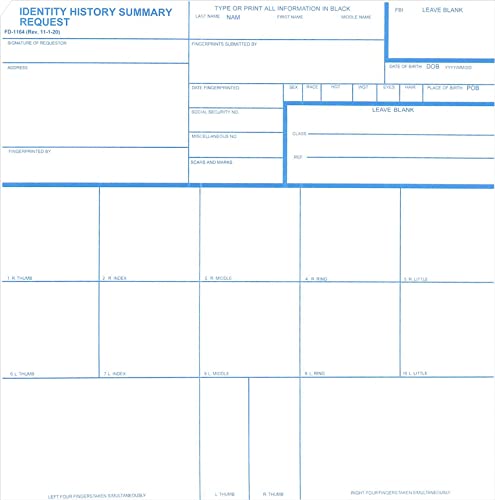
The FD-1164 card is used for fingerprinting for identity history summary checks. <P> The FBI Identity History Summary, also referred to as a "rap sheet:' is a listing of...
Documents to Gather Before Travel
A consulate, immigration office, lawyer, or border official may request more than a standard background report. Depending on the destination, useful documents may include:
- Certified final court disposition
- Charging document or indictment
- Sentencing order
- Proof that probation or parole ended
- Proof that fines and restitution were paid
- Expungement, sealing, pardon, or set-aside order
- Police certificates requested by the destination
- A personal statement explaining the offense and later conduct
- Evidence of employment, family responsibilities, education, community involvement, or rehabilitation
- Travel itinerary and evidence supporting the purpose of the visit
Documents may need certification, translation, or authentication. Follow the destination’s instructions rather than submitting an informal printout.
Pre-Travel Checklist
- Confirm that your passport is valid for the required period.
- Check for warrants, court orders, supervision conditions, or other restrictions.
- Read the official immigration and visa rules for the destination and any transit country.
- Review the exact criminal-history questions on the application.
- Obtain your FBI, state, and court records.
- Compare your offense with the destination’s legal standard.
- Apply for rehabilitation, a permit, waiver, or visa when required.
- Keep copies of every application and supporting document.
- Carry relevant approval letters and certified records when advised.
- Avoid nonrefundable bookings until the important approvals are complete.
Products Worth Considering


Frequently Asked Questions
How many years does a felony stay on your record?
A felony conviction does not normally disappear automatically after a fixed number of years. It may remain in court, state, or federal records unless the jurisdiction grants sealing, expungement, a set-aside, or another form of relief. Public access and permitted uses vary by jurisdiction.
Can you be charged for something that happened 30 years ago?
It depends on the offense and jurisdiction. Many crimes have a statute of limitations, but some serious crimes have longer periods or no limitation period. The clock may also be paused or extended in circumstances such as flight, concealment, later discovery, or the availability of DNA evidence.
Can I go to Canada if I had a felony 20 years ago?
Possibly. Canada assesses the Canadian equivalent of the offense, the sentence, when all sentence conditions ended, and whether you have other offenses. You may qualify for deemed rehabilitation, individual rehabilitation, or a temporary resident permit, but a 20-year-old conviction is not automatically approved or refused.
How long does a felony stay on your record in the USA?
There is no single nationwide expiration date. A conviction may remain in court and criminal-history records indefinitely unless state or federal law provides an effective form of relief. Rules for public access, employment reports, licensing checks, and government use are different.
Does an expungement guarantee that I can enter another country?
No. Expungement may improve the record under the law that granted it, but another country can apply its own disclosure and admissibility rules. Some applications require disclosure of convictions even when they were sealed, expunged, dismissed, or pardoned.
Can I travel internationally while on probation or parole?
Only when your court order, supervision conditions, and supervising authority permit it. A restriction against leaving the country or court jurisdiction can affect passport issuance or use. Obtain written permission when required before making travel arrangements.
Do I have to disclose a 40-year-old or sealed conviction?
Answer the exact question on the application. If it asks whether you have ever been convicted, including sealed, expunged, or pardoned matters, the age of the case does not remove the disclosure duty. Obtain legal advice when the wording or effect of a court order is unclear.
Conclusion
A felony from 40 years ago does not necessarily prevent international travel, but the age of the case alone cannot answer the question. First confirm your passport and departure eligibility. Then obtain accurate court and criminal-history records, study the destination’s current rules, and complete any rehabilitation, permit, waiver, or visa process before booking the trip.
Be truthful on every application and keep certified documents supporting the final disposition and your rehabilitation. When the destination has strict criminal-admissibility rules or the offense is serious, individualized advice from a qualified criminal-record or immigration lawyer can reduce the risk of denial, delay, or misrepresentation.
Sources
- U.S. Department of State: Passport Information for Law Enforcement — passport restrictions involving warrants, court orders, supervision conditions, and extradition.
- Immigration, Refugees and Citizenship Canada: Overcome Criminal Convictions — deemed rehabilitation, individual rehabilitation, record suspensions, and temporary resident permits.
- FBI: Identity History Summary Checks — reviewing, correcting, and understanding FBI criminal-history information.
- UK Home Office: Immigration Rules Part Suitability — current UK criminality grounds for refusal and cancellation.
- Australian Department of Home Affairs: Character Requirements for Visas — disclosure, police certificates, and character assessments.
- U.S. House Office of the Law Revision Counsel: 15 U.S.C. §1681c — federal consumer-report time limits and the conviction exception.
