
Last Updated on September 11, 2026 by Daniel Globe
You may travel outside the United States with a valid I-512 or I-512L advance parole document if it covers your departure and planned return. However, advance parole is not a visa and does not guarantee that U.S. Customs and Border Protection will parole you into the country. Your immigration category, case history, document dates, and reason for travel all matter.
Quick Answer
Yes, you may travel internationally if USCIS has already issued a valid advance parole document covering your departure and return. You must still pass CBP inspection. Travel may be unsafe if you have a removal order, inadmissibility issue, pending asylum claim, or other case complication. TPS travelers generally use Form I-512T instead.
Key Takeaways
- Do not leave the United States relying only on a pending Form I-131. Obtain the required travel document before departure unless a specific regulatory exception applies to you.
- Advance parole lets you travel to a U.S. port of entry and request parole. It does not guarantee admission or parole.
- Check the validity dates and whether the document allows one entry or multiple entries.
- TPS beneficiaries generally use Form I-512T, while refugees and asylees commonly need a Refugee Travel Document.
- Get case-specific legal advice before travel if you have a removal order, unlawful re-entry, criminal history, prior fraud finding, pending asylum case, or possible inadmissibility issue.
Legal information notice: This guide provides general information, not legal advice. Immigration consequences depend on your complete record. A valid travel document does not make every trip safe for every applicant.
Disclosure: As an Amazon Associate I earn from qualifying purchases. Some links on this page are affiliate links, at no extra cost to you.
What Is an I-512 Advance Parole Document?
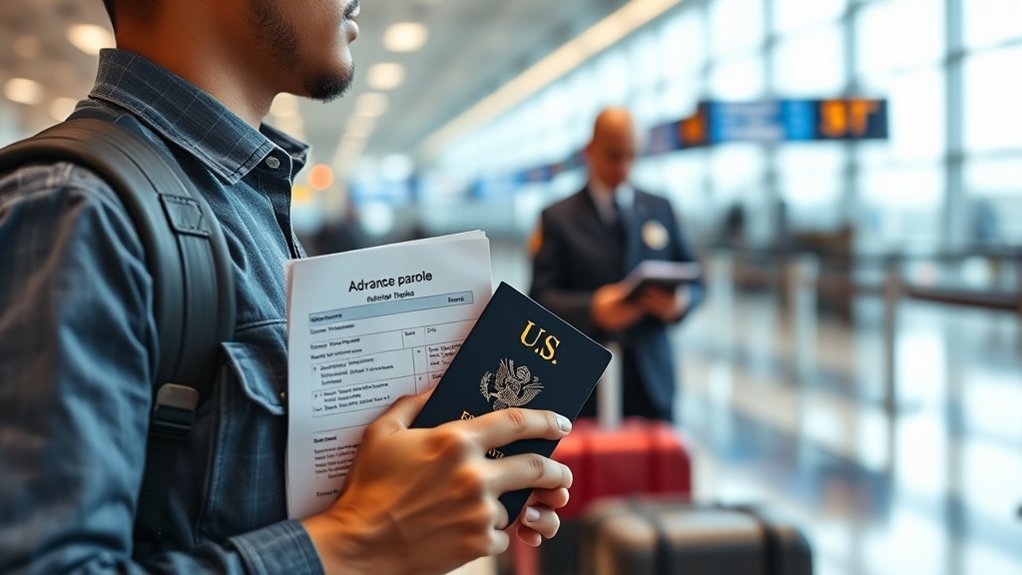
An I-512 or I-512L is an advance authorization that may allow a person in the United States to travel abroad temporarily and return to a U.S. port of entry to request parole. It is commonly issued after an eligible person files Form I-131, Application for Travel Documents, Parole Documents, and Arrival/Departure Records.
Some adjustment applicants receive a paper advance parole document. Others may receive a Form I-766 Employment Authorization Document with the words “Serves as I-512 Advance Parole”. This is commonly called a combo card because it provides both employment and travel authorization.
Advance parole is not a visa, lawful permanent resident card, or guarantee of entry. It allows you to present yourself for inspection and request parole. CBP makes the final decision at the port of entry.
Advance parole authorizes travel to a U.S. port of entry. It does not guarantee that CBP will permit you to enter or parole you into the United States.
Who Can Travel With Advance Parole?
Advance parole is available only in qualifying immigration situations. The correct document and travel rules depend on the benefit or status supporting your request.
| Immigration situation | Usual travel document or rule |
|---|---|
| Pending Form I-485 | Most adjustment applicants need approved advance parole before leaving. Limited exceptions may apply to qualifying H, L, K, or V nonimmigrants who meet all regulatory requirements. |
| Approved DACA | You must receive advance parole before departure. USCIS generally requires a humanitarian, educational, or employment purpose. An ordinary vacation is not a qualifying DACA travel purpose. |
| Pending asylum application | Leaving without advance parole creates a presumption that you abandoned the asylum application. Returning to the country of claimed persecution can also create a presumption of abandonment unless you establish compelling reasons. |
| Temporary Protected Status | TPS beneficiaries generally request TPS travel authorization and receive Form I-512T rather than an I-512L advance parole document. |
| Refugee or person granted asylum | A Refugee Travel Document is generally the appropriate document. Travel to the country connected to the protection claim can create serious concerns. |
Warning: Do not assume that having a pending application makes you eligible to travel. A removal order, prior departure, unlawful re-entry, criminal record, fraud finding, or inadmissibility ground may make travel dangerous even after USCIS issues a document.
Can You Travel While Advance Parole Is Pending?
You generally should not depart the United States while relying on a pending advance parole request. Filing Form I-131 does not itself authorize travel. You should have the required approved and unexpired travel document in your possession before leaving.
For most people with a pending Form I-485, departing without advance parole causes USCIS to treat the adjustment application as abandoned. USCIS also warns that a person who leaves before the requested advance parole document is issued may have difficulty returning or may be found to have abandoned a pending benefit request.
Exceptions for Some Nonimmigrants
Limited exceptions exist for certain adjustment applicants maintaining qualifying H-1B, H-4, L-1, L-2, K-3, K-4, or V status. These travelers must meet the applicable status and document requirements, which may include returning with a valid visa and continuing to qualify for the nonimmigrant classification.
These exceptions are technical. Do not assume that an unexpired visa, approval notice, or pending extension automatically protects your Form I-485. Confirm your eligibility before departure.
Risks of Leaving Before Approval
- Your pending Form I-485 or another benefit request may be treated as abandoned.
- An airline may refuse to board you for a return flight without an acceptable U.S. entry or travel document.
- You may be unable to return using an advance parole document issued after you already left.
- You may miss a biometrics appointment, interview, request-for-evidence deadline, or other USCIS notice.
- Your underlying application could be denied while you are outside the United States.
If urgent travel is necessary, request expedited processing or an emergency travel-document appointment instead of leaving without authorization.
How Do You File Form I-131?
Form I-131 covers several different travel and parole documents. Select the correct category for your immigration situation and follow the current form instructions rather than copying requirements from another category.
Eligibility and Supporting Documents
Your evidence will depend on why you are requesting the document. A typical filing may require:
- A completed and signed current edition of Form I-131.
- A copy of a government-issued identity document.
- Evidence supporting your eligibility, such as an I-485 receipt, DACA approval, pending asylum evidence, or TPS documentation.
- An explanation and evidence of the travel purpose when your category requires one.
- Passport-style photographs when required by the current instructions.
- A certified English translation for each foreign-language document.
Filing Steps and Fees
- Identify the correct request type. Advance parole, TPS travel authorization, a Refugee Travel Document, and a re-entry permit are different requests.
- Download the current form and instructions. USCIS can reject an outdated or incomplete form.
- Check the current fee. Use the USCIS Fee Schedule or fee calculator. The amount depends on the category, filing method, and any exemption or approved fee waiver.
- Use the correct filing method and location. Some Form I-131 categories may be filed online, while others must be mailed to a category-specific address.
- Keep a complete copy. Save the form, evidence, payment record, delivery confirmation, and receipt notice.
- Monitor your case. Watch for biometrics notices, requests for evidence, appointments, and the document’s delivery.
Pro Tip: Check the form edition, filing fee, and filing address again on the day you submit the application. USCIS can change them, and an incorrect fee or address can delay or cause rejection of the filing.
What Should You Bring for Re-entry?
Carry original travel documents in your hand luggage. Do not place your only advance parole document or combo card in checked baggage.
- Your valid passport, subject to the requirements of your destination, transit countries, airline, and nationality.
- Your original unexpired I-512/I-512L advance parole document or valid combo card marked “Serves as I-512 Advance Parole.”
- A copy of your Form I-485 receipt or other notice showing the underlying pending case.
- Copies of relevant USCIS approval notices and your attorney’s contact information, if represented.
- Any visa or travel authorization required by the destination or a country where you will change planes.
- Evidence explaining the purpose of travel when relevant, especially for DACA or emergency travel.
- A copy of the biographical page of your passport and electronic copies of important documents stored securely.
A Form I-797C receipt notice is useful evidence of a pending case, but it is not a substitute for an approved travel document and is not a universal stand-alone re-entry document.
Note: Secondary inspection is common for some advance-parole travelers. It does not automatically mean that CBP will refuse parole. Allow extra time for inspection and connecting flights.
Can CBP Refuse Re-entry With Advance Parole?

Yes. An advance parole document does not guarantee that CBP will parole you into the United States. You remain an applicant for admission during inspection, and parole is a discretionary decision.
CBP may review your identity, immigration history, criminal record, prior removals, travel history, admissibility, and whether the document is valid. An officer may send you to secondary inspection for additional review.
Travel is especially risky if you have:
- A final, reinstated, or previously executed removal or deportation order.
- A prior unlawful re-entry after removal or after substantial unlawful presence.
- Criminal arrests, charges, or convictions.
- Prior immigration fraud, misrepresentation, or a false claim to U.S. citizenship.
- A pending asylum claim and plans to visit the country of claimed persecution.
- An unresolved inadmissibility ground or a waiver that does not cover the relevant issue.
- A document that will expire before you return.
Warning: A valid advance parole document does not cancel a removal order, erase immigration violations, waive inadmissibility, or protect you from every re-entry bar. Obtain individual legal advice before leaving if any part of your history may create a problem.
Does Advance-Parole Travel Trigger the Three- or Ten-Year Bar?
Under the immigration decision known as Matter of Arrabally and Yerrabelly, a temporary trip taken with properly granted advance parole is not treated as a “departure” for the three- and ten-year unlawful-presence bars under INA 212(a)(9)(B).
This rule is limited. It does not erase prior unlawful presence, cure unauthorized entry, eliminate a prior-removal bar, resolve the permanent bar under INA 212(a)(9)(C), or waive another ground of inadmissibility.
How Long Can You Stay Abroad on Advance Parole?
There is no universal six-month limit for every advance-parole traveler. Your authorization dates and the number of permitted entries are printed on your document. You must comply with those terms and return while the document remains valid.
Check the Authorization on Your Document
Before booking travel, confirm:
- The earliest date on which you may depart.
- The last date on which you may use the document to return.
- Whether it permits one entry or multiple entries.
- Whether your passport will remain valid for the entire trip.
- Whether your underlying DACA, adjustment, asylum, or other case will remain pending and valid.
A document with a long validity period does not automatically make a long stay advisable. You must remain available for biometrics, interviews, requests for evidence, court hearings, and other case obligations. USCIS may deny an application if you miss a required appointment or fail to respond on time.
Plan a Reasonable Return Date
Plan to return well before the final validity date. Flight cancellations, illness, passport problems, civil unrest, airline document reviews, or other delays can prevent an on-time return.
DACA advance parole may authorize travel only during a specific period connected to the approved purpose. Follow the dates printed on the document rather than assuming that you may remain abroad for a full year.
What Happens If Advance Parole Expires Abroad?
An airline may refuse to board you if your advance parole document has expired. CBP may also refuse to parole you when you arrive without valid documentation.
You generally cannot renew or obtain a routine replacement advance parole document while outside the United States. If the document expires, is lost, is stolen, or is destroyed abroad, contact the nearest U.S. embassy or consulate and any USCIS international office with jurisdiction as soon as possible. Contact your immigration lawyer as well.
Do not assume that filing another Form I-131 from outside the United States will solve the problem. USCIS generally requires an advance-parole applicant to be inside the United States when requesting this form of travel authorization.
Warning: Returning before the printed expiration date is essential. Build a time cushion into your plans instead of scheduling your return on the final valid day.
How Much Does Advance Parole Cost and How Long Does It Take?
There is no single Form I-131 fee or processing time that applies to every traveler. The amount and timeline depend on the requested document, eligibility category, filing method, fee exemption or waiver rules, and the USCIS office handling the case.
| Item | Current guidance |
|---|---|
| Filing fee | Check Form G-1055 or the USCIS fee calculator for your exact I-131 category and filing method. |
| Fee waiver or exemption | Availability depends on the request type and your eligibility. Do not file without payment unless the current instructions confirm an exemption or you have an approved waiver where required. |
| Processing time | Use the USCIS Case Processing Times tool and select Form I-131, the correct category, and the processing office shown on your receipt. |
Processing-time data describes how long USCIS took to complete many recent cases. It is not a promise that your document will arrive by a certain date. File early and avoid buying nonrefundable travel until you have the document and have reviewed its validity dates.
When Should You Request Emergency Advance Parole?
USCIS may issue an emergency travel document when you are inside the United States and have a pressing or critical need to travel in less than 15 days. Examples include urgent medical treatment, the death or grave illness of a family member or close friend, or a critical professional, academic, or personal commitment.
To request emergency issuance, contact the USCIS Contact Center or use My Appointment. If USCIS determines that the situation may qualify, it will schedule an appointment at a field office.
Bring the following to the appointment:
- A completed and signed Form I-131.
- The applicable filing fee or acceptable payment documentation, unless an exemption applies.
- Evidence that you qualify for the requested travel document.
- Evidence of the urgent need, such as medical records, a hospital letter, death certificate, employer letter, school letter, or travel deadline.
- Two passport-style photographs.
- A full certified English translation of each foreign-language document.
USCIS states that even if you already have a pending Form I-131, you may need to file a new Form I-131 and pay the applicable fee at the emergency appointment.
Expedite Request Versus Emergency Issuance
If your planned departure is not within 15 days but normal processing may prevent timely travel, you may request expedited processing. USCIS encourages applicants with a pressing travel need to request an expedite at least 45 days before departure when possible.
Neither an expedite request nor an emergency appointment guarantees approval. Do not depart until USCIS has issued the required document.
Frequently Asked Questions
Can I travel outside the U.S. with I-512 advance parole?
Yes, if the document is approved, unexpired, permits the planned trip, and you do not have a case-specific issue that makes travel unsafe. You must return within the document’s authorized period and complete CBP inspection.
Is Form I-512L a visa?
No. It is an advance parole document. It allows you to travel to a U.S. port of entry and request parole, but it does not provide a visa, admission, permanent status, or guaranteed return.
Does advance parole guarantee that I can return?
No. CBP makes the final inspection and parole decision. A valid document does not remove inadmissibility grounds, prior-removal consequences, criminal issues, fraud findings, or other legal barriers.
How long can I remain outside the United States?
Follow the dates and entry conditions printed on your document. There is no universal six-month limit for every advance-parole traveler. Return well before expiration and remain available for appointments and deadlines in your underlying case.
Can a TPS beneficiary travel with Form I-512L?
USCIS generally issues TPS beneficiaries Form I-512T as TPS travel authorization. Check the exact document USCIS issued and the current TPS instructions before traveling.
Can a DACA recipient obtain advance parole for a vacation?
USCIS states that an ordinary vacation is not a valid DACA advance-parole purpose. Qualifying purposes are generally humanitarian, educational, or employment-related and are reviewed case by case.
Can I travel with advance parole if I have a removal order?
Travel may have severe consequences. Departure can execute or affect certain removal orders, and advance parole does not cancel an order. Obtain advice from a qualified immigration lawyer who has reviewed the complete court and DHS record before leaving.
Sources
- USCIS Emergency Travel — emergency issuance, expedite requests, appointment procedures, and required documents.
- USCIS DACA Frequently Asked Questions — DACA travel purposes, restrictions, validity, and removal-order warnings.
- USCIS Policy Manual, Adjustment Filing Instructions — effect of departure on a pending adjustment application.
- USCIS Policy Manual, Adjustment Eligibility — parole, TPS-authorized travel, and unlawful-presence-bar guidance.
- CBP Advance Parole Guidance — inspection, nonimmigrant exceptions, and the lack of guaranteed admission.
- USCIS Fee Schedule — current Form I-131 fees and applicable exemptions.
Conclusion
You can travel internationally with an approved and valid I-512 advance parole document, but the document is only one part of a safe trip. Confirm that it covers your travel dates and number of entries, carry the original, review your pending case, and return before it expires.
Do not travel based only on a pending Form I-131 or a general online answer. Seek individual legal advice before departure if you have a removal order, asylum claim, criminal history, prior unlawful re-entry, fraud issue, or possible ground of inadmissibility. Careful review before leaving is far safer than trying to fix a document or re-entry problem from abroad.
