
Last Updated on July 30, 2026 by Caleb Warren
Yes, a backpack can be used as a carry-on bag on most flights, but the word backpack does not determine how the airline classifies it. Its packed size, weight, fare allowance, and storage location do. A larger backpack normally counts as your overhead-bin carry-on, while a smaller one may count as the personal item that fits under the seat.
Quick Answer
A backpack can be a carry-on if it stays within your airline’s packed size and weight limits and fits in the overhead bin. A smaller backpack may instead count as a personal item if it fits under the seat. Check your fare and airline rules before packing because limits are not universal.
Key Takeaways
- Measure the backpack after it is packed, including bulging pockets, handles, wheels, and loose straps.
- A common U.S. carry-on limit is 22 × 14 × 9 inches, but airline, route, aircraft, fare, and weight rules vary.
- Follow the TSA 3-1-1 liquids rule unless an exception applies for medically necessary liquids, breast milk, formula, or similar items.
- Power banks and spare lithium batteries belong in the cabin and must be removed if your backpack is gate-checked.
- Pack travel documents, medication, valuables, and essential electronics where you can reach them quickly.
At a Glance
| Time Required | 5–10 minutes to check and measure |
| Difficulty | Easy |
| Tools Needed | Tape measure, luggage scale if a weight limit applies, and your airline’s baggage page |
| Cost | $0 unless your fare charges for an overhead carry-on or the bag is oversized |
Disclosure: As an Amazon Associate I earn from qualifying purchases. Some links on this page are affiliate links, at no extra cost to you.
Understanding Airline Carry-On Policies for Backpacks
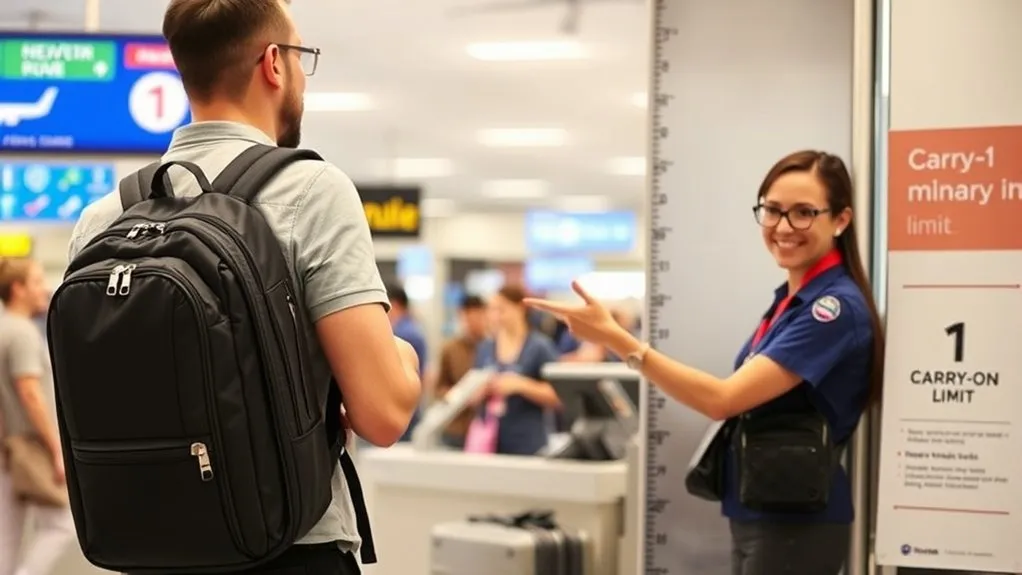
Airlines usually care about a bag’s dimensions, weight, number of pieces, and where it will be stowed—not whether it has shoulder straps. A backpack that fits the airline’s carry-on limit can normally go in the overhead bin. A smaller backpack may count as a personal item when it fits completely under the seat in front of you.
Your ticket matters too. Some fares include both one carry-on and one personal item, while others include only a personal item or charge separately for an overhead bag. Partner-airline and codeshare flights can also apply the operating carrier’s rules. Check the policy for every airline on the itinerary rather than relying on a single “standard” measurement.
For U.S. departures, the Transportation Security Administration controls checkpoint screening, while the Federal Aviation Administration publishes hazardous-material guidance for items such as lithium batteries. Outside the United States, follow the rules of the departure airport, local security authority, and airline.
Note: “Carry-on” and “personal item” are separate baggage categories. If your backpack is your carry-on, a second suitcase cannot also be your carry-on unless the airline or fare provides another allowance.
Size and Weight Restrictions for Carry-On Backpacks
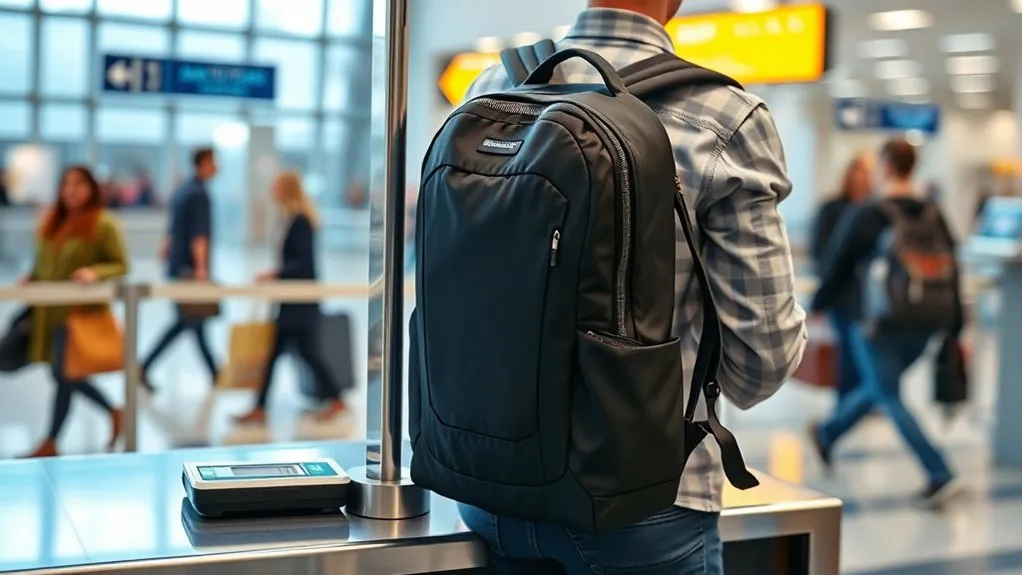
22 × 14 × 9 inches (56 × 36 × 23 cm) is a common overhead carry-on limit among several large U.S. airlines, but it is not a universal rule. Other carriers allow different dimensions, impose weight limits, or charge for the carry-on based on the fare. Personal-item limits vary even more.
| Airline example | Carry-on limit | Personal-item limit | Important detail |
|---|---|---|---|
| American Airlines | 22 × 14 × 9 in | 18 × 14 × 8 in | Measurements include handles and wheels. |
| United Airlines | 9 × 14 × 22 in | 9 × 10 × 17 in | Fare and route rules can affect the allowance. |
| Frontier Airlines | 24 × 16 × 10 in; 35 lb maximum | 14 × 18 × 8 in | Carry-on charges may apply; verify before departure. |
| Emirates Economy | 55 × 38 × 22 cm; 7 kg | Allowance varies by cabin and route | International weight limits are common. |
These are examples, not a substitute for checking your booking. Policies can change, and a smaller aircraft may have less bin space even when the backpack meets the published limit.
How to Measure a Backpack for a Flight
- Pack it as you plan to travel. A soft backpack may expand several inches when full.
- Measure the tallest point. Include the top handle or frame if it does not compress.
- Measure the widest point. Include stuffed side pockets and bottles.
- Measure the deepest point. Include bulging front pockets and back padding.
- Tighten and tuck the straps. Loose straps can catch on equipment and may stop the bag from fitting cleanly in a sizer.
- Weigh the packed bag. Do this whenever the airline publishes a cabin-bag weight limit.
A capacity label such as 30–45 liters is only a rough guide. Two backpacks with the same liter rating can have different exterior dimensions, and an overstuffed 40-liter pack may fail the airline’s sizer.
Pro Tip: Measure after packing and leave a little room to compress the bag. A backpack that matches the limit exactly while empty may become oversized once the front pocket and bottle sleeves are full.
Essential TSA Guidelines for Carry-On Items
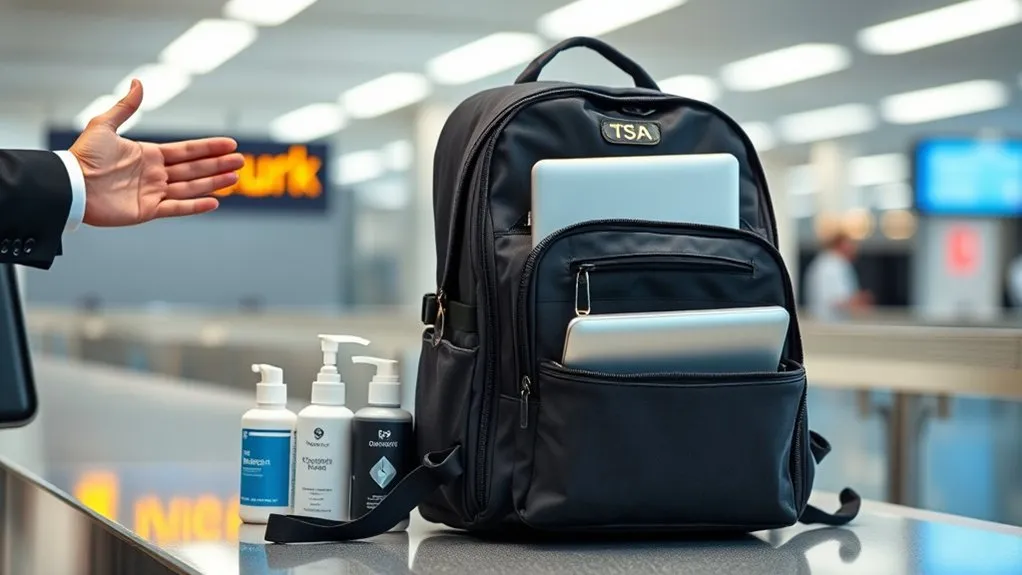
For flights departing from a U.S. airport, your backpack must pass TSA screening. Pack it so officers can see items clearly and so you can remove anything requested without emptying the entire bag.
Liquid Restrictions Explained
The standard TSA 3-1-1 rule allows liquids, aerosols, gels, creams, and pastes in containers of 3.4 ounces (100 milliliters) or less. The containers must fit comfortably in one clear, quart-sized, resealable bag, with one bag allowed per passenger.
The container size controls the rule. A partly filled 6-ounce bottle is still too large for the standard liquids bag. Keep the quart bag near the top of your backpack unless the officer tells you it can remain inside.
Important exceptions apply. Medically necessary liquids, gels, and aerosols may exceed 3.4 ounces in reasonable quantities for the trip, but you should tell the TSA officer at the start of screening. Formula, breast milk, toddler drinks, and baby or toddler food also have special screening rules and do not have to fit in the quart bag.
Electronics Screening Process
At a standard checkpoint, TSA may ask you to remove electronics larger than a cell phone—such as laptops, tablets, and e-readers—and place them in a bin with nothing above or below them. However, procedures vary. Travelers using TSA PreCheck generally leave laptops and compliant liquids in the bag, and checkpoints using computed-tomography scanners may also instruct passengers to leave electronics inside.
Follow the officer’s directions at your lane. Officers may ask you to power on a device, so charge important electronics before arriving. Keep cords organized and place the laptop in an easy-access sleeve to avoid slowing the line.
Prohibited Items Overview
Do not rely on a broad rule such as “all sharp objects are banned.” The details matter. Most knives and loose razor blades are prohibited in carry-ons, but disposable razors are allowed, and scissors may be carried when the blades are less than 4 inches from the pivot point. The TSA officer makes the final checkpoint decision.
Use the official TSA “What Can I Bring?” list for a specific item. Firearms are never permitted in carry-on baggage. When legally transported, they must be unloaded, locked in a hard-sided container, placed in checked baggage, declared to the airline, and handled according to all applicable laws and airline rules.
What Not to Pack: Prohibited Items for Carry-On Luggage
Items commonly prohibited from a carry-on backpack include:
- Most knives and cutting tools: Pocketknives, utility knives, box cutters, and loose razor blades belong in checked baggage when permitted.
- Firearms and ammunition: These cannot travel in a carry-on. Checked transport is subject to strict packing, declaration, airline, and legal requirements.
- Explosives and many flammables: Fireworks, flares, gunpowder, gasoline, and similar hazardous materials are generally forbidden on passenger aircraft.
- Bludgeoning sports equipment: Baseball bats, golf clubs, and similar equipment must normally be checked.
- Hazardous chemicals: Many fuels, corrosives, toxic substances, and certain aerosols are restricted or forbidden.
Some items need special instructions rather than a simple yes-or-no answer. Small scissors, disposable razors, tools, dry ice, powders, medication, food, and camping equipment each have their own rules. Check both TSA and airline guidance before leaving home.
Warning: Do not bring a firearm to a TSA checkpoint in your backpack, even by mistake. Firearms are prohibited in carry-on bags and can lead to delays, civil penalties, loss of trusted-traveler status, or criminal consequences depending on the circumstances and local law.
Batteries, Power Banks, and Smart Bags
Spare lithium batteries, portable chargers, and power banks must travel in the cabin, not in checked baggage. Under current FAA passenger-battery guidance, most lithium-ion batteries up to 100 watt-hours are allowed for personal use. Batteries from 101 to 160 watt-hours require airline approval, and no more than two spare batteries in that range are allowed. Batteries over 160 watt-hours are not permitted on passenger aircraft.
Protect spare battery terminals from short circuits by using the original packaging, terminal covers, tape, or separate protective pouches. Do not travel with a damaged, swollen, defective, or recalled battery unless the battery has been removed or otherwise made safe under applicable guidance.
If your backpack is gate-checked, remove power banks, spare batteries, electronic cigarettes, medication, travel documents, valuables, and essential electronics first. Smart luggage with a lithium battery may have additional requirements; if the battery cannot be removed, the bag may be refused.
Warning: A power bank must not remain in a backpack that is being checked at the gate. Remove it and keep it with you in the aircraft cabin.
Benefits of Using a Backpack as a Carry-On
A well-fitted backpack can make airport travel easier, especially when you need to move through stairs, trains, crowded terminals, or uneven streets after landing. It can also reduce your need for checked luggage when the bag and fare meet the airline’s cabin-baggage rules.
Hands-Free Convenience
Shoulder straps leave your hands free for a phone, boarding pass, or rolling bag. Soft-sided backpacks can be easier to place in odd-shaped overhead spaces than rigid luggage, and exterior pockets provide quick access to small essentials. The tradeoff is that a soft bag offers less crush protection for fragile items.
Flexible Packing Options
Multiple compartments can separate clothing, toiletries, electronics, and travel documents. Compression straps may control bulk, while a clamshell opening can make a travel backpack easier to pack like a suitcase. Capacity matters, but exterior measurements matter more: a 30–45 liter label does not guarantee that the bag qualifies for a particular airline.
Choosing the Right Backpack for Air Travel
Choose a backpack by working backward from the strictest airline on your itinerary. Compare these features:
- Packed dimensions: The bag should remain within the applicable carry-on or personal-item limit when full.
- Low empty weight: A lighter bag leaves more of any airline weight allowance for your belongings.
- Comfort: Look for adjustable padded shoulder straps, a supportive back panel, and a sternum strap. A removable hip belt can help on longer walks.
- Organization: A padded laptop sleeve, a top pocket, and a secure document pocket improve access at screening and boarding.
- Compression and strap control: Compression straps reduce depth, while strap keepers help prevent dangling webbing.
- Durability: Strong zippers, reinforced seams, and abrasion-resistant fabric are more useful than decorative features.
A rectangular travel backpack often uses cabin space more efficiently than a tall hiking pack. Large external frames, rigid hip belts, trekking-pole attachments, and protruding pockets can make a backpack harder to fit in a sizer or overhead bin.
How to Check If Your Backpack Will Qualify
- Open your reservation. Confirm the operating airline, fare, route, and included baggage allowance.
- Read the airline’s current baggage page. Record the carry-on and personal-item size and weight limits.
- Decide which category the backpack will use. An overhead carry-on and an under-seat personal item are not interchangeable when you bring two bags.
- Pack the backpack fully. Include the jacket, bottle, and items you expect to add at the airport.
- Measure and weigh it. Include every protruding part and compare the results with the strictest flight segment.
- Prepare for gate-checking. Put batteries, medication, documents, valuables, and one small in-flight kit where they can be removed quickly.
Packing Tips for Your Carry-On Backpack
Start with the heaviest dense items close to your back and around the middle of the pack. This usually feels more stable than placing all heavy items at the bottom. Use packing cubes or pouches to group clothing and accessories, but avoid compressing the bag until it exceeds the airline’s depth limit.
Rolling soft clothing can reduce wasted space, while folding structured garments may limit wrinkles. Keep the quart-sized liquids bag, laptop, identification, boarding documents, medication, and any item that may need separate screening in easy-to-reach compartments.
- Wear the bulkiest shoes or jacket when practical.
- Use solid toiletries to reduce the number of liquids.
- Fill small gaps with socks, cables, or soft accessories.
- Do not bury snacks, medication, or charging cables under all your clothing.
- Leave a little free space for items added during the trip.
Utilizing Your Personal Item Effectively
If your fare permits both a carry-on backpack and a personal item, use the smaller under-seat bag for the belongings you cannot afford to lose access to during the flight:
- Travel documents: Keep your identification, passport, boarding information, and itinerary secure and reachable.
- Medication: Carry essential prescriptions and medically necessary supplies in the cabin.
- Valuables: Keep keys, cash, jewelry, and small electronics with you rather than in a bag that may be checked.
- Snacks and comfort items: Pack solid snacks, headphones, a light layer, and an empty refillable bottle.
- Entertainment devices: Bring a tablet, e-reader, or book without blocking access to safety equipment under the seat.
The best personal item is not the bag that holds the most—it is the bag that fits fully under the seat and keeps your essentials within reach.
Keep the personal item lightweight and compact enough to remain within the airline’s limit. It must not block the aisle, extend into an emergency-exit path, or prevent you from placing your feet safely.
Pros and Cons of Backpacks as Carry-Ons
Advantages
- Hands-free movement through terminals and public transportation
- Flexible organization with pockets, cubes, and compression straps
- Easier handling on stairs and rough surfaces than wheeled luggage
- Potential to avoid checked-bag delays and fees when the fare includes a carry-on
- Useful as everyday luggage after arrival
Drawbacks
- Less crush protection for fragile belongings than a hard-shell case
- Shoulder, neck, or back discomfort if the pack is too heavy or poorly fitted
- Soft sides can bulge beyond the published depth limit
- Straps and buckles can catch unless secured
- Large travel packs may be too tall for under-seat use even when their liter capacity sounds modest
Choose based on your comfort, itinerary, and packing style. A well-designed backpack is convenient, but it is not automatically lighter, safer, or compliant simply because it lacks wheels.
What Happens If Your Backpack Does Not Fit?
An airline may ask you to place the backpack in a sizer, compress it, pay an applicable bag fee, check it at the ticket counter, or gate-check it. A bag can also be gate-checked on a full flight or a small aircraft even when it meets the published dimensions.
Before handing over the bag, remove:
- Power banks and spare lithium batteries
- Electronic cigarettes and vaping devices
- Medication and medical supplies
- Identification, travel documents, keys, and money
- Fragile or valuable electronics
- Anything needed during the flight or immediately after landing
Use a luggage tag with your contact information, secure loose straps, and keep a small foldable pouch available so essential items can stay in the cabin.
Final Tips for a Smooth Travel Experience
A smooth trip depends on checking the current rules, packing for screening, and leaving a margin below the maximum dimensions rather than treating the limit as a target.
Packing Efficiency Strategies
- Use packing cubes or pouches to separate clothing, toiletries, cables, and small items.
- Roll soft clothing where it saves room, but fold garments that wrinkle easily.
- Place dense items close to your back and balance the left and right sides.
- Keep documents, medication, liquids, and screening-sensitive electronics accessible.
- Use compression straps carefully so the backpack remains within the airline’s packed depth limit.
- Try the fully packed backpack at home and remove nonessential items if it feels uncomfortable.
Stay Informed on Regulations
Check your airline’s baggage page and your reservation shortly before departure. Confirm the allowance for each flight segment, especially on codeshares, budget fares, regional aircraft, and international routes. For U.S. screening questions, review the TSA website or contact AskTSA. For batteries and dangerous goods, check FAA PackSafe guidance and the airline’s own restrictions.
Note: A compliant backpack is not guaranteed overhead space. Boarding staff may still gate-check it when bins are full or the aircraft has limited storage.
Frequently Asked Questions
Can I use a backpack as my personal item?
Yes. A backpack can count as a personal item when it stays within the airline’s personal-item limit and fits completely under the seat. If it must go in the overhead bin, the airline may treat it as your carry-on instead.
Are there airlines that do not allow backpacks as carry-ons?
Airlines generally classify bags by allowance, size, weight, and storage location rather than banning backpacks as a category. A backpack may still be refused, charged, or checked if it exceeds the limit, is unsafe to stow, or is not included with the fare.
What type of backpack is best for air travel?
A lightweight rectangular backpack with controlled exterior dimensions, comfortable straps, lockable zipper pulls, a padded laptop sleeve, and compression straps works well. Choose the bag according to the strictest airline on your itinerary rather than capacity alone.
How do I secure my backpack while traveling?
Close every zipper, use lockable pulls or a small lock where practical, keep valuables in an internal pocket, and wear the bag in crowded areas. A zipper lock is only a deterrent, so keep the backpack in sight and never leave travel documents or valuables in a bag being checked.
Can I fit a laptop in a carry-on backpack?
Yes, provided the laptop fits securely and the packed backpack remains within the airline’s limit. Use a padded sleeve and keep the computer easy to remove because standard TSA screening may require electronics larger than a phone to be placed in a separate bin.
Can I bring a backpack and a carry-on suitcase?
Usually, yes, when your fare includes one carry-on and one personal item and the backpack fits the personal-item limit. If the backpack is too large for under-seat storage, it may count as the carry-on, leaving no allowance for a second full-size cabin bag.
Is a 40-liter backpack allowed as a carry-on?
It may be, but liters measure internal volume rather than exterior size. Pack the bag, measure its full height, width, and depth, weigh it if required, and compare those numbers with the airline’s current limit.
What should I remove before a backpack is gate-checked?
Remove power banks, spare lithium batteries, electronic cigarettes, medication, documents, keys, money, valuables, and fragile electronics. Keep those items with you in the aircraft cabin.
Conclusion
A backpack can be an excellent carry-on because it is mobile, flexible, and easy to organize. The key is to treat it like any other piece of cabin baggage: check the fare, measure the fully packed bag, follow the strictest size and weight limit on the itinerary, and pack TSA-sensitive items where they are easy to reach. Keep power banks and spare batteries in the cabin, and be ready to remove essentials if the backpack is gate-checked. With those checks complete, you can travel with less stress and fewer surprises at the airport.
Sources
- TSA: Liquids, Aerosols, and Gels Rule — standard carry-on liquid limits and exceptions.
- TSA: Security Screening — electronics screening and checkpoint preparation.
- TSA: What Can I Bring? Complete List — item-specific carry-on and checked-bag rules.
- FAA: Airline Passengers and Batteries — lithium battery, power bank, and watt-hour limits.
- American Airlines: Carry-On Bags — example carry-on and personal-item dimensions.
- Frontier Airlines: Bag Size and Weight Limits — example of a U.S. airline with a carry-on weight limit.

