
Last Updated on July 29, 2026 by Daniel Globe
The best Italian songs of all time span far more than one style or decade. Italy’s essential music includes traditional Neapolitan standards, postwar pop, poetic singer-songwriters, romantic ballads, rock, protest music, Sanremo winners, and international crossover hits. This guide brings those traditions together in a curated list built around cultural influence, memorable songwriting, longevity, and global recognition.
Quick Answer
Essential Italian songs include “‘O Sole Mio,” “Nel blu dipinto di blu (Volare),” “Azzurro,” “Bella Ciao,” “Ti amo,” “Caruso,” “L’italiano,” “La solitudine,” “Con te partirò,” “Soldi,” and “Zitti e buoni.” “Volare” is perhaps the strongest international consensus choice, although no single ranking can be completely objective.
Key Takeaways
- “‘O Sole Mio” represents the worldwide legacy of the Neapolitan song tradition.
- “Volare” combined Italian songwriting with rare international success and won two major Grammy categories.
- Sanremo has shaped Italian popular music since 1951 and helped introduce generations of major performers.
- Italian classics cover love, loneliness, identity, resistance, humor, and social change—not only romance.
- Modern artists such as Mahmood, Måneskin, Angelina Mango, and Sal Da Vinci show how the tradition continues to evolve.
The Heart of Italian Music
Italian popular music is shaped by melody, expressive voices, regional traditions, and a strong connection between lyrics and everyday life. A song may tell a private love story, describe homesickness, celebrate a summer afternoon, challenge political oppression, or examine what it means to be Italian.
The country’s musical identity reaches from nineteenth-century Neapolitan songs to contemporary pop and rock. One of the strongest links between those eras is the Sanremo Music Festival. RAI records that the festival began on radio in 1951, moved to television in 1955, and later provided an important platform for performers including Eros Ramazzotti and Laura Pausini.
Note: There is no scientific way to name one definitive “best” song. The selections below consider historical importance, songwriting, continued popularity, international reach, and influence on later performers.
Best Italian Songs at a Glance
This list is arranged broadly by era rather than as an absolute ranking. It gives traditional songs, pop standards, ballads, singer-songwriter classics, and modern hits room to be judged within their own musical settings.
| Song | Artist or tradition | Year or era | Why it belongs |
|---|---|---|---|
| Funiculì, Funiculà | Traditional Neapolitan repertoire | 1880 | A lively early example of a Neapolitan song becoming an international standard. |
| ‘O Sole Mio | Giovanni Capurro, Eduardo Di Capua and Alfredo Mazzucchi | 1898 | One of the world’s most recognizable Neapolitan melodies. |
| Tu vuò fa’ l’americano | Renato Carosone | 1956 | A witty mix of Neapolitan language, jazz, and commentary on Americanization. |
| Nel blu dipinto di blu (Volare) | Domenico Modugno | 1958 | A global breakthrough that won Grammy awards for Record and Song of the Year. |
| Il cielo in una stanza | Mina | 1960 | A defining vocal performance built around intimate, imaginative songwriting. |
| Non ho l’età | Gigliola Cinquetti | 1964 | Italy’s first Eurovision-winning song. |
| Azzurro | Adriano Celentano | 1968 | An upbeat sing-along whose cheerful surface contrasts with loneliness and longing. |
| Bella Ciao | Traditional protest repertoire | Origins uncertain; popularized after World War II | A worldwide symbol of resistance and freedom. |
| Parole parole | Mina and Alberto Lupo | 1972 | A theatrical duet about empty romantic promises that inspired many adaptations. |
| Ti amo | Umberto Tozzi | 1977 | One of the best-known Italian-language love songs outside Italy. |
| Gloria | Umberto Tozzi | 1979 | A powerful pop composition that also became an international hit in adaptation. |
| Sarà perché ti amo | Ricchi e Poveri | 1981 | A joyful, highly recognizable party and stadium sing-along. |
| Felicità | Al Bano and Romina Power | 1982 | An enduring duet built around simple images of everyday happiness. |
| L’italiano | Toto Cutugno | 1983 | A portrait of Italian habits and identity that became especially popular abroad. |
| Caruso | Lucio Dalla | 1986 | A dramatic story-song inspired by the final period of tenor Enrico Caruso’s life. |
| Musica è | Eros Ramazzotti | 1988 | A polished example of the emotional pop-rock that made Ramazzotti an international star. |
| Perdere l’amore | Massimo Ranieri | 1988 | A dramatic Sanremo-winning performance about dignity after lost love. |
| Almeno tu nell’universo | Mia Martini | 1989 | A vulnerable plea for honesty, carried by one of Italy’s most expressive voices. |
| Senza una donna | Zucchero with Paul Young | 1990 international version | A blues-influenced crossover that brought Italian songwriting to a wider pop audience. |
| La solitudine | Laura Pausini | 1993 | A youthful song of separation that launched a major international career. |
| Con te partirò | Andrea Bocelli | 1995 | A classical-crossover standard known around the world. |
| Soldi | Mahmood | 2019 | A modern, rhythm-driven account of family tension, money, and fractured trust. |
| Zitti e buoni | Måneskin | 2021 | A forceful rock song that won both Sanremo and Eurovision. |
| La noia | Angelina Mango | 2024 | A contemporary blend of Italian pop, folk color, and rhythmic experimentation. |
| Per Sempre Sì | Sal Da Vinci | 2026 | The 2026 Sanremo winner and Italy’s fifth-place Eurovision entry. |
Products Worth Considering


Timeless Classics from Postwar Italian Pop
Italian popular music changed sharply during the 1950s and 1960s. Performers began combining older vocal traditions with jazz, rock and roll, orchestral pop, television, and a new generation of personal songwriting.
“Volare” and Domenico Modugno
Domenico Modugno’s “Nel blu dipinto di blu,” commonly called “Volare,” won Sanremo in 1958 and represented Italy at Eurovision, where it finished third. Its open-armed performance style and soaring chorus helped turn it into one of the most internationally successful Italian-language songs.
The Recording Academy lists the song as the winner of both Record of the Year and Song of the Year at the first Grammy Awards. That combination of Italian identity, songwriting recognition, and worldwide familiarity makes “Volare” a leading candidate whenever listeners discuss the most iconic Italian song.
“Volare” did more than travel abroad: it showed that an Italian-language song could compete at the center of international popular music.
“Azzurro” and Adriano Celentano
Released in 1968, “Azzurro” pairs a bright, marching rhythm with a narrator who is alone in the city during summer. That contrast is part of its appeal. Crowds can sing it as a cheerful anthem even though the story expresses boredom, distance, and the wish to be somewhere else.
Mina, Carosone, and Postwar Innovation
Mina’s “Il cielo in una stanza” turns a private room into a limitless emotional space, while “Parole parole,” her dialogue with Alberto Lupo, exposes romantic language as empty performance. Renato Carosone took a different path in “Tu vuò fa’ l’americano,” mixing Neapolitan humor with jazz and a sharp portrait of borrowed American style.
These songs show why the period cannot be reduced to sentimental ballads. Italian artists were also experimenting with character, irony, rhythm, dialect, and social observation.
What Makes Italian Songs Iconic?
The most enduring Italian songs usually combine a memorable melody with a distinctive point of view. Their appeal does not depend on understanding every word. A strong vocal phrase, dramatic shift, repeated chorus, or recognizable rhythm can communicate before the listener reads a translation.
Memorable Melodic Structures
- Singable choruses: Songs such as “Volare,” “Azzurro,” and “Sarà perché ti amo” are easy for groups to join.
- Dynamic vocal writing: Italian pop often gives singers room to move from intimate verses to forceful climaxes.
- Clear emotional contrast: Cheerful arrangements may carry lonely or bittersweet stories.
- Strong rhythmic identity: Neapolitan song, orchestral pop, disco, rock, and contemporary production all contribute recognizable patterns.
Poetic Lyricism and Emotion
Italian songs often use concrete images to express large emotions. “Caruso” places its story near the sea and connects love, performance, memory, and mortality. “La solitudine” approaches separation through the experience of a young person missing someone who has moved away. “Soldi” uses family memories and the recurring sound of clapping to frame distrust and emotional distance.
This writing works because the emotions grow from scenes and characters rather than from repeated claims that love is powerful.
Cultural Resonance and Legacy
Some songs become important because they represent a historical moment. Others remain popular through weddings, football crowds, family celebrations, films, cover versions, and television performances. Regional language also matters: a Neapolitan song is part of Italian musical culture without being written in standard Italian.
Sanremo has helped preserve this shared repertoire while introducing new sounds. Its long history allows orchestral ballads, singer-songwriters, electronic pop, rap, and rock to occupy the same national conversation.
Romantic Italian Ballads That Celebrate Love
Italian romantic music ranges from direct declarations to painful reflections on separation. The strongest ballads avoid treating love as a single uncomplicated feeling.
- “Ti amo” — Umberto Tozzi: A direct, passionate declaration with a melody recognized far beyond Italy.
- “Caruso” — Lucio Dalla: A dramatic narrative inspired by stories surrounding tenor Enrico Caruso’s final period in Sorrento. The song appeared on Dalla’s 1986 album DallAmeriCaruso.
- “Almeno tu nell’universo” — Mia Martini: A request for one sincere person in a confusing and unreliable world.
- “Perdere l’amore” — Massimo Ranieri: A theatrical examination of heartbreak, pride, and emotional collapse.
- “La solitudine” — Laura Pausini: A young person’s experience of absence, memory, and unfinished connection.
- “Con te partirò” — Andrea Bocelli: A grand crossover ballad about leaving and beginning a journey with another person.
Pro Tip: For a romantic playlist with more emotional range, alternate direct love songs such as “Ti amo” with reflective tracks such as “Almeno tu nell’universo,” “Caruso,” and “Perdere l’amore.”
Products Worth Considering


Top Feel-Good Italian Anthems to Sing Along
Italian sing-along songs work best when the chorus is simple enough for a room, stadium, or family gathering to join after one listen. The lyrics are not always purely happy, but the arrangements create a shared sense of release.
Uplifting Melodies to Enjoy
- “Sarà perché ti amo” by Ricchi e Poveri: Fast, cheerful, and built for group singing.
- “Felicità” by Al Bano and Romina Power: A list of small pleasures presented through an instantly recognizable duet.
- “Azzurro” by Adriano Celentano: An upbeat national favorite with a more wistful story beneath the melody.
- “Volare” by Domenico Modugno: A chorus associated with flight, freedom, and celebration.
- “Gloria” by Umberto Tozzi: Driving pop with a chorus that demands a powerful vocal response.
Classic Sing-Along Favorites
“L’italiano” is especially meaningful for many Italians and Italian communities abroad because it turns everyday habits, contradictions, and national symbols into a musical self-portrait. “‘O Sole Mio” offers a different experience: it invites sustained, theatrical singing and connects listeners with the Neapolitan tradition.
Together, these songs demonstrate that an Italian sing-along can be playful, nostalgic, romantic, or proudly theatrical.
Iconic Neapolitan Songs and Why They Matter
Neapolitan song is a distinct tradition with its own language, history, and performance style. It should not be treated simply as an early version of modern Italian pop.
Politecnico di Milano’s Transatlantic Transfers project dates “‘O Sole Mio” to 1898 and credits lyricist Giovanni Capurro and composers Eduardo Di Capua and Alfredo Mazzucchi. The source also notes the song’s habanera rhythm, showing that musical exchange was already shaping popular song in the nineteenth century.
“Funiculì, Funiculà,” written in connection with the Mount Vesuvius funicular, is faster and more playful. “Tu vuò fa’ l’americano” came much later but continued the tradition’s ability to mix local language with imported musical styles and sharp humor.
- Cultural roots: These songs preserve Neapolitan language, humor, scenery, and storytelling.
- Vocal expression: Their long phrases reward careful breath control and dramatic interpretation.
- International reach: Singers around the world have recorded and adapted the repertoire.
- Continuing influence: Contemporary Neapolitan performers still combine local traditions with pop, theatre, and electronic production.
“Bella Ciao” as a Song of Resistance
“Bella Ciao” is often described as a partisan anthem from World War II, but its history is more complicated than a single date or origin story suggests. The melody and text have been connected to several folk traditions, and evidence of its widespread use by wartime partisans is limited.
Treccani’s historical overview explains that the song became a broadly recognized symbol of the Italian Resistance mainly after the war. It was promoted strongly during the 1960s because its general message could represent different parts of the Resistance more easily than songs tied to one political group.
Today, “Bella Ciao” is sung internationally at demonstrations and commemorations. Its modern importance is real, but that importance should not be supported with a falsely precise 1953 release date.
Warning: Avoid describing “Bella Ciao” as a simple, fully documented wartime recording. Its origins, versions, and spread remain subjects of historical debate.
Top Modern Italian Hits: Pop and Rock Evolution
Modern Italian music continues the country’s tradition of strong melodies while using rock, rap, electronic production, global pop, regional influences, and multilingual writing.
| Artist | Representative song | Contribution |
|---|---|---|
| Eros Ramazzotti | “Musica è” | Melodic pop-rock with international reach. |
| Zucchero | “Senza una donna” | Italian songwriting blended with blues, soul, and crossover pop. |
| Laura Pausini | “La solitudine” | Emotionally direct pop recorded for a multilingual international audience. |
| Mahmood | “Soldi” | Contemporary production, personal storytelling, and a multicultural perspective. |
| Måneskin | “Zitti e buoni” | Modern Italian rock with a forceful stage identity and global success. |
| Angelina Mango | “La noia” | Rhythmic pop that combines contemporary production with Mediterranean color. |
| Sal Da Vinci | “Per Sempre Sì” | A modern continuation of theatrical Italian and Neapolitan romantic pop. |
“Per Sempre Sì” won Sanremo 2026 before representing Italy at Eurovision in Vienna. The official Eurovision record lists Sal Da Vinci in fifth place. A recent competition result does not automatically make a song an all-time classic, but it shows that traditional romantic performance remains part of contemporary Italian music.
Italian Songs That Shone at Eurovision
Italy’s Eurovision history includes songs that became global standards, three victories, and several influential performances.
- “Nel blu dipinto di blu” — Domenico Modugno, 1958: Finished third but became one of the most successful songs associated with the contest.
- “Non ho l’età” — Gigliola Cinquetti, 1964: Gave Italy its first Eurovision victory.
- “Insieme: 1992” — Toto Cutugno, 1990: Won with a message of European unity and delivered Italy’s second victory.
- “Zitti e buoni” — Måneskin, 2021: Won the contest with a hard-edged rock performance and gave Italy its third victory.
- “Soldi” — Mahmood, 2019: Finished second and introduced a modern, highly personal style of Italian pop to a wide audience.
- “Per Sempre Sì” — Sal Da Vinci, 2026: Finished fifth after winning Sanremo earlier in the year.
The official Eurovision history records Italy’s winning songs and the contest’s changing musical landscape. Italy’s entries have included traditional ballads, singer-songwriters, rap-influenced pop, and rock rather than one fixed national style.
What Do Italian Song Lyrics Really Mean?
Translations help, but the meaning of an Italian song also depends on tone, historical context, regional language, and the character speaking.
- “Volare”: Uses dreamlike images of flight and freedom rather than telling a realistic travel story.
- “Azzurro”: Places loneliness inside a bright summer setting, creating a memorable emotional contrast.
- “Parole parole”: Treats elaborate romantic language as performance without meaningful action.
- “Bella Ciao”: In its best-known partisan version, presents sacrifice and death in the struggle against an invader.
- “L’italiano”: Builds a humorous, affectionate, and sometimes contradictory portrait of Italian identity.
- “Soldi”: Connects money with an absent or unreliable father, distrust, and painful family memory.
It is also important to distinguish standard Italian from regional languages and dialects. “‘O Sole Mio” and “Tu vuò fa’ l’americano” are rooted in Neapolitan language and culture, so a standard Italian translation may miss part of their sound, humor, and local identity.
Using Italian Songs for Language Learning
Italian songs can support listening, vocabulary, pronunciation, and cultural understanding when they are used actively. Research on second-language learning suggests that repeated, task-focused listening can help learners recognize spoken forms, connect words with meanings, and remember common word combinations. Music should supplement structured study rather than replace it.
A peer-reviewed Frontiers in Education study found positive vocabulary-learning results from song-based activities, while also noting limits to how broadly one study can be generalized.
- Listen once without reading: Notice the mood, repeated sounds, and words you already recognize.
- Read a licensed lyric source: Mark unfamiliar words and repeated expressions without copying large portions.
- Check a translation: Compare ideas rather than translating every line mechanically.
- Listen again in short sections: Pause after each phrase and repeat it aloud.
- Record useful phrases: Focus on expressions that also occur in normal conversation.
- Return to the song later: Spaced repetition is more useful than trying to master everything in one session.
Products Worth Considering
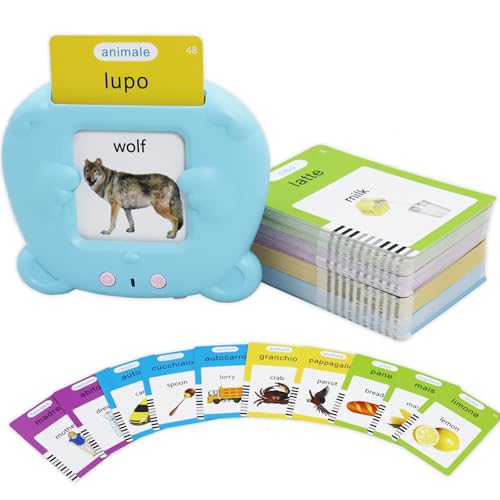
【English and Italian Learning】The talking flash cards contain 224 sight words with 12 themes, including letters, numbers, animals, vegetables, fruits, vehicles, family, etc. Each card is printed with an english word and the corresponding italian word, which is suitable for children to improve their language skills and cognitive abilities.


Songs for Beginning Learners
- “Azzurro”: Memorable rhythm and repeated vocabulary.
- “Felicità”: Concrete images and a highly repetitive title phrase.
- “Sarà perché ti amo”: A clear chorus with common emotional vocabulary.
- “Ti amo”: Useful for recognizing direct expressions, although the complete lyrics contain more complex language.
Songs for Intermediate Learners
- “La solitudine”: Narrative language and descriptions of personal experience.
- “L’italiano”: Cultural references, adjectives, and identity-related vocabulary.
- “Soldi”: Contemporary pronunciation, family vocabulary, and less traditional song structure.
- “Caruso”: Poetic imagery and emotionally complex phrasing.
Pro Tip: Choose a song whose singer articulates clearly and whose chorus repeats. Repeating one short section carefully is usually more useful than playing a long playlist in the background.
How to Build a Balanced Italian Music Playlist
A good introduction to Italian music should not consist entirely of romantic ballads or current chart songs. Use several categories so the playlist shows how styles and language changed.
- Start with two Neapolitan standards: “‘O Sole Mio” and “Funiculì, Funiculà.”
- Add postwar foundations: “Tu vuò fa’ l’americano,” “Volare,” “Il cielo in una stanza,” and “Azzurro.”
- Include major romantic songs: “Ti amo,” “Caruso,” “Almeno tu nell’universo,” and “La solitudine.”
- Lift the energy: Add “Sarà perché ti amo,” “Felicità,” “Gloria,” and “L’italiano.”
- Represent political and historical music: Include a historically appropriate recording of “Bella Ciao.”
- Finish with modern variety: Use “Soldi,” “Zitti e buoni,” “La noia,” and a recent Sanremo selection.
This approach creates a playlist that moves through more than a century of music without suggesting that every Italian song follows the same emotional or melodic formula.
Frequently Asked Questions
What is the most iconic Italian song?
“Nel blu dipinto di blu,” better known as “Volare,” is one of the strongest choices. It won Sanremo, placed third at Eurovision, achieved major international success, and won Grammy awards for both Record of the Year and Song of the Year. “‘O Sole Mio” is an equally important choice when traditional Neapolitan music is included.
What are 10 of the greatest Italian songs of all time?
A balanced top 10 could include “‘O Sole Mio,” “Volare,” “Azzurro,” “Il cielo in una stanza,” “Bella Ciao,” “Ti amo,” “Caruso,” “L’italiano,” “La solitudine,” and “Con te partirò.” Other lists may favor different genres, regions, or decades.
What is the most famous Italian love song?
“Ti amo” by Umberto Tozzi is one of the most internationally recognized Italian love songs. “Caruso,” “Almeno tu nell’universo,” “Con te partirò,” and “La solitudine” are also major romantic or emotionally focused classics.
What is the No. 1 Italian song of all time?
There is no official No. 1 because musical greatness is subjective. “Volare” has one of the strongest cases based on awards and international reach, while “‘O Sole Mio” has a longer history and an exceptional worldwide legacy.
Is “‘O Sole Mio” written in Italian?
It is written in Neapolitan rather than standard Italian. Neapolitan has its own vocabulary, pronunciation, and literary tradition and is central to the song’s identity.
Which Italian songs won Eurovision?
Italy’s three winning songs are “Non ho l’età” by Gigliola Cinquetti in 1964, “Insieme: 1992” by Toto Cutugno in 1990, and “Zitti e buoni” by Måneskin in 2021.
Conclusion
The best Italian songs reveal a musical culture that is far more varied than its romantic stereotype. “‘O Sole Mio” carries the Neapolitan tradition around the world, “Volare” represents a landmark international breakthrough, “Azzurro” turns loneliness into a communal sing-along, and “Caruso” shows the narrative power of the Italian ballad.
Later songs by Laura Pausini, Mahmood, Måneskin, Angelina Mango, and Sal Da Vinci demonstrate that Italian music continues to change without abandoning melody, performance, and emotional storytelling. Start with the essential classics, then explore individual artists, regional traditions, Sanremo performances, and modern releases to discover which songs belong in your own personal top list.
Sources
- Recording Academy: Domenico Modugno — verifies the Grammy wins for “Nel blu dipinto di blu (Volare).”
- RAI News: History of the Sanremo Music Festival — supports Sanremo’s history and role in launching Italian artists.
- Eurovision Song Contest History — supports Italy’s Eurovision victories and contest history.
- Eurovision: Sal Da Vinci, Vienna 2026 — verifies “Per Sempre Sì” and Italy’s fifth-place result.
- Treccani: The History of “Bella Ciao” — supports the careful account of the song’s uncertain origins and postwar popularization.
- Politecnico di Milano: “‘O Sole Mio” — supports the song’s date, authorship, musical influences, and international significance.
- Frontiers in Education: Songs and Vocabulary Learning — supports the evidence-based language-learning guidance.
