
Last Updated on September 27, 2026 by Logan Reeves
A dull chainsaw chain makes cutting harder and can leave you with uneven results. The best chainsaw sharpeners help restore a consistent cutting edge without removing more metal than necessary.
Our top pick is the Granberg G106B, which holds your filing angle with a bar-mounted guide. For a simpler starter kit, the Oregon 104004 includes the essential files and guides.
We compared manufacturer specifications, chain compatibility, included accessories, maintenance requirements, and available product information to help you choose.
Best Chainsaw Sharpeners Compared
| Product | Best for | Sharpening method | Chain compatibility |
|---|---|---|---|
|
Premium
|
Best overall | Bar-mounted manual guide | Standard pitches; separate file required |
|
Premium
|
Best bench grinder | 120V electric grinder | Common pitches up to .404″ |
|
Mid-range
|
Best for SP33G chains | Guided manual filing | .325″ Pixel SP33G |
|
Mid-range
|
Best 2-in-1 sharpener | Combined cutter and depth-gauge filing | Linked .325″ variant |
|
Mid-range
|
Best handheld electric | Powered rotary grinding | Multiple bit sizes |
|
Budget
|
Best value | Manual filing kit | Chains requiring a 5/32″ file |
| Basic alignment aid; listing unavailable | Manual jig | Fit not independently confirmed | |
| Occasional alignment reference; listing unavailable | Basic sharpening jig | Fit not independently confirmed | |
|
Budget
|
Best multipurpose attachment | Rotary-tool attachment | Multiple chain pitches with matching stones |
Best Chainsaw Sharpeners: Our Top Picks
1. Granberg G106B

Bottom line: The Granberg G106B gives you precise control over manual sharpening. It suits homeowners and experienced saw users who want repeatable filing angles without a powered grinder.
Key Specs
- Type: Bar-mounted filing guide, keeps the guide attached to the saw.
- Chain fit: Standard chain pitches, accepts different file sizes.
- Included: Filing guide only, purchase the correct round file separately.
- Power: Manual, no electrical supply required.
The cast-aluminum and zinc-plated steel construction gives the guide a sturdy platform. It mounts directly to the chainsaw bar, allowing you to sharpen without removing the chain.
Calibrated swivel markings help you set the filing angle. The guide also helps control file height and tooth length, reducing the guesswork involved in freehand sharpening.
You can use it in the workshop or carry it to a jobsite. The main trade-off is setup: you still need the correct file and must learn to adjust the guide properly.

Pros and Cons
- Bar-mounted design allows sharpening without chain removal.
- Calibrated markings help maintain consistent angles.
- Supports standard chain pitches with suitable files.
- Cast-aluminum and steel construction.
- Can also help with depth-gauge adjustment.
- Round files are not included.
- Initial setup takes more effort than a simple file holder.
- Manual filing requires practice and consistent technique.
2. Oregon 310-120

Bottom line: The Oregon 310-120 brings electric sharpening to a home workshop. Its compact design and included grinding wheels suit occasional sharpening across different chain pitches.
Key Specs
- Type: Bench-mounted chain grinder, provides a fixed sharpening station.
- Chain fit: Common pitches up to .404″, covers many saw chains.
- Included: Two grinding wheels, dressing brick, and profile guide.
- Power: 120V, 85W motor, requires a suitable electrical outlet.
- Speed: 4,600 RPM, uses powered grinding rather than manual filing.
This grinder uses a manual chain-clamping vise to hold the chain while you work. Its one-way motor rotation and adjustable setup help you maintain repeatable cutter geometry.
The supplied grinding wheels measure 3.2 mm and 4.7 mm thick. Select the proper wheel and grinding angles for your exact chain before starting.
The included dressing brick and profile guide help maintain the wheel’s shape. Avoid pressing too hard or grinding continuously against one cutter, since excess heat can damage the cutting edge.
It is designed primarily for occasional users. If you sharpen many chains every day, a larger professional grinder may better suit your workflow.

Pros and Cons
- Supports several common chain pitches.
- Includes two grinding wheels.
- Manual vise secures the chain during sharpening.
- Compact alternative to larger professional grinders.
- Dressing brick and profile guide included.
- Requires electrical power and workspace.
- Chain setup takes longer than a quick hand-file touch-up.
- Designed for occasional rather than continuous high-volume use.
3. Husqvarna X-Cut SP33G File Kit

Bottom line: The Husqvarna X-Cut SP33G File Kit provides the essential tools for maintaining compatible .325-inch Pixel chains. It is especially useful if your saw uses Husqvarna SP33G chain.
Key Specs
- Type: Guided manual filing kit, suitable for regular chain maintenance.
- Chain fit: .325″ Pixel SP33G, designed for this chain family.
- Included: Two round files, flat file, handle, and combination guide.
- Power: Manual, works without an electrical outlet.
The combination guide includes a roller file guide and depth-gauge function. It helps you maintain the correct filing position without relying entirely on freehand judgment.
Because the matching files are included, you do not need to assemble a separate collection of sharpening tools before starting.
The kit fits easily into a toolbox or saw-maintenance bag. Its main limitation is chain compatibility: do not assume it fits every .325-inch chain simply because the pitch matches.

Pros and Cons
- Designed specifically for SP33G chain maintenance.
- Includes round and flat files.
- Combination guide helps maintain filing angles.
- Integrated depth-gauge function.
- Compact for storage and field use.
- Not a universal kit for every chain pitch.
- Requires manual filing technique.
- Other chain types may need different files and guides.
4. STIHL 2-in-1 Filing Guide

Bottom line: The STIHL 2-in-1 Filing Guide sharpens cutters and lowers depth gauges during the same operation. It is a convenient choice for users maintaining compatible .325-inch chains.
Key Specs
- Type: Two-in-one filing guide, combines cutter and depth-gauge maintenance.
- Chain fit: Linked .325″ variant, verify your chain specification.
- Included: Two round files, flat file, and integrated guide.
- Power: Manual, suitable for workshop and field maintenance.
The two-in-one system reduces the need to switch between separate cutter-filing and depth-gauge tools. Its integrated guide helps keep the files positioned correctly.
The plastic handles provide a reference for maintaining the filing angle. Keep them parallel to the bar and follow the indicated filing direction.
The design is useful for routine touch-ups, but it is not a universal sharpener. STIHL offers different versions for different chain pitches, so selecting the correct variant matters.

Pros and Cons
- Sharpens cutters and lowers depth gauges together.
- Integrated angle guidance simplifies manual filing.
- Includes the necessary files for its intended chain.
- Portable and requires no electricity.
- Different chain pitches require different variants.
- Replacement files are eventual maintenance items.
- Not intended for reshaping badly damaged cutters.
5. EzzDoo Electric Chainsaw Sharpener
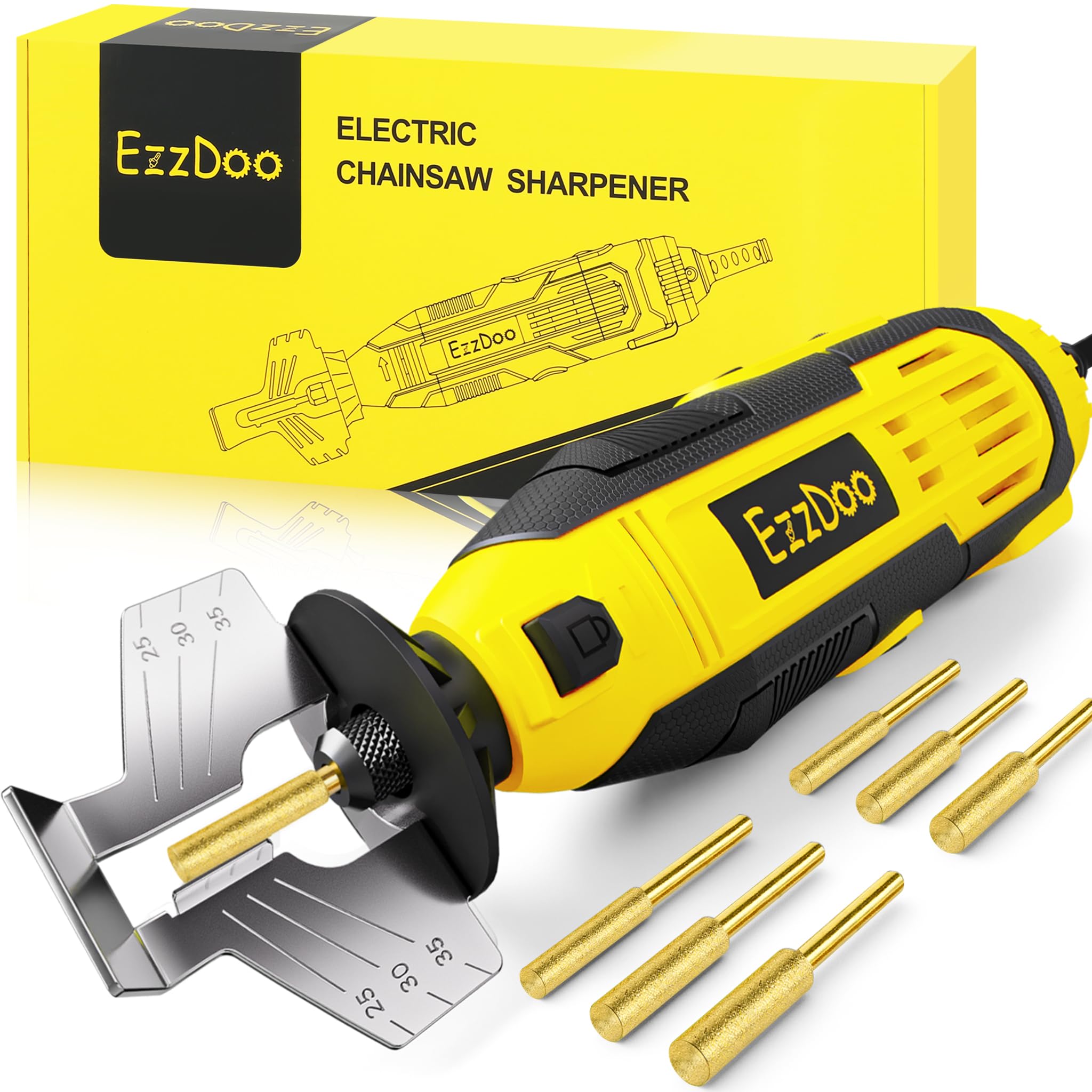
Bottom line: The EzzDoo Electric Chainsaw Sharpener uses powered grinding to reduce manual filing effort. Its included bits and angle attachment make it useful for frequent touch-ups on compatible chains.
Key Specs
- Type: Handheld electric sharpener, uses powered rotary grinding.
- Chain fit: Multiple chain types, select the matching grinding bit.
- Included: Six titanium-coated diamond bits and an angle guide.
- Power: Electric, requires a suitable power source.
The handheld design lets you work on the chain without removing it from the bar. This is useful when you want powered sharpening but do not have space for a bench grinder.
The angle attachment provides a reference while you move between cutters. You still need to control the tool carefully to avoid uneven filing or excessive metal removal.
Unlike a bench-mounted system, a handheld grinder relies heavily on your technique. Start with light passes and follow your chain manufacturer’s sharpening specifications.

Pros and Cons
- Powered grinding reduces repetitive hand filing.
- Chain can remain mounted during sharpening.
- Multiple grinding bits included.
- Angle attachment helps guide positioning.
- Compact alternative to a bench grinder.
- Requires careful hand positioning.
- Incorrect bit selection can damage cutter geometry.
- Powered grinding can remove metal too aggressively.
6. Oregon 104004

Bottom line: The Oregon 104004 includes the essential tools for maintaining chains that require a 5/32-inch round file. It is a practical starter kit for learning consistent hand sharpening.
Key Specs
- Type: Manual sharpening kit, provides essential filing tools.
- Chain fit: Chains requiring a 5/32″ file, confirm manufacturer guidance.
- Included: Round file, flat file, guide, two handles, and depth gauge.
- Power: Manual, usable without electricity.
- Depth gauge: .025″ drop-center tool, check your chain’s required setting.
The assembled file guide helps keep the round file at the intended position while sharpening. Its angle markings provide a reference for maintaining consistent cutter geometry.
You also get a flat file and depth-gauge tool, allowing you to handle both cutting teeth and routine depth-gauge maintenance.
The 5/32-inch file size is the main buying consideration. If your chain needs a different diameter, select the appropriate kit instead of trying to compensate with filing technique.

Pros and Cons
- Includes both round and flat files.
- Assembled guide helps maintain filing angles.
- Includes a depth-gauge adjustment tool.
- Wooden file handles included.
- Portable for routine maintenance.
- Includes only one round-file diameter.
- Not suitable for every chain pitch.
- Manual sharpening takes practice.
7. CONGDAREN 2132 Sharpening Jig Kit

Bottom line: The CONGDAREN 2132 Sharpening Jig Kit is a basic alignment accessory. Its linked listing is currently unavailable, and its limited product documentation makes chain compatibility difficult to establish.
The compact design aims to assist with basic sharpening alignment. However, the original article reported concerns about fit, construction, and consistency.
Those limitations make it difficult to establish reliable suitability for regular maintenance. The guide’s exact supported chain pitches have not been independently confirmed.
Pros and Cons
- Compact design.
- Basic alignment-guide concept.
- Simple manual construction.
- Linked listing currently unavailable.
- Chain compatibility is not independently confirmed.
- Original article reports fit and construction concerns.
View the CONGDAREN 2132 Sharpening Jig Kit listing on Amazon.
8. CONGDAREN Chainsaw Sharpener
Bottom line: The CONGDAREN Chainsaw Sharpener is a compact sharpening accessory, but its linked listing is currently unavailable. Detailed compatibility information could not be established from reliable manufacturer documentation.
Its basic design aims to provide an alignment reference for occasional maintenance. The original article also notes concerns about fit, durability, and inconsistent alignment.
For frequent sharpening, the available information is insufficient to establish reliable performance or compatibility across different chain types.

Pros and Cons
- Compact format.
- Simple sharpening-guide concept.
- Designed as a basic manual accessory.
- Linked listing currently unavailable.
- Detailed chain compatibility is unconfirmed.
- Original article identifies fit and durability concerns.
View the CONGDAREN Chainsaw Sharpener listing on Amazon.
9. Dremel A679-02

Bottom line: The Dremel A679-02 adds chainsaw, mower-blade, and garden-tool sharpening functions to a compatible Dremel rotary tool.
Key Specs
- Type: Rotary-tool attachment kit, adds several sharpening functions.
- Chain fit: Multiple pitches with matching stones, check chain specifications.
- Included: Three sharpening attachments and four grinding stones.
- Power: Compatible Dremel rotary tool required, sold separately.
The kit includes separate attachments for chainsaws, lawn mower blades, and garden tools. Its screw-on mounting system makes changing attachments straightforward.
The chainsaw stones cover several common file sizes. Select the proper stone before sharpening rather than using one size for every chain.
This kit makes sense if you already own a compatible rotary tool and want to maintain several types of cutting equipment. It is less suitable if you need a dedicated, fixed-angle chain grinder.

Pros and Cons
- Supports several sharpening tasks.
- Includes dedicated chainsaw and mower attachments.
- Four grinding stones included.
- Compact accessory kit.
- Useful with an existing compatible Dremel tool.
- Rotary tool is not included.
- Compatibility depends on your Dremel model.
- Not a substitute for a dedicated high-volume chain grinder.
Granberg G106B vs Oregon 104004: Is the Upgrade Worth It?
The main difference is the sharpening system. Granberg provides an adjustable bar-mounted guide, while Oregon supplies a complete basic filing kit.
- Guide design: Granberg mounts directly to the bar; Oregon uses a handheld file guide.
- Chain flexibility: Granberg accepts different file sizes, while the Oregon kit includes a 5/32-inch round file.
- Included tools: Oregon supplies files and a depth-gauge tool; Granberg requires a separate file.
- Learning curve: Granberg offers more adjustments, while Oregon provides a simpler starting point.
Which Chainsaw Sharpener Should You Buy?
- Precise manual filing: Get the Granberg G106B.
- Workshop sharpening: Get the Oregon 310-120.
- SP33G chain maintenance: Get the Husqvarna X-Cut SP33G File Kit.
- Combined cutter and depth-gauge filing: Get the STIHL 2-in-1 Filing Guide.
- Handheld electric sharpening: Get the EzzDoo Electric Chainsaw Sharpener.
- Basic filing kit: Get the Oregon 104004 if its file size matches your chain.
How We Chose
- Chain compatibility: We checked whether each tool supports the intended chain pitch and sharpening requirements.
- Guidance and precision: We considered file guides, clamping systems, and features that help maintain repeatable angles.
- Included accessories: We compared files, grinding wheels, depth gauges, and other essential components.
- Ease of use: We considered setup, portability, electrical requirements, and maintenance.
- Source quality: We prioritized manufacturer specifications, product documentation, and available safety information rather than unsupported performance claims.
These recommendations are based on product information and documented features, not a new hands-on laboratory test.
How to Sharpen a Chainsaw Safely
Before sharpening, switch off the saw and let it cool. Disconnect the power source where applicable and follow the manufacturer’s maintenance instructions.
Secure the bar, adjust the chain as instructed, and engage the chain brake while filing. Wear suitable gloves and eye protection.
Mark your starting cutter so you know when you have completed the chain. Use even forward strokes and follow the specified sharpening angle.
For electric grinding, use light contact and avoid overheating the cutter. Replace damaged grinding wheels and maintain their profiles according to the grinder instructions.
After sharpening, inspect the cutters and depth gauges. Check chain tension before returning the saw to service.
Chainsaw Sharpener Buying Guide
Chain Pitch and File Diameter
Start by identifying your chain. Common pitches include 1/4 inch, .325 inch, 3/8-inch low profile, 3/8 inch, and .404 inch.
Pitch alone does not always identify the exact file or guide you need. Check the chain manufacturer’s specifications for file diameter, cutter profile, and depth-gauge setting.
The Granberg G106B accepts different file sizes, while the Oregon 104004 includes a specific 5/32-inch file.
Manual vs Electric Sharpeners
Manual file kits are portable and give you direct control over metal removal. They are useful for regular touch-ups and jobs away from electrical power.
Electric sharpeners reduce repetitive filing effort. A bench grinder holds the chain in a fixed station, while a handheld electric tool requires more control from your hands.
Choose the Oregon 310-120 for occasional workshop grinding or the EzzDoo Electric Chainsaw Sharpener for handheld powered maintenance.
Depth-Gauge Adjustment
Sharp cutters alone do not guarantee proper cutting. Depth gauges control how deeply each cutter enters the wood.
As cutters wear and are sharpened, depth gauges may need adjustment. Follow the chain manufacturer’s specified setting rather than applying one measurement to every chain.
The STIHL 2-in-1 Filing Guide combines cutter sharpening and depth-gauge maintenance in one tool.
Workshop Space and Power
A bench grinder needs a secure mounting position, adequate lighting, and access to suitable power.
Hand files and bar-mounted guides are easier to carry when you work outdoors. They also avoid the need to transport powered workshop equipment.
Consider where you sharpen most often before selecting a larger grinding system.
Included Accessories and Replacement Parts
Check what comes in the package. A low-cost guide may require separate files, while a complete kit may include handles, guides, and depth-gauge tools.
Grinding stones and files are consumables. Their availability matters if you plan to keep using the sharpener for several seasons.
If you already own a compatible rotary tool, the Dremel A679-02 can add several sharpening functions without requiring another complete powered tool.
Mistakes to Avoid When Buying Chainsaw Sharpeners
- Buying by pitch alone: Confirm the required file diameter and chain profile.
- Ignoring depth gauges: Include the proper gauge and flat file in your maintenance setup.
- Assuming every kit is complete: Check whether files, wheels, and the power tool are included.
- Overlooking setup: Choose a guide you can adjust and use consistently.
- Grinding too aggressively: Use light passes to avoid unnecessary metal removal and overheating.
FAQs
Which Chainsaw Sharpener Should I Choose?
Choose a sharpener that matches your chain and how often you maintain it. A guided file kit suits occasional touch-ups, while a bench grinder provides a fixed sharpening station. A bar-mounted guide offers more adjustment for manual filing. Always confirm chain pitch, file diameter, and cutter requirements before selecting a tool.
How Do I Know When to Sharpen My Chainsaw?
A chain may need sharpening when cutting becomes slower, you must apply more pressure, or the saw produces fine dust instead of normal wood chips. Uneven cutting can also indicate cutter problems. Inspect the chain for damage before filing, and replace it if the manufacturer specifies that the damage or wear is beyond repair.
What Size File Do I Need for My Chainsaw?
The correct file diameter depends on the exact chain model and cutter design. Common sizes include 5/32 inch, 3/16 inch, and 7/32 inch, but they are not interchangeable. Check the manufacturer’s chain identification and sharpening chart before buying. Using an incorrect file can change the cutter profile and reduce sharpening quality.
Can I Sharpen a Chainsaw Chain Without Removing It?
Yes, many manual guides and handheld sharpening tools allow the chain to remain installed on the bar. Secure the saw, disconnect its power source, and follow the manufacturer’s sharpening procedure. Bar-mounted guides can help maintain filing geometry. Bench grinders normally require removing the chain and securing it in the grinder’s vise.
How Often Should I Check the Depth Gauges?
Check depth gauges during routine sharpening, particularly as the cutters become shorter. Their correct height depends on your chain’s specifications. A suitable depth-gauge tool helps identify when adjustment is needed. Avoid filing them lower than recommended, since excessive depth can make the chain cut too aggressively and increase kickback risk.
How Do I Sharpen Safely and Consistently?
Secure the saw, disconnect the power source, and wear suitable gloves and eye protection. Use the correct file or grinding wheel and follow the chain manufacturer’s sharpening angle. Apply consistent strokes and avoid excessive grinding pressure. Inspect depth gauges, chain tension, and cutter condition before returning the saw to service.
Customer Preferences
Buyers generally need to balance portability, compatibility, and ease of use. Manual file kits suit occasional maintenance, while a bench grinder provides a fixed workshop setup.
Before choosing, identify the chain models you maintain and determine whether you need one dedicated file size or a tool that accepts several sizes.
Final Verdict
The best chainsaw sharpeners are the ones that fit your chain and help you maintain its intended cutter geometry. For adjustable manual guidance across standard chain pitches, the Granberg G106B is our overall pick.
If you prefer electric workshop sharpening, the Oregon 310-120 offers a compact alternative to larger grinders.
For a simpler filing kit, consider the Oregon 104004. For a powered workshop setup, compare the Oregon 310-120.
| Product Name | Image | Rating | Type of Sharpener | Material | Weight |
|---|---|---|---|---|---|
| Granberg Chainsaw Sharpener, G106B |
|
4.3/5 (1,427 reviews) | Bar Mounted Guide System | High-Quality Cast Aluminum, Zinc-Plated Steel | 1.11 Pounds |
| Oregon Compact 120-Volt Mini Bench Grinder |
|
4.4/5 (651 reviews) | Mini Bench Grinder | Alloy Steel | 0.01 Ounces |
| Husqvarna X-Cut SP33G Chainsaw File Kit |
|
4.7/5 (411 reviews) | File Kit | N/A | 0.26 Pounds |
| Stihl 2 IN 1 Easy File Chainsaw Chain Sharpener |
|
4.7/5 (4,104 reviews) | File Sharpener | N/A | 0.35 Kilograms |
| EzzDoo Electric Chainsaw Sharpener Kit |
|
4.4/5 (3,945 reviews) | Electric Sharpener | High Carbon Steel, Plastic, Rubber, Titanium | 1.4 Pounds |
| Oregon 104004 Chainsaw Sharpening Kits |
|
4.6/5 (307 reviews) | Sharpening Kit | N/A | N/A |
| 2132 Sharpening Jig Kit |
|
1.0/5 (1 review) | Jig Kit | N/A | 15.2 Ounces |
| Chainsaw Sharpener by CONGDAREN |
|
3.4/5 (6 reviews) | Sharpener | N/A | 15.5 Ounces |
| Dremel A679-02 Sharpening Attachment Kit |
|
4.5/5 (3,951 reviews) | Attachment Kit | N/A | N/A |
