

Last Updated on July 29, 2026 by Caleb Warren
If your travel pillow height feels wrong, the solution is not to follow a fixed inch measurement. The right fit depends on your neck length, shoulder height, seat angle, headrest, and where your head naturally falls when you relax. A well-adjusted pillow should support your head without pushing it forward, forcing it sideways, or pressing tightly against your throat.
Quick Answer
Adjust a travel pillow by sitting in your normal travel position, placing the thickest support where your head naturally falls, and changing the height until your head stays near neutral—not pushed forward or tilted hard to one side. Secure it gently, then test the fit for five to ten minutes.
Key Takeaways
- There is no universal travel-pillow height for side, back, or stomach sleepers because upright travel is different from sleeping on a mattress.
- The pillow is too high if it pushes your chin down, moves your head away from the seat, or forces a strong sideways tilt.
- The pillow is too low if your head still drops, your neck muscles remain tense, or you must lean far to reach the support.
- Test the pillow in your actual travel posture and adjust it again whenever the seat angle, clothing, or head position changes.
At a Glance
| Time Required | 5–10 minutes for the initial fit, plus minor adjustments during the trip |
| Difficulty | Easy |
| Tools Needed | Your travel pillow, a travel seat or similar chair, and an optional mirror or phone camera |
| Cost | $0 if you already own the pillow |
Disclosure: As an Amazon Associate I earn from qualifying purchases. Some links on this page are affiliate links, at no extra cost to you.
Understanding the Importance of Travel Pillow Height
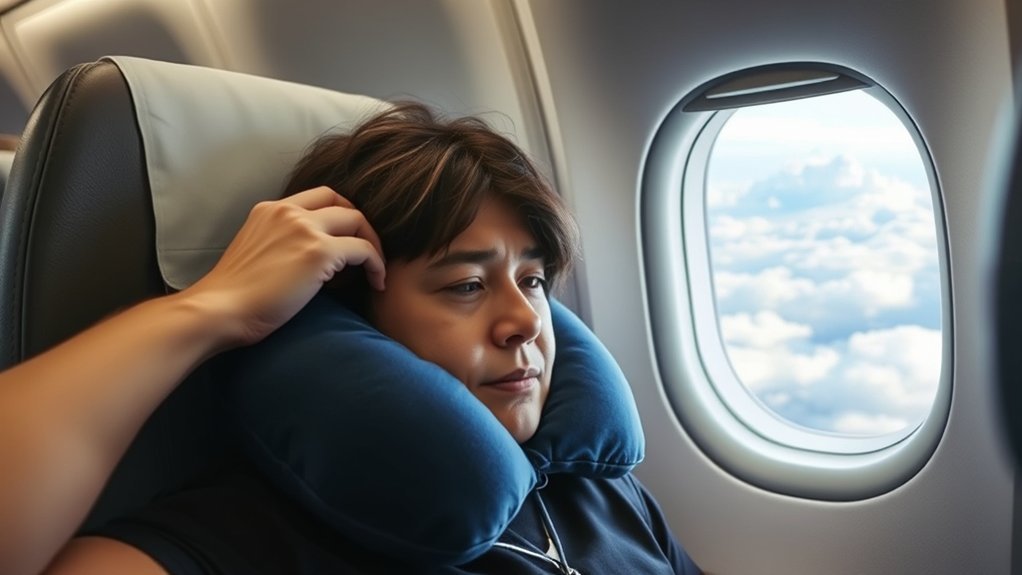
The height of a travel pillow determines where it contacts your jaw, neck, shoulder, and head. Too much height can push your head forward or force it away from the headrest. Too little height leaves an empty gap, allowing your head to drop until your muscles or ligaments take the load.
Research on ordinary bed pillows shows that pillow height, shape, body dimensions, pressure, and support properties can affect head and neck positioning. However, those findings do not establish a universal inch measurement for upright travel. A travel pillow must be fitted while you are sitting in the posture you expect to use. The research overview in this systematic review of pillow-height determinants supports using individual fit rather than relying on one number for everyone.
The correct travel-pillow height is the amount of support that fills the gap around your neck without forcing your head away from a relaxed, near-neutral position.
Your normal sleeping position at home may still offer a clue. For example, someone who usually turns toward one side may also lean that way while traveling. It should not, however, be used to prescribe a fixed travel-pillow loft such as 4, 5, or 6 inches.
Identifying Issues With Your Travel Pillow Height
Test your pillow while sitting against a seat rather than lying on a bed. Set the seat to the recline angle you expect to use, place both feet comfortably, relax your shoulders, and look straight ahead. Then let your head relax slightly without deliberately holding it upright.
Signs Your Travel Pillow Is Too High
- Your chin is pushed toward your chest.
- The back of your head cannot rest naturally near the seat or headrest.
- Your head is forced strongly toward the opposite side.
- The pillow presses under your jaw or into your throat.
- You feel jaw tension, throat pressure, or difficulty swallowing.
- You keep trying to pull the pillow downward.
Signs Your Travel Pillow Is Too Low
- Your head still drops forward or sideways before reaching the support.
- You must lean farther than feels natural to make contact with the pillow.
- Your neck muscles remain tense because you are still holding your head up.
- The pillow slips below your shoulder or rotates away from the area that needs support.
- You wake with a sharp bend in your neck despite wearing the pillow.
A Simple Seated Alignment Check
Look at yourself in a mirror or take a side-view photo while seated. Your head does not need to be perfectly vertical, but your ear should remain reasonably close to the line of your shoulder. Your chin should not be jammed down, and your nose should not point sharply toward one shoulder. Mild supported leaning can be comfortable; a forced end-range position usually is not.
Note: A thick jacket, hood, large hairstyle, over-ear headphones, or high seat wings can change the effective pillow height. Fit the pillow with the clothing and accessories you expect to use during the trip.
How to Adjust Your Travel Pillow for Maximum Comfort
- Set up your seat. Sit fully back and choose the recline angle you expect to use. Do not fit the pillow while leaning forward over a table or phone.
- Notice where your head falls. Relax for a moment. Determine whether your head tends to move forward, left, right, or backward.
- Place support in that direction. Rotate or position the pillow so its thickest, firmest, or structured area meets the side that needs support.
- Change the height gradually. Add or remove air, move adjustable lobes, turn height controls, fold a soft section, or change the pillow’s vertical position. Make one small change at a time.
- Set the closure gently. Tighten straps, toggles, hook-and-loop fabric, or clasps enough to stop slipping, but not enough to press against your throat or restrict comfortable swallowing.
- Test for five to ten minutes. Relax your jaw and shoulders. Look forward, close your eyes, and allow your head to settle. Recheck for forward pressure, side-bending, slipping, heat, or jaw discomfort.
Warning: Do not tighten a travel pillow against your throat or use it in a way that covers your nose or mouth. On an aircraft, keep your seat belt fastened as directed, make sure the pillow does not interfere with the belt, and follow all crew instructions. The Federal Aviation Administration recommends remaining buckled while seated.
Adjusting an Inflatable Pillow
Begin below maximum inflation. A fully inflated pillow may feel firm and portable, but it can also push the head forward or create pressure under the jaw. Release air in short bursts until the pillow fills the gap without feeling rigid. Recheck it after changes in cabin pressure and temperature because the pillow may feel different during the trip.
Adjusting a Fixed Foam Pillow
A fixed memory-foam pillow cannot be made physically taller or shorter in the same way. You can still change its effective height by rotating it, wearing it higher or lower, moving the opening, tightening or loosening the closure, or placing the thicker side where your head falls. If every position pushes your head forward, the model may simply be too thick for your neck and seat.
Adjusting a Structured or Height-Controlled Pillow
Follow the manufacturer’s directions because adjustment systems differ. Some models use internal supports, movable lobes, or dials. For example, the Trtl Pillow Plus currently uses controls to change support height, while the Cabeau Evolution X advertises adjustments for height, circumference, and closure. These examples do not mean every pillow from either brand has the same features.
How to Position Your Pillow for Neck Support
The best orientation depends on the pillow’s shape and the direction your head moves. Do not assume that every U-shaped pillow must be worn with the opening in front.
- If your head falls forward: Try placing more support beneath the chin or toward the front of the neck, provided it does not press on your throat. With some conventional U-shaped designs, placing the opening behind you may bring the padded section forward. A Cleveland Clinic specialist describes this option in the clinic’s travel posture guidance.
- If your head falls to one side: Rotate the thickest or structured section toward that side. Lean only far enough to meet the support; do not force your ear hard toward your shoulder.
- If the seat pushes your head forward: Use a pillow with a flatter back, move the rear section lower, or try a side-support design. A thick pad behind the neck can make the problem worse.
- If you switch sides: Choose a pillow that can be rotated easily or supports both sides without a tall rear section.
Pro Tip: Test the pillow at home in a dining chair, recliner, or parked vehicle for at least ten minutes. A fit that feels comfortable for thirty seconds may begin pressing on your jaw or pushing your head forward after several minutes.
Tips for Maximizing Comfort With Your Travel Pillow
- Relax your shoulders first: Raised shoulders shorten the gap between your neck and shoulder and can make a suitable pillow feel too tall.
- Recheck after reclining: Changing the seat angle alters where your head meets the pillow and headrest.
- Keep your lower back supported: Slouching moves the head forward and can make the neck pillow seem too short or badly shaped.
- Avoid stacking bulky items: A hood, scarf, and thick pillow together may create too much pressure.
- Use the headrest when helpful: Adjustable headrest wings can share the load with the pillow and reduce the amount of side support you need.
- Take movement breaks: A pillow supports rest, but it does not replace changing position and moving during a long trip when it is safe to do so.
- Keep the cover clean: Sweat, skin oils, and compressed fabric can affect grip and comfort. Follow the care label, especially because many foam inserts cannot be machine washed.
Troubleshooting Common Fit Problems
Your head still bobs forward: Move the supportive section closer to the chin, reduce empty space inside the pillow, or try an orientation that places the opening behind you. Stop if the adjustment puts pressure on your throat.
The pillow pushes your head forward: Lower or rotate the rear section, remove some air, loosen the closure, or choose a design with a flatter back.
The pillow slips: Tighten the closure slightly, place it closer to your neck before fastening, and remove slippery clothing layers between the pillow and your shoulder.
Your jaw hurts: Reduce height or firmness and move the support away from the jaw hinge. The pillow should cradle your head, not lift your jaw forcefully.
You feel too warm: Loosen the wrap, use a breathable cover, or choose a ventilated or inflatable model with less material around the neck.
One side feels comfortable and the other does not: Your shoulder height, posture, or headrest may be asymmetrical. Rotate the pillow when you change sides instead of forcing one setting to work everywhere.
Comparing Travel Pillow Types for Height and Comfort Adjustability
Each travel pillow type controls height differently. The best choice is the one that fits your body and seat without forcing your head into an uncomfortable position.
| Type | Height Control | Main Advantage | Common Fit Problem |
|---|---|---|---|
| Inflatable | Add or release air | Highly packable and easy to fine-tune | Overinflation can feel rigid or push the head forward |
| Memory foam | Usually fixed; adjusted by rotation and placement | Cushioned, shape-conforming feel | A thick rear section may move the head away from the seat |
| Wrap-around | Closure tension and pillow position | Support can be moved around the neck | Can feel hot, restrictive, or tight under the jaw |
| Structured scarf or brace-style | Support location, wrap tension, and model-specific controls | Concentrated support on the side where the head falls | The support angle may not suit every neck length |
Inflatable Pillow Adjustability Features
Inflatable pillows offer the widest range of firmness and effective height. Inflate the pillow until it takes shape, then sit back and release small amounts of air. The goal is not maximum firmness. The goal is enough support to stop excessive head movement without creating a hard pressure point.
- Easy to inflate or deflate in small steps.
- Useful when different seats require different support levels.
- Compact when packed.
- May feel less stable if underinflated.
- Can feel rigid or bulky if overinflated.
- Depends on a reliable valve and leak-free construction.
Memory Foam Benefits
Memory foam can conform to the shape of your head and neck and often provides a cushioned feel. Its height is usually fixed, so correct sizing matters more. Foam does not guarantee better alignment or pain relief; a pillow that is too thick can still push your head forward, regardless of the material.
Check the rear profile before buying. A flat or thin back often works better with a protruding aircraft headrest, while taller side sections may help someone whose head falls sideways. Foam pillows are usually bulkier than inflatable models, although some compress into a travel bag.
Wrap Around Support Design
Wrap-around pillows surround more of the neck and may help travelers who change head position. Their effective height depends on the thickness of each section, how tightly the pillow closes, and where the thicker areas sit.
- Adjustability: A clasp, strap, or overlapping fabric can reduce gaps and change where the support contacts the neck.
- Multiple support zones: Some designs support the chin and both sides, while others concentrate support in one area.
- Fit limitations: Too much material can trap heat, press on the jaw, or feel restrictive.
Secure a wrap-around pillow gently. You should be able to breathe, swallow, and turn your head enough to respond to your surroundings.
Structured Scarf and Side-Support Designs
These pillows use an internal frame, reinforced panel, or firm support against one side of the neck. They can be useful when your head consistently falls left or right. Position the support between your shoulder and jaw without forcing your ear toward your shoulder. Height-adjustable versions offer more flexibility for different neck lengths.
Choosing the Best Travel Pillow for Your Needs
Choose a pillow according to your seated posture rather than your usual mattress sleeping position. Consider the following questions:
- Where does your head fall? Forward droppers need chin or front support; side leaners need stable lateral support.
- Does the seat have a large headrest? Look for a flat-back pillow if the headrest already pushes your head forward.
- Do you have a short or long neck? A fixed tall pillow may overwhelm a short neck, while a low pillow may leave a gap for someone with more distance between the jaw and shoulder.
- Will you change seats often? An inflatable or height-adjustable model is easier to adapt.
- Do you sleep hot? Check ventilation, cover fabric, and how much of the neck the pillow encloses.
- How much luggage space is available? Inflatable and scarf-style designs usually pack smaller than thick foam.
- Can the cover be cleaned? A removable washable cover is useful for frequent travel.
Whenever possible, try the pillow in a chair before the return window closes. Wear the same hoodie, headphones, or jacket you commonly use while traveling. A model that fits well without those items may become too tall once extra material surrounds your neck.
When to Stop Adjusting the Pillow
A travel pillow is a comfort accessory, not a treatment for an injury or neurological condition. Remove it if it causes increasing pain, numbness, tingling, weakness, dizziness, difficulty swallowing, breathing discomfort, or a severe headache.
If neck pain is persistent, follows an accident, travels into an arm, or occurs with weakness or numbness, seek medical advice rather than continuing to change the pillow. Cleveland Clinic’s neck pain guidance explains common symptoms and when professional evaluation may be appropriate.
Frequently Asked Questions
Can a travel pillow cause neck pain if it is the wrong height?
A poor fit can contribute to discomfort by holding your head forward, forcing it sideways, or leaving it unsupported. Reduce the height or firmness if the pillow pushes your head away from a relaxed position. Remove it if pain increases or you develop numbness, weakness, dizziness, or other unusual symptoms.
How do I know if my travel pillow is too high or too low?
It is probably too high if your chin is forced down, your head moves away from the headrest, or the support presses under your jaw. It is probably too low if your head still drops before reaching the pillow or your neck muscles remain tense. Test the fit while sitting in your actual travel posture.
Are there travel pillow models with adjustable height?
Yes. Current examples include the Trtl Pillow Plus, which uses height controls, and the Cabeau Evolution X, which advertises adjustable height, circumference, and closure. Product lines change, so check the manufacturer’s current specifications before buying rather than assuming every model from a brand is adjustable.
What materials help a travel pillow maintain its height?
Dense foam and structured internal supports tend to hold a fixed shape, while inflatable pillows depend on air pressure and valve integrity. Fiber and microbead fills may compress more easily. Material alone does not determine comfort; the pillow’s shape, dimensions, closure, and fit against the seat also matter.
How frequently should I adjust my travel pillow during a trip?
Adjust it whenever you recline the seat, change sleeping sides, add or remove a jacket, move the headrest, or notice pressure and slipping. There is no required schedule. A quick fit check after each major position change is more useful than adjusting it at fixed time intervals.
Should the opening of a U-shaped travel pillow face forward or backward?
Either orientation may work, depending on the design and where your head falls. If your head drops forward, putting the opening behind you may move more padding under the chin. If you need side support, rotate the thickest section toward that side. Always follow the manufacturer’s instructions and avoid pressure on the throat.
Can I use bed-pillow loft measurements to choose travel pillow height?
Not reliably. Bed-pillow measurements are based on lying on a mattress, where the shoulders, head, and spine are supported differently. Choose travel-pillow height by testing it upright in a seat and checking whether it supports your head without forcing it forward or sharply sideways.
Conclusion
The right travel pillow height is not a universal number. It is the setting that supports your head in the seat you are using without forcing your chin down, pushing your head forward, or creating a sharp sideways bend. Fit the pillow while seated, place support where your head naturally falls, make small adjustments, and test each setting for several minutes.
An inflatable or height-adjustable pillow offers the most flexibility, while a fixed foam model can work well when its shape matches your neck and headrest. Stop using any pillow that causes throat pressure, breathing difficulty, numbness, weakness, dizziness, or increasing pain.
Sources
- Ergonomic Consideration in Pillow Height Determinants and Evaluation — research review covering body dimensions, alignment, pressure, muscle activity, and other factors that influence pillow height.
- Cleveland Clinic: Tips for Traveling With Back Pain — seated posture guidance and an expert suggestion for positioning a conventional neck pillow.
- Cleveland Clinic: Neck Pain — general neck alignment, symptom, and medical-evaluation guidance.
- Federal Aviation Administration Passenger Safety Tips — seat-belt and cabin safety guidance.
- Trtl Pillow Plus Official Product Information — current height-adjustment and positioning instructions for that model.
- Cabeau Evolution X Official Product Information — current height, circumference, and closure-adjustment information for that model.

