
Last Updated on July 29, 2026 by Caleb Warren
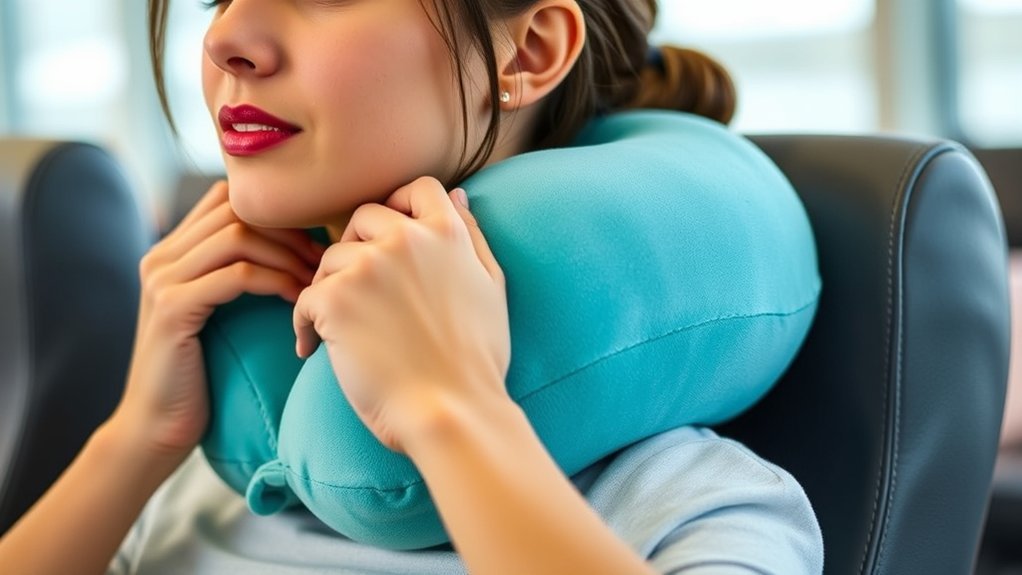
A travel pillow should limit unwanted head movement without pushing your chin down or forcing your head forward. The correct setup depends on the pillow’s design, so a traditional U-shaped pillow, a scarf-style support, and an infinity pillow may all be worn differently. Start with the manufacturer’s directions, then fine-tune the fit while seated.
Quick Answer
Sit fully against the seat and position the pillow so it fills the unsupported space around your neck without tilting your head. On many U-shaped pillows, the thin section sits behind you and the opening or clasp faces forward. Other designs support the side or chin, so always check the product instructions.
Key Takeaways
- There is no single correct opening direction for every travel pillow.
- Your ears should remain roughly over your shoulders, with your chin level rather than pressed toward your chest.
- A clasp or wrap should feel secure but should not press on your throat, jaw, or ears.
- A travel pillow may improve comfort, but it cannot guarantee sleep or treat an existing neck condition.
At a Glance
| Time Required | About 3–5 minutes |
| Difficulty | Easy |
| Tools Needed | Travel pillow and a supportive seat |
| Cost | No additional cost if you already own the pillow |
Disclosure: As an Amazon Associate I earn from qualifying purchases. Some links on this page are affiliate links, at no extra cost to you.
Common Travel Pillow Problems and Solutions
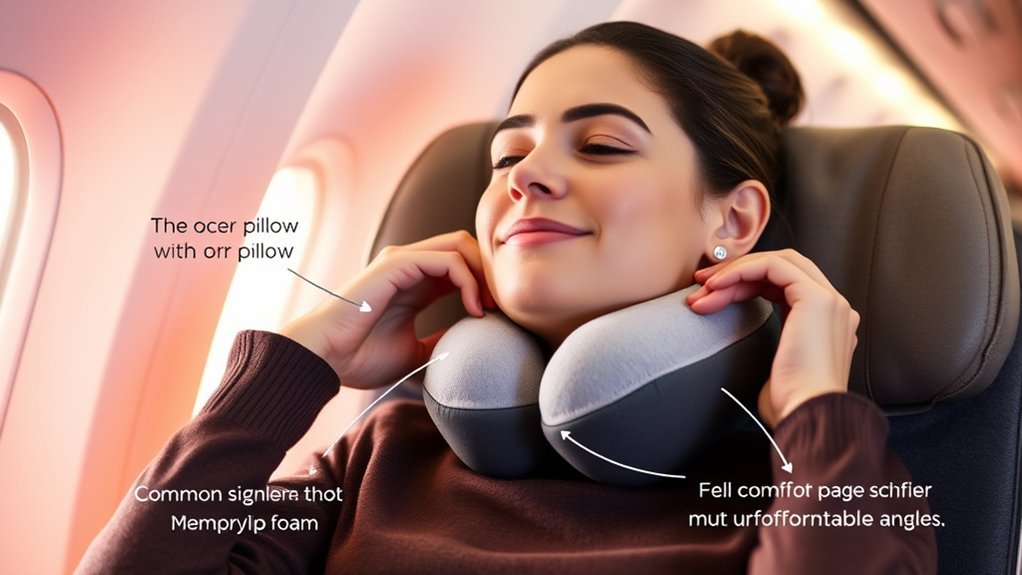
Most travel-pillow problems come from using the wrong orientation, choosing the wrong height, or tightening the pillow too much. The goal is not to lock your neck in place. It is to reduce uncomfortable head movement while allowing you to breathe, swallow, and change position normally.
- Your head falls forward: Move more support toward the front or under the chin if the design allows it. Tighten the front clasp slightly, but do not pull it against your throat.
- Your head drops to one side: Shift an adjustable support toward that side or place the taller section beneath the jaw.
- The pillow pushes your head forward: Check whether the thickest section is incorrectly placed behind your neck. Some U-shaped models use a thin, flat rear panel for this reason.
- Your jaw or ears hurt: Loosen the pillow, lower the support, or move it away from the sensitive area.
- The pillow slips: Use only its built-in clasp, wrap, or approved seat straps. Do not tie it to a seat belt, harness, tray table, or other safety equipment.
- You feel too warm: Loosen the wrap, uncover part of your neck, or choose a breathable or inflatable design.
Note: Pillow orientation is design-specific. For example, the Cabeau Evolution S3 uses a thin rear panel and front clasp, while the Trtl Travel Pillow places its internal support against the side of the neck or nearer the chin.
How to Adjust Your Travel Pillow in Simple Steps
- Identify the pillow type. Find the label, instructions, clasp, valve, internal brace, flat panel, or raised support section. These features reveal how the pillow is meant to sit.
- Set your seated posture first. Sit with your hips against the seatback, shoulders relaxed, and feet supported. Adjust the headrest when possible before adding the pillow.
- Position the main support. On many U-shaped pillows, the thin section sits behind the neck and the opening or clasp faces forward. On scarf-style pillows, place the internal support beneath one side of the jaw or closer to the chin. Rotate reversible or wraparound pillows until they fill the space where your head tends to fall.
- Secure the pillow gently. Close the clasp, hook-and-loop fastening, or wrap until the pillow stays in place. You should still be able to breathe, swallow, and slide one or two fingers between the closure and your neck.
- Check your alignment. Keep your chin near level, your face pointing forward, and your ears roughly above your shoulders. The pillow should not force your head forward, backward, or sharply to one side.
- Test the fit before sleeping. Relax for several minutes and let your head become heavy. Make small changes to the height, firmness, orientation, or closure until the support feels stable without creating pressure.
Pro Tip: Adjust the pillow while you are wearing the same jacket, hoodie, or headphones you plan to use during the trip. Extra layers can change the pillow’s height and tightness.
How to Position Different Travel-Pillow Designs
- Traditional U-shaped pillow: Begin with the curved section around the back and sides of your neck and the opening toward the front. Rotate it only when the design permits and another position gives better support.
- Thin-back U-shaped pillow: Place the flat panel against the seatback and close the clasp in front. The raised sides should support the jaw without lifting your shoulders.
- Scarf or brace-style pillow: Place the internal support on the side where your head tends to fall, then wrap the fabric securely around your neck.
- Inflatable pillow: Inflate it partly, put it on, and add air gradually. An overinflated pillow can feel rigid and push your neck away from a neutral position.
- Infinity or wraparound pillow: Loop or fold it to fill the space between your neck, shoulder, and seat. These designs may need several trials before the best configuration is clear.
How Proper Neck Alignment Makes Travel More Comfortable
Neutral alignment means that your head remains centered over your upper body instead of hanging forward or leaning sharply to one side. Mayo Clinic recommends keeping the head centered over the spine and the ears over the shoulders to reduce strain associated with poor posture.
A travel pillow should fill unsupported space around your neck; it should not force your head into a new or uncomfortable position.
A suitable fit may help by:
- Limiting head bobbing: Side or chin support can reduce the distance your head drops before the pillow catches it.
- Reducing sustained bending: Keeping your head nearer the center may reduce the time spent with your neck sharply flexed or tilted.
- Improving perceived comfort: Stable support may make it easier to relax while sitting upright.
Comfort alone does not prove that the pillow is medically correcting your spine. Stop and readjust it if you notice increasing pain, numbness, tingling, dizziness, jaw pressure, or difficulty breathing or swallowing.
Why Proper Pillow Use Matters for Better Travel Sleep
A travel pillow can make upright rest more comfortable, but it cannot guarantee that you will sleep or arrive without stiffness. A 2021 systematic review of ordinary sleep-pillow designs found some effects on waking pain and neck disability, but it did not find a significant improvement in sleep quality among people with chronic neck pain. Evidence about travel pillows specifically is more limited.
For better comfort during a long trip:
- Keep your lower back supported so your upper body does not slide forward.
- Place your phone, tablet, or book closer to eye level rather than bending your neck toward your lap.
- Use the seat’s headrest or adjustable wings when available.
- Avoid reclining so far that your body slides beneath the pillow.
- Change position regularly instead of holding one posture for the entire journey.
- On a plane, stand or walk only when the seat-belt sign is off and conditions are safe.
- On a road trip, wait for a safe rest stop before getting out to stretch.
Common Mistakes to Avoid When Using Travel Pillows
- Following a universal front-or-back rule: The correct orientation depends on the pillow. Read the label or manufacturer’s instructions before rotating it.
- Putting a bulky section behind your neck: Too much rear padding can push your head forward and bring your chin toward your chest.
- Tightening the closure too much: The pillow should be secure, not restrictive. Loosen it if it presses on your throat or jaw.
- Using a pillow that is too tall: Raised sides should meet your jaw without forcing your shoulders upward.
- Ignoring your seat position: A pillow cannot compensate fully for slouching, sliding forward, or staring down at a screen.
- Inflating the pillow fully before testing it: Begin with less air and increase the firmness in small steps.
- Expecting the pillow to treat pain: A travel pillow is a comfort accessory, not a substitute for medical assessment or treatment.
Warning: Never put on, remove, inflate, or adjust a travel pillow while driving. A driver needs a clear range of motion and must be able to check mirrors and surrounding traffic without obstruction.
How to Tell Whether the Travel Pillow Fits
The Fit Is Probably Good When
- Your chin remains near level.
- You can turn your head enough for normal movement.
- The support contacts your neck or jaw without creating a pressure point.
- Your shoulders remain relaxed.
- Your head does not fall far forward or sideways when you relax.
- You can breathe and swallow normally.
The Pillow May Be Too High or Firm When
- Your chin is pushed downward.
- Your shoulders are lifted.
- The support presses into your ears or jaw.
- You feel trapped or unable to change position.
The Pillow May Be Too Low or Loose When
- Your head still drops a long distance before meeting the pillow.
- The pillow slides away from the area needing support.
- You have to shrug your shoulder upward to reach it.
- The clasp or wrap opens as soon as you relax.
Choosing the Right Travel-Pillow Material
No single material is best for every traveler. Choose according to the support, temperature, packing space, and cleaning method you prefer.
- Memory foam: Contours to the neck and often feels stable, but it can be bulky and warm. Many models have washable covers while the foam core requires spot cleaning.
- Inflatable: Packs small and allows firmness adjustments. It may feel rigid when overinflated and can lose air if the valve or shell is damaged.
- Fiber or microbead: Usually soft and lightweight, though it may provide less structured support and can flatten with use.
- Scarf-style support: Uses an internal brace rather than thick cushioning. It is compact and offers targeted side support but may take practice to position.
- Hybrid designs: Combine foam, air, straps, or adjustable inserts. Follow the model’s setup and care instructions closely.
Plane, Car, and Child Safety
Adults may use travel pillows while seated as passengers on planes, trains, buses, and cars, provided the pillow does not interfere with a seat belt, harness, emergency equipment, or crew instructions. Do not route a seat belt through the pillow unless the manufacturer expressly designed it for that purpose.
Use extra care with children. The National Highway Traffic Safety Administration does not recommend aftermarket products with car seats unless the original car-seat manufacturer made or permitted the accessory. A separate neck pillow must never change the harness position, push the child’s head forward, or create space between the child and the restraint.
Note: This article provides general comfort guidance, not medical advice. Seek medical care for severe neck pain, pain after an injury, pain that persists for several days, or symptoms that spread into an arm or occur with numbness, weakness, tingling, or a severe headache.
Frequently Asked Questions
Can I use a travel pillow on a plane and in a car?
Yes. Adults can use one while riding as passengers, provided it does not interfere with the seat belt, headrest, emergency equipment, or normal breathing and movement. Do not wear or adjust one while driving.
What materials are best for travel pillows?
The best material depends on your needs. Memory foam offers shaped support, inflatable pillows save packing space and allow firmness changes, and scarf-style supports are compact. Consider heat, weight, washability, firmness, and the direction in which your head usually falls.
How do I clean my travel pillow?
Read the care label first. Remove the cover or internal support when instructed. Wash removable fabric covers using the stated temperature and cycle. Do not machine-wash a memory-foam core, plastic brace, air bladder, or electronic component unless the manufacturer specifically permits it. Let every part dry fully before storage.
Are travel pillows suitable for children?
Only when the pillow fits the child and does not interfere with safety equipment. Do not add an aftermarket pillow to a car seat or booster unless the car-seat manufacturer allows it. The harness and seat belt must remain correctly positioned and snug.
Can I adjust my travel pillow while sleeping?
You may wake briefly and reposition it, but make the main adjustments before falling asleep. If you wake with pressure, numbness, tingling, breathing difficulty, or increasing pain, remove the pillow rather than tightening it further.
Should the travel-pillow opening face forward or backward?
It depends on the design. Many U-shaped pillows have a front opening or clasp and a thinner rear section. Some reversible pillows can be rotated, while scarf-style models place support at the side or under the chin. Follow the manufacturer’s directions instead of applying one rule to every pillow.
How tight should a travel pillow be?
It should be tight enough to stay in position but loose enough for normal breathing, swallowing, and head movement. Loosen or remove it if the closure presses against your throat, jaw, ears, or skin.
Conclusion
The best travel-pillow position is the one intended for your specific design and adjusted to keep your head comfortably centered. Begin with the manufacturer’s instructions, sit fully against the seat, secure the pillow without overtightening it, and test the fit before sleeping. Reposition or remove it whenever it pushes your head forward, lowers your chin, creates pressure, or interferes with normal movement.
Sources
- Mayo Clinic: Neck Pain — posture, movement breaks, alignment, and symptoms that require medical attention.
- PubMed: Effects of Pillow Designs on Neck Pain and Sleep — evidence on pillow design, waking pain, disability, and sleep quality.
- PubMed Central: Pillow Height and Cervical Alignment — the relationship between pillow dimensions and cervical-spine positioning.
- Cabeau Evolution S3 Instructions and Features — thin-back U-shaped design, front clasp, raised sides, and seat straps.
- Trtl Travel Pillow Instructions — side, jaw, and chin positioning for a scarf-style support.
- National Highway Traffic Safety Administration: Car Seat Glossary — guidance about aftermarket products used with child restraints.

