
Last Updated on July 29, 2026 by Daniel Globe
The Gospel of Matthew says the Magi came “from the east” to Jerusalem, but it does not identify their homeland, starting city, route, transport, distance, or travel time. Any mileage is therefore an estimate. Depending on whether they began in Mesopotamia or western Iran, they may have traveled roughly 550 to 900 miles or more before making the final short journey from Jerusalem to Bethlehem.
Quick Answer
The Bible gives no exact distance for the Magi’s journey. A reasonable estimate is about 550 to 900 miles (885 to 1,450 kilometers), possibly more after road detours. The lower end fits an origin near Babylon; the upper end fits parts of western Iran. Their actual starting point, route, and travel time remain unknown.
Key Takeaways
- Matthew identifies the Magi only as visitors “from the east.”
- A distance of roughly 550 to 900 miles or more is possible, but no single figure can be proved.
- Persia, Media, Babylonia, and Arabia have all been proposed as possible regions of origin.
- The Bible does not say there were three Magi, call them kings, name them, or say they rode camels.
- Many weeks to several months is a reasonable possibility, but Matthew gives no travel schedule.
Disclosure: As an Amazon Associate I earn from qualifying purchases. Some links on this page are affiliate links, at no extra cost to you.
Who Were the Magi?
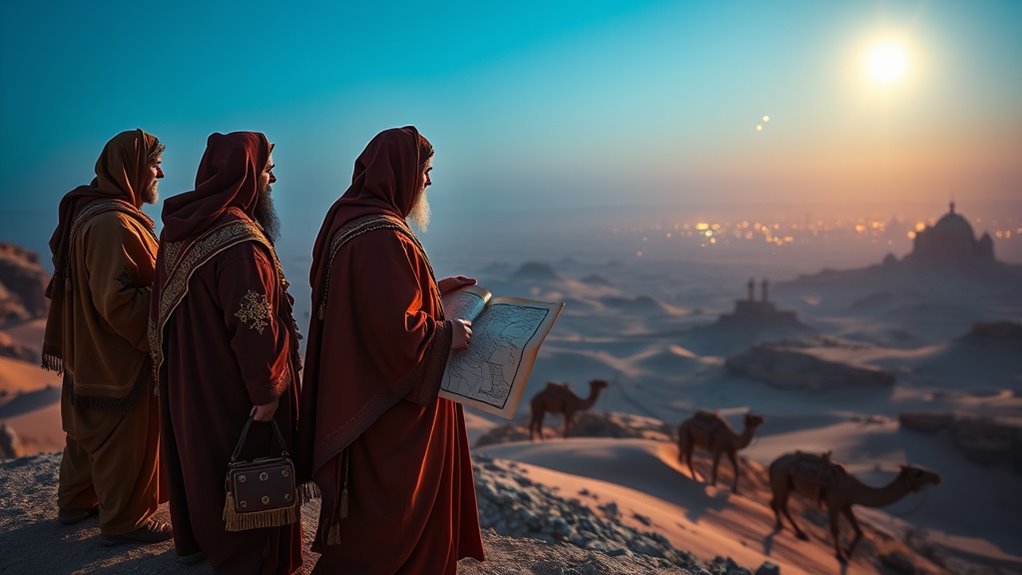
Matthew 2 calls the visitors magi and says they came “from the east.” The account does not name their country, city, ethnicity, religion, or social rank.
The Greek term magoi could refer to learned religious specialists, astrologers, interpreters of dreams, or members of an eastern priestly tradition. Historical Iranian Magi did serve as priests and court advisers. However, that background does not prove that Matthew’s Magi came from a particular Persian city or that they followed one clearly defined form of Zoroastrianism. The relationship between ancient Magi and Zoroastrian belief changed over time and remains a complex scholarly subject, as explained by Encyclopaedia Iranica.
Their interest in a star makes Babylonia another plausible context because Mesopotamia had a long tradition of observing and interpreting the sky. Arabia has also been suggested because gold, frankincense, and myrrh were associated with trade networks extending through the Arabian Peninsula. None of these proposals can be confirmed from Matthew alone.
The Bible also does not say there were exactly three Magi. The familiar number most likely developed because Matthew lists three kinds of gifts: gold, frankincense, and myrrh. It does not call the visitors kings, provide their later traditional names, or mention camels.
Note: The most reliable way to read the story is to separate what Matthew states from later art, Christmas traditions, and modern historical reconstruction.
How Far Did the Magi Travel?
No exact mileage survives because the starting point is unknown. The often-repeated figure of 800 to 900 miles can fit some locations in western Iran, but it should not be presented as the only answer.
A broader estimate of about 550 to 900 miles or more is more defensible. A starting point near Babylon would fall near the lower end. A starting point near Ecbatana in ancient Media or another western Iranian center would fall near the upper end. Actual road travel would normally be longer than a straight line because travelers had to follow usable terrain, water sources, crossings, settlements, and secure corridors.
Estimated Distance Traveled
The following figures are rounded modern map benchmarks. They illustrate how strongly the answer changes when a different origin is proposed; they are not proof that the Magi began in any of these places.
| Possible starting region | Approximate direct distance to Jerusalem | What it means |
|---|---|---|
| Babylon or central Mesopotamia | About 540 miles | An overland route would likely exceed the direct measurement. |
| Susa or southwestern Iran | About 765 miles | Road mileage could move the total toward or beyond 850 miles. |
| Ecbatana or western Media | About 800 miles | A practical land route could approach or exceed 900 miles. |
| Arabian Peninsula | Varies widely | “Arabia” covers too large an area for one meaningful total. |
Once the Magi reached Jerusalem, Bethlehem was only a short distance farther south. That final stage was small compared with any journey from Mesopotamia, Iran, or Arabia.
The honest answer is not one exact number: the Magi may have traveled roughly 550 to 900 miles or more, depending on where “the east” began.
Routes and Travel Time
A long journey from Mesopotamia or Iran would probably have followed established roads and trade corridors rather than a straight path across open desert. Organized routes offered access to water, food, settlements, river crossings, and some degree of protection.
Ancient overland travel was still slow. A group carrying valuable gifts would need time for rest, resupply, weather, animals, local permissions, and unexpected delays. For that reason, many weeks to several months is a reasonable possibility. Matthew does not provide enough information to calculate a more exact duration.
The claim that the journey took years goes beyond the evidence. The Magi found Jesus in a house, and Matthew calls him a child, but those details do not reveal the day the travelers left home. Herod later ordered the killing of boys aged two and under based on the time he had learned from the Magi. That action reflects Herod’s violent attempt to eliminate uncertainty; it does not prove that the Magi spent two years traveling.
Which Routes Could Have Led Them to Jerusalem?
Matthew does not record the route. Historians can identify roads and trading networks that existed around the beginning of the first century, but they cannot place the Magi on one specific road.
The famous Persian Royal Road ran between Susa and Sardis through Mesopotamia and Asia Minor. It formed part of a much larger transportation system, but it was not a direct documented highway from Persia to Jerusalem. Calling it “the Magi’s route” overstates the evidence.
If the Magi came from western Iran, they could have moved west through Mesopotamia and then joined routes crossing Syria or following the Euphrates corridor. If they came from Babylonia, their trip would begin farther west and be shorter. If they came from Arabia, they could have used branches of the incense-trade network connected with Petra, Gaza, Damascus, and other regional centers.
The Metropolitan Museum of Art’s overview of Roman and Parthian trade describes real routes linking Ecbatana, Ctesiphon, Palmyra, Petra, Damascus, and eastern Mediterranean ports. These networks make long-distance travel historically plausible, but they do not reveal which cities the Magi personally visited.
| Possible route family | Historical basis | What remains unknown |
|---|---|---|
| Western Iran through Mesopotamia | Major roads linked Iranian centers with Babylonian and Syrian networks. | The Magi’s city of origin and exact road. |
| Babylonia through Syria | Mesopotamia was connected to Syria and the Mediterranean by trade corridors. | Whether Matthew’s “east” refers to Babylonia. |
| Arabian trade network | Incense routes moved frankincense, myrrh, and other goods northward. | The starting kingdom, branch road, and connection to Jerusalem. |
Matthew says that after visiting Jesus, the Magi were warned in a dream not to return to Herod. They went back to their country “by another way.” The text does not say whether that alternate road followed the coast, crossed the desert, or simply bypassed Jerusalem.
Note: A route can be historically possible without being the route the Magi actually used. The article’s map must remain a reconstruction, not a recovered itinerary.
What Role Did the Star Play?
In Matthew’s story, the star is a sign announcing the birth of the “king of the Jews.” The Magi say they saw the star at its rising and came to honor the child. However, the narrative does not simply show them following a bright object across every mile of the journey.
The Magi first arrived in Jerusalem and asked where the new king had been born. Herod then consulted the chief priests and scribes, who pointed to Bethlehem through their reading of prophecy. After the Magi left Jerusalem, Matthew says the star went before them and stopped over the place where the child was.
This sequence suggests that the star functioned as a theological sign and guide within the story, while Jerusalem and the scriptural consultation also played essential roles. Calling it an ordinary navigational tool or a “magic GPS” oversimplifies Matthew’s account.
Astronomers and historians have proposed conjunctions, comets, novae, planetary movements, and astrological horoscopes as possible backgrounds for the Star of Bethlehem. Other scholars read it primarily as a miraculous or literary-theological sign. No theory can be treated as conclusively proven from the surviving evidence.
What Hardships Did the Magi Face?
Matthew does not describe storms, bandits, dehydration, injured animals, or nights in roadside stations. Those details are historically plausible for a long overland journey, but they remain reconstruction rather than direct biblical information.
The account does identify one clear danger: Herod. The Magi’s question about a newborn king troubled him, and he secretly asked when the star had appeared. After the visitors did not report back, Herod responded with violence. The warning dream and alternate return route therefore belong to a real political threat within Matthew’s narrative.
Long-Distance Travel
Any journey covering hundreds of miles would demand preparation. Travelers would need provisions, access to water, suitable clothing, money or trade goods, local knowledge, and a plan for moving through changing terrain.
- Distance and fatigue: Slow travel over hundreds of miles would require repeated rest and resupply.
- Water and food: Established routes were valuable because they connected settlements, trading posts, and dependable stopping points.
- Weather and terrain: Travelers could encounter hot lowlands, cold nights, rain, mountains, rivers, and rough roads depending on the season and route.
- Security: Valuable gifts and unfamiliar territory could make an organized group safer than traveling alone.
Ancient merchants used pack animals, including camels, across parts of the Near East. The Magi may have traveled with animals and attendants, but Matthew does not say so. Camels should therefore be described as a traditional and historically possible detail, not a biblical fact.
Risky Route Choices
The travelers would need to balance distance against access to supplies and security. A shorter desert track could be more dangerous than a longer route connecting established towns. Still, the exact choices they faced cannot be recovered.
| Potential challenge | Why it is historically plausible | Certainty for the Magi |
|---|---|---|
| Water and provisions | Long-distance travelers depended on settlements, wells, and supply points. | Plausible, but not described by Matthew. |
| Theft or violence | Travelers carrying valuable goods could prefer protected routes and companions. | Possible, but no bandit encounter is recorded. |
| Political danger | Their search for a new king brought them into conflict with Herod’s interests. | Explicitly present in Matthew’s account. |
Why the Magi’s Journey Still Matters
The Magi’s journey remains important because Matthew presents outsiders from the east recognizing Jesus while Herod responds with fear and hostility. Their arrival broadens the story beyond one local community and turns the gifts into an act of honor.
The account also brings together several themes without requiring readers to pretend that every historical detail is known:
- Seeking: The Magi respond to the sign they believe they have seen.
- Learning: They ask questions in Jerusalem and receive additional direction from Scripture.
- Worship: They enter the house, honor the child, and present valuable gifts.
- Discernment: They refuse to return to Herod after being warned in a dream.
- Perseverance: Whatever their starting point, the journey required them to cross a significant distance.
For Christian readers, the journey can symbolize faith, humility, and the search for truth. Historically, it also reflects a world in which goods, ideas, religious practices, and travelers moved through interconnected regions. The meaning of the story does not depend on claiming an exact road that the evidence cannot establish.
Frequently Asked Questions
How far did the Magi travel to find Jesus?
The Bible gives no exact distance. Depending on whether the Magi began in Mesopotamia or western Iran, they may have traveled roughly 550 to 900 miles or more. Actual road mileage would be longer than a direct map measurement.
What route did the Magi take?
Matthew does not say. They may have used established routes through Mesopotamia, Syria, western Iran, or Arabia, but no surviving evidence identifies their cities, roads, or stopping places.
How long did the Magi’s journey take?
Many weeks to several months is plausible for a journey of several hundred miles, especially with rest and supply stops. The Bible gives no departure date, speed, or arrival interval, so a precise duration cannot be calculated.
Did the Magi travel on camels?
The Bible does not mention camels. Camels and other pack animals were used in ancient Near Eastern travel, so the image is historically possible, but it comes from tradition rather than Matthew’s description.
Were there three Magi?
Matthew does not give their number. The tradition of three Magi probably developed because the visitors presented three kinds of gifts: gold, frankincense, and myrrh.
Did the star guide the Magi for the entire journey?
Matthew does not explicitly say that it guided every stage. The Magi saw the star, traveled to Jerusalem, asked where the king had been born, learned that Bethlehem was the expected location, and then saw the star go before them.
Sources
- United States Conference of Catholic Bishops: Matthew 2 — primary text for the Magi, star, house, gifts, Herod, and alternate return route.
- Bible Odyssey: The Magi — scholarly overview of their uncertain identity and origin.
- Bible Odyssey: Star of Bethlehem — background on the star in Matthew’s narrative.
- Encyclopaedia Iranica: Magi — historical evidence concerning Iranian Magi and their priestly roles.
- Encyclopaedia Iranica: Commerce in the Achaemenid Period — the Royal Road and wider Persian road system.
- Metropolitan Museum of Art: Trade Between Rome and the Empires of Asia — regional trade routes, pack animals, and eastern caravan networks.
Conclusion
The Magi may have traveled roughly 550 to 900 miles or more, but no exact figure can be recovered from Matthew’s account. The answer depends on whether “the east” refers to Babylonia, Media, Persia, Arabia, or another region. Their road, transport, party size, and travel time also remain unknown.
What Matthew clearly presents is a demanding search: foreign visitors saw a sign, came to Jerusalem, continued to Bethlehem, honored Jesus, and then avoided Herod by returning another way. The uncertainty surrounding their route does not weaken the story. It helps readers see where the biblical account ends, where historical context begins, and where later tradition has filled the gaps.
