
Last Updated on September 11, 2026 by Tyler Morgan
Seat pitch is one of the most useful numbers to check when comparing airline seats, but it is often mistaken for the exact amount of open legroom you will get. Pitch measures from a fixed point on one seat to the same point on the seat directly ahead. In economy, current configurations commonly range from about 28 inches in tighter layouts to 34 inches in extra-legroom rows. Before you book, check the specific aircraft and seat map because seat design can make two rows with the same advertised pitch feel surprisingly different.
Quick Answer
Seat pitch is the distance from a fixed point on one airline seat to the same point on the seat directly ahead. Standard economy is commonly around 30–32 inches, while tighter layouts can be 28–29 inches and extra-legroom or premium-economy seats generally provide more space. Pitch is useful, but it is not the same as actual knee clearance.
Key Takeaways
- Seat pitch measures the repeated distance between seats; it does not measure the exact empty space in front of your knees.
- Current economy layouts range roughly from 28–29 inches in some tight configurations to around 30–32 inches on many standard-economy products, with extra-legroom rows often providing more.
- Seatback thickness, recline, under-seat hardware, tray tables, and cabin layout can change usable legroom even when two seats have the same pitch.
- For long trips, prolonged immobility is the main blood-clot concern; regular movement and calf exercises matter more than any single pitch number.
- Always check the seat map and aircraft version for your specific flight, and recheck after an aircraft change.
What Seat Pitch Really Means
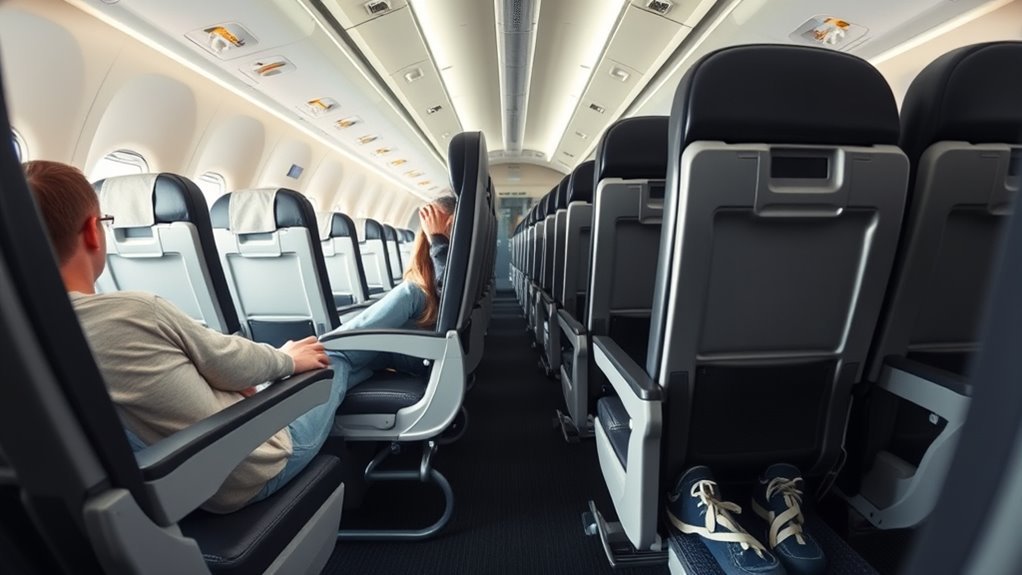
Seat pitch is the distance from a fixed point on one seat to the same point on the seat directly ahead or behind it. The FAA describes pitch essentially as the distance from one seat to the next, but its research also points out an important limitation: seats with the same pitch can provide different amounts of usable passenger space depending on their design.
That makes pitch a useful comparison number, but not a perfect measurement of legroom. A slim seatback may leave more knee clearance at the same pitch than a thicker seat with bulky padding, a large entertainment unit, or other hardware.
Seat pitch is also different from seat width. Width measures side-to-side space, while pitch measures front-to-back row spacing. A seat can therefore have generous width but tight pitch, or good pitch but a narrow cushion.
The same advertised seat pitch does not guarantee the same usable legroom. Seatback thickness and cabin design can change how much space your knees, shins, and feet actually get.
Why Seat Pitch Affects Comfort
More seat pitch generally creates more room between rows, which can make it easier to position your knees, change posture, reach the aisle, and use a laptop or tray table. The effect becomes more noticeable for taller passengers and on long flights.
Pitch is only one part of comfort, though. Seat width, cushion shape, recline design, foot space, the location of entertainment boxes, and the passenger’s own body proportions all matter.
Legroom and Knee Space
Airlines use pitch as a convenient way to describe row spacing, but actual knee clearance is the open space your body can use. Those numbers are not identical.
Current airline specifications show how much configurations vary. Spirit lists standard seats at 28–29 inches of pitch on several aircraft, while American Airlines lists many Main Cabin seats around 30–31 inches and extra-legroom Main Cabin Extra seats around 34 inches or more depending on aircraft.
That does not mean every 30-inch seat feels exactly the same. A thinner seatback can preserve knee room, while an entertainment box beneath the seat ahead can reduce foot space without changing the published pitch.
Note: The FAA’s cabin research explains that seat pitch can remain unchanged while different seat designs provide more or less usable passenger space. Treat pitch as a strong comparison tool, not a complete measurement of comfort.
Recline and Posture Fit
Seat pitch does not determine how many degrees a seat can recline; that is primarily a feature of the seat design. Pitch does affect how much that recline intrudes into the personal space of the passenger behind.
In a tightly spaced row, a reclining seat can bring the seatback and tray table closer to your torso and knees. With more row spacing, there is usually more room to change posture or work at the tray table after the person ahead reclines.
This is another reason not to judge a seat by pitch alone. Some newer economy seats use thinner backs and different recline mechanisms to preserve usable space at relatively modest pitch.
Long-Haul Comfort Impact
| Approximate Pitch | Practical Interpretation |
|---|---|
| 28–29 in | Tight economy spacing; body proportions and seat design matter greatly |
| 30–32 in | Common standard-economy range on many aircraft |
| 33–36 in | Usually more room to move in extra-legroom economy |
| About 38 in | Typical of several current long-haul premium-economy products |
| Lie-flat cabin | Compare bed length and suite dimensions rather than pitch alone |
These ranges are guides, not comfort guarantees. Your height, femur length, preferred posture, seatback design, and flight duration can make the same pitch feel very different from one traveler to another.
Health Note: The CDC says long-distance travel lasting more than four hours can involve a risk of venous blood clots because passengers remain still for long periods. For most travelers the absolute risk is low, but risk increases with factors such as previous blood clots, recent surgery, pregnancy, estrogen use, active cancer, obesity, and limited mobility. Move your legs regularly and get up to walk when it is safe to do so.
How Airline Seat Pitch Varies
Seat pitch can differ between airlines, aircraft types, cabin classes, and even different configurations of the same aircraft model.
For example, current American Airlines aircraft specifications list Main Cabin pitch at 30 inches on some Airbus A319 and A321 configurations, 31 inches on several long-haul aircraft, and 31–32 inches on one A320 configuration. Main Cabin Extra frequently provides about 34 inches or more. Spirit lists standard seats at 28–29 inches on several configurations.
Premium economy increases the separation further on many long-haul aircraft. American lists 38-inch premium-economy pitch on several Boeing 777 and 787 layouts.
Once you reach modern business and first-class products, however, pitch becomes less useful. Airlines may describe these seats by lie-flat capability, bed length, direct aisle access, or suite dimensions instead of a conventional row-to-row pitch.
For that reason, a true seat comparison should use the specific aircraft configuration, not an airline-wide average.
Is There a Minimum Legal Airline Seat Pitch?
There is no simple universal U.S. rule that lets travelers say every commercial airline seat must have at least a specific number of inches of pitch.
Congress directed the FAA to address minimum passenger-seat dimensions that are necessary for safety, including pitch, width, and length. The FAA has conducted evacuation and cabin-dimension research and sought public comments on minimum dimensions.
As of July 28, 2026, travelers should therefore not treat 28, 29, 30, or any other commonly published pitch as a universal FAA-mandated comfort minimum. Airline seating must comply with applicable aircraft-certification and operational safety requirements, but comfort and usable knee room are separate questions.
Note: FAA seat-dimension research focuses on passenger safety and evacuation. It should not be read as a promise that every compliant seat will feel comfortable for every passenger.
How Much Seat Pitch You Need
There is no single pitch that guarantees a comfortable flight for everyone. Body proportions matter as much as height: two passengers of the same height can have very different knee clearance because one has longer thighs.
A practical way to compare economy seats is to treat 28–29 inches as tight spacing, roughly 30–32 inches as a common standard-economy range, and 33–36 inches as the territory where many extra-legroom products begin to provide noticeably more room between rows.
Premium economy on several major long-haul products reaches about 38 inches. American Airlines, for example, currently publishes 38-inch pitch for Premium Economy on multiple Boeing 777 and 787 configurations.
For a taller traveler or a long overnight flight, paying for additional pitch can be worthwhile because it creates more room to move and change posture. On a short flight, you may decide that tighter standard economy is an acceptable tradeoff for a lower fare.
Pro Tip: Check exit rows and bulkheads separately rather than assuming both provide the same benefit. Exit rows often have additional space, but passengers must be physically capable and willing to perform emergency duties. A bulkhead may provide open knee space but can restrict foot extension, remove under-seat storage, or place you near bassinets, galleys, or lavatories.
How to Judge Seat Pitch Before You Book
Before booking, find the seat pitch for your exact aircraft configuration rather than relying on an airline average. This matters because an airline may operate several versions of the same aircraft with different layouts.
Start with the airline’s own aircraft or seat-map page whenever it publishes dimensions. Then use reputable seat-map databases as a secondary check. Those travel tips make it easier to distinguish standard economy from extra-legroom rows.
- Confirm the aircraft type and, when available, the specific configuration.
- Compare pitch and seat width rather than pitch alone.
- Check for exit-row, bulkhead, and extra-legroom labels.
- Look for under-seat entertainment boxes or other hardware that can reduce foot space.
- Check whether the seat has limited or fixed recline.
- Review the seat map again before departure in case the airline swaps aircraft.
An aircraft change can alter the cabin layout after you book, so even careful research is not a guarantee that the original configuration will operate your flight.
Seat Pitch vs. Legroom, Seat Width, and Recline
These terms are related, but they measure different parts of your seating space:
- Seat pitch: the repeated front-to-back distance from a point on one seat to the same point on the next seat.
- Legroom: the usable room available to your legs and knees; seatback design can change it without changing pitch.
- Seat width: the side-to-side width of the seating area, commonly measured around the armrests or seat cushion depending on the airline’s specification.
- Recline: how far the seatback moves or changes angle; this is a seat-design feature rather than another name for pitch.
- Under-seat space: the area available for your feet and personal item, which can be reduced by structural or entertainment equipment.
This distinction explains why simply choosing the highest pitch number does not always identify the best seat.
Ways to Stay Comfortable in Tight Rows
You can make a tight row more manageable by choosing a seat that makes movement easier, keeping the area around your feet clear, and changing position during the flight.
An aisle seat is useful on longer trips because you can get up without asking other passengers to move. A small lumbar cushion or neck pillow may also help you maintain a more comfortable posture.
Smart Seat Choices
- Check the aircraft’s published seat pitch before booking.
- Review the exact cabin layout instead of relying only on the airline name.
- If you are tall or have long legs, give extra-legroom rows greater consideration for longer flights.
- Check whether a bulkhead actually improves usable legroom before paying extra.
- Use an exit row only if you meet the airline and FAA requirements and are willing to assist in an emergency.
A travel pillow or small lumbar support may help you keep a neutral posture when the seat itself provides limited support.
In-Flight Comfort Tips
On a long flight, focus on movement, posture, and access to the aisle rather than trying to remain in one position for hours.
Flex your ankles and calf muscles while seated and stand or walk periodically when the seat-belt sign is off and conditions are safe. The CDC advises people traveling for long periods to move their legs frequently and take walking breaks.
Dress in comfortable layers so cabin-temperature changes do not add to the discomfort of a tight seat. Keep bulky personal items out of your footwell when possible so you do not sacrifice the limited space available for your feet.
Some travelers at increased risk of blood clots may be advised to use graduated compression stockings or other preventive measures. That is individualized medical guidance rather than a routine requirement for every passenger, so discuss it with a qualified health professional if you have risk factors or a previous blood clot.
At a Glance: Seat Pitch by Cabin
| Tight economy layouts | About 28–29 inches on some current configurations |
| Standard economy | Commonly around 30–32 inches; varies by aircraft |
| Extra-legroom economy | Often around 33–36 inches, with some rows providing more |
| Premium economy | Around 38 inches on several current major U.S. long-haul products; airline configurations vary |
| Business / first class | Pitch may not be directly comparable; check lie-flat bed length, suite dimensions, recline, and aisle access |
Frequently Asked Questions
Is a 31-inch seat pitch good?
A 31-inch pitch is within the standard-economy range used on many current aircraft and provides more row spacing than a 28- or 29-inch layout. Whether it feels good depends on your height, leg proportions, seatback design, recline, and flight length.
Is a 38-inch seat pitch good?
Yes. A 38-inch pitch provides substantially more row spacing than typical standard economy and is used by several current premium-economy products. It generally gives passengers more room to move their knees and change posture, although seat design still affects the final experience.
Is a 35-inch seat pitch good?
A 35-inch pitch is generous compared with many standard-economy layouts and commonly falls into extra-legroom territory. Taller passengers may especially appreciate the additional row spacing on longer flights.
Is seat pitch the same as legroom?
No. Seat pitch measures from the same point on one seat to the same point on the next seat. Legroom is the usable space available to your legs and knees. Seatback thickness, recline, foot-space obstructions, and other hardware can make two seats with the same pitch feel different.
Is there a minimum legal airline seat pitch in the U.S.?
There is not a simple universal U.S. minimum pitch number that passengers can use as a comfort standard. Congress has directed the FAA to address minimum passenger-seat dimensions necessary for safety, and the FAA has studied seat pitch, width, and evacuation performance. Airline seat configurations remain subject to applicable aircraft and operational safety requirements.
Conclusion
Seat pitch is one of the best numbers available for comparing airline seating, but it is not a complete measurement of comfort or usable legroom. A few extra inches generally create more room to move, yet seatback thickness, width, recline, under-seat equipment, and your own body proportions can change how a row actually feels.
Before booking, compare the exact aircraft and cabin rather than relying on an airline-wide average. Check again before departure for aircraft changes, and look carefully at the tradeoffs of exit rows and bulkheads. When you use seat pitch together with seat width and layout information, you can make a much more informed choice and reduce the chances of spending a long flight in an unnecessarily cramped row.
Sources
- Federal Aviation Administration: Effects of Airplane Cabin Interiors on Egress — seat-pitch definition, seat design, occupiable space, and evacuation research
- Federal Aviation Administration: Minimum Seat Dimensions Necessary for Safety — federal minimum-seat-dimension research and rulemaking background
- Federal Aviation Administration: Flying Safe — exit-row passenger responsibilities and safety guidance
- CDC: Understanding Your Risk for Blood Clots with Travel — long-distance travel, mobility, blood-clot risk factors, and prevention guidance
- American Airlines: Aircraft and Seat Specifications — current Main Cabin, extra-legroom, premium-economy, and lie-flat seating specifications
- Spirit Airlines: Onboard Experience and Seat Specifications — current examples of 28–29-inch standard-seat pitch and larger exit-row seating
