
Last Updated on September 11, 2026 by Daniel Globe
Malaysia Airlines is a full-service carrier based at Kuala Lumpur International Airport, with domestic, regional, and long-haul flights operated by aircraft such as the Boeing 737-800, Boeing 737-8, Airbus A330, A330neo, and A350. Its current oversight and IATA status support a reasonable level of confidence, but no audit or airline rating can guarantee a risk-free flight. A useful review should consider its present operations, tragic historical record, exact fare rules, operating carrier, and current travel requirements.
Quick Answer
Malaysia Airlines is a reasonable option for international travel based on its current IATA membership, IOSA-linked oversight, and active fleet modernization. Its tragic 2014 history still matters, but it should be weighed separately from present-day operations. Before booking, confirm the operating carrier, aircraft, baggage allowance, and connection details shown on your ticket.
Key Takeaways
- Malaysia Airlines is a current IATA member, and IOSA evaluates an airline’s operational management and control systems.
- IOSA is a useful oversight signal, but it is not a guarantee that a particular flight will be free of risk.
- Checked baggage is based on the fare, route, and ticket—not a universal 30 kg, 40 kg, or 50 kg cabin-class rule.
- Economy cabin baggage is limited to 7 kg, while Business Class and Business Suite receive 14 kg combined across two pieces.
- Malaysia Airlines has strict current rules for power banks, including a two-unit limit and a ban on using or charging them during the flight.
Disclosure: As an Amazon Associate I earn from qualifying purchases. Some links on this page are affiliate links, at no extra cost to you.
Is Malaysia Airlines Safe for International Travel?
Malaysia Airlines is a current member of the International Air Transport Association. IATA membership is an important sign of industry participation and requires eligible member airlines to maintain registration under the IATA Operational Safety Audit program.
IOSA reviews an airline’s operational management and control systems across areas such as flight operations, maintenance, cabin operations, ground handling, cargo, dispatch, security, and safety management. It is more meaningful than an unsupported online “safety score,” but it should not be treated as a promise that nothing can go wrong.
IATA reported that IOSA-registered airlines recorded 0.98 accidents per million flight sectors in 2025, compared with 2.55 for non-IOSA carriers. This is registry-wide data, not a Malaysia Airlines-specific accident rate.
The airline’s current oversight, established operating network, ongoing fleet renewal, and participation in international audit systems support the conclusion that it is a reasonable airline to consider. However, travelers should evaluate safety using several signals together rather than relying on one certificate, aircraft model, rating website, or customer review.
Note: No airline, regulator, audit, or safety database can guarantee the outcome of a future flight. Weather, maintenance, air traffic, human performance, airport conditions, and unexpected events all affect aviation risk.
What Makes Malaysia Airlines Safe?
The strongest current evidence comes from formal oversight, documented operating systems, trained crews, regulated maintenance, and repeated auditing. Malaysia Airlines’ IATA membership and IOSA-linked status show that its operational systems are subject to recognized industry requirements rather than relying only on the airline’s advertising.
Current Fleet and Operations
The airline’s current fleet information includes the Airbus A350-900, A330 family, newer A330neo, Boeing 737-800, and Boeing 737-8. These aircraft serve different route lengths and may have different seats, entertainment systems, and onboard connectivity.
Newer aircraft may offer updated cabin systems, improved fuel efficiency, and newer passenger features. However, aircraft age or model alone does not determine whether an airline is safe. Maintenance quality, operating procedures, crew preparation, regulatory oversight, and correct response to hazards are more important than whether an aircraft is described as “modern.”
Historical Safety Record
A balanced review must acknowledge the airline’s history. Malaysia Airlines Flight MH370 disappeared on March 8, 2014 while flying from Kuala Lumpur to Beijing. The main wreckage and flight recorders have not been recovered, and the investigation could not establish a definitive explanation for the disappearance. The Australian Transport Safety Bureau provides an official overview of the search and investigation work.
Malaysia Airlines Flight MH17 was lost over eastern Ukraine on July 17, 2014 during an armed conflict. The investigation and later follow-up work by the Dutch Safety Board led to important recommendations concerning conflict-zone information, airspace decisions, and airline risk assessment.
These events continue to shape public perception and should not be hidden or dismissed. At the same time, they do not by themselves describe every aspect of the airline’s current daily operations. A fair assessment considers both the historical record and present oversight.
What Routes Does Malaysia Airlines Offer?
Malaysia Airlines operates from its main hub at Kuala Lumpur International Airport. Its current oneworld profile reports service to 55 destinations across 20 countries and territories, while the airline’s destination page lists 16 locations within Malaysia.
The network covers destinations in Malaysia, other parts of Asia, Australia, Europe, and the Middle East. Exact cities, flight frequencies, seasonal services, and aircraft assignments can change, so use the airline’s live destination information for the dates you intend to travel.
- Direct Malaysia Airlines flight: The flight is marketed and operated by Malaysia Airlines.
- Codeshare flight: The flight may carry an MH flight number but be operated by another airline.
- Connecting itinerary: One or more sectors may be operated by oneworld or other partner airlines.
Codeshare and oneworld partnerships can expand the available network to hundreds of additional destinations. However, the operating airline’s aircraft, service, check-in procedure, seat selection, and baggage rules may apply to part of the journey.
Pro Tip: Check the words “operated by” beside every flight segment before paying. This tells you which airline supplies the aircraft and crew and helps you confirm the correct baggage, seating, terminal, and check-in rules.
What Are Malaysia Airlines’ Baggage Allowances?
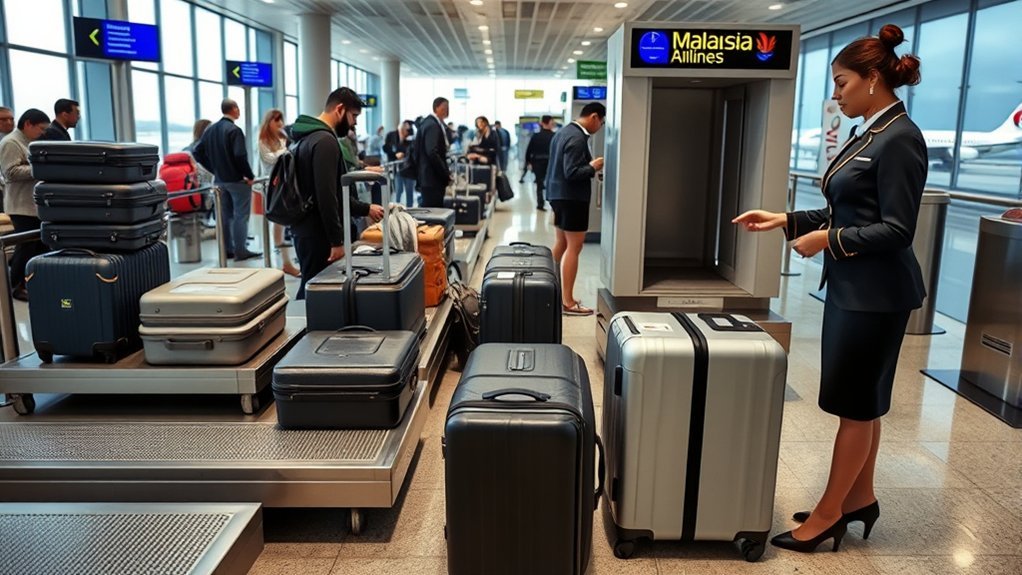
Malaysia Airlines does not use one universal checked-baggage allowance for every Economy, Business, or premium ticket. The allowance can depend on the fare family, booking class, route, baggage concept, frequent-flyer status, and whether another airline operates part of the itinerary.
Cabin and Checked Limits
| Baggage category | Current general rule |
|---|---|
| Economy cabin baggage | One piece weighing no more than 7 kg. A permitted personal item must remain within the combined 7 kg limit. |
| Business Class and Business Suite cabin baggage | Two pieces with a combined weight of no more than 14 kg. Each piece must weigh no more than 7 kg. |
| Maximum cabin-bag size | 56 cm × 36 cm × 23 cm for a bag stored in the overhead compartment. |
| Checked baggage | Varies by fare, route, booking class, weight or piece concept, and operating carrier. Use the allowance printed in the booking and e-ticket. |
| Maximum single checked piece | Generally 32 kg, with standard linear dimensions below 158 cm. Oversized items may require a surcharge or cargo service. |
Current Economy fare products commonly begin with 20 kg of checked baggage, but this should not be treated as a universal allowance. Some routes use a piece concept, and exceptions apply to certain destinations and partner-airline itineraries. Review the airline’s checked-baggage policy and the allowance displayed on your own ticket.
Class-Based Allowance Differences
The airline currently uses the names Economy Class, Business Class, and Business Suite. Business Suite is the airline’s highest cabin product on eligible aircraft; it should not be described as First Class.
Higher fares and cabins may include more checked baggage, more flexible changes, lounge access, priority services, or improved seating. These benefits still vary by fare product. A discounted Business fare may have different conditions from a flexible Business fare, just as Economy Value, Basic, and Flex products can differ.
Always confirm these five details on the fare-selection screen:
- Checked-baggage weight or number of pieces
- Change and refund conditions
- Seat-selection charges
- Lounge and priority-service eligibility
- Which airline operates each flight
Special Items and Exceptions
Malaysia Airlines has separate rules for infant equipment, medical devices, mobility aids, musical instruments, sports equipment, fragile items, perishables, and oversized baggage.
- Infant and mobility equipment: Eligible strollers, child seats, wheelchairs, walking aids, and other personal medical equipment may receive special handling. Contact the airline before travel when approval or assistance is needed.
- Musical instruments: A small instrument may fit within the cabin allowance. A larger fragile instrument may require an additional seat, special packing, checked-baggage acceptance, or cargo arrangements.
- Valuables: Keep passports, cash, jewelry, medicines, documents, and electronics out of checked baggage.
- Seafood: Malaysia Airlines states that properly packed seafood may be accepted only as cabin baggage, subject to size, weight, security, and destination quarantine rules.
- Self-heating meals: Self-heating food and drink packs are prohibited in both cabin and checked baggage because their heating chemicals can create flammable gas or corrosive hazards.
Warning: Do not assume a partner airline will honor Malaysia Airlines’ baggage allowance. On codeshare or interline journeys, the operating or most-significant carrier’s rules may control the entire itinerary.
How Does Malaysia Airlines Compare on Price and Service?
Malaysia Airlines is a full-service airline, so a fare may include services that a low-cost carrier sells separately. Depending on the fare and route, these may include checked baggage, a meal or snack, beverages, in-flight entertainment, seat options, and connection support.
A base-fare comparison alone can be misleading. Compare the total price after adding:
- Checked and cabin baggage
- Seat selection
- Food and drinks
- Change or cancellation flexibility
- Airport and connection convenience
- Overnight accommodation needed for long connections
Onboard features vary by aircraft. Malaysia Airlines offers complimentary Wi-Fi on the A350-900, A330neo, Boeing 737-8, and selected A330 aircraft, subject to technical availability. Entertainment can also differ: some aircraft provide seatback systems, some use wireless entertainment, and some flights may have limited facilities.
Pro Tip: After finding a suitable fare, check the aircraft and seat map again shortly before departure. Airlines may substitute aircraft for maintenance, scheduling, weather, or operational reasons.
When Should You Arrive and Check In?
Malaysia Airlines recommends arriving at least three hours before an international flight and two hours before a domestic flight. These are planning recommendations, while the airline’s check-in and gate closures are hard deadlines.
Check-In Timing
| Stage | Malaysia Airlines timing |
|---|---|
| Online or mobile check-in | Generally available from 48 hours until 90 minutes before departure. |
| International airport arrival | At least 3 hours before departure. |
| Domestic airport arrival | At least 2 hours before departure. |
| Counter and baggage drop | Close 60 minutes before departure for domestic and international flights. |
| Departure gate | Closes 30 minutes before departure. |
Check-in procedures can vary at overseas airports, and extra document inspection may be required for visas, transit permission, onward travel, health documents, or passenger assistance. Review the airline’s current check-in page and your departure airport’s instructions.
Gate Arrival Tips
- Keep your passport or identification, boarding pass, and any required visa documents accessible.
- Complete shopping, lounge visits, and meals early enough to reach the gate before boarding begins.
- Check airport screens and the airline app because gate numbers can change.
- Allow extra time when traveling with children, mobility equipment, oversized baggage, or document requirements.
- Do not use the scheduled departure time as your gate-arrival target; the gate closes earlier.
Which Baggage and Battery Rules Should You Know?
Power banks and spare lithium batteries require special attention. Malaysia Airlines’ current rules are stricter and more specific than the general advice in many older travel guides.
Warning: Power banks must be carried in cabin baggage. Do not pack one in checked baggage, use it during the flight, charge it from an aircraft outlet, or place it in the overhead compartment.
- Quantity: A passenger may carry no more than two power banks.
- Up to 100 Wh: Permitted within the two-power-bank limit.
- More than 100 Wh up to 160 Wh: Requires airline approval.
- More than 160 Wh: Prohibited.
- Storage: Keep power banks with you in a protective pouch, under the seat, or in the seat pocket—not in an overhead bin.
- Condition: Swollen, damaged, recalled, or non-compliant power banks are prohibited.
- Use: Do not charge the power bank or use it to charge another device during the flight.
- Spare batteries: Carry them in cabin baggage and protect exposed terminals from short circuits.
Portable devices with installed batteries should preferably remain in cabin baggage. When an eligible device is accepted in checked baggage, it should be protected against damage and accidental activation and switched completely off rather than left in sleep mode.
Battery-powered wheelchairs and mobility aids have separate acceptance, disconnection, packaging, and notification requirements based on the battery type. Contact Malaysia Airlines before departure and provide the device make, model, battery chemistry, watt-hour rating, and handling instructions.
Review the airline’s current additional restrictions before every trip because battery policies can change quickly.
How Do You Use an eSIM in Malaysia?
A travel eSIM can provide mobile data in Malaysia without replacing your physical SIM. Malaysia Airlines does not require a particular eSIM provider, so compare coverage, data limits, hotspot support, validity period, network speed, and refund terms before buying.
- Confirm compatibility: Check that your phone supports eSIM and is not locked to your home carrier.
- Choose a plan: Compare a Malaysian carrier, your home carrier’s roaming plan, and reputable international eSIM providers.
- Install over Wi-Fi: Use the provider’s app or scan its QR code before leaving home, but follow its instructions about when to activate the plan.
- Label the lines: Name one line “Home” and the other “Malaysia” so you do not select the wrong data plan.
- Select mobile data: After arrival, set the Malaysia eSIM as the cellular-data line. Enable data roaming for that eSIM only when the provider requires it.
- Control home-line charges: Turn off data roaming and cellular-data switching on your home line unless your domestic plan includes Malaysia.
Apple provides an official guide for using an eSIM while traveling internationally with an iPhone. Google also provides instructions for adding an eSIM to a Pixel phone. Menu names differ on Samsung and other Android devices.
Pro Tip: Save a screenshot of the QR code, installation instructions, provider support details, and APN settings in an offline folder. Some eSIM QR codes can be scanned only once.
Frequently Asked Questions
Is Malaysia Airlines safe to fly now?
Malaysia Airlines is a reasonable airline to consider based on its current IATA membership, IOSA-linked oversight, established operations, and fleet renewal. IOSA is a meaningful audit system, but it does not guarantee that any particular flight will be risk-free.
How trustworthy is Malaysia Airlines?
It is an established full-service airline and current IATA member with international partners and documented operating rules. Trust should still be based on current oversight, clear ticket conditions, the operating carrier, and transparent recognition of its historical record.
Does Malaysia Airlines have a good safety record?
Its record is mixed historically because MH370 and MH17 remain major tragedies. Its current IATA status, IOSA-linked oversight, fleet program, and daily operations should be considered separately from those events while still acknowledging them honestly.
How safe is Malaysia for American citizens?
The U.S. Department of State currently places Malaysia at Level 1, meaning exercise normal precautions overall. It advises increased caution on islands and maritime areas off eastern Sabah because of kidnapping risk. Travelers should check the advisory again shortly before departure.
How much baggage does Malaysia Airlines allow?
Economy cabin baggage is generally one piece up to 7 kg. Business Class and Business Suite receive two pieces with a combined 14 kg limit. Checked baggage varies by fare, route, booking class, baggage concept, and operating carrier, so the allowance on the ticket is controlling.
Can I carry a power bank on Malaysia Airlines?
Yes, subject to limits. You may carry up to two power banks in cabin baggage. They cannot be checked, used, charged, or placed in an overhead compartment. Units above 100 Wh and no more than 160 Wh require airline approval, while units above 160 Wh are prohibited.
Conclusion
Malaysia Airlines is a reasonable full-service option for international and regional travel when judged by its current IATA membership, IOSA-linked oversight, operating network, and fleet program. Its historical record includes the unresolved disappearance of MH370 and the destruction of MH17, and those events should remain part of an honest assessment.
Before booking, check the operating carrier, aircraft, total fare conditions, baggage allowance, connection time, and current route schedule. Before departure, verify travel documents, check in early, carry power banks only under the current cabin rules, and review government travel advice for every destination and transit point.
Sources
- IATA — Malaysia Airlines member profile — confirms current IATA membership and airline identifiers.
- IATA 2025 Safety Report release — provides current IOSA and non-IOSA accident-rate comparisons.
- Malaysia Airlines fleet information — supports current aircraft and fleet-modernization details.
- Malaysia Airlines checked-baggage policy — explains weight and piece concepts, dimensions, and fare-dependent allowances.
- Malaysia Airlines check-in guide — supports online check-in, baggage-drop, counter, and gate deadlines.
- U.S. Department of State Malaysia Travel Advisory — supports current guidance for U.S. citizens and the eastern Sabah exception.
