
Last Updated on July 27, 2026 by Daniel Globe
London in May usually feels like late spring: mild during the day, cool in the morning and evening, and changeable enough that a sunny spell can give way to a shower. The best approach is to plan around long daylight hours, check the forecast each day, and carry light layers rather than dress for one fixed type of weather.
Quick Answer
London weather in May is generally mild, with Heathrow 1991–2020 averages of about 18.4°C (65°F) for the daily high and 9.1°C (48°F) for the low. Expect roughly 46 mm (1.8 in) of rain, about eight days with at least 1 mm of rain, and long, bright spring evenings.
Key Takeaways
- Average May temperatures at Heathrow are about 18.4°C (65°F) by day and 9.1°C (48°F) at night.
- May averages about 45.9 mm (1.8 in) of rain and eight days with at least 1 mm of rainfall.
- Daylight grows from roughly 14 hours 50 minutes at the start of May to more than 16 hours by the end of the month.
- Pack layers, a light waterproof jacket, comfortable walking shoes, sunglasses, and sunscreen.
Disclosure: As an Amazon Associate I earn from qualifying purchases. Some links on this page are affiliate links, at no extra cost to you.
London May Weather at a Glance
The latest standard climate-normal period published by the Met Office is 1991–2020. Heathrow is a useful long-running station for London, although conditions can vary across the city and from year to year.
| May climate measure | Heathrow 1991–2020 average |
|---|---|
| Average daily maximum | 18.37°C (65.1°F) |
| Average daily minimum | 9.08°C (48.3°F) |
| Monthly rainfall | 45.91 mm (1.81 in) |
| Days with at least 1 mm of rain | 8 days |
| Monthly sunshine | 207.49 hours |
These are long-term averages, not a forecast for a specific trip. Check the Met Office forecast for the City of London close to your travel dates.
Typical Temperature Range in May
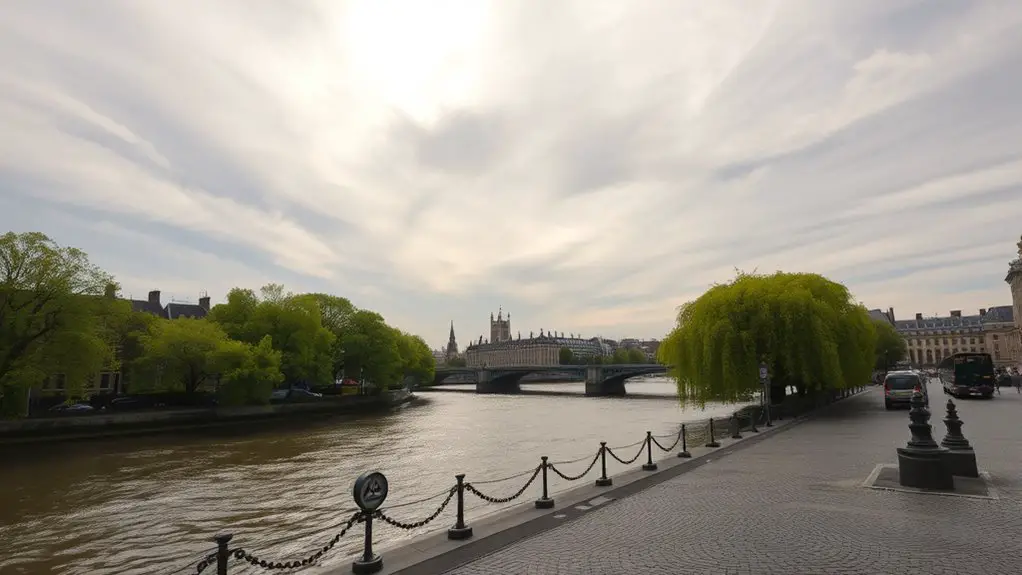
According to the Met Office Heathrow climate normals, the average May daily maximum is 18.37°C (65.1°F), while the average daily minimum is 9.08°C (48.3°F).
That makes May noticeably warmer than March and April, but mornings and evenings can still feel cool. A light sweater, cardigan, or jacket is useful early and late in the day, while a T-shirt or light long-sleeve layer may be comfortable during a mild afternoon.
Averages do not set a ceiling or floor for the weather. Individual May days can be cooler, warmer, wetter, or sunnier than the long-term norm, so use climate data for packing and the short-range forecast for daily plans.
At Heathrow, May’s 1991–2020 climate averages are 18.37°C for the daily maximum, 9.08°C for the daily minimum, 45.91 mm of rain, and 207.49 hours of sunshine.
Rainfall and Humidity Levels

May is not rain-free, but the long-term numbers do not support a rule that rain is concentrated in particular weeks. At Heathrow, May averages 45.91 mm (1.81 in) of rainfall and about eight days with at least 1 mm of rain.
That statistic does not mean it rains all day on eight days, and it does not count every trace of drizzle. London can have brief showers, longer spells of rain, or several dry days in a row.
Humidity also changes with temperature and air mass. The Met Office explains relative humidity as a measure of how close the air is to saturation at a given temperature, so a cool morning can feel damper than a warmer afternoon even without a dramatic change in the amount of water vapour present.
Rainfall Distribution Patterns
There is no dependable early-May or late-May rain pattern that you can use to schedule a trip. Long-term monthly climate data show how much rain typically falls, but not which week will be wet in a particular year.
Showers can develop at different times of day, and occasional thunderstorms are possible in spring. For practical planning, check the hourly forecast each morning rather than assuming one part of the month will be drier.
A compact umbrella can be useful, but a light waterproof jacket with a hood is often easier when you are walking, using public transport, or moving through crowded streets.
Pro Tip: Treat the monthly rainfall figure as a packing guide, not a daily schedule. Use the Met Office hourly forecast to choose outdoor windows, and keep one waterproof layer in your day bag.
Humidity Fluctuation Trends
Humidity can make two days with the same air temperature feel different. Higher relative humidity can feel clammy, while a breeze can make a cool evening feel colder than the thermometer suggests.
Because relative humidity depends partly on temperature, percentages often rise as air cools and fall as it warms. That is why damp-feeling mornings do not necessarily mean the whole day will be muggy.
For sightseeing, the most useful measure is often the forecast “feels like” temperature, which accounts for factors such as wind and humidity as well as the measured air temperature.
Daylight Hours and Sunshine Duration

May gives visitors long days for sightseeing. Cloud cover changes how bright the day feels and how much direct sunshine reaches you, but it does not change the astronomical length of the day.
In 2026, London had about 14 hours 51 minutes of daylight on May 1 and about 16 hours 17 minutes on May 31, according to Timeanddate’s London sunrise and sunset data. The exact clock times vary slightly from year to year.
Heathrow’s 1991–2020 May average is 207.49 hours of sunshine for the month, equal to about 6.7 hours per day when averaged across all 31 days.
Increasing Daylight Lengths
Sunrise comes earlier and sunset later as May progresses. By the end of the month, London has more than 16 hours between sunrise and sunset, leaving plenty of time for parks, walking routes, riverfront sightseeing, and outdoor dining.
Long daylight does not guarantee warm or sunny weather. A cloudy day still has the same sunrise-to-sunset length as a clear day on the same date, although it can look dimmer.
Sunshine Hours Fluctuate
Sunshine varies from day to day, so it is more accurate to use a monthly climate average than fixed labels such as “sunny day” or “cloudy day.” The Heathrow climate record provides the following useful context:
| Measure | May average |
|---|---|
| Total sunshine | 207.49 hours per month |
| Average sunshine across the month | About 6.7 hours per day |
| Daylight at start of May | About 14 hours 50 minutes |
| Daylight at end of May | More than 16 hours |
Some days will be much sunnier than this daily average and others much cloudier. Keep plans flexible and use the short-range forecast to decide when to schedule weather-sensitive activities.
Cloud Cover Variability
Cloud can move in or clear quickly, changing the amount of direct sunshine you experience without changing the actual number of daylight hours. A bright morning can turn overcast, or a grey start can clear into a sunny afternoon.
This matters for comfort as well as sightseeing. Strong spring sunshine can feel warm even when the air temperature is modest, while a cloudy breeze can make the same temperature feel cooler.
Do not assume cloudy weather means there is no UV exposure. The NHS notes that sunburn can occur in the UK even when it is cloudy.
Weather Variability and How to Prepare
London’s May weather can move between mild sunshine, cool cloud, breeze, and rain within the same trip. The simplest strategy is to dress in light layers and carry one weatherproof outer layer.
| Condition | Suggested Gear |
|---|---|
| Sunny and mild | Light top, sunglasses, sunhat, SPF 30+ sunscreen |
| Showery or rainy | Light waterproof jacket, optional compact umbrella, water-resistant shoes |
| Cool or breezy | Sweater or cardigan under a light jacket |
Check the forecast before leaving your accommodation, especially when you have timed outdoor tickets, a long walk, a river trip, or a day trip outside central London.
Note: Climate averages describe what is typical over decades. A forecast tells you what is expected on your actual travel date. Use both: averages for packing and forecasts for daily decisions.
Best Times for Outdoor Activities
There is no reliable rule that late morning or early afternoon is always the most weather-stable part of a May day in London. A better approach is to use the hourly forecast and choose the driest window for activities that depend on good weather.
Long daylight gives you flexibility. Parks, markets, walking tours, and riverfront routes can work well in the morning, afternoon, or early evening when the forecast is dry.
If the UV index is 3 or higher, protect your skin. The NHS sun-safety guidance recommends at least SPF 30 sunscreen and notes that the sun is strongest in the UK between 11 a.m. and 3 p.m. from March to October.
Warning: Do not treat cool or cloudy spring weather as proof that UV exposure is low. Check the UV index and use sun protection when needed, especially if you will be outdoors for several hours.
Seasonal Clothing Tips for May
Dress in layers that are easy to add or remove. A practical May outfit starts with a T-shirt or lightweight long-sleeve top, followed by a sweater, cardigan, or fleece for cooler periods.
Bring a light waterproof or water-resistant outer layer. A compact umbrella is optional, but a hooded jacket is often more convenient when you are walking between attractions or using busy public transport.
Comfortable walking shoes matter more than heavy winter footwear. Water-resistant trainers or walking shoes are useful if the forecast includes showers.
Add sunglasses, a hat, and sunscreen for brighter days. The NHS recommends SPF 30 or higher, along with clothing and shade when the sun is strong.
Practical May Packing List
- Light T-shirts or long-sleeve tops
- One sweater, cardigan, or light fleece
- Light waterproof jacket with a hood
- Comfortable walking shoes, preferably water-resistant
- Compact umbrella if you prefer one
- Sunglasses and a sunhat
- SPF 30+ sunscreen
- Small day bag for layers you remove
Frequently Asked Questions
How does London’s weather in May compare with other spring months?
May is typically warmer and sunnier than March and April. At Heathrow, the 1991–2020 average daily maximum rises from 11.73°C in March to 15.00°C in April and 18.37°C in May. Average monthly sunshine also rises from 124.45 hours in March to 176.67 in April and 207.49 in May.
Are any unusual weather events expected in May?
Specific storms, heat spikes, or other anomalies cannot be predicted reliably months in advance. Check the Met Office forecast and weather warnings close to your travel dates, then adjust outdoor plans if heavy rain, thunderstorms, strong winds, or unusually warm weather are forecast.
What is the best way to stay updated on London’s daily forecast?
Use the Met Office London forecast and check it again on the morning of your plans. For weather-sensitive activities, look at the hourly forecast, rain probability, “feels like” temperature, UV index, wind, and any active weather warnings.
How does London’s May weather affect local transportation?
Ordinary showers usually do not stop London’s transport network, but severe rain, flooding, storms, or heat can cause delays or service changes. Check Transport for London status updates before a time-critical journey when disruptive weather is forecast.
Are there annual weather patterns specific to London in May?
The dependable seasonal pattern is a general move toward warmer temperatures and longer days, not a fixed sequence of wet and dry weeks. Heathrow’s long-term May averages are about 18.37°C for the daily maximum, 9.08°C for the minimum, 45.91 mm of rain, and 207.49 sunshine hours.
Does it rain all day in London in May?
Not necessarily. Monthly climate data count rainfall totals and days above a threshold, not the length of each shower. A day recorded with rain may still include long dry periods, so an hourly forecast is more useful than the monthly average for sightseeing plans.
Is May a good time to visit London for outdoor sightseeing?
Yes, May can be very comfortable for outdoor sightseeing because average temperatures are mild and daylight is long. The trade-off is changeable weather, so carry a waterproof layer and keep one indoor backup option for wetter periods.
Sources
- Met Office — Heathrow location-specific long-term averages — 1991–2020 temperature, rainfall, rainy-day, sunshine, and wind averages.
- Met Office — City of London forecast — current forecast, hourly conditions, and longer-range outlook.
- Met Office — Understanding humidity — relative humidity and how temperature affects it.
- Timeanddate — London sunrise and sunset times for May 2026 — daylight-length examples for the start and end of May.
- NHS — Sunscreen and sun safety — UK UV and SPF guidance.
- Transport for London — Status updates — live and planned service information.
Conclusion
May is a strong month for exploring London because the days are long and average temperatures are mild. Plan for an average high near 18°C (65°F) and a low near 9°C (48°F), but expect day-to-day variation. Pack light layers, a waterproof outer layer, comfortable shoes, and sun protection, then use the short-range forecast to fine-tune each day.
