Last Updated on August 26, 2026 by Caleb Warren
Internal and external frame backpacks can both carry multi-day hiking loads, but they handle the job differently. Internal-frame packs sit close to your body and are usually the better choice for uneven or technical terrain, while external-frame packs provide excellent ventilation and convenient attachment space for bulky or awkward gear. The best choice depends on fit, load, terrain, climate, and the specific backpack—not frame type alone.
Quick Answer
Choose an internal-frame backpack for close-to-body stability, mobility, and the widest choice of modern backpacking designs. Choose an external-frame backpack when ventilation, numerous tie-down points, or carrying bulky and irregular gear matters most. In either case, proper torso length, hipbelt fit, load rating, and comfort with real weight are more important than the frame label alone.
Key Takeaways
- Internal-frame packs dominate modern backpacking choices and generally provide close-to-body stability on uneven terrain.
- External-frame packs remain useful for ventilation, heavy or awkward loads, and attaching bulky equipment outside the packbag.
- Weight varies by model. Modern external frames can be much lighter than traditional designs.
- Organization is not determined by frame type. Modern internal packs can have numerous pockets, zippers, and attachment points.
- Fit comes first. Measure your torso and hips and test the pack with realistic weight before relying on specifications alone.
Disclosure: As an Amazon Associate I earn from qualifying purchases. Some links on this page are affiliate links, at no extra cost to you.
Internal vs. External Frame Backpack Comparison
| Feature | Internal Frame | External Frame |
|---|---|---|
| Frame location | Hidden inside or integrated into the backpanel | Visible outside the packbag |
| Terrain | Usually best for uneven, steep, or technical trails | Often works well on maintained trails and with bulky loads |
| Stability | Close-to-body carry generally improves control | Rigid structure supports loads but can feel less agile |
| Ventilation | Varies; suspended-mesh designs can provide strong airflow | Usually very good because the load is held away from the back |
| Bulky gear | Attachment options vary by model | Exposed frame makes lashing large or irregular items easy |
| Organization | Ranges from minimalist to highly compartmentalized | Traditionally offers several pockets and attachment points |
| Best for | Most backpackers, technical trails, compact loads | Hot conditions, bulky equipment, specialized heavy-load use |
REI’s backpack selection guide notes that most backpacking packs it sells today use internal frames, while external frames remain useful for heavy or irregular loads and provide good ventilation and attachment options.
What Is an Internal Frame Backpack?
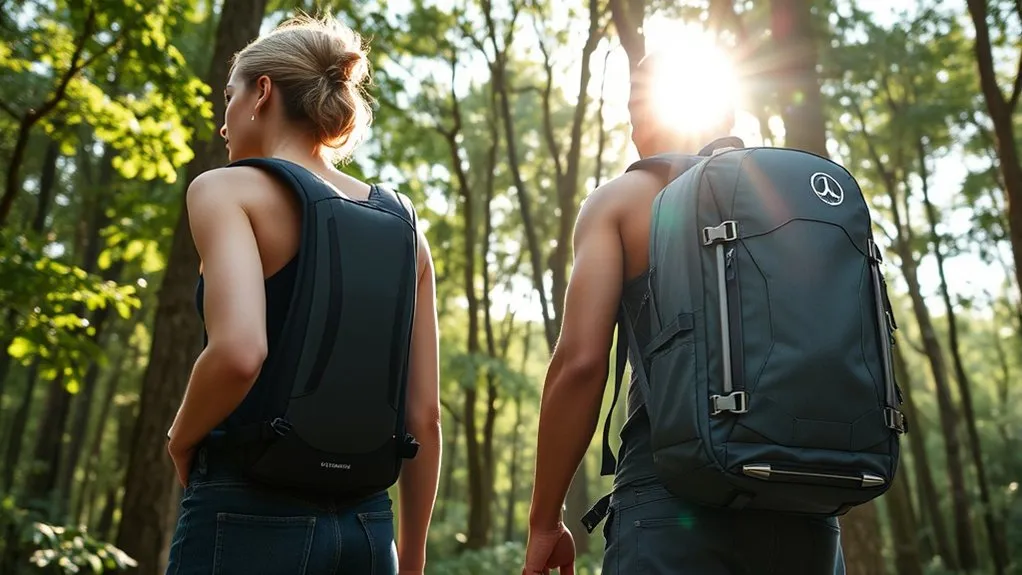
An internal-frame backpack places its structural support inside or directly against the pack’s backpanel. Depending on the model, that support may include aluminum stays, a perimeter wire frame, a framesheet, composite components, or a combination of these systems.
The close-to-body design generally improves stability and control when you are scrambling, climbing over obstacles, hiking across a slope, or moving on uneven ground. Modern suspension systems also use hipbelts and load lifters to transfer much of the load away from your shoulders and toward your hips.
Internal-frame backpacks are not all minimalist. Some have one large top-loading compartment, while others include front access, sleeping-bag compartments, hipbelt pockets, stretch pockets, hydration sleeves, and numerous attachment points. Organization depends more on the specific model than on whether its frame is internal.
One traditional disadvantage is reduced airflow when the pack sits directly against your back. However, many modern internal-frame packs use suspended-mesh backpanels or ventilation channels that create space for airflow, so a sweaty back is no longer an unavoidable feature of every internal design.
What Is an External Frame Backpack?
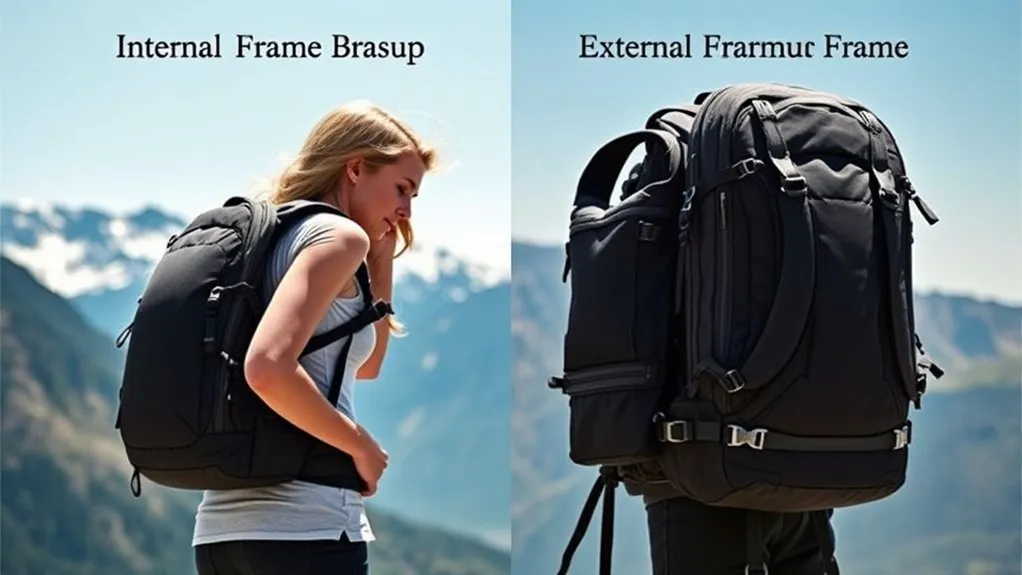
An external-frame backpack mounts the packbag and suspension system to a visible rigid frame. Traditional models commonly use aluminum tubing, while some modern designs use lighter materials such as titanium.
The frame creates space between the packbag and your back, which can improve airflow and ventilation. Its exposed structure also provides convenient places to attach bulky items such as sleeping pads, shelters, packrafts, tools, or other equipment that may not fit neatly inside a conventional packbag.
External frames can transfer substantial loads through the suspension and hipbelt, but their wider, more rigid shape may feel less natural when scrambling, ducking under branches, or moving across steep or uneven terrain. Their strengths are most noticeable when the load is heavy, unusually shaped, or difficult to contain inside a standard backpack.
Structure and Design Features
External-frame backpacks are easy to identify because the supporting frame remains visible outside the packbag. The exact design varies widely between traditional aluminum-frame packs and newer lightweight systems.
| Feature | Typical External-Frame Design |
|---|---|
| Frame Location | Visible outside the packbag |
| Load Transfer | Rigid frame, hipbelt, and suspension work together to support the load |
| Ventilation | Frame normally keeps much of the packbag away from the back |
| Organization | Often includes several exterior pockets plus numerous lashing locations |
| Shape | Usually more rigid and less body-hugging than an internal-frame pack |
A current example is the Kelty Trekker 65, which uses an aluminum external frame, adjustable suspension, load lifters, a 65-liter packbag, and seven exterior pockets.
Load Distribution Benefits
Both frame styles can transfer load to your hips when they fit correctly. External frames achieve this with a rigid frame connected to the shoulder harness and hipbelt, while internal-frame designs use stays, framesheets, perimeter frames, or other suspension systems.
External frames are especially useful when equipment is bulky or awkwardly shaped because it can often be secured directly to the frame. The gap between the load and your torso also promotes airflow.
Load placement still matters. Heavy equipment that is badly positioned can affect balance and energy use regardless of frame type. A load-carriage study indexed by PubMed found meaningful differences in physiological response when load position changed, reinforcing the importance of thoughtful packing rather than relying on the frame alone.
Note: A manufacturer’s recommended or optimal load range is more useful than assuming every external frame is a heavy-load pack or every internal frame is a lightweight pack.
Current Trends in Backpack Design
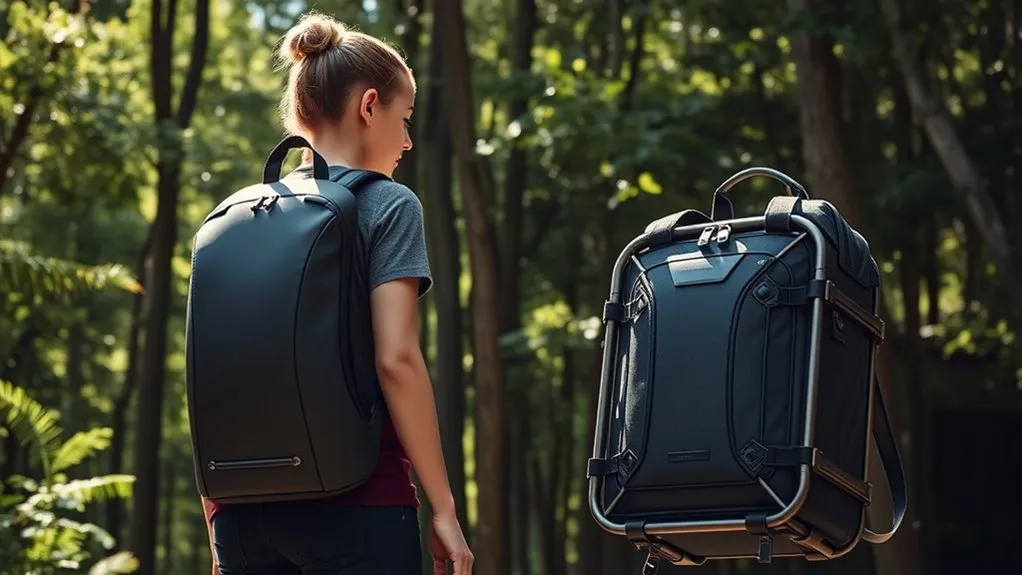
Internal-frame backpacks remain the mainstream choice for modern backpacking. REI currently describes the majority of the packs it sells as internal-frame models, largely because they combine close-to-body stability with adjustable suspension and a wide range of capacities and features.
Internal frames are the mainstream design, but external frames still solve real problems when ventilation, awkward equipment, or exposed attachment space matters.
External frames have not disappeared. Kelty continues to sell the Trekker 65, and Vargo offers a line of titanium external-frame systems. The Vargo ExoTi AR2, for example, combines a 46-liter packbag with a titanium external frame and weighs 2 lb 12 oz.
Modern development is less about a simple internal-versus-external divide and more about improving suspension, ventilation, fit, materials, and modularity. Common trends include:
- Better fit adjustment: Adjustable torso systems and more refined hipbelts help a single model fit a wider range of hikers.
- Suspended ventilation: Many internal-frame packs now hold the packbag away from the back with tensioned mesh.
- Lighter frame materials: Manufacturers use thin steel or aluminum wire, composite framesheets, and even titanium external frames to control weight.
- More sustainable materials: Recycled fabrics and DWR treatments made without intentionally added PFAS are increasingly common in current backpack lines.
- Modularity: Some systems allow bags, lids, straps, or other components to be removed or changed for different trips.
Weight and Size Comparison
Frame type affects a backpack’s structure, but it does not determine its finished weight. Fabric, capacity, padding, pockets, hardware, suspension complexity, and intended load range all contribute.
The original Osprey Levity 45 is a useful legacy ultralight example, but it should not be treated as a current product benchmark. Osprey’s archived Levity/Lumina manual lists the Levity 45 at approximately 1.71 to 1.89 lb depending on size, with a relatively light 5–20 lb recommended load range.
Pack Weight Differences
A more accurate comparison uses individual models rather than assuming all external frames are heavy:
- Legacy Osprey Levity 45: approximately 1.71–1.89 lb depending on size; an ultralight internal-frame design intended for lighter loads.
- Vargo ExoTi AR2: 2 lb 12 oz; a modern titanium external-frame pack with a 46-liter bag and 35 lb recommended maximum pack load.
- Kelty Trekker 65: 5 lb 5 oz; a traditional aluminum external-frame pack with a 65-liter volume and 50–70 lb optimal carry range.
- Practical lesson: Compare total pack weight with the manufacturer’s load range and your expected load. A lighter pack is not automatically more comfortable when overloaded.
Size and Capacity Insights
Capacity is normally stated in liters, and the measurement does not become larger simply because a pack uses an external frame. A 60-liter internal pack and a 60-liter external pack both have roughly 60 liters of rated storage volume, although external frames can make it easier to carry additional bulky items outside the packbag.
The Vargo ExoTi AR2 illustrates why frame stereotypes can be misleading: it is a lightweight external-frame pack weighing 2 lb 12 oz, not an internal-frame model. Its main bag is 46 liters, and the exposed lower section of the frame can accept bulky equipment.
Traditional external designs such as the Kelty Trekker 65 are substantially bulkier, while many internal-frame packs have a narrower profile that is easier to maneuver through brush, rocks, public transportation, or tight storage spaces.
Storage Capacity and Load Distribution
Storage capacity and load distribution should be evaluated separately. Frame type influences how the pack carries, while the packbag design determines how easily you can organize and access equipment.
- Internal-frame backpacks: May use one large compartment or several access points, pockets, sleeping-bag compartments, and exterior stretch panels.
- External-frame backpacks: Often make it particularly easy to lash oversized items to the exposed frame and may provide numerous exterior pockets.
- Load transfer: Properly fitted packs of either type use the hipbelt and suspension to move much of the load away from the shoulders.
- Heavy loads: Compare each manufacturer’s recommended or optimal carry range rather than assuming a frame category guarantees a particular carrying capacity.
Items attached outside either type of backpack remain more exposed to rain, mud, abrasion, branches, and loss. Protect sleeping gear and clothing with waterproof stuff sacks, a pack liner, or other appropriate weather protection.
Fit and Comfort Considerations
Fit matters more than frame type. Your backpack should match your torso length and hip circumference so the hipbelt can sit securely over your hip bones and the shoulder harness follows your body correctly.
REI’s backpack fitting guide recommends sizing a backpack by torso length rather than overall height and explains that the hipbelt should carry most of the load. Shoulder straps, load lifters, and the sternum strap are then adjusted to stabilize the pack.
Internal-frame packs generally hug the body closely, which helps when scrambling or moving across uneven terrain. External-frame packs create more separation from your torso and often provide strong airflow, which can be welcome on long hikes in hot conditions.
Modern internal packs with suspended-mesh backpanels reduce the ventilation gap between the two designs, so you should evaluate the actual backpanel rather than assuming every internal pack will feel hot.
Pro Tip: Try a backpack with realistic weight inside it. A pack that feels perfect when empty can create pressure points, shoulder strain, or unwanted movement once loaded for a multi-day trip.
How to Choose the Right Frame Type
Use your actual trip conditions instead of choosing by tradition or appearance.
- Choose an internal frame if you hike technical, steep, wooded, or uneven terrain and want the load to stay close to your body.
- Consider an external frame if you routinely carry bulky or irregular equipment that is difficult to fit inside a conventional pack.
- Prioritize ventilation in hot climates, but compare external frames with modern internal packs that use suspended-mesh backpanels.
- Check the load rating if you regularly carry substantial weight. Do not assume a lightweight frame is designed for the same load as a heavier expedition-oriented pack.
- Compare pockets and access individually. Frame type does not guarantee better organization.
- Measure your torso and hips before buying, particularly when a pack is offered in multiple sizes.
Durability and Longevity
Neither frame type is automatically more durable. Lifespan depends on the materials, stitching, hardware, load, abrasion, maintenance, and how easily damaged components can be repaired or replaced.
The most durable backpack is not necessarily the one with the most visible frame; it is the one whose materials and suspension match the loads and conditions you actually use.
- Frame material: Aluminum, steel, titanium, composite stays, and framesheets have different stiffness, weight, and repair characteristics.
- Fabric: Heavier-denier fabrics may resist abrasion better, while ultralight fabrics save weight but require more care.
- Stress points: Inspect shoulder-strap anchors, hipbelt attachments, buckles, zippers, frame connections, and compression straps regularly.
- Maintenance: Remove grit, let the pack dry fully, follow the manufacturer’s cleaning instructions, and repair small tears or loose stitching before damage spreads.
External frames can sometimes make structural components easier to inspect because the frame is exposed, but that does not mean every external-frame backpack will outlast an internal-frame model.
Price Range and Options
Price should be treated as a model-specific and time-sensitive specification, not a fixed difference between internal and external frames. Materials, suspension, capacity, manufacturing cost, and features all influence price.
| Example | Frame Type | Listed Price When Checked | Notable Details |
|---|---|---|---|
| Kelty Trekker 65 | External | $279.95 | 65 L, 5 lb 5 oz, 50–70 lb optimal carry range |
| Vargo ExoTi AR2 | External | $299.95 | 46 L, 2 lb 12 oz, titanium frame, 35 lb recommended maximum load |
| Used packs | Either | Varies widely | Check frame damage, fabric condition, straps, buckles, hipbelt fit, and replacement-part availability |
| New internal-frame packs | Internal | Varies widely by model | Much wider selection across lightweight, traditional, and heavy-load designs |
The former idea that a Kelty Trekker 65 costs about $149 is no longer current. Kelty currently lists the Trekker 65 at $279.95. Prices and availability can change, so confirm them directly with the manufacturer before buying.
Final Verdict on Frame Types
Neither frame design is automatically better. The best backpack is the one that fits your body, supports your real load, and matches the terrain and climate where you hike.
Choose the pack for its fit, suspension, load rating, and intended use first; treat “internal” or “external” as one part of the decision.
- Terrain: Internal frames are usually the safer bet for technical, steep, or uneven trails because the load stays closer to your body.
- Ventilation: External frames provide excellent natural airflow, although suspended-mesh internal packs can also ventilate very well.
- Bulky equipment: External frames make it particularly easy to attach oversized or irregular gear.
- Organization: Compare individual pocket layouts rather than assuming one frame type is better.
- Weight: Check the actual specification. Modern external frames can weigh less than 3 lb, while heavily featured internal packs can weigh considerably more.
- Fit: Torso length, hipbelt sizing, and a loaded test carry should have the final say.
Frequently Asked Questions
Can internal-frame backpacks accommodate hydration reservoirs?
Yes. Many modern internal-frame backpacking packs include a dedicated hydration sleeve and a hose port. Hydration compatibility is model-specific, however, so check the manufacturer’s specifications before buying.
Are external-frame backpacks suitable for winter hiking?
They can be. An external frame can carry bulky winter equipment well, but suitability depends on terrain, load stability, weather protection, and the individual pack. On steep or technical winter terrain, a closer-fitting internal-frame pack may provide better mobility.
How do frame types affect packing efficiency?
Internal-frame packs usually keep the load compact and close to your body. External frames make it easier to strap bulky items directly to the frame. In either case, place dense items where they remain stable and follow the manufacturer’s packing and load recommendations.
Which frame type is better for children?
Fit and load weight matter more than the frame label. Youth-specific or smaller internal-frame packs are common because they offer compact dimensions and adjustable suspension. A child’s pack should match their torso and hips and should not be overloaded simply because the pack has a supportive frame.
Can I attach additional gear to either frame type?
Yes. Internal-frame packs commonly provide compression straps, tool loops, daisy chains, or stretch pockets. External frames usually offer even more exposed structure for lashing bulky equipment. Secure every item so it cannot swing, snag, or upset your balance.
Are external-frame backpacks always heavier?
No. Traditional aluminum external frames can be heavy, but modern examples such as the Vargo ExoTi AR2 weigh under 3 lb. Compare specific pack weights instead of assuming the frame type determines weight.
Which frame type is better in hot weather?
External frames traditionally have an advantage because they hold the packbag away from your back. However, many internal-frame packs now use suspended-mesh backpanels that provide substantial airflow, so compare the actual ventilation system before deciding.
Conclusion
For most backpackers, an internal-frame backpack offers the best combination of stability, mobility, fit options, and modern features. An external-frame backpack remains a strong choice when you need excellent airflow or regularly carry bulky, irregular, or specialized equipment.
Do not make the decision from frame type alone. Compare torso fit, hipbelt comfort, pack weight, manufacturer load range, ventilation, organization, and how the backpack feels with the weight you actually expect to carry. A properly fitted pack that matches your terrain will matter more on the trail than whether its frame is hidden or visible.
Sources
- REI — How to Choose a Backpack — frame types, ventilation, organization, attachment points, and backpack selection.
- REI — How to Size and Fit a Backpack — torso measurement, hipbelt placement, load lifters, and fit adjustment.
- Kelty — Trekker 65 — current external-frame specifications, load range, weight, volume, features, and listed price.
- Vargo — ExoTi AR2 Backpack — titanium external-frame classification, weight, volume, load rating, and features.
- Osprey — Levity/Lumina Series Manual — legacy Levity 45 weight, volume, and recommended load specifications.
- PubMed — Effect of Load Position During Backpack Load Carriage — evidence that load position can affect physiological and perceived effort.