
Last Updated on September 11, 2026 by Daniel Globe
Airplane economy seats often felt roomier in the 1970s, but the popular claim that a 20-inch-wide seat was the universal standard is too simple. Many coach cabins did offer more space between rows, and early widebody layouts sometimes used fewer seats across. Still, seat width varied by aircraft, airline, and configuration—just as it does today.
Quick Answer
Yes, many 1970s economy cabins had more seat pitch and sometimes wider seats than comparable cabins today. However, there was no single 20-inch economy standard. A common historical estimate is about 35 inches of pitch, while seat width depended on the aircraft and how many seats the airline installed in each row.
Key Takeaways
- Many 1970s economy cabins offered about 34–35 inches of pitch, compared with roughly 30–32 inches on many current U.S. airline aircraft.
- A 20-inch-wide economy seat existed in some layouts, but it was not a universal industry standard.
- Widebody aircraft can feel spacious, but the airline’s seats-per-row layout matters more than the aircraft label alone.
- Deregulation changed fares, routes, and competition; tighter seating developed through later airline cost and capacity decisions rather than one rule that ordered seats to shrink.
- Check the exact aircraft and seat map before booking because dimensions vary within the same airline.
Seat Width, Pitch, and Legroom Explained
Seat width is usually measured between the inner faces of the armrests. Seat pitch is the distance from one point on a seat to the same point on the seat in front of it. Pitch is not the same as usable legroom because seat-back thickness, supports, entertainment boxes, and recline also affect the space around your knees and feet. The Federal Aviation Administration uses the same basic definition of seat pitch.
Note: Seat dimensions are not measured and advertised in exactly the same way by every airline. Use them as comparison tools, not as a perfect prediction of comfort.
Why 1970s Economy Seats Felt Roomier
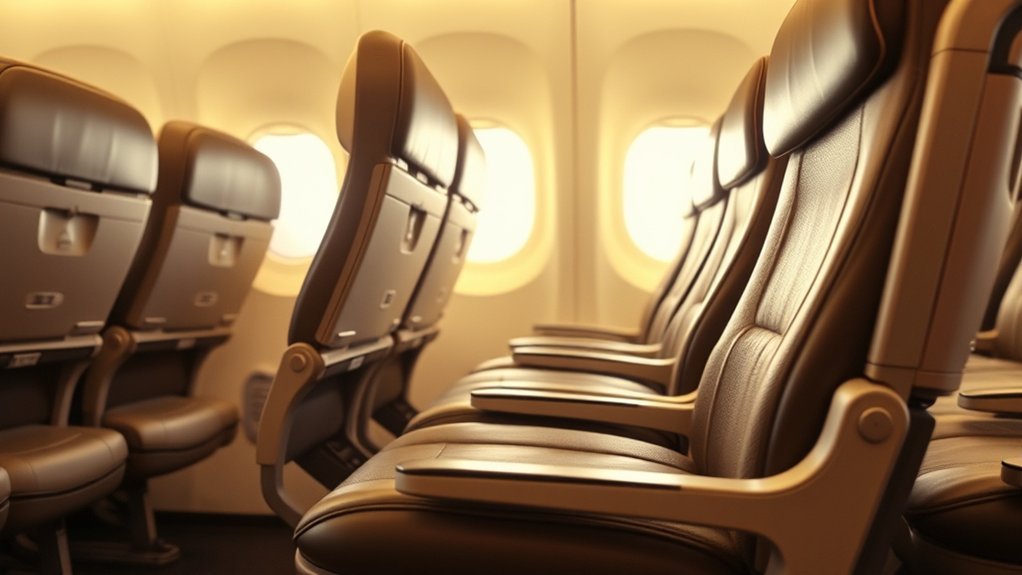
Many travelers remember 1970s economy cabins as roomier for three main reasons: more space between rows, lower-density layouts on some aircraft, and flights that were often less full. A historical aviation study describes about 35 inches of seat pitch before the tighter 28–31-inch layouts found on many later aircraft.
The cabin also looked more open on early jumbo jets. The Boeing 747 entered Pan Am service in January 1970, and some early 747 economy sections used nine seats across. Pan Am’s 1977 annual report later described a move to 10-abreast economy seating to raise capacity by 9 percent. That archive shows why “1970s seating” cannot be reduced to one width or one layout.
Some widebody aircraft also had lounges or social areas, especially when airlines had unused cabin space. Those features helped create a more relaxed image, but they were not available on every aircraft, route, or fare.
The strongest historical difference was usually front-to-back spacing and cabin density—not proof that every 1970s economy seat was 20 inches wide.
How Airline Seat Pitch Changed Over Time
Seat pitch generally became tighter as airlines added rows and introduced denser fare products. A drop from 35 inches to 31 inches removes about 11 percent of the row spacing; a drop from 35 inches to 28 inches removes 20 percent. Those percentages describe pitch, not pure knee room.
Today, standard economy pitch often falls near 30–32 inches on major U.S. airline aircraft, although some rows offer more or less. For example, Delta lists 30–31 inches of Main Cabin pitch on its Airbus A320, while its Comfort+ cabin lists 34 inches. Exact figures can change when an airline reconfigures an aircraft.
Why Widebody Jets Felt More Spacious
A widebody has two aisles and a broader cabin, which can improve movement and make the space feel open. It does not automatically guarantee a wider seat. Airlines decide how many seats to place across the cabin, how wide the aisles will be, and how much pitch each row receives.
The early 747 is a useful example. Pan Am promoted its roomy comfort, yet the airline also changed its economy section from a lower-density layout to 10 seats across. Modern widebodies show the same tradeoff. Delta currently lists 18-inch Main Cabin seats with 31–32 inches of pitch on its Airbus A330-300. Another airline can configure the same aircraft family differently.
For comfort, compare the actual cabin layout rather than assuming every widebody is better than every narrowbody.
Why Airlines Shrunk Economy Seats
Airlines can lower the cost per passenger when they spread a flight’s operating costs across more seats. Over time, many carriers added rows, used thinner seat backs, or increased the number of seats across. The result was often less personal space in standard economy, while extra-legroom and premium cabins became separate products.
Deregulation and Profit Pressure
The Airline Deregulation Act of 1978 removed federal control over domestic fares, routes, and market entry. It did not order airlines to shrink seats. Instead, it increased price and route competition, which encouraged airlines to lower costs, fill more seats, and separate comfort upgrades from the lowest fare.
That distinction matters. Deregulation changed the business environment, but each airline still made its own cabin decisions based on demand, aircraft limits, costs, and the fares travelers were willing to buy.
More Seats, Less Space
Adding one row increases the number of tickets an airline can sell without adding another flight. Adding one seat to each row can produce an even larger capacity gain. Pan Am’s move to 10-abreast economy seating on the 747 is a documented historical example: the airline said it would increase the aircraft’s capacity by 9 percent.
Seat design also changed. Modern slimline seats can create more usable knee space at the same pitch than thick older seats, but that does not make pitch irrelevant. Travelers still feel the effects of tight row spacing, limited recline, narrow foot space, and a full cabin.
How Today’s Economy Seats Compare
There is no single modern economy seat size. Official airline specifications show the range clearly. Delta lists 18-inch seats and 30–31 inches of pitch in the Main Cabin of its Airbus A320. Its Boeing 757-200 configurations list Main Cabin widths around 17.2–17.3 inches and pitch around 30–32 inches. Other airlines and aircraft differ.
For that reason, “today’s economy seat is 16.5 inches wide” is too broad. A figure near 16 inches may describe the narrowest usable width at a particular location or aircraft measurement, while the advertised seat width for the cabin can be higher. Always check the airline’s aircraft page and the specific flight’s seat map.
What Changed Besides Seat Dimensions
Seat measurements tell only part of the story. Cabins can feel tighter today because flights are commonly fuller, overhead bins are busy, and more passengers carry bags into the cabin. Older seats were often thicker and more heavily padded, while newer seats use slimmer structures to save weight and space.
Passenger body-size trends also affect comfort. The National Center for Health Statistics documents a long-term rise in overweight and obesity among U.S. adults since the early 1960s. That does not change an aircraft’s dimensions, but it increases the mismatch between a fixed seat and the range of bodies using it.
What 20 Inches of Seat Width Really Means
A 20-inch economy seat would provide generous hip and elbow room compared with many current standard-economy seats. The problem is not the meaning of the number; it is treating that number as the normal width for all 1970s economy cabins.
Seat Width in Context
Seat width changes with fuselage width, aisle width, armrest design, and seats per row. Historical 747 cabins could move from nine-abreast to 10-abreast seating, while current aircraft also have several airline-specific layouts.
| Example | Seat Width | Seat Pitch | What It Shows |
|---|---|---|---|
| Often-cited 1970s pitch | Varied by aircraft and layout | About 35 in | More row spacing was common, but width was not universal. |
| Delta Airbus A320 Main Cabin | 18 in | 30–31 in | A current narrowbody can still have 18-inch seats. |
| Delta Airbus A330-300 Main Cabin | 18 in | 31–32 in | Widebody comfort still depends on the airline’s configuration. |
Space, Comfort, and Fit
An extra inch of width can reduce shoulder and hip contact, especially in a full row. More pitch can make it easier to change position and stand up. Comfort also depends on seat shape, cushion firmness, recline, footwell space, and whether the armrests move.
- More width can improve shoulder and hip clearance.
- More pitch usually improves knee space and access to the aisle.
- A thinner seat back may improve usable space without changing pitch.
- Bulkhead, exit-row, and last-row seats can have special tradeoffs.
Are There Minimum Airline Seat-Size Rules?
The FAA regulates aircraft evacuation, seat strength, flammability, exit access, and other safety features. It has also studied whether minimum seat dimensions are needed for passenger safety. The agency’s current public statement says it is reviewing comments gathered during its 2022 minimum-seat-dimensions process.
That means travelers should not assume a broad federal comfort minimum for pitch or width. Airlines must publish certain seat-width information to help families determine whether child restraint systems will fit, but cabin comfort still varies by carrier and aircraft.
How to Compare Economy Seats Before Booking
- Find the aircraft type. Check the flight details before choosing a fare.
- Open the airline’s official aircraft page. Look for seat width, pitch, and cabin layout.
- Confirm the cabin product. Standard economy, extra-legroom economy, and premium economy are different products.
- Check the seats-per-row layout. A 3-3-3 widebody layout can feel different from a 3-4-3 layout.
- Review special-row limits. Bulkhead seats may lack under-seat storage; exit rows have eligibility rules; last rows may have limited recline.
- Recheck near departure. Airlines can swap aircraft, which may change the seat map.
Pro Tip: Compare the official seat specification with the map for your exact flight. A fleet page may show several configurations of the same aircraft.
How to Make Tight Economy Seats More Bearable
Choose an aisle seat if you expect to stand often, or a window seat if uninterrupted sleep matters more. Extra-legroom economy can be worthwhile on a long flight, but check whether the seat is also wider; many products add pitch without adding width.
Keep bulky items out of the footwell, wear clothing that does not restrict movement, and use a small lumbar support if it helps your posture. On long trips, move your legs and stand or walk when it is safe. The CDC advises travelers on trips longer than four hours to move their legs frequently and walk around every one to two hours when possible.
Warning: Long-distance travel can increase blood-clot risk for some people. Travelers with a previous clot, recent surgery, pregnancy, cancer, limited mobility, or other risk factors should ask a healthcare professional for personal advice before flying.
Frequently Asked Questions
Were airplane seats bigger in the 1970s?
Many economy rows had more pitch, often around 34–35 inches, and some layouts used fewer seats across. However, seat width varied, so it is more accurate to say many cabins were less dense rather than claim every seat was a fixed size.
Was a 20-inch economy seat standard in the 1970s?
No universal 20-inch standard applied across airlines and aircraft. Some seats or low-density layouts may have approached that width, but historical cabin records show airlines changed the number of seats across, which changed the space available to each passenger.
Why avoid seat 11A on a plane?
There is no universal reason to avoid seat 11A. The row can be a standard seat, an exit row, a bulkhead, or even absent depending on the aircraft and airline. Check the exact seat map for window alignment, recline, storage, and exit-row restrictions.
What drinks should you avoid on a plane?
No drink is automatically unsafe for every passenger. Water is a practical choice. Limit alcohol if it disrupts your sleep, worsens reflux, or makes you less likely to move. Choose caffeine and carbonated drinks based on your own tolerance and medical advice.
What country flies the most?
It depends on the metric. In IATA’s 2025 country ranking, the United States was the largest passenger market, with 890.1 million arriving and departing passengers. Rankings can differ when measured by flights, passenger-kilometers, or domestic traffic alone.
Does more seat pitch always mean more legroom?
Usually, but not perfectly. Seat-back thickness, supports, entertainment boxes, and the shape of the seat can change usable knee and foot space. Pitch is still the best quick comparison when the measurements come from the same airline.
Conclusion
Many 1970s economy cabins were roomier than standard economy cabins today, especially in seat pitch and overall density. The original article’s 20-inch figure should not be treated as a universal norm. A better comparison is about 34–35 inches of historical pitch versus roughly 30–32 inches on many current aircraft, with seat width varying by plane and layout. Check the exact aircraft before booking instead of relying on one era-wide number.
Sources
- University of Miami Libraries: Pan Am 1977 Annual Report — documents the airline’s move to 10-abreast 747 economy seating and the capacity increase.
- Collegiate Aviation Review International: Government Seat Pitch Regulation — supports the historical comparison between about 35 inches of pitch and later 28–31-inch layouts.
- U.S. Department of Transportation: Essential Air Service — explains what the Airline Deregulation Act of 1978 changed.
- Federal Aviation Administration: Seat Size Legislation Statement — defines seat pitch and summarizes the agency’s review of minimum seat dimensions.
- Delta Air Lines: Airbus A320 Seat Specifications — provides a current official example of economy seat width and pitch.
- Centers for Disease Control and Prevention: Blood Clots and Travel — supports movement and risk guidance for long-distance travel.
